
May 26, 2026 - PBS News Hour full episode
5/26/2026 | 56m 46sVideo has Closed Captions
May 26, 2026 - PBS News Hour full episode
May 26, 2026 - PBS News Hour full episode
Problems playing video? | Closed Captioning Feedback
Problems playing video? | Closed Captioning Feedback
Major corporate funding for the PBS News Hour is provided by BDO, BNSF, Consumer Cellular, American Cruise Lines, and Raymond James. Funding for the PBS NewsHour Weekend is provided by...
May 26, 2026 - PBS News Hour full episode
5/26/2026 | 56m 46sVideo has Closed Captions
May 26, 2026 - PBS News Hour full episode
Problems playing video? | Closed Captioning Feedback
How to Watch PBS News Hour
PBS News Hour is available to stream on pbs.org and the free PBS App, available on iPhone, Apple TV, Android TV, Android smartphones, Amazon Fire TV, Amazon Fire Tablet, Roku, Samsung Smart TV, LG TV, and Vizio.
Providing Support for PBS.org
Learn Moreabout PBS online sponsorshipAMNA NAWAZ: Good evening.
I'm Amna Nawaz.
GEOFF BENNETT: And I'm Geoff Bennett.
On the "News Hour" tonight: Negotiations to end the war falter, as the U.S.
strikes Iranian missile sites.
We report from the location of a deadly attack on a school in Southern Iran.
AMNA NAWAZ: The president gets his fourth checkup since returning to the White House, renewing public scrutiny of his health.
GEOFF BENNETT: And we explore how artificial intelligence and interactive labs are being used to help teach the next generation of nurses.
JANICE COLLINS-MCNEIL, North Carolina Central University: The students are here in a safe environment, where it's OK for them to make their errors, because that's a teachable moment.
(BREAK) GEOFF BENNETT: Welcome to the "News Hour."
Two cease-fires are on shaky ground tonight.
Iran says the U.S.
has violated its truce after the U.S.
carried out what it called self-defense strikes against Iranian missile launch sites and boats.
And Israel is escalating its offensive against Hezbollah in Lebanon.
AMNA NAWAZ: Still, U.S.
officials insist both cease-fires remain intact.
And they await a response from Iran on the latest outlines of a deal to end the war.
But, at least publicly, Iran is digging in, accusing the U.S.
of acting in bad faith.
And Iran's navy claims that dozens of tankers have passed through the Strait of Hormuz since yesterday, only with their permission.
William Brangham starts us off.
WILLIAM BRANGHAM: Across the airwaves in Iran today, state broadcasters promised consequences for recent U.S.
strikes that came in the middle of peace negotiations.
WOMAN (through translator): The Foreign Ministry, in a statement condemning the cease-fire violation by the U.S.
terrorist military, emphasized that the Islamic Republic of Iran will leave no act of aggression unanswered.
WILLIAM BRANGHAM: And, on the streets of Tehran, continued public displays of defiance, like this huge banner depicting President Trump's mouth stitched shut with a ribbon shaped like the Strait of Hormuz, claiming the U.S.
had reached -- quote -- "the breaking point."
The U.S.
military said it carried out so-called self-defense strikes last night against Iranian missile launch sites and boats that were attempting to lay mines in the Strait of Hormuz.
The U.S.
said they were carried out with restraint in light of the weeks-long cease-fire.
But some Iranians viewed it as more evidence that the U.S.
could not be trusted.
REZA RAHIMI, Tehran, Iran, Resident (through translator): The politicians should not pay any attention to America and their agreements at all, because they really go back on all their agreements.
WILLIAM BRANGHAM: U.S.
officials insist the cease-fire is holding.
Secretary of State Marco Rubio told reporters the strikes won't set back the peace talks.
But he said the details could take some time.
MARCO RUBIO, U.S.
Secretary of State: Like anything with something like this, it's going to take a couple days to settle on even down to the disagreements over a word, a sentence.
It's either going to be a good deal or there isn't going to be one.
WILLIAM BRANGHAM: Both Iranian and U.S.
officials have cited progress towards an initial deal that would lead to further negotiations, including on the fate of Iran's nuclear program.
In what amounted to a potential softening of his position, President Trump wrote on social media last night that Iran's highly enriched uranium would be -- quote -- "destroyed in place or at another acceptable location, with the Atomic Energy Commission or its equivalent being witness."
That echoes what Iranian officials have told the "News Hour," that they are willing to export their highly enriched uranium to the U.N.
's nuclear watchdog, the IAEA, but not to the U.S.
Still, there has been no public confirmation that Iran is willing to restrict its nuclear program, which it has always claimed is for civilian use only.
As part of the latest proposal, there would be an end to all fighting, including in Lebanon.
But Israeli Prime Minister Benjamin Netanyahu has ordered more frequent and heavier strikes against Iran-backed Hezbollah militants across Lebanon, despite the U.S.-brokered cease-fire there that remains in name only.
Massive strikes overnight leveled entire blocks in Southern and Eastern Lebanon, killing at least a dozen people.
Netanyahu huddled with his top military officials today and later announced that Israeli troops would be pushing further north.
BENJAMIN NETANYAHU, Israeli Prime Minister (through translator): Under my direction, the IDF is operating with large forces on the ground and is seizing controlled areas.
WILLIAM BRANGHAM: Israeli military officials said their operations will push past the so-called yellow line of demarcation near Lebanon's southern border.
Israel has said it will not withdraw until Hezbollah is no longer close enough to pose a threat to its northern villages.
For the "PBS News Hour," I'm William Brangham.
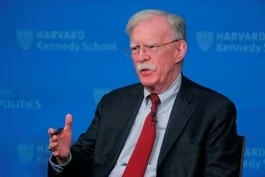
AMNA NAWAZ: For a view on the latest developments in the war with Iran, we turn now to John Bolton, former national security adviser in President Trump's first term.
During his tenure, the U.S.
announced it was withdrawing from the JCPOA.
That's the nuclear agreement with Iran negotiated during the Obama administration.
Ambassador Bolton, welcome back to the "News Hour."
Thanks for joining us.
JOHN BOLTON, Former U.S.
National Security Adviser: Thanks for having me.
AMNA NAWAZ: So you have been saying in recent interviews repeatedly that you do not believe the U.S.
should be negotiating with Iran or working towards a deal, that the U.S.
needs to use military force to open the Strait of Hormuz.
Explain to us what that means, what it would look like.
JOHN BOLTON: Well, the Iranians have made palpable what was a potential threat to close the Strait of Hormuz for many years.
And people discounted it.
We benefited from it from lower oil prices.
Now they have closed it and threatened the use of force.
I think that their efforts to negotiate a reopening of the strait are simply intended to demonstrate that they do control it and that you have to bargain with them before they will consent to let Arab oil and other cargoes come out of the Gulf.
I think that's a mistake, because, if they negotiate an end to the blockade of their own oil and opening the strait to everybody else, I think they will believe they can turn the Strait of Hormuz on and off like a light switch.
And if we're not prepared to use force today, who in the future is going to be prepared to use it?
I don't understand why the Gulf Arabs can even contemplate this, but I think we have a larger obligation, because if this precedent is established in the Strait of Hormuz, not only will it have continuing negative economic consequences for the world because of the oil and gas coming from the Gulf, but it will call into question every other international waterway similar to the geography of the Strait of Hormuz, like the Dardanelles and Bosphorus in Turkey, like the Strait of Malacca between Malaysia and Indonesia.
These are -- have been deemed for centuries to be international waterways to which ships have it a right of free passage.
And if that is taken away, this is a much bigger change than just the Strait of Hormuz.
AMNA NAWAZ: Ambassador, if I may, wouldn't U.S.
military action in that way, wouldn't that immediately lead to Iran striking more of America's Gulf allies in the region?
These are allies who do not want the war to resume, have reportedly been pushing the Trump administration to try to reach a deal.
JOHN BOLTON: Well, we don't know what Iran will do.
We -- they're as good as bluffing as the Trump administration is.
And he had a plan to open the strait and backed away from it, I think because the Gulf Arabs were not at all sure he would continue to defend them.
Look, this is a regime in Tehran that's desperately playing for time.
And if we let it up off its back, if we effectively give it control of the strait, and they're able to gain the oil revenues from resuming export of their oil, they will rebuild the Quds Force.
They will rebuild the Basij militia.
They will rebuild their nuclear program.
They will rebuild their missile program.
They will rebuild their drone program.
They will repress their own people, and they will threaten the Gulf in the Middle East even more than before.
AMNA NAWAZ: I want to ask you about the regime in just a moment, but specific to the Strait of Hormuz, we did speak to an expert in maritime traffic who talks to a lot of the shipping companies.
And this person maintained that the shipping companies don't trust that the U.S.
could keep the strait open, that Iran maintains a lot of low-tech capabilities, they could continue to ships.
Doesn't take a lot to damage those ships, this person told us.
So, if the companies don't trust that the strait is safe, what difference does it make?
JOHN BOLTON: Well, in the Project Freedom, 36 hours, while it lasted, Maersk, which is one of the biggest shipping companies in the world, maybe the biggest, had one of their cargo vessels come out.
Two American flagships went in.
American destroyers were attacked and destroyed the attacking Iranian drones and fast boats.
I'm not saying it would be easy, but I am saying that if you allow Iran to keep control of this, in effect, whether they're charging -- quote, unquote -- "environmental tolls" or not, we are going to come to regret it in a major way.
And so should every other country around the world that depends on freedom of the seas, because that is the fundamental question that Iran is raising here.
What had been an international waterway where there was a right of innocent passage, not only for commercial vessels, but even for warships in time of peace, that right of innocent passage is on the way to being history.
AMNA NAWAZ: I have heard in another interviews you have also been calling for regime change, a full-on regime change in Iran.
And I want to point you towards some reporting from The New York Times recently where they talked about the fact that Iran's military remains much stronger than we have heard from the president, from President Trump, and from this administration, according to one assessment, that they have kept operational access to 30 of its 33 missile sites along the Strait of Hormuz.
Why do you think that Iran has proven to be so much more resilient than this administration seemed to expect?
JOHN BOLTON: Well, I don't know what the administration expected, and I don't know exactly whether we can judge the accuracy of these reports compared against what the Pentagon has said.
But I would say this.
The Iranian regime has spent 47 years entrenching itself in power.
Think of it as an even bigger version of Hamas that over the years spent billions of dollars, not for the benefit of the Palestinian residents of Gaza, but to build a fortress of tunnels under the Gaza Strip.
That's what the regime in Iran has done.
Now, if we were going to go after regime change, I certainly would have done many different things than what the Trump administration has done.
And you have to rely on the estimates of your military and intelligence for what you think is necessary, and plan for the contingency that maybe you need to do more.
Just because the Iranian regime has proven to be more fanatic and more desperate to keep itself in power than perhaps the Trump White House realized simply proves the importance of getting rid of this regime before it is able once again to pursue nuclear weapons and international terrorism around the world, with the threat of death and destruction that those programs entail.
AMNA NAWAZ: That is former National Security Adviser Ambassador John Bolton joining us tonight.
Good to speak with you.
Thank you for your time.
JOHN BOLTON: Thank you.
GEOFF BENNETT: The U.S.
and Israel's air war with Iran has killed thousands since it started nearly three months ago.
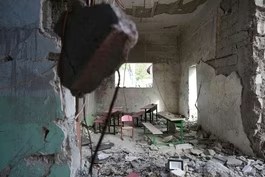
But few attacks have left a deeper mark than the strike on a school in Southern Iran on the war's opening day.
More than 150 people were killed when airstrikes hit the school in Minab, most of them children.
And there is little dispute that the missiles were American-made.
Special correspondent Reza Sayah is the first American television journalist to report from the site, and he sent us this report.
REZA SAYAH: Every night for more than 12 weeks, Asma Mogheirnin says she sits, prays and grieves in front of what's left of Shajarah Tayyebeh Elementary School.
ASMA MOGHEIRNIN, Minab, Iran, Resident (through translator): The sounds of children are still here for me.
I can still hear them in my mind.
Ever since this happened, my heart has been broken.
REZA SAYAH: For Asma and the people of Minab, the grief and pain of what happened here still feels fresh, the elementary school believed to be hit by a U.S.
Tomahawk missile strike on February 28, the day U.S.
and Israeli forces attacked and started war with Iran.
Fazel Alinejead says he was working just a mile away when he heard the booming sounds of missiles hitting Minab.
FAZEL ALINEJEAD, Minab, Iran, Resident (through translator): It was the first explosion, second, third, fourth explosion.
My nephew and I took out our phones and started filming.
REZA SAYAH: This is what he shot.
Fazel says he didn't know what was hit.
He just raced towards the smoke until he arrived at the school.
FAZEL ALINEJEAD (through translator): The school building had collapsed.
There was smoke coming from the windows.
For a moment, I asked myself, maybe this is a dream.
You're dreaming.
Please, let this be a dream.
I looked on the ground, body parts, small body parts, hands, fingers, heads.
REZA SAYAH: This is a satellite image of the two-story elementary school prior to the strike.
Authorities here say two missiles fired minutes apart flattened half the building, burying children inside.
FAZEL ALINEJEAD (through translator): All I did was dig like a madman.
My hands and fingernails were bleeding.
All I did was dig, just in case -- I'm sorry -- just in case we find someone alive.
REZA SAYAH: The Pentagon says what happened here is still under investigation, and the school was inside an active military base.
JAFAR KARIMI, Minab, Iran, Resident (through translator): It's not.
That's a lie.
REZA SAYAH: Jafar Karimi lives near the school.
He and other residents say the area used to be a military facility, but that was more than a decade ago.
The walled area that houses the school has a pharmacy, a cafe, and a cultural center, but no obvious signs of military facilities.
JAFAR KARIMI (through translator): The conclusion is clear.
It's a school.
America lies.
Netanyahu lies.
Their Arab allies lie.
REZA SAYAH: Authorities here say among the 168 victims of this airstrike, 120 were students between the ages of 6 and 11.
We don't have time to give you all of their names, but we're going to introduce you to some.
This young man is Saper Khadimi (ph).
This young lady, proudly holding up her school certificate, is Motahare Ahmadzadeh (ph).
This young lady is Atare Zarei (ph).
This young lady is Khadij Darwishi (ph).
This little man, Mohammed Taha Jafari (ph).
This young man with the big eyes, Hami Sadegh (ph).
This young man is Mohamed Sadegh Ghulami (ph).
This young man is Ali Hafizi (ph).
This little man with a big smile is Amir Hossein Jaffari (ph).
And here's another young lady proudly holding up her school certificate, Hananeh Mehdiqa (ph).
These are some of the adult victims, mostly teachers and some parents.
Authorities say they recovered remains of every victim, except one, Macan Nassari (ph).
But they're not giving up.
Every night, volunteers carefully sift through crushed concrete, debris, and shred pages of notebooks, hoping to find Macan, even parts of him, for a proper burial.
This is another one of Minab's heartbreaking nightly rituals.
This is the local cemetery here in the city of Minab.
And this is where all the victims of the school bombing are buried.
Every day at sunset, families of victims come to mourn their loved ones.
They sit and pray.
They light candles.
They celebrate birthdays of loved ones no longer here.
This touch is how Abbas Mirani tells his son Arsha (ph) he misses him.
But he's also honored that in his view, Arsha is a martyr.
ABBAS MIRANI, Father of Minab School Attack Victim (through translator): We had to sacrifice this blood for our country, for our people to understand no American soldier, no European or Western country will ever bring us peace and security.
We knew this from the beginning, but when our children were martyred, our people woke up, our nation woke up.
REZA SAYAH: Eleven-year-old Reyhandeh Mehdi Khah was at the school when the missile hit.
REYHANDEH MEHDI KHAH, Survivor of Minab School Attack (through translator): When they hit the school, the entire building shook from side to side.
The windows shattered.
Everything was shaking.
REZA SAYAH: It was only by chance Reyhandeh was in this section of the building, the section that didn't collapse.
REYHANDEH MEHDI KHAH (through translator): This part of my face was cut open in full of blood.
The kids saw there was an opening we could go through, and I followed them.
We were on the second floor.
We climbed down over the debris until we got to the schoolyard.
REZA SAYAH: Hours later, Reyhandeh learned that she had lost her little sister, a first grader at the school.
Reyhandeh says she has hate in her heart for what happened to her sister, but not for the American people.
REYHANDEH MEHDI KHAH (through translator): It's just the government that's cruel and dirty.
Most people in America are good.
They know this is not right.
REZA SAYAH: What's right, many here say, is to defend the honor of the children of Shajarah Tayyebeh Elementary School and continue the fight against the United States, the country they blame for what they call a crime they will never forget or forgive.
For the "PBS News Hour," I'm Reza Sayah in Minab, Iran.
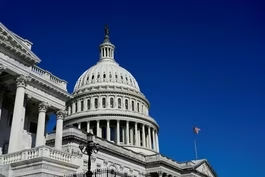
GEOFF BENNETT: We start today's other headlines with two developments from the nation's redistricting fight.
South Carolina's Senate rejected a push from President Trump to redraw its maps in a way that would have eliminated the state's only majority-Black district, represented by longtime Democratic Congressman James Clyburn.
Some Republican lawmakers argued it was too late to enact new district lines with early primary voting starting today.
And a federal court in Alabama is temporarily blocking a plan that would eliminate one of that state's two majority-Black districts.
For now, Alabama will use the same districts from the 2024 election, though the state's Republican leaders are expected to appeal.
In Washington, state authorities say an undisclosed number of people died when a chemical tank imploded earlier today.
At least 10 people were injured and others remain missing.
Fire officials say that a tank containing a chemical solution that's used in the paper-making process ruptured at the Nippon Dynawave Packaging Company.
Authorities say some victims had suffered burns or inhalation injuries, but there is no immediate threat to the public.
Meantime, in California, emergency officials have lifted an evacuation order for thousands of people who live near a damaged chemical tank.
They say temperatures have fallen enough to eliminate the risk of a major explosion, but they warn there's still a chance for a smaller blast or a fire.
As a result of the decreased threat, authorities reduced the evacuation zone in the city of Garden Grove, saying it's safe for about two-thirds of the affected residents there to return home.
DR.
REGINA CHINSIO-KWONG, Orange County, California, Health Officer: I want to reassure everyone who is in -- outside of the new evacuation zone that, when you go home, you can feel safe.
There was no contamination.
There were no fumes.
There were no vapors that came from this incident.
There was no leak.
GEOFF BENNETT: Despite the signs of progress, around 16,000 people are still not allowed to go home.
Officials say they will keep monitoring the air and checking the sewer and storm drains in the coming months for any sign of contamination.
Well, there was a flurry of activity from the U.S.
Supreme Court today.
While there were no major rulings, the justices decided the fate of a handful of cases, including Florida's attempt to sue California and Washington state over commercial licenses for drivers who don't speak English and who entered the U.S.
illegally.
The justices rejected the longshot bid, which stems from a crash in Florida last year that killed three people.
They also sided with the Trump administration in a free speech case involving immigration judges and how they get approval for public speaking engagements.
They refused to intervene in a discrimination lawsuit brought by former Miami Dolphins head coach Brian Flores against the NFL.
And they declined to hear a bid by Meta to a block of Vermont lawsuit accusing the tech company of harming young users.
In Western Europe, an early heat wave is shattering records and raising health concerns for millions across the region.
For a second day in a row, the U.K.
broke a century-old heat record for May, with temperatures topping 95 degrees Fahrenheit near London.
Meantime, firefighters in Scotland have been battling a wildfire near Edinburgh.
British authorities say at least four people have died in drownings that may be connected to the heat.
Similar fatalities have been reported in France, which also broke its heat record for may on Monday.
Health officials there are warning people to take the heat seriously.
STEPHANIE RIST, French Health Minister (through translator): You need to protect yourself from these heat waves, even if we're starting to get used to them.
Check on vulnerable people around you who might be less likely to think about drinking water.
It's a kind of general solidarity needed with this heat wave under way.
GEOFF BENNETT: The unseasonal heat extends to the south as well, with tourists and locals braving high temperatures today in Rome, among other places.
The heat there is expected to peak tomorrow before starting to cool off.
On Wall Street, today's stocks ended mixed following the long holiday weekend.
The Dow Jones industrial average slipped more than 100 points, but the Nasdaq surged around 300 points, so more than 1 percent.
The S&P 500 also posted a solid gain.
And Clarence B. Jones has died.
He was a lawyer and organizer during the civil rights movement of the 1960s and a close personal friend of Martin Luther King Jr.
That's Jones behind Dr.
King in 1963.
Jones helped plan the March on Washington that same year and drafted parts of the famous "I Have a Dream" speech.
In the first few paragraphs, Jones wrote that the Constitution and Declaration of Independence were a promissory note for future generations to cash in, words then delivered by Dr.
King.
MARTIN LUTHER KING III, Civil Rights Leader: This note was a promise that all men, yes, black men, as well as white men, would be guaranteed to the inalienable rights of life liberty and the pursuit of happiness.
GEOFF BENNETT: Jones was the unsung hero behind a number of landmark civil rights events, which included a pivotal role in sneaking out Dr.
King's notes that later became his "Letter From Birmingham Jail."
More than a half-a-century later, in 2024, Jones received the Presidential Medal of Freedom.
Clarence B. Jones 95 years old.
Still to come on the "News Hour": health workers in Central Africa struggle to slow the Ebola outbreak, as officials warn it's outpacing containment efforts; historian Jon Meacham joins the "News Hour" podcast to reflect on 250 years of the United States; and we look back at the remarkable life of the late jazz legend Sonny Rollins.
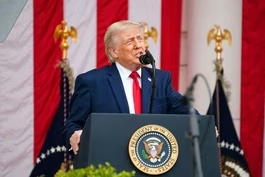
AMNA NAWAZ: President Trump's health is under renewed scrutiny this evening, as his more-frequent-than-usual screenings seem at odds with his own proclamations of being in exceptional health.
This morning, he got his fourth publicly announced exam of his second administration.
Our White House correspondent, Liz Landers, is here with what we know and what we don't know about the health of the president.
So, Liz, tell us about today's visit.
What do we know?
LIZ LANDERS: The president was at Walter Reed medical facility for about 3.5 hours.
He was also there, apparently, according to the schedule, to meet with troops and to speak with them as well.
But this is the third medical checkup that he's had in about 13 months.
He's also had a dental checkup a few weeks ago in Florida.
This is the oldest president to ever be inaugurated.
But listening to the president and his aides, he's constantly touting his vitality and his health.
He said on TRUTH Social after his visit that he finished his six-month physical and that everything checked out perfectly.
We have reached out to the White House to ask for a more detailed readout of what tests were done, what happened while he was there today.
White House officials said that they are still working on it.
We have not gotten that yet.
But I did speak earlier today with former White House physician Dr.
Jeffrey Kuhlman.
He wrote a book on serving presidents.
He served under Clinton, Bush and President Obama.
And he said that most 80-year-olds go to the doctor frequently.
President Trump is almost 80.
So he said that this is likely related to his age and not necessarily to his position as the president.
He also explained that a visit to Walter Reed is usually for more advanced medical checkups, like a colonoscopy, MRI, a CAT scan, things that you cannot do at the doctor's office within the White House.
They do have that facility there, Amna, that allows for blood tests, he said, some kinds of dental checkups.
And they can also do ultrasounds there as well.
AMNA NAWAZ: So, what did Dr.
Kuhlman say he would be looking for if he were President Trump's doctor?
LIZ LANDERS: Dr.
Kuhlman said that he has three main things that he's looking for.
Here's what he told me earlier today.
DR.
JEFFREY KUHLMAN, Former Physician to the President: Specifically for an 80-year-old president, advanced age is by far the number one concern.
I'd worry about cardiovascular fitness, cancer, and making sure they don't have neurodegenerative disease.
LIZ LANDERS: Dr.
Kuhlman also said that for a patient the president's age, that he'd want to do a treadmill test to test that cardiovascular health, also a CAT scan of his heart to look at coronary arteries.
He said when it comes to cancer that the president has a lower risk of that.
He's a nonsmoker and has always been a nondrinker as well.
He said, for cognitive health, that he would recommend doing more advanced cognitive tests than something fast.
And I also asked him about some of the images that people have seen of the president.
The president has been photographed with swollen ankles recently, also bruises on his hands.
The president has said that the bruises on his hands are from aspirin use and handshaking.
He has covered those up with makeup.
Dr.
Kuhlman said that those can be benign explanations as for why the president may have those swollen ankles and those bruising on his hands, but he's concerned about the transparency around that and maybe that the public is not getting all the information that they need.
AMNA NAWAZ: We will see if the White House releases more information.
In the meantime, some of the president's activity has caught the public's attention as well, specifically things like his late-night social media activity, a lot of flurry of tweets and so on, the habit of closing his eyes during some daytime meetings.
What did the doctors say about the president's sleep habits?
LIZ LANDERS: The president has been posting really late at night, sometimes after 1:00 in the morning.
We have seen some recent examples of that.
Dr.
Kuhlman's take on that was that he thinks that people that survive on sleep deprivation, it's actually not good for your mental or physical health.
So he did have some concerns about some of the late-night posting that we have seen from the president.
He also noted that President Biden was evaluated for this and used a CPAP for sleeping.
And President Trump has attacked President Biden consistently for his lack of energy and stumbling during public events.
But critics of President Trump have noted recently some of those moments where his eyes are closed in meetings, Amna.
AMNA NAWAZ: All right, our White House correspondent, Liz Landers.
Liz, thank you.
LIZ LANDERS: Of course.
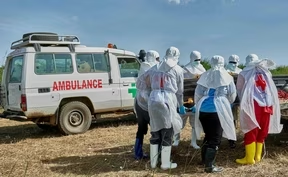
GEOFF BENNETT: At least 220 people are believed to have died from the Ebola outbreak in Central Africa, with suspected cases now nearing 1,000.
The director-general of the World Health Organization warned the outbreak is spreading so quickly that response efforts are struggling to keep pace.
The epicenter remains in the Democratic Republic of Congo, where deep mistrust of health authorities is complicating containment efforts.
Funerals organized by the Red Cross teams are now taking place under military and police escort after several health care facilities were attacked in recent days.
Here's how one Red Cross volunteer described the resistance she's encountered.
VANNY BIRUNGI, Red Cross Volunteer (through translator): We have come to tell the people of Bivo Kolomani (ph) that the disease is here.
Unfortunately, we're facing resistance.
And some people want to stone us, but we're not going to give up.
We're continuing to tell them that the disease is here.
Some accept it and others don't.
We fear that, because the resistance is strong, people will continue to die, but we're not giving up.
GEOFF BENNETT: For more on the outbreak and efforts to contain it, we're joined now by Dr.
Celine Gounder, editor at large for public health at KFF Health News.
Thanks for being with us.
DR.
CELINE GOUNDER, KFF Health News: My pleasure.
GEOFF BENNETT: You were on the ground back in 2014 during the Ebola outbreak in West Africa.
As you watch this outbreak unfold, what stands out to you most about the response?
DR.
CELINE GOUNDER: You have many of the same conditions that we saw during the 2014-to-2016 West African epidemic.
So, again, we have no vaccine, no specific treatment, which at the time was the case with that species of Ebola.
We're seeing delayed detection in part because of difficulties with contact tracing, a health care system that is dysfunctional, cross-border spread, in part by migrant workers.
On top of that, you have armed conflict.
You have these militants backed by the Rwandan government in much of the affected area.
You also have refugee camps in Southern Sudan.
And Kampala, where we have seen some of the cases in Uganda, is a major travel hub.
So you have all of the conditions ripe for a huge epidemic.
GEOFF BENNETT: And you have raised concerns about the cuts to USAID at a moment like this.
Walk us through the practical impact, the capabilities, the staffing, the response infrastructure that is potentially undermined by a lack of funding.
DR.
CELINE GOUNDER: So a key number here is one in five.
One in five contacts of Ebola cases or who've had high risk exposures, only one in five are currently undergoing contact tracing and follow-up, so once they're identified, having follow-up for three weeks to make sure they don't develop symptoms, if they develop symptoms, that they're isolated and they receive treatment.
And that's exactly the kind of work that the people who were funded by USAID were doing.
And so now you don't have local health care workers funded to do that contact tracing, to do the isolation, and then also, importantly, safe burials.
So a key part of Ebola control is, if somebody passes away from Ebola, that the body is handled safely so that other people don't get infected.
And that requires special safe burial teams that have the equipment to do this and also have a relationship with the community to do this safely.
GEOFF BENNETT: You mentioned the cross-border spread of Ebola.
What should people understand about the risk beyond the region?
DR.
CELINE GOUNDER: Well, I do think we're going to see a very large regional outbreak.
We may see some sporadic cases outside of the immediate region.
I don't think, for a whole host of reasons, that we're going to see sustained transmission outside of the region.
Our level of infection control in health care facilities is much higher in Western health facilities.
We also have better water, sanitation, and so forth.
So I don't think you're going to see that kind of explosive spread outside of the region, but we may see some sporadic cases.
GEOFF BENNETT: And researchers at the University of Oxford, as I understand it, are testing a next-generation Ebola vaccine using technology similar to what was used during the COVID pandemic.
How promising does that appear at the moment?
DR.
CELINE GOUNDER: This is still very early stage, and I'm not aware of anything that is ready for human clinical trials at this stage.
Ideally, you would have something that you could study in the middle of an outbreak.
That's the best way to actually get data on the vaccine quickly, but I don't think that we have anything that's ready for prime time yet.
GEOFF BENNETT: Dr.
Celine Gounder, thanks for your insights, as always.
We appreciate it.
AMNA NAWAZ: As we have been reporting, there's real concern about the growing prevalence of A.I.
and other technologies in higher education, but some schools have found benefits as well.
In the case of nursing programs, more and more are integrating immersive technologies like generative A.I.
and virtual reality into their curricula.
Ali Rogin spotlights one of those for our series Rethinking College.
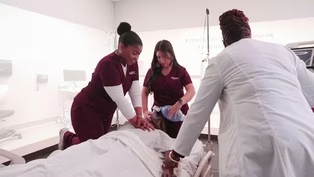
ALI ROGIN: It's a familiar hospital scene.
The patient's heart has stopped.
It's a code blue emergency, but this patient is a mannequin.
And while this looks and sounds like a hospital, it's an immersive interactive lab.
TINA SCOTT, North Carolina Central University: It really mirrors just what they would see in any given day in the hospital.
ALI ROGIN: Tina Scott is director of the Experiential Learning Center at North Carolina Central University.
TINA SCOTT: There are scenarios, case studies that we can embed and just transform that room into any type of scenario we would want it to be.
JAZMINE LOCKLEAR, Nursing Student: You hear beeping.
You may hear someone screaming.
They can even simulate smells.
ALI ROGIN: North Carolina has one of the largest projected nursing shortages in the country.
To help meet demand, schools like North Carolina Central University, a historically Black institution, are turning to technology.
TINA SCOTT: We're able to train more students.
We're able to bring more students in.
In any event that we cannot get a clinical space, we can do a clinical day right here.
ALI ROGIN: NCCU does not have a hospital, which means students have faced barriers to securing clinical placements, where they would get hands-on experience in a real-world health care setting.
JAZMINE LOCKLEAR: We're competing against a lot of other nursing schools for clinical rotations.
ALI ROGIN: So immersive technology is expanding access for students like Jazmine Locklear, a member of the Lumbee Tribe of North Carolina.
JAZMINE LOCKLEAR: I grew up in a real small, Southern rural area.
Access to health care isn't always the best.
I wanted to be the change for our people that we needed to create.
ALI ROGIN: NCCU introduced virtual reality clinicals two years ago.
HAILEY TURNER, Nursing Student: Hello.
My name is Hailey.
I will be the nurse working with you today.
ALI ROGIN: Students are put in virtual health care settings where they treat patients that are powered by conversational artificial intelligence.
HAILEY TURNER: Can you state your name and date of birth for me?
A.I.
VOICE: My name is Habib Abdelah.
I was born on July 13, 1949.
TINA SCOTT: He's very sensitive, so very realistic.
And they go in and take care of the patient.
HAILEY TURNER: Mr.
Habib, are you in any pain?
A.I.
VOICE: I have a headache rated around four out of 10, but I don't want any pain medication.
ALI ROGIN: First-year nursing student Haley Turner thinks this kind of practice is invaluable.
HAILEY TURNER: The biggest things that I'm still getting a little nervous about is actually talking to the patient, like, knowing what to say, knowing the right questions to ask them.
ALI ROGIN: Clemson University researcher Jason Thrift says exam room nerves are common.
JASON THRIFT, Clemson University: Simply knocking on the door and walking in the first time and being able to just talk to a patient, that can be the most scary and trying thing that they do when they're first trying to understand these processes.
So, putting them in V.R., that can kind of take away some of that angst.
ALI ROGIN: Jazmine Locklear had a miscommunication with one of her A.I.
patients.
JAZMINE LOCKLEAR: I do have an accent sometimes, and I needed to enunciate better so that I didn't offend the patient, because she kept telling me that I was pronouncing her name wrong.
And that's a very real scenario that I could experience in the hospital.
ALI ROGIN: Scott says V.R.
clinicals sharpen several skills.
TINA SCOTT: Critical thinking.
That patient's vital signs are changing.
What am I going to do?
Not only that, but delegation.
Now that I'm in this room taking care of this patient, all of a sudden, I'm getting a buzz from my other patient in the other room.
What do I do?
Prioritization.
Which patient should I go see first?
ALI ROGIN: Kimberly Johnson is in the accelerated nursing program.
KIMBERLY JOHNSON, Nursing Student: I had four patients that were all -- well, that could have all been deemed high priority.
ALI ROGIN: Walk me through that decision-making process.
How did you prioritize those four patients?
KIMBERLY JOHNSON: So we have something called prebrief.
It allows you to see the clients' vital signs.
It allows you to see their diagnosis.
It allows you to see medications and it also allows you to see what was done before you entered that V.R.
clinical.
And so I often would just use that as my guide to say, hey, if this was already done for this client, I know that I can lower this client's priority status.
ALI ROGIN: Afterwards, students debrief with their instructors.
TINA SCOTT: We're able to talk to them about their behaviors, what went well.
It actually will give them a report.
So they're actually able to see their gaps, those things they may need to work a little bit more on it.
Also helps us tailor a better plan for them.
And, says Professor Janice Collins-McNeil, since these are simulations, there are no life and death mistakes.
JANICE COLLINS-MCNEIL, North Carolina Central University: The students are here in a safe environment where it's OK for them to make their errors, because that's a teachable moment.
ALI ROGIN: But there are drawbacks to headset training.
JAZMINE LOCKLEAR: The V.R.
in particular isn't great if you have emotion sickness.
ALI ROGIN: But Locklear says illness isn't an issue in the immersive interactive room, where students can experience more than 2,000 medical training scenarios with images and graphics projected onto the walls.
Johnson raced the clock to spot all the hazards in a hospital room.
A.I.
VOICE: Sharps bin overflowing.
KIMBERLY JOHNSON: When I'm walking into rooms at a hospital during clinical, these are the things that I need to be looking for.
ALI ROGIN: The technology is used to test knowledge through interactive games like "Jeopardy."
JAZMINE LOCKLEAR: A client is experiencing a nose bleed.
What terminology would a nurse used when documenting this?
It is epistasis.
(CHEERING) ALI ROGIN: After the introduction of immersive technologies, North Carolina Central's pass rate for the nursing licensure exam rose from 94 to 96 percent.
Professor Collins-McNeil thinks her students are more prepared than ever.
JANICE COLLINS-MCNEIL: We're seeing a level of professionalism that we had not seen this early in their education.
They're much more critical in their assessments and their decision-making.
JASON THRIFT: I think that we will see V.R.
become kind of a mainstay for a while.
ALI ROGIN: As nursing programs grow to meet high demand, Clemson's Jason Thrift predicts the use of virtual reality will grow too.
JASON THRIFT: It may provide an ability to do more clinical aspects, even including when they become a nurse, to help renew training for, say, CPR.
ALI ROGIN: Jazmine Locklear, for one, is eager to put her high-tech training to good use in the real world.
JAZMINE LOCKLEAR: There's something at home that we like to say about making the impact that lasts the next seven generations.
As a nurse and a future family nurse practitioner, I want to make sure that we're living our healthiest lives and we're not still dealing with the health disparities that plague our communities.
ALI ROGIN: America's nursing shortage is critical, but, on this campus, America's nurses-to-be are showing strong signs.
For the "PBS News Hour," I'm Ali Rogin in Durham, North Carolina.
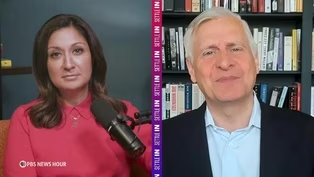
AMNA NAWAZ: We turn now to our PBS video podcast "Settle In" and an episode with Pulitzer Prize-winning presidential historian and bestselling author Jon Meacham.
We talked about his latest book, "American Struggle," which looks back at historical texts to tell us more about who we are today and why he still has hope in the state of our democracy.
Here's part of that conversation.
JON MEACHAM, Presidential Historian: There's a difference between optimism and hope, right?
Hope is the opposite of fear.
I am still full of hope that we can construct a present and a future commensurate with the aspirations of the Declaration of Independence and the country that abolished slavery and preserved the union and extended suffrage and did away with Jim Crow.
But the same country that did away with Jim Crow created Jim Crow, right?
The same country that extended suffrage denied suffrage.
The same country that abolished slavery protected slavery.
So it's never fully light versus dark.
I thought, after Charlottesville, after the tone and the chaos of the first Trump term, I thought the country would say, you know what, we wanted to send a message to the establishment.
The world as it's taken shape since - - hmm, really, since the mid 1960s has not been commensurate with our cares and concerns.
So get it together.
I thought that message had been sent and that people, having sent it, would realize that the messenger was now actually causing more harm than good.
And in 2020, that was proven right.
President Biden's been elected.
There's a certain return of gravity.
As ever, history confounds us.
Human nature confounds us.
Because in the midst of that return of gravity was the introduction, to shift metaphors, of a particularly devastating virus into the body politic, which is the denial of full, free and fair elections if you don't like the result.
And so the undermining of trust and the ways in which the will of the people is expressed was something I didn't foresee.
AMNA NAWAZ: It's worth noting you're close to President Biden.
You have called him a friend.
You have called him an American hero.
You have advised him on his speeches.
Understanding there were a lot of other forces at play, the pandemic as you mentioned, and a lot of other things happening in the country bubbling up for a generation at least, how do you look back now on what President Biden as a leader and his administration did or didn't do that also helped to get us where we are today?
And not just the decision to run again, right, which has been called into question and examined a dozen different ways, but also maybe not going after some of the officials from the first Trump administration the way some Democrats wanted them to.
How do you look at that now?
JON MEACHAM: So the first answer before I blather on is, I'm not sure.
My friend Michael Beschloss, our friend Michael Beschloss likes to say it takes 20, 25 years to be able to assess a presidency in historical terms, as opposed to journalistic ones.
And I think that's true.
It was true for Truman.
It was true for George Herbert Walker Bush.
And it's going to be true for President Biden.
What happened with President Biden and choosing to run again was in many ways a classic tragedy.
And I mean it this way.
The personal characteristics that enabled Joe Biden from 1972 until 2020 to survive and even ultimately thrive amid immense personal tragedy and remarkable political setback and stasis, right, those characteristics prevented him from stepping away.
I do not think -- I would bet the mortgage on this.
I don't think President Biden was clinging to power because he wanted an airplane or because he loved power so much.
It was a result of his resilience, his determination to keep moving no matter what, and not ever surrendering.
And he believed that he was the person who was the catcher in the rye, if you will, between the country and Trump, President Trump.
And he was wrong.
But this is -- from Greek tragedy through Shakespeare, this is a fundamental human drama.
The characteristics that propelled him to the pinnacle of power prevented him from doing what he needed to do to step away from it.
Do I wish that history had turned in a different way?
Do I wish President Biden had made different decisions in his last two years?
Absolutely.
What in one season was admirable resilience became in a different season a blindness to reality.
AMNA NAWAZ: And you can watch that full episode of "Settle In" on our YouTube page or wherever you get your podcasts.
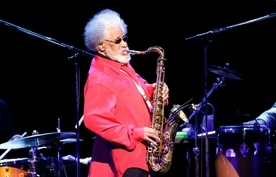
GEOFF BENNETT: Finally tonight, remembering one of jazz music's all-time greats.
Sonny Rollins died yesterday after more than five decades pushing the boundaries of the genre.
One of the best jazz musicians of his time, Rollins won two Grammys and a Grammy Lifetime Achievement Award in the early 2000s.
He toured well into his 80s and died at his home in Woodstock, New York, after years of health issues.
Senior arts correspondent Jeffrey Brown has a look back at the life and impact of Sonny Rollins.
JEFFREY BROWN: Sonny Rollins often said he was always a work in progress.
And that work, as the world got to hear, was as prolific as it was varied.
He spent almost seven decades recording more than 60 studio and live albums, relentlessly experimenting and honing his craft.
He received numerous awards in his lifetime, including a 2011 Kennedy Center Honors.
And ahead of that, he talked to us about his life and work.
SONNY ROLLINS, Musician: So I was just immersed in it from the beginning really.
JEFFREY BROWN: Rollins was born in Harlem in 1930 to a musical family.
He received his first saxophone at 11 and was largely self-taught.
SONNY ROLLINS: When my mother let me the secondhand alto saxophone, I went into the bedroom and I just started playing.
I mean, I don't know what I was doing, but I was in a zone.
I was already doing something.
JEFFREY BROWN: In fact, Rollins was a sensation even as a teenager.
He performed and recorded with leading players of the day.
His first album as a band leader came in 1951 and many more followed.
SONNY ROLLINS: Playing with those great people like Charlie Parker, Thelonious Monk, Miles Davis and all those giants, I wasn't afraid, because I felt that I belonged there.
JEFFREY BROWN: You felt you belonged with them?
SONNY ROLLINS: Yes.
But I was still in awe of them.
And it was -- I mean, I didn't feel I was equal to them.
I'm not saying that.
But I felt that -- especially they accepted me.
But I felt that I was where I was supposed to be at.
So it was quite a wonderful experience in a way.
JEFFREY BROWN: One of the things that people have long admired you for is the ability to -- I always hear this phrase find fresh musical ideas.
SONNY ROLLINS: Wow.
Well, jazz, as you know, is an endless source of ideas, because you can use anything.
You can play operatic arias.
You can incorporate them into jazz.
You can play gypsy music and incorporate it into jazz.
You can European classical and you can incorporate it into jazz.
You can use anything and jazz it up, as they used to say.
JEFFREY BROWN: And where does the improvisation come in?
SONNY ROLLINS: Well, Jeffrey, improvisation is something which is highly misunderstood these days.
Improvisation -- I think my friend Branford Marsalis, saxophonist, he explained it very good.
Improvisation is really not so much remembering things.
And this is what I do when I play.
I forget things.
When I go on the stage, I want my mind to be a blank, so that I can -- things can come into me without my knowing where they came from.
JEFFREY BROWN: So are you surprised by what comes out?
SONNY ROLLINS: Sometimes, I'm surprised by what comes out, yes.
JEFFREY BROWN: At several key points in his career, Rollins simply stopped performing and recording.
Most famously, he spent one of what he called his sabbaticals practicing on the Williamsburg Bridge in New York.
He later released an album titled "The Bridge."
SONNY ROLLINS: Jeffrey, I think the biggest thing that -- in my life that I can be proud of, my epitaph is that I knew inside how I was doing, whether I was playing great or whether I wasn't playing great.
And I shut out the people that were telling me, oh, Sonny, don't go away.
You will lose your audience.
And so, I said, no, I want to practice.
I want to get better.
So, I feel that I have an obligation to jazz and also to myself to play as good as I can play.
I haven't reached that point yet.
JEFFREY BROWN: When we spoke in 2011, Rollins had outlived many of his renowned contemporaries, including Miles Davis, John Coltrane, and Thelonious Monk, by decades.
You're one of the last ones left from that great time, right?
SONNY ROLLINS: Well... JEFFREY BROWN: You must be aware of that.
Does it weigh on you?
SONNY ROLLINS: Well, it does.
All my friends are gone, Miles, Coltrane, Monk.
I mean, in a sense, they're gone, but not really.
I'm the last guy.
But, in a way, I'm not, because, when I'm gone, the music -- my music is going to be here.
So we're all still here.
We're all still here.
JEFFREY BROWN: Sonny Rollins was 95 years old.
For the "PBS News Hour," I'm Jeffrey Brown.
AMNA NAWAZ: And that's the "News Hour" for tonight.
I'm Amna Nawaz.
GEOFF BENNETT: And I'm Geoff Bennett.
Thanks for joining us, and have a good evening.
 New
NewGiving Iran control of strait a mistake, Bolton argues
Video has Closed Captions
Giving Iran control of Strait of Hormuz would be a mistake, Bolton argues (6m 44s)
 New
NewHealth workers in Africa struggle to slow Ebola outbreak
Video has Closed Captions
Health workers in Africa struggle to slow Ebola outbreak (4m 53s)
 New
NewHow schools are using AI and VR to train nurses
Video has Closed Captions
How schools are using AI and VR to train the next generation of nurses (7m 20s)
 New
NewIran says U.S. acting in 'bad faith' after new strikes
Video has Closed Captions
Iran says U.S. acting in 'bad faith' after strikes during peace talks (4m 16s)
 New
NewJon Meacham joins Amna Nawaz on 'Settle In'
Video has Closed Captions
Jon Meacham and Amna Nawaz examine the state of our democracy on 'Settle In' (5m 53s)
 New
NewNews Wrap: South Carolina Senate rejects redistricting push
Video has Closed Captions
News Wrap: South Carolina Senate rejects redistricting push (5m 48s)
 New
NewOn the ground at the Iranian school devastated by airstrike
Video has Closed Captions
At Iranian school devastated by airstrike, grieving families say they will never forget (7m 33s)
 New
NewRemembering the remarkable life of jazz legend Sonny Rollins
Video has Closed Captions
Remembering the remarkable life of jazz legend Sonny Rollins (5m 36s)
 New
NewTrump's 4th medical checkup renews scrutiny of his health
Video has Closed Captions
Trump's 4th medical checkup renews public scrutiny of his health (4m 24s)
Providing Support for PBS.org
Learn Moreabout PBS online sponsorship
- News and Public Affairs

Today's top journalists discuss Washington's current political events and public affairs.

- News and Public Affairs

FRONTLINE is investigative journalism that questions, explains and changes our world.











Support for PBS provided by:
Major corporate funding for the PBS News Hour is provided by BDO, BNSF, Consumer Cellular, American Cruise Lines, and Raymond James. Funding for the PBS NewsHour Weekend is provided by...