
Remembering the remarkable life of jazz legend Sonny Rollins
Clip: 5/26/2026 | 5m 36sVideo has Closed Captions
Remembering the remarkable life of jazz legend Sonny Rollins
Sonny Rollins, one of jazz's all-time greats, died Monday at the age of 95 after spending more than five decades pushing the boundaries of the genre. Rollins won two Grammys and a Grammy Lifetime Achievement Award in the early 2000s. Senior arts correspondent Jeffrey Brown has a look at his career.
Problems playing video? | Closed Captioning Feedback
Problems playing video? | Closed Captioning Feedback
Major corporate funding for the PBS News Hour is provided by BDO, BNSF, Consumer Cellular, American Cruise Lines, and Raymond James. Funding for the PBS NewsHour Weekend is provided by...
Remembering the remarkable life of jazz legend Sonny Rollins
Clip: 5/26/2026 | 5m 36sVideo has Closed Captions
Sonny Rollins, one of jazz's all-time greats, died Monday at the age of 95 after spending more than five decades pushing the boundaries of the genre. Rollins won two Grammys and a Grammy Lifetime Achievement Award in the early 2000s. Senior arts correspondent Jeffrey Brown has a look at his career.
Problems playing video? | Closed Captioning Feedback
How to Watch PBS News Hour
PBS News Hour is available to stream on pbs.org and the free PBS App, available on iPhone, Apple TV, Android TV, Android smartphones, Amazon Fire TV, Amazon Fire Tablet, Roku, Samsung Smart TV, LG TV, and Vizio.
Providing Support for PBS.org
Learn Moreabout PBS online sponsorshipGEOFF BENNETT: Finally tonight, remembering one of jazz music's all-time greats.
Sonny Rollins died yesterday after more than five decades pushing the boundaries of the genre.
One of the best jazz musicians of his time, Rollins won two Grammys and a Grammy Lifetime Achievement Award in the early 2000s.
He toured well into his 80s and died at his home in Woodstock, New York, after years of health issues.
Senior arts correspondent Jeffrey Brown has a look back at the life and impact of Sonny Rollins.
JEFFREY BROWN: Sonny Rollins often said he was always a work in progress.
And that work, as the world got to hear, was as prolific as it was varied.
He spent almost seven decades recording more than 60 studio and live albums, relentlessly experimenting and honing his craft.
He received numerous awards in his lifetime, including a 2011 Kennedy Center Honors.
And ahead of that, he talked to us about his life and work.
SONNY ROLLINS, Musician: So I was just immersed in it from the beginning really.
JEFFREY BROWN: Rollins was born in Harlem in 1930 to a musical family.
He received his first saxophone at 11 and was largely self-taught.
SONNY ROLLINS: When my mother let me the secondhand alto saxophone, I went into the bedroom and I just started playing.
I mean, I don't know what I was doing, but I was in a zone.
I was already doing something.
JEFFREY BROWN: In fact, Rollins was a sensation even as a teenager.
He performed and recorded with leading players of the day.
His first album as a band leader came in 1951 and many more followed.
SONNY ROLLINS: Playing with those great people like Charlie Parker, Thelonious Monk, Miles Davis and all those giants, I wasn't afraid, because I felt that I belonged there.
JEFFREY BROWN: You felt you belonged with them?
SONNY ROLLINS: Yes.
But I was still in awe of them.
And it was -- I mean, I didn't feel I was equal to them.
I'm not saying that.
But I felt that -- especially they accepted me.
But I felt that I was where I was supposed to be at.
So it was quite a wonderful experience in a way.
JEFFREY BROWN: One of the things that people have long admired you for is the ability to -- I always hear this phrase find fresh musical ideas.
SONNY ROLLINS: Wow.
Well, jazz, as you know, is an endless source of ideas, because you can use anything.
You can play operatic arias.
You can incorporate them into jazz.
You can play gypsy music and incorporate it into jazz.
You can European classical and you can incorporate it into jazz.
You can use anything and jazz it up, as they used to say.
JEFFREY BROWN: And where does the improvisation come in?
SONNY ROLLINS: Well, Jeffrey, improvisation is something which is highly misunderstood these days.
Improvisation -- I think my friend Branford Marsalis, saxophonist, he explained it very good.
Improvisation is really not so much remembering things.
And this is what I do when I play.
I forget things.
When I go on the stage, I want my mind to be a blank, so that I can -- things can come into me without my knowing where they came from.
JEFFREY BROWN: So are you surprised by what comes out?
SONNY ROLLINS: Sometimes, I'm surprised by what comes out, yes.
JEFFREY BROWN: At several key points in his career, Rollins simply stopped performing and recording.
Most famously, he spent one of what he called his sabbaticals practicing on the Williamsburg Bridge in New York.
He later released an album titled "The Bridge."
SONNY ROLLINS: Jeffrey, I think the biggest thing that -- in my life that I can be proud of, my epitaph is that I knew inside how I was doing, whether I was playing great or whether I wasn't playing great.
And I shut out the people that were telling me, oh, Sonny, don't go away.
You will lose your audience.
And so, I said, no, I want to practice.
I want to get better.
So, I feel that I have an obligation to jazz and also to myself to play as good as I can play.
I haven't reached that point yet.
JEFFREY BROWN: When we spoke in 2011, Rollins had outlived many of his renowned contemporaries, including Miles Davis, John Coltrane, and Thelonious Monk, by decades.
You're one of the last ones left from that great time, right?
SONNY ROLLINS: Well... JEFFREY BROWN: You must be aware of that.
Does it weigh on you?
SONNY ROLLINS: Well, it does.
All my friends are gone, Miles, Coltrane, Monk.
I mean, in a sense, they're gone, but not really.
I'm the last guy.
But, in a way, I'm not, because, when I'm gone, the music -- my music is going to be here.
So we're all still here.
We're all still here.
JEFFREY BROWN: Sonny Rollins was 95 years old.
For the "PBS News Hour," I'm Jeffrey Brown.
 New
NewGiving Iran control of strait a mistake, Bolton argues
Video has Closed Captions
Giving Iran control of Strait of Hormuz would be a mistake, Bolton argues (6m 44s)
 New
NewHealth workers in Africa struggle to slow Ebola outbreak
Video has Closed Captions
Health workers in Africa struggle to slow Ebola outbreak (4m 53s)
 New
NewHow schools are using AI and VR to train nurses
Video has Closed Captions
How schools are using AI and VR to train the next generation of nurses (7m 20s)
 New
NewIran says U.S. acting in 'bad faith' after new strikes
Video has Closed Captions
Iran says U.S. acting in 'bad faith' after strikes during peace talks (4m 16s)
 New
NewJon Meacham joins Amna Nawaz on 'Settle In'
Video has Closed Captions
Jon Meacham and Amna Nawaz examine the state of our democracy on 'Settle In' (5m 53s)
 New
NewNews Wrap: South Carolina Senate rejects redistricting push
Video has Closed Captions
News Wrap: South Carolina Senate rejects redistricting push (5m 48s)
 New
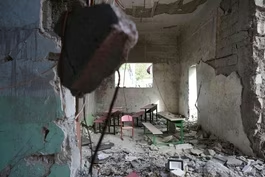
NewOn the ground at the Iranian school devastated by airstrike
Video has Closed Captions
At Iranian school devastated by airstrike, grieving families say they will never forget (7m 33s)
 New
NewTrump's 4th medical checkup renews scrutiny of his health
Video has Closed Captions
Trump's 4th medical checkup renews public scrutiny of his health (4m 24s)
Providing Support for PBS.org
Learn Moreabout PBS online sponsorship
- News and Public Affairs

Today's top journalists discuss Washington's current political events and public affairs.

- News and Public Affairs

FRONTLINE is investigative journalism that questions, explains and changes our world.











Support for PBS provided by:
Major corporate funding for the PBS News Hour is provided by BDO, BNSF, Consumer Cellular, American Cruise Lines, and Raymond James. Funding for the PBS NewsHour Weekend is provided by...