
Israel and Iran exchange strikes, threatening ceasefire
Clip: 6/8/2026 | 4m 48sVideo has Closed Captions
Exchange of missile strikes between Israel and Iran threatens fragile ceasefire
Israel and Iran traded long-range missile strikes for the first time since the ceasefire went into effect two months ago. Both countries appear to have agreed to stop their attacks, but not before sparking fears of a return to full combat in the region. Now, Trump and regional mediators are scrambling to salvage a deal to end the war with Iran. Ali Rogin reports.
Problems playing video? | Closed Captioning Feedback
Problems playing video? | Closed Captioning Feedback
Major corporate funding for the PBS News Hour is provided by BDO, BNSF, Consumer Cellular, American Cruise Lines, and Raymond James. Funding for the PBS NewsHour Weekend is provided by...
Israel and Iran exchange strikes, threatening ceasefire
Clip: 6/8/2026 | 4m 48sVideo has Closed Captions
Israel and Iran traded long-range missile strikes for the first time since the ceasefire went into effect two months ago. Both countries appear to have agreed to stop their attacks, but not before sparking fears of a return to full combat in the region. Now, Trump and regional mediators are scrambling to salvage a deal to end the war with Iran. Ali Rogin reports.
Problems playing video? | Closed Captioning Feedback
Where to Watch PBS News Hour
PBS News Hour is available to stream on pbs.org and the PBS app.
Providing Support for PBS.org
Learn Moreabout PBS online sponsorshipAMNA NAWAZ: Welcome to the "News Hour."
Israel and Iran traded long-range missile strikes for the first time since the cease-fire went into effect two months ago.
Both countries appear to have agreed to stop their attacks, but not before sparking fears of a return to full combat in the region.
Both President Trump and Russia regional mediators are now in a scramble to try and salvage a deal to end the war with Iran.
Here's Ali Rogin.
ALI ROGIN: Tonight, the guns have gone silent for now after a precarious Sunday evening.
Iranian missiles streaked across the night sky threatening to return the region to wider war, their target, Israel, for the first time since fighting was stopped by a fragile April truce.
The missiles soared over Western Iran on state broadcasts to music and cheers.
Crowds waved both Iranian and Hezbollah flags in a nod to Israel's continued strikes against Iran's ally inside Lebanon.
And their missiles came with messages, including "You will regret."
(SIRENS BLARING) ALI ROGIN: Air raid sirens sounded across Jerusalem by daybreak, as the strikes forced Israelis, including hospital patients, to shelter underground.
Like grim fireworks, interceptions of the long-range missiles could be seen across the sky.
Others broke through, but did not explode, standing like headstones in the soil in both the occupied West Bank and as far as Damascus, Syria, reminders that this escalation could once again embroil the entire region.
Tehran said its latest attacks were in retaliation for Israeli strikes this weekend against Hezbollah strongholds in the Lebanese capital of Beirut.
Earlier today, Iran urged the United States to rein in its ally.
ESMAEIL BAGHAEI, Iranian Foreign Ministry Spokesman (through translator): The United States bears clear responsibility.
Whether such violations are carried out by the Zionist Israeli regime in Lebanon or through its coordination with the United States in our region, the direct responsibility of the United States is unequivocal.
And the consequences of any escalation of tensions will also rest with the United States.
ALI ROGIN: Israel's military responded to Iran's attacks by striking a petrochemical facility in Southwestern Iran, as well as other unspecified targets.
And within hours of Israel and Iran exchanging fire another of Tehran's allies, the Houthis of Yemen, brandished video claiming missile attacks against Israel.
And the group renewed threats against Israeli-linked ships in the Red Sea.
With regional war threatening to erupt again and the cease-fire with Iran on the brink, President Trump urged restraint on social media, saying both countries must immediately stop shooting, adding, "Final negotiations on peace are proceeding, subject to ignorance or stupidity getting in its way," that perhaps a reference not just to Iran, but to the president's confrontation with Israeli Prime Minister Benjamin Netanyahu, who has defied Mr.
Trump by continuing to operate against Hezbollah inside Lebanon, including with new strikes in Southern Lebanon just today.
Iran has said a cease-fire in Lebanon is the only way it will pursue U.S.
talks.
In a video address, Netanyahu said his fight with Iran was stopped for the moment.
BENJAMIN NETANYAHU, Israeli Prime Minister (through translator): Right now, the fire at the front is contained because, after we hit the terrorist regime in Tehran, it stopped attacking us.
If the terrorist regime in Iran makes the mistake and attacks us again, we will respond forcefully.
ALI ROGIN: Trump recently voiced his displeasure with Netanyahu, telling The Financial Times: "I call all the shots."
He later told Axios that if Netanyahu went back to war with Iran, he might find himself fighting alone.
And in an interview taped before today's back-and-forth attacks, the president insisted that this was not becoming an endless war.
DONALD TRUMP, President of the United States: I don't like these endless wars.
This is not an endless war.
We have been doing this for three months.
Much of it has been under the form, a pretty good form of cease-fire.
KRISTEN WELKER, Moderator, "Meet the Press": During your 2016 campaign, you called the Middle East a quagmire.
DONALD TRUMP: It is.
KRISTEN WELKER: What makes you so sure this won't become a quagmire?
DONALD TRUMP: We're not going to be there.
KRISTEN WELKER: You're convinced this won't become a quagmire?
DONALD TRUMP: It's not a quagmire.
I just wiped out the military of a very dangerous country.
ALI ROGIN: Yet, clearly, Iran's military retains its ability to launch long-range strikes.
And one of Iran's top negotiators today said both the U.S.
and Israel are neither committed to a cease-fire nor believe in dialogue, as a deal to permanently end the conflict remains out of reach.
For the "PBS News Hour," I'm Ali Rogin.

Dave Eggers on ‘Contrapposto’ and supporting young writers
Video has Closed Captions
Dave Eggers on ‘Contrapposto’ and supporting the next generation of writers (6m 54s)

Fact-checking Trump’s claims of election fraud in California
Video has Closed Captions
Former election official fact-checks Trump’s claims of election fraud in California (7m 5s)

Millions lose SNAP benefits as stricter requirements kick in
Video has Closed Captions
Millions lose SNAP benefits as One Big Beautiful Bill’s stricter requirements kick in (9m 18s)

News Wrap: 3 more screwworm cases found in Texas, New Mexico
Video has Closed Captions
News Wrap: 3 more screwworm cases found in Texas and New Mexico (5m 27s)
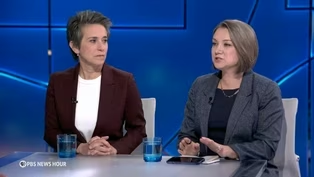
Tamara Keith and Amy Walter on Trump’s NBC interview walkout
Video has Closed Captions
Tamara Keith and Amy Walter on Trump’s walkout from NBC interview (9m 34s)
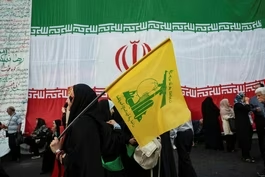
What Iran and Israel’s escalation means for peace efforts
Video has Closed Captions
What Iran and Israel’s escalation means for efforts to end regional conflict (9m 1s)
Providing Support for PBS.org
Learn Moreabout PBS online sponsorship New Episode
- News and Public Affairs

Today's top journalists discuss Washington's current political events and public affairs.

- News and Public Affairs

FRONTLINE is investigative journalism that questions, explains and changes our world.

 New Episode
 New Episode
 New Episode
 New Episode
 New Episode


 New Episode
 New Episode
Support for PBS provided by:
Major corporate funding for the PBS News Hour is provided by BDO, BNSF, Consumer Cellular, American Cruise Lines, and Raymond James. Funding for the PBS NewsHour Weekend is provided by...