
What Iran and Israel’s escalation means for peace efforts
Clip: 6/8/2026 | 9m 1sVideo has Closed Captions
What Iran and Israel’s escalation means for efforts to end regional conflict
For analysis on how the latest escalation in the Middle East will affect a host of issues in the region, Amna Nawaz speaks with Miad Maleki at the Foundation for Defense of Democracies and David Makovsky at the Washington Institute for Near East Policy.
Problems playing video? | Closed Captioning Feedback
Problems playing video? | Closed Captioning Feedback
Major corporate funding for the PBS News Hour is provided by BDO, BNSF, Consumer Cellular, American Cruise Lines, and Raymond James. Funding for the PBS NewsHour Weekend is provided by...
What Iran and Israel’s escalation means for peace efforts
Clip: 6/8/2026 | 9m 1sVideo has Closed Captions
For analysis on how the latest escalation in the Middle East will affect a host of issues in the region, Amna Nawaz speaks with Miad Maleki at the Foundation for Defense of Democracies and David Makovsky at the Washington Institute for Near East Policy.
Problems playing video? | Closed Captioning Feedback
Where to Watch PBS News Hour
PBS News Hour is available to stream on pbs.org and the PBS app.
Providing Support for PBS.org
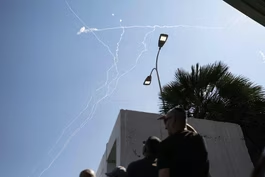
Learn Moreabout PBS online sponsorshipAMNA NAWAZ: And a short time ago, the Israeli military said it had intercepted what it called a -- quote -- "suspicious aerial element" in the far south of Israel.
The IDF said the incursion was from Yemen, where an Iran-backed proxy group is based.
To help us understand how this latest escalation will affect a host of issues, I'm joined now by Miad Maleki.
He's a senior fellow at the Foundation for Defense of Democracies and previously served as a senior U.S.
sanctions strategist in both the first Trump and Biden administrations.
And, from Jerusalem, David Makovsky, he is a distinguished fellow at the Washington Institute for Near East Policy and host of the podcast "Decision Points."
Gentlemen, welcome to you both.
And, Miad, I will start with you.
It's fair to say Iran has long said a cease-fire in Lebanon is a condition to peace talks.
The shift from words to action is a big deal.
Why would Iran choose to strike Israel now?
MIAD MALEKI, The Foundation for Defense of Democracies: Well, it is a big deal.
I think Iran is very clear that, for Iranians, the regime has been supporting these proxy groups for decades now, arming them, funding them.
This is a very first time that they're actually stepping into help one of its proxy - - one of the proxy groups militarily.
I mean, this is the first time Iran is going into help one of these proxy groups.
And it really -- it is very significant in that term.
And I think what really happened here is, Secretary Rubio came out right before the conflict in Lebanon and before their strikes in Lebanon and said, we're not going to give Iran any sanctions relief.
The only thing Iran is going to get from opening the Strait of Hormuz is the lifting of the blockade.
And it's very clear that Iran's economy is under pressure, probably more than any other economies, from the closure of Strait of Hormuz.
They need the strait to be open.
But also they need some kind of a sanctions relief.
I mean, if they go back economically, they're going to have to deal with a population that is going to deal with inflation rate of 87 percent, food inflation rate of 200 percent.
And if they're not getting the sanctions relief up front, things are going to get very difficult for them domestically.
Now they sense a few things.
One, President Trump wants a deal, and they need -- have the leverage to now get some kind of sanctions relief.
Two, I think they sense some disagreements between President Trump and Prime Minister Netanyahu.
And I think they really try to exploit that in a way that they can get some leverage out of this and turning Hezbollah into a negotiating asset.
They never -- Iranian regime never agreed to bring its proxy groups into negotiations.
They only wanted to negotiate over the nuclear program.
Now they're using Hezbollah as a negotiating asset.
That's -- I think that's very significant.
AMNA NAWAZ: So, David, if you can respond to what Miad just said there, you're in Israel.
How have the Iranian attacks there impacted or changed the discussion about the war?
And is there a wedge between the U.S.
and Israel when it comes to Israel's war in Lebanon?
DAVID MAKOVSKY, Senior Fellow, Washington Institute for Near East Policy: Well, I think here you eat there's a bunch of variables that they're trying to juggle.
The country has gotten used to going in and out of safe rooms, shelters at a time of missile strikes.
And then life just goes back to being normal.
It's almost like a flash mob.
They all come together and then they all go back to normal.
But the prime minister is in a rough spot here because every day on the TV and on the radio, he's getting slammed by mayors of Northern Israel, who are saying, you have abandoned us.
You have become the vassal of Donald Trump by -- he doesn't want you to hit in Lebanon, you don't hit.
But there have been like 15 soldiers I think that have been killed in the last couple of weeks.
There are these fiber-optic drones that Hezbollah operates that the IDF, for all of its technological prowess, has not found an answer to.
And these very well-publicized attacks of Trump on Netanyahu, don't act in Lebanon, I think has led Netanyahu to be in this unusual position where he's being outflanked on the right by these mayors, saying that Northern Israel could turn into a ghost town if you keep going on this way.
And so I think he was under a lot of pressure to strike, to come up with this new formula, which is an attack on a Northern Israel means an attack on Dahiyeh.
That's the Hezbollah stronghold in Southern Beirut.
And I think that's somewhat the backdrop.
And then Iran upped the ante and said, well, to can play this game.
And you say an attack on Northern Israel is an attack on Dahiyeh.
Well, an attack on Dahiyeh is an attack on Iran.
And then it was off to the races last night with the Iranian attacks on Israel that accelerated and this dramatic phone call which seems like took place before 7:00 a.m.
this morning, D.C., time, Eastern time, where it seems the president really restrained Netanyahu from a much more dramatic strike that was about to unfold from Israel against Iran a few hours later.
AMNA NAWAZ: So, Miad, Iran, as David has said, has now upped the ante.
How would you describe the status of the cease-fire?
What does this mean for the future of any peace talks?
MIAD MALEKI: Well, I think at this point it's very clear President Trump is willing to put pressure on Prime Minister Netanyahu to calm things down, go back to the talks and see what they can get with Iran.
Now, Iran has changed the way things were as a couple of days ago.
Now you don't just have Israel having been deterred to a point to not engage militarily in Iran, but you also now going to see probably Houthis that start coming into the combat and engaging both Israel and potentially some issues that they can cause in the Strait of Bab-el-Mandeb, another strategically important strait that Iran can control through its whole proxy group Houthis that are going to be more emboldened now.
They economically are in a bad spot.
Yemen's economy is in a very bad shape, the Houthi-controlled area.
They probably need to get some leverage.
They're probably hoping they can get some kind of deal with the U.S.
and the West, get some sanctions relief.
So they wouldn't be just carrying the water for the Iranian regime, but also they can get some kind of deal themselves.
And they can see a President Trump that is really interested in opening up their Strait of Hormuz and putting an end to the conflict.
So they might want to leverage that.
AMNA NAWAZ: David, how would you look at this in the future of peace talks?
Also this issue that Netanyahu is now facing pressure from Trump, who is dealing with a very unpopular war here, but also, as Miad has pointed out, empowered Iranian proxies and Iran looking for more leverage in those talks.
How much flexibility does Bibi Netanyahu have?
DAVID MAKOVSKY: Well, he doesn't have a lot because the government of Lebanon on one hand is a government for the first time in decades that wants to take its country back from Hezbollah that's been a state within a state, because, in the Middle East, if you fire the shots, you call the shots.
And the government in Lebanon and Israel actually have a convergence to say Iran should not be the arbiter of Lebanon's future.
That's the good news.
The bad news is, is that there are all these structural problems here, because, for all their nice intentions of the government of Lebanon, they're not really willing to send troops to disarm Hezbollah in the south.
And it's a no-man zone and they just keep firing in Israel.
There's no government there.
And so Israel's stuck.
And my concern is that the Iranian -- as much as Israel is trying to decouple the Lebanon front from the Iranian front, the Hezbollah might have found the wedge they're looking for now that Iran has brought themselves closer to Hezbollah, that what Hezbollah says is, hey, this is great for me because it incentivizes me to create a rift between Trump and Netanyahu.
If Iran's going to say -- in other words, the keys are in my hand, Hezbollah.
I could fire on Israel.
Israel's going to retaliate.
But then Iran's going to hit.
And then Trump is going to come down on Israel like a ton of bricks.
So I am concerned that this cease-fire could hang by a thread because Hezbollah has every incentive to increase the friction between Trump and Netanyahu.
And that's what the Iranian linkage of these last 24 hours has done.
And that's why we should be aware of it.
Yes, it's true Iran is not 10 feet tall.
None of their rockets, missiles got through, all intercepted by Israel, no injuries in Israel at all.
But I am concerned that Hezbollah has found the key to deepen friction between both the -- both Trump and Netanyahu.
AMNA NAWAZ: David Makovsky, Miad Maleki, we thank you both so much for joining us.
DAVID MAKOVSKY: Delighted to be with you, as always.

Dave Eggers on ‘Contrapposto’ and supporting young writers
Video has Closed Captions
Dave Eggers on ‘Contrapposto’ and supporting the next generation of writers (6m 54s)

Fact-checking Trump’s claims of election fraud in California
Video has Closed Captions
Former election official fact-checks Trump’s claims of election fraud in California (7m 5s)
Israel and Iran exchange strikes, threatening ceasefire
Video has Closed Captions
Exchange of missile strikes between Israel and Iran threatens fragile ceasefire (4m 48s)

Millions lose SNAP benefits as stricter requirements kick in
Video has Closed Captions
Millions lose SNAP benefits as One Big Beautiful Bill’s stricter requirements kick in (9m 18s)

News Wrap: 3 more screwworm cases found in Texas, New Mexico
Video has Closed Captions
News Wrap: 3 more screwworm cases found in Texas and New Mexico (5m 27s)
Tamara Keith and Amy Walter on Trump’s NBC interview walkout
Video has Closed Captions
Tamara Keith and Amy Walter on Trump’s walkout from NBC interview (9m 34s)
Providing Support for PBS.org
Learn Moreabout PBS online sponsorship New Episode
- News and Public Affairs

Today's top journalists discuss Washington's current political events and public affairs.

- News and Public Affairs

FRONTLINE is investigative journalism that questions, explains and changes our world.

 New Episode
 New Episode
 New Episode
 New Episode
 New Episode


 New Episode
 New Episode
Support for PBS provided by:
Major corporate funding for the PBS News Hour is provided by BDO, BNSF, Consumer Cellular, American Cruise Lines, and Raymond James. Funding for the PBS NewsHour Weekend is provided by...