
March 24, 2026 - PBS News Hour full episode
3/24/2026 | 57m 46sVideo has Closed Captions
March 24, 2026 - PBS News Hour full episode
March 24, 2026 - PBS News Hour full episode
Problems playing video? | Closed Captioning Feedback
Problems playing video? | Closed Captioning Feedback
Major corporate funding for the PBS News Hour is provided by BDO, BNSF, Consumer Cellular, American Cruise Lines, and Raymond James. Funding for the PBS NewsHour Weekend is provided by...
Support provided by:

March 24, 2026 - PBS News Hour full episode
3/24/2026 | 57m 46sVideo has Closed Captions
March 24, 2026 - PBS News Hour full episode
Problems playing video? | Closed Captioning Feedback
How to Watch PBS News Hour
PBS News Hour is available to stream on pbs.org and the free PBS App, available on iPhone, Apple TV, Android TV, Android smartphones, Amazon Fire TV, Amazon Fire Tablet, Roku, Samsung Smart TV, and Vizio.
Providing Support for PBS.org
Learn Moreabout PBS online sponsorshipGEOFF BENNETT: Good evening.
I'm Geoff Bennett.
Amna Nawaz is away.
On the "News Hour" tonight: Residential buildings come under fresh fire in Israel, Iran and across the region, while the U.S.
says it's pursuing diplomacy with Iran.
An ongoing investigation finds multiple failures likely led to the fatal collision between a plane and a fire truck at New York's LaGuardia Airport.
And how President Trump is reshaping the landmarks of the nation's capital in his own image.
NEIL FLANAGAN, Heurich House Museum: The demolition of the East Wing was definitely the wake-up call for everyone.
Suddenly, the building was no longer there and the whole sense of the world was torn down as well.
(BREAK) GEOFF BENNETT: Welcome to the "News Hour."
Israel pounded Tehran and Beirut today, as Iran sent waves of missiles and drones throughout the Mideast, targeting Israel and Gulf nations.
President Trump again touted efforts toward a diplomatic solution, even as the U.S.
continues its attacks.
We start in Israel, where our Nick Schifrin is again tonight.
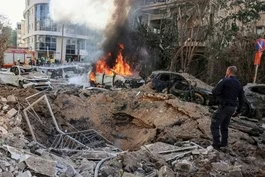
NICK SCHIFRIN: In Central Tel Aviv this morning, the ripped-up, blown-apart aftermath of an Iranian attack.
Israeli authorities say an Iranian missile or missile fragment with more than 200 pounds of explosives hit this apartment block, walls now windows in what used to be homes.
Remarkably, nobody was seriously injured.
All local residents were saved by sirens and a local bomb shelter.
PELEG BEN BARAK, Tel Aviv, Israel, Resident: When the last guy just closed the door, there was a massive explosion outside.
And we knew it was right here.
NICK SCHIFRIN: Peleg Ben Barak is a 27-year-old Australian Israeli.
This is what's left of his apartment, including the missile fragment.
And this is now his view.
In previous conflicts, he evacuated.
Not this time.
And now will you stay?
PELEG BEN BARAK: In Tel Aviv?
Yes.
Yes, no doubt.
I mean, we're going to be evacuated to a hotel today, hopefully, but we will stay in Tel Aviv.
NICK SCHIFRIN: That resilience shared by 37-year-old Ori Mannis and his three boys, including 9-year-old Shahar.
SHAHAR MANNIS, Tel Aviv, Israel, Resident (through translator): We heard a very loud boom, and it scared us.
NICK SCHIFRIN: Scary, but now a way of life.
On average, Iran has fired 10 missiles across Israel every day.
ORI MANNIS, Tel Aviv, Israel, Resident: Everywhere, it's a place that a bomb could hit.
So, I don't know., it's where we live.
NICK SCHIFRIN: And Iran today also targeted Arab Gulf countries.
(SIRENS BLARING) NICK SCHIFRIN: Sirens blared in Kuwait, which today woke up to power outages after shrapnel hit power lines.
Despite all these repeated Iranian attacks, President Trump claimed today Iran had turned over a new leaf.
DONALD TRUMP, President of the United States: We have really regime change.
This is a change in the regime, because the leaders are all very different than the ones that we started off with that created all those problems.
The other side, I can tell you, they'd like to make a deal.
And who wouldn't if you were there?
Look... NICK SCHIFRIN: Today, the U.S.
continued to strike Iranian missiles and drones, and Israel continued its attacks on Iran's infrastructure.
That's left no refuge for people trapped in a war they didn't choose.
Today, a child pulled out from the ruins of his family home.
Across the city, residential buildings are reduced to rubble.
The Iranian Red Crescent said more than 82,000 civilian units have been damaged or destroyed so far.
Today, Israel also intensified its campaign in Lebanon targeting Hezbollah infrastructure.
It hit this mosque in Al-Khiyam in Southern Lebanon.
And multiple explosions rocked Tyre in the south.
Israel is isolating the south, destroying more bridges.
The campaign has displaced more than a million people.
And now Israeli Defense Minister Israel Katz warned, the Israeli army would occupy Southern Lebanon until a political agreement.
ISRAEL KATZ, Israeli Defense Minister (through translator): The IDF is maneuvering into Lebanese territory to seize a front line of defense.
NICK SCHIFRIN: Into those Israeli communities, since Hezbollah entered the war, Israel says Hezbollah has fired at least 850 drones and missiles, including this strike during our recent visit into a civilian neighborhood in Northern Israel's largest city.
A handful of civilians have died, including Ofer Moskowitz, his funeral this week limited in size and held miles from his border hometown because it's too dangerous.
Moskowitz was an avocado farmer and the well-known spokesman of the Kibbutz Misgav Am.
Eyal Moskowitz is Ofer's brother.
How do you remember your brother?
EYAL MOSKOWITZ, Brother of Ofer Moskowitz: It's hard for me to speak now how I remember him, because he's still alive.
I can't talk to him -- talk about him on past tense.
NICK SCHIFRIN: But Moskowitz was not killed by Hezbollah.
He was killed accidentally by Israeli artillery fire.
Eyal does not blame the army.
EYAL MOSKOWITZ: It doesn't affect.
Mistake happens.
He died, and he died.
We can't change it.
NICK SCHIFRIN: That acceptance is not universal.
Hanan Rubinski is an old friend of Moskowitz and fellow resident of Misgav Am.
HANAN RUBINSKI, Friend of Ofer Moskowitz: It was five shells that fell into the kibbutz, not one after another, one, five minutes, another one.
Somebody's head has to be chopped.
NICK SCHIFRIN: His anger is felt in these communities that last year were promised the previous war in Lebanon had eradicated the Hezbollah threat.
It has not.
HANAN RUBINSKI: You can't fool us every time, but this time we were fooled.
We believed that they will be quiet.
We believed that after a year-and-a-half of this so powerful war, we will have 10 years of quiet, and we had only -- not even a year.
NICK SCHIFRIN: Israel's strategy is now not to evacuate the citizens of this area, but instead try and push the defensive lines deeper into Lebanon.
And you see that village behind me, about half-a-mile, a Lebanese village where Hezbollah used to be based, now destroyed by Israeli forces.
Thunderous outgoing Israeli attacks are the northern border's drumbeat.
CAPTAIN M, Israeli Defense Forces: What the army did in the last war is actually push Hezbollah back as much as they can.
And there's no doubt that it has hurt Hezbollah as an organization.
It hurt their infrastructure.
And -- but they are still here.
They are still present, and they are still threatening our civilians, and that's why we are here.
NICK SCHIFRIN: The IDF asked us to identify this company commander as Captain M. He's assigned to protect Metula, Israel's northernmost town.
Since October the 7th, he's deployed to Northern Israel for 500 days.
CAPTAIN M: Our job as reservists and our job as the IDF in general is to create a barrier and to create a -- to make sure that we are what is between them and what we consider our enemy.
MIRIAM HOD, Metula, Israel, Resident: We are like the phoenix.
NICK SCHIFRIN: Yes?
MIRIAM HOD: We rise again.
NICK SCHIFRIN: Miriam Hod is one of those residents living in Metula.
Are you glad that you're here despite everything that's going on instead of being evacuated?
MIRIAM HOD: It's my home.
It's my home.
I never leave my house ever, never.
NICK SCHIFRIN: But do you feel safe?
MIRIAM HOD: Well, not too much, but I hope it's's over fast, soon.
NICK SCHIFRIN: And Miriam Hod's sentiment is shared widely here.
Everyone hopes the war will end soon, but they're staying put no matter what -- Geoff.
GEOFF BENNETT: Nick, we heard President Trump again suggest that diplomacy could soon end the war.
Any movement on that front today?
NICK SCHIFRIN: Today, Pakistan reiterated what you and I talked about last night, that they are willing to host or be the venue for future negotiations.
But Iran said today that not only are there no negotiations, but they vowed to -- quote -- "fight to victory.
And Iran, Geoff, is also publicly refusing to engage with the U.S.'
ongoing demands to stop domestic enrichment, to cap the range of missiles and end support of its proxies.
That said, one sign perhaps that the U.S.
is trying to eye a particular negotiator, Mohammad Bagher Ghalibaf is the speaker of Iran's Parliament, and an official with knowledge of the operation today told me that Israel's ongoing targeting of Iran's leadership will not include Ghalibaf in the coming days.
But, Geoff, as you and I discussed last night, Israel is simultaneously preparing the country to keep fighting for the next two weeks during Passover and accepting that their operation against Iran may have to stop even tonight if the president declares some kind of victory.
And that kind of dual reality goes to this point as well.
The president indicates he wants to negotiate, and yet a U.S.
official confirms to me tonight that members of the 82nd Airborne have been given voice approval to deploy to the Middle East, including headquarters, staff, and ground troops.
But a U.S.
official says this could be a relatively small deployment.
Again, Geoff, what is happening here is the president is both publicly saying he wants to negotiate, and the possibility of escalation still very much remains on the table, Geoff.
GEOFF BENNETT: Nick Schifrin with the very latest from Tel Aviv tonight.
Nick, thank you.
NICK SCHIFRIN: Thank you.
GEOFF BENNETT: Now the latest on the collision at New York's LaGuardia Airport Sunday night that killed two pilots and injured dozens more.
The National Transportation Safety Board said today it was likely a series of failures that led to the accident when an Air Canada jet struck a fire truck responding to a possible emergency with another plane.
Many questions remain, but we learned today that a runway warning system failed to sound the alarm moments before the accident and that a fire truck was given permission to cross the runway less than 30 seconds before they collided.
Two controllers were on duty.
For more, we're joined now by our science and aviation correspondent, Miles O'Brien.
Miles, it's good to see you.
So what more did we learn today from the NTSB and the timeline presented today?
MILES O'BRIEN: Well, the timing itself, Geoff, is kind of breathtaking.
The controllers in the tower there, two of them, were dealing with an emergency on the field.
A 737 United Airlines had fumes in the cabin, flight attendants were feeling sick, and so the crew made the decision to evacuate the passengers off the aircraft.
And that's what precipitated the need to get emergency trucks on the way to this other aircraft.
The tower team continued pretty much normal operations, allowing the Air Canada aircraft to continue its approach and, only 20 seconds before it was to touch down, gave it clearance to cross the runway.
That is extremely tight, and the controller later said, quoting him now: "I messed up."
But it's not so much an individual's responsibility in this case when you look at the whole system and how it failed.
GEOFF BENNETT: Miles, we have spoken on this program in the past about the concerns over air traffic controller staffing.
And one of the questions that came up during the press conference today was the fact that the air controller in charge was doing the duties of two positions.
Here's what the NTSB chair, Jennifer Homendy, said: JENNIFER HOMENDY, Chair, National Transportation Safety Board: In this situation for the midnight shift, it is standard operating procedure that they only have to on duty, and those two perform the duties of other controllers.
That is our understanding right now.
However, we're going to further dig into that as part of our investigation.
Certainly, I can tell you that our air traffic control team has stated this is a problem, that this is a concern for them for years, that they have had this concern for quite a long time.
GEOFF BENNETT: So that's the SOP?
You have two controllers staffing one shift.
Is that even safe?
MILES O'BRIEN: Yes, safe is a hard thing to put in a line in the sand on, but they have been doing it for years with two people.
And it is on a standard operating night, a normal night, you can get away with it.
They have for years and years.
Is it safe?
Well, if something goes awry, maybe it isn't.
Maybe you need the two additional people that the NTSB would have recommended in this case to manage the emergency that was unfolding as that occurred.
And so clearly there is a staffing issue here.
And for the FAA to try to sidestep this is just not being fully honest with the situation.
We know air traffic control is way understaffed.
We know the difficulties the FAA has had in hiring people to become properly staffed.
Takes a long time to do it.
And we know that this has a factor to play in a lot of situations when people are stressed, mandatory overtime, working long hours.
Sometimes hard to quantify how that impacts safety, but it's always there.
GEOFF BENNETT: The other thing we learned today, Miles, is that the fire truck that was involved in this collision didn't have a transponder.
Why would that have mattered?
MILES O'BRIEN: Well, this is one of those layers of redundancy we have been talking about, Geoff, right?
You have got fewer people in the tower, and now we have got apparatus at LaGuardia, as busy a piece of concrete on the planet when it comes to aviation, running around without a transporter.
And a transporter basically turns sort of a blurry blip on a radar into a very specific piece of identification that would say, hey, that's fire truck number one.
I can see it over there, and would have given the controllers way more visibility than that blip, which ultimately was not enough to give them any level of alarm or concern.
So, yes, a simple device like a transponder in the apparatus that are running around airports is fundamental and should have been in it, for sure.
GEOFF BENNETT: And, Miles, as you said, we know that fire truck was responding to another aircraft, a United Airlines plane.
MILES O'BRIEN: Yes, this is the thing at the -- a foundational issue here, to me, is, you had an emergency on the field at LaGuardia.
The first thing that should have been done as a matter of rote procedure is stop all arrivals.
Air Canada, go around.
Discontinue your approach while I sort this problem out.
And I think there's a certain psychology problem here is that these controllers are in a high-pressure job where they're trying to maintain a certain tempo to allow the number of arrivals and departures at a place like LaGuardia, which is incredibly stressful, high-tempo.
And I think, frankly, they try to perform at that level no matter what.
As I said, so many times, controllers on a daily basis perform heroic acts in order to make this system safe.
We should not be relying on heroic acts.
And when those controllers are in that heroic mode, they may decide, well, maybe I can sneak one more departure in or arrival in, in this case, and then simultaneously handle that emergency.
It's a mind-set that needs to change.
GEOFF BENNETT: Science and aviation correspondent Miles O'Brien.
Miles, our thanks to you, as always.
MILES O'BRIEN: You're welcome, Geoff.
GEOFF BENNETT: In the day's other headlines: Markwayne Mullin took the oath of office today as the new head of the Department of Homeland Security.
PAM BONDI, U.S.
Attorney General: Congratulations, Secretary.
(APPLAUSE) GEOFF BENNETT: Sworn in this morning this afternoon at a ceremony in the Oval Office, Mullin begins his tenure as secretary amid an ongoing DHS shutdown.
And he leaves behind his Oklahoma Senate seat, which the state's Republican governor quickly filled.
SEN.
CHARLES GRASSLEY (R-IA): So help your God.
SEN.
ALAN ARMSTRONG (R-OK): I do.
SEN.
CHARLES GRASSLEY: God bless you.
GEOFF BENNETT: Energy executive Alan Armstrong was sworn in to the U.S.
Senate today to finish out the remaining nine months of Mullin's term.
Returning now to that ongoing DHS shutdown that's lasted for more than a month, a number of Republican senators say they believe they have reached a potential deal to end it after meeting with President Trump at the White House yesterday evening.
SEN.
JOHN THUNE (R-SD): It is time to end this.
The time to end this is now.
The Democrats have in front of them a proposal with legislative text.
GEOFF BENNETT: The deal under consideration would fund most of DHS and parts of Customs and Border Protection and ICE, but not the part of ICE charged with arresting and deporting undocumented immigrants.
In the Oval Office today, President Trump remained noncommittal.
DONALD TRUMP, President of the United States: Well, I don't want to comment until I see the deal.
But, as you know, they're negotiating a deal.
I guess they're getting fairly close.
But I think any deal they make, I'm pretty much not happy with it.
GEOFF BENNETT: Meantime, several of the nation's busiest airports continue to be overwhelmed by long security lines, forcing travelers to wait for hours.
That's led one major airline to put pressure on lawmakers.
Delta Air Lines says it has suspended specialty service for members of Congress, a perk that's allowed them to bypass lines.
Delta now says they will be treated like other passengers.
President Trump has cast another mail-in ballot in Florida, even as he has publicly called the method -- quote -- "mail-in cheating."
Voter records in Palm Beach County, where the president is registered to vote, show he voted by mail-in today's special election.
His ballot was counted.
Mr.
Trump was in Palm Beach over the weekend, when early in-person voting was available.
All of this comes as the president pushes a sweeping bill known as the SAVE Act, which would overhaul elections, including putting a ban on most mail-in ballots.
Officials in Minnesota have sued the Trump administration over access to evidence regarding three shootings in the state by federal officers.
That includes the fatal shootings of U.S.
citizens Renee Good and Alex Pretti.
The suit alleges that the federal government hasn't cooperated with the state's investigation and asks the court to step in.
Minnesota leaders have long questioned the federal government's willingness to investigate itself.
DHS has since withdrawn thousands of federal agents it had surged into Minnesota as part of an immigration enforcement crackdown late last year.
Turning now to Ukraine, officials say a major Russian air assault killed at least six people and injured dozens more in a number of cities.
Some 400 drones and missiles rained down on civilian areas overnight and into today, like in Zaporizhzhia, where a strike sent a high-rise apartment building up in flames.
As residents rushed to the ground floor, some said they lost everything.
DMYTRO ZAIETS, Zaporizhzhia, Ukraine, Resident (through translator): It's a residential building, 16 floors.
People were living here peacefully and this is what's happening.
Not so long ago, the building had just been rebuilt.
And, today, it was hit by a Shahed drone.
GEOFF BENNETT: Meantime, in Western Lviv, another drone smashed into this 17th century church, a building that's part of a UNESCO World Heritage Site.
It comes as Ukraine's military braces for a new Russian ground offensive as spring arrives and the weather improves.
In Afghanistan, Taliban authorities have released American academic Dennis Coyle after he was detained in the country for more than a year.
Afghan authorities arrested Coyle last January and accused him of violating laws without ever specifying which ones.
The U.S.
State Department welcomed Coyle's release after it had designated Afghanistan a sponsor of wrongful detention earlier this month.
Afghanistan has rejected allegations that it engages in what's known as hostage diplomacy.
Here at home, many people in Hawaii are starting to clean up and assess the full scope of the damage left behind from the worst flooding there in decades.
On Oahu, high water and thick red volcanic mud covered towns north of the capital, Honolulu.
Hundreds of homes and structures were damaged and more than 230 people had to be rescued from flash floods.
Hawaii's governor, Josh Green, said the damage could cost more than a billion dollars.
Parts of the Big Island and Maui are still under flash flood watches and warnings at least through this evening, local time.
A New Mexico jury ruled late today that social media giant Meta must pay a $375 million penalty for violating state consumer protection law.
Prosecutors had argued that Meta, which owns Instagram, Facebook and WhatsApp, prioritized profits and failed to safeguard young users against child predators.
Meta says it will appeal.
The landmark decision ends a nearly seven-week trial and also comes as a federal court in California awaits a verdict in a similar child safety trial involving both Meta and YouTube.
Meantime, stocks handed back some of their recent gains as uncertainty remains over the war with Iran.
The Dow Jones industrial average slipped by more than 80 points, a small loss.
The Nasdaq fell by nearly 1 percent and the S&P 500 also finished slightly lower.
Still to come on the "News Hour": the Pentagon shifts its media policy after losing a press freedom lawsuit; the economic risks from the war with Iran mount, as energy prices continue to climb; and how urban living and climate change are colliding in the world's largest city.
Last night, the Defense Department issued a revised policy for credentialing media to enter the Pentagon.
It comes after a judge on Friday struck down the Pentagon's previous rules that determined access to the building.
But a spokesperson for The New York Times, which sued the Pentagon, said the new policy does not comply with the judge's order and the newspaper has filed a new motion this evening to compel the Defense Department to do so.
Our Liz Landers is here with more -- Liz.
LIZ LANDERS: That's right, Geoff.
For decades, journalists who have covered the Defense Department were issued press credentials that allowed them to come and go into the Pentagon.
But, last year, the vast majority of reporters who cover the building walked out en masse after losing their workspace and refusing to agree to new Trump administration rules for credentialing reporters.
Those rules demanded reporters sign a document saying they would not seek information from Pentagon employees, something most reporters would not agree to.
In December, The New York Times filed a lawsuit challenging these restrictions.
And its lead attorney, Ted Boutrous, joins me now.
Ted, thank you so much for joining the "News Hour."
THEODORE BOUTROUS, Attorney for The New York Times: Thank you.
LIZ LANDERS: Let's begin first by asking about the merits and the legal argument that you made in this case.
You said that the Pentagon's policy was a violation not only of the First Amendment, but also of the fifth.
What did the judge's opinion find?
THEODORE BOUTROUS: The judge's opinion powerfully found that the Pentagon's policy was meant to engage in viewpoint discrimination, that it was meant to purge reporters who wanted to independently ferret out information from sources and from the Pentagon independently and only get reporters in there who would report the party line from the department, authorized information, which, as you know, is directly counter to the way journalism works and the way the government works.
That violated the First Amendment.
And then, on due process, the court found that the standards were so vague in terms of when the department could take away a credential or deny a press credential that it gave what the Supreme Court called unbridled discretion to government officials at the Defense Department to pick and choose whichever reporter they wanted for whatever reason they wanted, to boot them out of the Pentagon.
And all of that frustrated the First Amendment rights of the reporters, but also the American people's ability to get information they need, particularly in a time of war.
LIZ LANDERS: We mentioned at the top of the segment that the Pentagon has issued this new guidance yesterday, saying that they disagree with the judge's opinion that came out yesterday and they are going to appeal that decision.
But they claim that they're going to abide by it and that they have now issued this revised policy.
What is objectionable in this latest Pentagon guidance from yesterday?
Why did you file this motion just a few minutes ago?
THEODORE BOUTROUS: We filed it because, instead of abiding by and following the judge's order and opinion, they're defying it, brazenly defying it.
It reinstates, in the words of one of the lawyers for the government, the same standards, but using different words and using more words.
He literally said that in an interview.
And so it's creating the same constitutional problems regarding reporting on unauthorized information.
It's vague.
And then they added new restrictions that the court barred them from enforcing these instructions.
So they doubled down.
They for the first time in history have barred reporters with press credentials from going into the Pentagon without an escort, which is just shocking, I must say.
And then they have said that it's presumptively evidence that a reporter is violating the policy and engaging in wrongful conduct if they promise anonymity or confidentiality to a source, which, again, is a First Amendment violation of the first order, unheard of.
No government entity does that, not the White House, not the Justice Department.
It's inexplicable, and it really shatters a longstanding tradition at the Pentagon and in our government of getting information to the public.
LIZ LANDERS: One of those provisions was that idea of not soliciting information.
And, originally, the Pentagon said that reporters could not solicit classified or non-public.
So, even nonclassified information, they were told not to solicit.
That's a basic way that reporters do their jobs.
We ask for tips and information from the public.
Does the new policy that was issued yesterday get and solve this problem?
Does it get at that issue?
THEODORE BOUTROUS: It does not solve that problem.
And, as the judge pointed out, reporters, their job is to ask questions.
And you can't have a government policy that prohibits that or criminalizes it.
In some ways, they are now saying that asking for information that's not been authorized to be disclosed implicates the criminal laws, which is, again just wrong.
It's what reporters do.
They have changed the words.
They have now said induce, intentionally induce the disclosure of unauthorized information, even if it's unclassified.
And that, again, flies in the face of the judge's order.
It was very clear that this type of restriction violated the due process clause, violated the First Amendment.
So they haven't made it better.
They have taken out some provisions, but then added in others that really are meant to defeat the order and defy the order.
LIZ LANDERS: Do you think that the judge's ruling applies to more than just The New York Times' reporters that you were representing?
THEODORE BOUTROUS: We do.
We specifically asked for the court to vacate the offending unconstitutional provisions in the new policy.
And the government argued that the court shouldn't do that, that it should remand it back to the government, the department, so they could revise the policy.
And the judge rejected that and vacated it and said that the ruling and its injunction apply to all reporters, all regulated parties.
But that's part of the problem with what the government has done here.
They have done exactly what they asked the judge to do, and he rejected it.
And they're really just flying in the face of what the court ordered and what the court intended.
That's why we filed the motion.
LIZ LANDERS: We have just a few moments left, but The New York Times has continued to robustly report on the Pentagon and this current conflict that we're seeing with Iran.
Why does it matter if they have access to the building itself?
THEODORE BOUTROUS: We put in declarations from longtime journalists who covered the Pentagon for decades and for years, and from Pete Williams, who was also not just a journalist, but a spokesman for the Department of Defense.
And all of them agreed that the benefits to the public and to reporters, even if you can report outside the Pentagon, are immense and that it's a great loss, because reporters establish relationships with the department officials.
Officials trust the reporters.
They exchange information.
That benefits the department because they can get the truth out to the American people and explain themselves.
It benefits the public because they get more information.
And, as the judge put it, in a time of war and running up to elections, people need as much information as they can get to try to determine whether to support those policies, to protest and who to vote for.
And that's what the First Amendment is all about.
LIZ LANDERS: OK, attorney Ted Boutrous, thank you so much for joining the "News Hour."
THEODORE BOUTROUS: Thank you for having me.
GEOFF BENNETT: Yesterday, a coalition of leading cultural and architectural preservation organizations asked the Washington, D.C., federal court to stop the Trump administration from carrying through with its quarter-billion-dollar Kennedy Center reconstruction project.
It's the latest development in an ongoing fight over the very look and architecture of the nation's capital and a referendum on the power of the Trump presidency.
Senior arts correspondent Jeffrey Brown reports for our Art in Action series, exploring the intersection of art and democracy as part of our Canvas coverage.
JEFFREY BROWN: A bulldozer pushing dirt and debris onto a growing manmade mountain, an ordinary enough urban scene, but this is what's left from an extraordinary demolition.
Last October, the East Wing of the White House was torn down to make room for a new ballroom, a project President Trump had announced just three months earlier.
The speed and scale, says architect and architectural historian Neil Flanagan, rocked this city and beyond.
NEIL FLANAGAN, Heurich House Museum: The demolition of the East Wing was definitely the wake-up call for everyone.
Suddenly, the building was no longer there and the whole sense of the world was torn down as well.
It came down with the roof.
DONALD TRUMP, President of the United States: That's an interior of the ballroom.
JEFFREY BROWN: The ballroom and its latest planned 90,000 square feet and larger than the executive residence and West Wing combined, is just one among a number of projects that would change the look and feel of the capital.
Those include a 250-foot arch near Arlington National Cemetery, a new championship caliber golf course on public land where East Wing rubble is now being piled, painting over the granite exterior of the Eisenhower Executive Office Building, and the possible demolition of historic federal sites like the Wilbur J. Cohen Building, renowned for its iconic New Deal era murals.
Projects like these typically go through two expert panels created by Congress, the Commission of Fine Arts and the National Capital Planning Commission.
Typically staffed by architects, engineers and preservationists, both are involved with evaluating design, site selection, public input and the broader impact on the city before construction begins, experts not in charge but with influence.
NEIL FLANAGAN: The norm that has been in place for about 100 years has been that there are bodies of experts on these panels and then also outside who are just advisory, to whom the president has deferred.
So if they were to say that a building should be placed one place or there should be a certain size or certain style, the presidency has typically deferred to them and reached some kind of understanding.
JEFFREY BROWN: Today, both panels have been reshaped.
President Trump appointed all seven members of the Commission of Fine Arts and named his assistant and White House staff secretary, Will Scharf, an attorney, as chairman of the National Capital Planning Commission.
NEIL FLANAGAN: What we see is Trump realizes that he does not need to abide by an elite that he seems to feel someone aggrieved by in general.
CATESBY LEIGH, Co-Founder, National Civic Art Society: I'm grateful for the executive order.
JEFFREY BROWN: For some, part of Trump's focus on the Capitol's look is welcome.
CATESBY LEIGH: Trump's populist instinct to stick it to the status quo isn't entirely irrational.
JEFFREY BROWN: Architecture critic Catesby Leigh, who met us at the site of the proposed art, writes about public art and building, and is a co-founder of the National Civic Art Society.
He favors an executive order issued by the president last August declaring: "Classical architecture shall be the preferred and default architecture for federal public buildings in the District of Columbia."
But the arch, for Leigh, is complicated.
On the one hand: CATESBY LEIGH: Every major Western capital has an arch and it's an archetypal monumental form.
JEFFREY BROWN: And, as a capital city, Washington should have one, is what you think?
CATESBY LEIGH: It should.
It should.
We should put a temporary arch at the Rotary Circle, which is rather bare.
JEFFREY BROWN: But then the president presented his vision.
DONALD TRUMP: We're building an arch like the Arc de Triomphe, and it's something that is so special.
It will be like the one in Paris, but-, to be honest with you, it blows it away.
JEFFREY BROWN: The site, just across the Arlington Memorial Bridge, visually connects the Lincoln Memorial to the Custis-Lee Mansion atop the hill, a symbolic unobstructed line meant to represent reunion between the North and South after the Civil War.
Trump's proposal, unlike Leigh's original idea, would be 250 feet tall, dwarfing landmarks like the Lincoln Memorial, 99 feet tall, and the Jefferson Memorial at 129 feet.
And that's a problem even for supporters of the idea.
CATESBY LEIGH: That's way out of scale.
JEFFREY BROWN: That's too high?
CATESBY LEIGH: Way too big, in my opinion.
If the president wants to build a really big arch, there are other parts of the city where he could do it.
The Rotary Circle is not the place.
JEFFREY BROWN: There are also legal issues.
The president has said the arch would be made in time for the nation's 250th anniversary this coming July.
But construction hasn't started, no plans have been formally approved, and lawsuits have been filed, with what happened with the East Wing of the White House very much.
WENDY LIU, Public Citizen: I think it shows that an unlawful plan, if not stopped, can be a fait accompli.
And so that's why we have gone into court to ask for a preliminary injunction to halt the construction of the arch before it's too late.
JEFFREY BROWN: Wendy Liu is a lawyer with the nonprofit advocacy group Public Citizen, whose clients include three Vietnam War veterans.
For them, stopping the arch is about preserving a symbolic view and something more personal.
WENDY LIU: The thought of their fallen comrades being interred, the thought of themselves being interred in Arlington National Cemetery in the shadow of what they have described as a vainglorious arch, a personal vanity project, is deeply disrespectful to the service of all of the veterans who are buried there.
JEFFREY BROWN: More urgently, Lou says, it's against the law.
WENDY LIU: Nobody, including the president, can just unilaterally erect a monument.
JEFFREY BROWN: The White House did not respond to "News Hour" requests for comment about the proposed arch or other projects.
Other changes to the capital city are also being challenged in court, including the renaming of the John F. Kennedy Center for the Performing Arts to include President Trump and its upcoming renovations.
And the president's name isn't the only thing appearing more throughout the city.
A giant banner with his image now hangs from the Justice Department building.
CARA FINNEGAN, University of Illinois, Urbana-Champaign: President Trump is interested in circulating images of President Trump.
And he's done that in ways that are unusual for the presidency, but perhaps not so unusual for him.
JEFFREY BROWN: Cara Finnegan is a communication professor at the University of Illinois and author of the book "Photographic Presidents: Making History From Daguerreotype to Digital," which examines how presidents shape their public image, what she calls their symbolic power.
CARA FINNEGAN: What I mean when I talk about Trump communicating his symbolic power is that he is asserting a kind of leaderly role visually that is unprecedented.
JEFFREY BROWN: In what sense?
CARA FINNEGAN: In the sense that he wants to be visually associated with everything in the government.
JEFFREY BROWN: It's a visual assertion that continues to grow.
CARA FINNEGAN: So he's really kind of using his visual image to colonize other elements of the federal government in ways that assert, not just a symbolic control, but I think that really echo material control.
JEFFREY BROWN: Where is all this headed?
That, says architectural historian Neil Flanagan, is also a question of politics, citing the ballroom project and more.
NEIL FLANAGAN: Congress is the only body that can truly constrain the president at this point.
If the project is delayed and Congress changes hands, I think the project may very well be dead.
And I think that's true of all the other ones.
JEFFREY BROWN: So, at this moment, we really don't know how much Washington's look is going to change?
NEIL FLANAGAN: I think we have no idea.
So, we're really in unprecedented territory, and there's a ton of uncertainty.
And it seems like it gets more uncertain every day.
JEFFREY BROWN: For the "PBS News Hour," I'm Jeffrey Brown in Washington, D.C.
GEOFF BENNETT: Let's turn now to the impact of the war on the U.S.
and global economy.
Oil prices rose again today, hovering near $120 a barrel in recent weeks.
That's raising new questions for the Federal Reserve as it tries to navigate between inflation that remains too high and signs of a cooling job market.
Fed Chair Jerome Powell said last week, the Central Bank is taking a -- quote -- "wait-and-see approach."
For more on what this means for the economy, we are joined by Austan Goolsbee, president of the Federal Reserve Bank of Chicago.
Always good to see you.
AUSTAN GOOLSBEE, President, Federal Reserve Bank of Chicago: Yes, great to see you, Geoff.
GEOFF BENNETT: So let's start there.
How big a threat is this war to the economy?
You have got oil and gas spikes.
You have got shipping disruptions, attacks on energy, infrastructure.
What's it all mean?
AUSTAN GOOLSBEE: Well, part of it is, it's the direct effect that everybody can see.
The price of oil goes up, the price of gasoline is going to go up, and it's the most public price that we have in the economy.
So you're likely to see some downturns in consumer sentiment.
You're likely to see people expressing a lot of dissatisfaction with the cost of living and their expectations of what's going to happen to the inflation rate.
If you're old enough that you remember the 1970s, there's a kind of a pit of dread down in your stomach.
Uh-oh.
The price of oil goes up, isn't that going to lead us into a stagflationary recession?
It's probably worth remembering that a lot has changed in the economy since the 1970s.
So the U.S.
became a major energy producer, much more so than it was back then.
So there is -- there are some parts of the economy that go up when the price of oil goes up and you will probably see some investment in fracking and that sort of thing if this is sustained.
But the issues of the way the supply chain affects inflation are not really deniable.
And so that's a risk.
That's a -- and a worry for anybody who's in the Fed or anybody who's analyzing the national economy.
GEOFF BENNETT: And I want to come back to that.
But, beyond energy, we're seeing pressure on sectors like pharmaceuticals, fertilizer, even helium.
How broad is the economic impact?
AUSTAN GOOLSBEE: I think it's pretty broad, because energy is such a major component of the supply chain.
And out in the Chicago Fed, we're the most manufacturing-intensive of all the districts of the Fed, and especially so in autos.
And I talked to some major auto executives, and they said the thing to remember about manufacturing is that part of the shift to just-in-time manufacturing means that, at any given moment, virtually everything that's going to be put into a car has to be shipped from somewhere.
And a lot of it is not in a warehouse.
It's in a truck driving somewhere.
So, if the price of gasoline goes into Chicago, where it's $4.89 a gallon, if the price of gasoline is going to be like that, it's going to be more expensive in the supply chain and you're probably going to see some disruption.
So everybody's hoping that the impact that we have seen on oil prices proves temporary and that they can get back to a little more certainty.
But, as you say, the impact extends far beyond just the direct impact.
GEOFF BENNETT: Well, I read where you said that energy prices could stay elevated even if this war ends soon.
Is that right?
What accounts for it?
AUSTAN GOOLSBEE: That's possibly right.
And, well, what could account for it?
If there were damage to the energy infrastructure, if there were changes to the supply chain and what could come out of the Persian Gulf, those would be things that would affect the overall price of energy or price of oil, even if the conflict came to an end.
So that's why I think everybody who's looking at this has got to highlight there are direct effects and then there are spillover effects that are still to come that we're trying to figure out.
GEOFF BENNETT: So, how is the Fed seeing this, this real trade-off between fighting inflation and supporting growth?
AUSTAN GOOLSBEE: Well, I can't speak for the whole Fed.
I'm only supposed to speak for myself.
The entire Fed did think about the possibility of what we consider stagflationary shocks, that is, where both sides of the Fed's mandate are going wrong at the same time.
It has a dual mandate to maximize employment and stabilize prices.
Shocks to the energy market, which drive up the price of oil, can drive down employment while simultaneously driving up inflation.
And our thinking is, try to figure out which side is getting worse more than the other and how long it will last.
That's the -- that's kind of the philosophy of how to think about a stagflationary direction shock, but it's worth remembering, that's the worst thing that a Central Bank ever has to deal with, because there's not an obvious playbook for what you do.
If there's an overheating economy, there's an obvious playbook.
If there's a regular garden variety recession, again, there's an obvious playbook.
But things where both sides get worse at the same time, now it's more subtle, and that's a bad situation for the Central Bank.
GEOFF BENNETT: I know you love when journalists ask if there's going to be another rate cut.
(LAUGHTER) (CROSSTALK) GEOFF BENNETT: But, earlier this year, the expectation was one rate cut.
But, given the conflict, is that still realistic?
AUSTAN GOOLSBEE: I don't know.
It depends how long it lasts.
I have been, as you know, one of the more optimistic folks in the dot plot about the possibility for rate cuts this year, but I was uncomfortable with front-loading the rate cuts before we knew that inflation was going to go away.
I think there's an unfortunate aspect of this shock to energy prices that we're likely to see an impact driving up inflation at a time when we still haven't quite cleared out the previous shock that was driving up inflation, and that people were already amped up about the cost of living and affordability, and now we're probably going to take another bit of a hit on that.
For it to be realistic that rates would come down further this year, we have got to see progress in inflation, I think, and have some -- we have a 2 percent inflation target.
We got to have some comfort that we are on a path back to 2 percent inflation.
If what we're doing is encountering a period where inflation was already elevated, has been above the target for five years in a row, and now is going to start trending the wrong way with inflation going up more, we're going to have to really think through what the options are and how we're going to get through it.
GEOFF BENNETT: Austan Goolsbee, president of the Federal Reserve Bank of Chicago, thanks again for joining us.
AUSTAN GOOLSBEE: Thank you for having me, Geoff.
GEOFF BENNETT: Across the U.S.
and around the world, coastal cities are grappling with rising seas and worsening floods.
Now a look at a place facing those threats on an even larger scale.
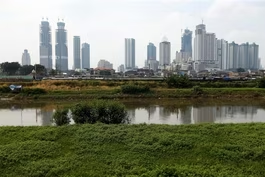
Indonesia's capital, Jakarta, now the world's largest city and home to 42 million people, is sinking rapidly, as climate change and overdevelopment collide.
For our climate series tipping point, Fred de Sam Lazaro reports now from North Jakarta.
FRED DE SAM LAZARO: In Jakarta's north, only a seawall stands between this megacity and the Java Sea, holding back the tide, but not always, especially between October and April, as the rainy season and rising seas collide.
Entire neighborhoods are submerged, motorbikes stall in water, and children find new joy in the streets filled with contaminated floodwaters.
For millions like 35-year-old Ratini, who, like many Indonesians, goes by just one name, this flooding is now routine.
RATINI, Jakarta, Indonesia, Resident (through translator): The water can reach thigh high.
Cars and motorcycles can't enter the area.
FRED DE SAM LAZARO: She spent her entire life here and cares for a family of seven.
RATINI (through translator): It's difficult for everyone, because, when there is a flood, it's hard to make a living for me and the children.
FRED DE SAM LAZARO: When we visited, one son was sick, a reminder of the flood season's impact.
RATINI (through translator): We often get sick during floods.
Everything becomes chaotic.
Sometimes, electricity goes out as well.
FRED DE SAM LAZARO: Her husband, like many here, supports the family by collecting scrap, earning roughly $6 a day.
During floods, that slashed in half.
About 40 percent of Jakarta is below sea level, and it's estimated nearly half of the city could be inundated and uninhabitable by 2050.
Water is everywhere in Indonesia, an archipelago of 17,000 islands.
Farmers here depend on the rains to flood rice paddies that help feed the world's fourth most populous country.
But in the densely populated capital, water is no longer a lifeline; it's a threat.
M. ABDUL BAITS, Indonesian Forum for the Environment (through translator): It's reached the second floor.
FRED DE SAM LAZARO: M. Abdul Baits, with one of Indonesia's most prominent environmental groups, showed us the impact years of flooding has had in Ratini's neighborhood.
M. ABDUL BAITS (through translator): This is proof that Jakarta has sunk below sea level here.
This used to be a two-story house.
FRED DE SAM LAZARO: Nearby, this submerged mosque has become a symbol of what's been lost in the world's largest Muslim-majority country, its dome disappearing over recent years.
The capital city has been sinking as much as six inches per year, and, at the same time, sea levels have risen about four inches in the last three decades.
That's led to more severe flooding, in 2020 reaching record levels that killed more than 60 and forced tens of thousands to evacuate.
Decades of growth has depleted groundwater, slowly hollowing out the land and causing it to sink.
M. ABDUL BAITS (through translator): During the 1970s and '80s, there was massive development, especially in industrial and commercial areas.
That level of construction required huge amounts of water.
FRED DE SAM LAZARO: And the glittering high-rises that now stretch out for miles add to the burden.
M. ABDUL BAITS (through translator): Most structures are made of concrete.
The weight of those buildings adds significant pressure to the land.
FRED DE SAM LAZARO: This construction covered wetlands and mangrove swamps.
M. ABDUL BAITS (through translator): It is no longer ecologically functional.
Jakarta is like a sponge.
If the sponge is sealed, it can no longer absorb water, and eventually it collapses.
FRED DE SAM LAZARO: By law, a third of Jakarta is supposed to be green, open space.
In reality, Baits says, it's less than 5 percent, leaving rainwater nowhere to go.
Trash and debris often block existing drainage points.
M. ABDUL BAITS (through translator): Flooding in Jakarta has a huge impact on people, especially those living in slums and densely populated areas.
This is deeply unfair.
They're not the ones causing the flooding, yet they suffer the most.
KARITEM, Jakarta, Indonesia, Resident (through translator): Tidal flooding is the worst.
Luckily, this house is on stilts now.
We couldn't cook at all.
We even had to boil water using candles.
FRED DE SAM LAZARO: Karitem (ph), Ratini's mother, lost her nearby home to flooding and moved in with her daughter.
They feel safe for now a level above the street.
RATINI (through translator): After the embankment was built, we don't get flooded as much.
The water is blocked now, so it feels much safer.
FRED DE SAM LAZARO: The government began building coastal defenses and pumps in the early 2000s.
Today, roughly nine miles of seawall protect parts of the shoreline.
Last year, the government announced plans for a massive 435-mile seawall project.
And, in 2019, Indonesia also announced plans to move its capital, now on the island of Java, to Borneo, a transition scheduled for 2028.
Pitched as a green, futuristic city by former President Joko Widodo, it was meant to ease Jakarta's burdens.
JOKO WIDODO, Former Indonesian President (through translator): This is a massive project with a timeline of 15 to 20 years.
This isn't a one-to two-year project.
FRED DE SAM LAZARO: But progress has been slow.
Only parts are built, mainly government offices and housing, with few residents so far.
And environmental and indigenous groups warn, the project could endanger one of the world's largest surviving tropical rain forests.
M. ABDUL BAITS (through translator): Relocating the capital does not address the root environmental and social problems.
Those issues remain unresolved.
FRED DE SAM LAZARO: Baits wants to see existing laws about green space enforced, and local communities consulted to find the solutions, instead of what he calls top-down big infrastructure projects.
M. ABDUL BAITS (through translator): This is not a long-term solution.
Seawater gradually erodes concrete, and, over time, it will weaken and fail.
In fact, it could become a time bomb.
People may feel safe because the wall is there, but it does not eliminate the risk.
If a larger disaster happens, the impact could be far worse.
FRED DE SAM LAZARO: In a city that has adapted to the sea since its very beginning 500 years ago, Baits says that skill will be put to its severest test in generations to come.
For the "PBS News Hour," I'm Fred de Sam Lazaro.
GEOFF BENNETT: And that's the "News Hour" for tonight.
I'm Geoff Bennett.
For all of us here at the "News Hour," thanks for spending part of your evening with us.
 New
NewChicago Fed president breaks down economic risks of Iran war
Video has Closed Captions
Chicago Fed president breaks down economic risks of Iran war (7m 5s)
 New
NewCivilians find no refuge from strikes as Mideast war widens
Video has Closed Captions
Civilians find no refuge from strikes as Middle East war widens (8m 57s)
 New
NewJakarta sinks as climate change and overdevelopment collide
Video has Closed Captions
Jakarta rapidly sinks as climate change and overdevelopment collide (7m 3s)
 New
NewMultiple failures likely led to deadly LaGuardia collision
Video has Closed Captions
Investigators believe multiple failures led to deadly LaGuardia Airport collision (6m 14s)
 New
NewNews Wrap: Mullin sworn in as Homeland Security secretary
Video has Closed Captions
News Wrap: Mullin sworn in as Homeland Security secretary (6m 5s)
 New
NewPentagon faces another legal challenge over new media rules
Video has Closed Captions
Pentagon faces another legal challenge over new media rules (7m 45s)
 New
NewTrump’s plans for D.C. draw backlash and court challenges
Video has Closed Captions
Trump’s vision for D.C. draws design backlash and court challenges (8m 58s)
Providing Support for PBS.org
Learn Moreabout PBS online sponsorship
- News and Public Affairs

FRONTLINE is investigative journalism that questions, explains and changes our world.

- News and Public Affairs

Amanpour and Company features conversations with leaders and decision makers.












Support for PBS provided by:
Major corporate funding for the PBS News Hour is provided by BDO, BNSF, Consumer Cellular, American Cruise Lines, and Raymond James. Funding for the PBS NewsHour Weekend is provided by...