
March 19, 2026 - PBS News Hour full episode
3/19/2026 | 57m 46sVideo has Closed Captions
March 19, 2026 - PBS News Hour full episode
Thursday on the News Hour, Israel and Iran trade attacks on oil infrastructure across the region, further spiking global prices. We speak with Republican Sen. Rick Scott about the uncertain future of the conflict. The White House turns to internet memes to promote the ongoing war. Plus, we speak with the mother of a 23-year-old U.S. citizen who was shot and killed by ICE agents in Texas.
Problems playing video? | Closed Captioning Feedback
Problems playing video? | Closed Captioning Feedback
Major corporate funding for the PBS News Hour is provided by BDO, BNSF, Consumer Cellular, American Cruise Lines, and Raymond James. Funding for the PBS NewsHour Weekend is provided by...
Support provided by:

March 19, 2026 - PBS News Hour full episode
3/19/2026 | 57m 46sVideo has Closed Captions
Thursday on the News Hour, Israel and Iran trade attacks on oil infrastructure across the region, further spiking global prices. We speak with Republican Sen. Rick Scott about the uncertain future of the conflict. The White House turns to internet memes to promote the ongoing war. Plus, we speak with the mother of a 23-year-old U.S. citizen who was shot and killed by ICE agents in Texas.
Problems playing video? | Closed Captioning Feedback
How to Watch PBS News Hour
PBS News Hour is available to stream on pbs.org and the free PBS App, available on iPhone, Apple TV, Android TV, Android smartphones, Amazon Fire TV, Amazon Fire Tablet, Roku, Samsung Smart TV, and Vizio.
Providing Support for PBS.org
Learn Moreabout PBS online sponsorshipGEOFF BENNETT: Good evening.
I'm Geoff Bennett.
Amna Nawaz is on assignment.
On the "News Hour" tonight: Israel and Iran trade attacks on oil infrastructure across the region, further spiking global prices.
We speak with Republican Senator Rick Scott about the uncertain future of the war.
SEN.
RICK SCOTT (R-FL): I think the American public is not happy about forever wars, so I don't think there's a bunch of a chance we will have a forever war here.
GEOFF BENNETT: The White House turns to Internet memes to promote the ongoing war.
Critics say it minimizes the human cost.
And we speak with the mother of a 23-year-old U.S.
citizen shot and killed by ICE agents in Texas.
RACHEL REYES, Mother of Ruben Ray Martinez: I don't understand why they had to do that, because I know my son wouldn't use his vehicle as a weapon, and it just didn't make any sense at all.
And I knew something was not right.
It has never made any sense.
(BREAK) GEOFF BENNETT: Welcome to the "News Hour."
Iranian strikes on oil and gas facilities across the Persian Gulf sent shockwaves through global energy markets today, a day after Israel struck Iran's main natural gas complex.
For his part, President Trump sought to reassure Americans as gas prices surge, even as the Pentagon appears poised to ask Congress for up to $200 billion for the war effort.
Our special correspondent, Leila Molana-Allen, has more.
LEILA MOLANA-ALLEN: Today, across the Middle East, oil fields inflames.
Iran ramped up its attacks on the economic lifeblood of the region, striking an oil refinery in Saudi Arabia and several in Kuwait, sending the price of Brent crude oil to a staggering $119 a barrel this morning in response to an unprecedented Israeli airstrike on the South Pars gas reserve, a mammoth deposit of gas beneath the Persian Gulf that could supply the entire world for over a decade.
The Iranian-Qatari co-owned reserve is the biggest domestic gas supplier for Iran.
President Trump today condemned the strike.
QUESTION: Have you talked to Prime Minister Netanyahu about attacking the oil and gas fields?
DONALD TRUMP, President of the United States: Yes, I did.
I did.
I told him, don't do that.
And he won't do that.
We didn't discuss.
We do -- we're independent.
We get along great.
It's coordinated, but on occasion he will do something and if I don't like it -- then so we're not doing that anymore.
LEILA MOLANA-ALLEN: And sitting with Japanese Prime Minister Sanae Takaichi, Trump defended the American decision not to tell allies it would attack Iran with a surprising reference.
DONALD TRUMP: One thing, you don't want to signal too much.
When we go in, we went in very hard and we didn't tell anybody about it because we wanted surprise.
Who knows better about surprise than Japan?
OK?
(LAUGHTER) DONALD TRUMP: Why didn't you tell me about Pearl Harbor?
LEILA MOLANA-ALLEN: And, today, Iranian Foreign Minister Abbas Araghchi vowed revenge, posting on X that Iran would -- quote -- "use zero restraint if our infrastructures are struck again" after Trump last night posted on TRUTH Social that the U.S.
had no knowledge of the attack and that no more strikes would be launched against South Pars unless Qatar was targeted again -- quote -- "In which instance the United States of America, with or without the help or consent of Israel, will massively blow up the entirety of the South Pars gas field at an amount of strength and power that Iran has never seen or witnessed before."
Today, Israeli Prime Minister Benjamin Netanyahu reiterated that Israel acted alone in its attack on South Pars.
BENJAMIN NETANYAHU, Israeli Prime Minister: Israel acted alone against the Asaluyeh gas compound.
Fact number two, President Trump asked us to hold off on future attacks and we're holding off.
LEILA MOLANA-ALLEN: Iran yesterday launched massive retaliatory attacks against the world's largest liquefied gas export facility in Qatar, causing a fire so huge it illuminated the entire city skyline, forcing the Gulf nation to completely suspend its liquefied natural gas production, which supplies 20 percent of the worldwide market.
In total, six refineries, facilities and oil fields have been attacked and damaged in the region in the last 24 hours, as well as oil refineries in the Northern Israeli city of Haifa, as Treasury Secretary Scott Bessent today voiced a surprising proposal to alleviate the spike in oil prices.
SCOTT BESSENT, U.S.
Treasury Secretary: In the coming days, we may unsanction the Iranian oil that's on the water.
It's about 140 million barrels.
So, depending on how you count it, that's 10 days to two weeks of supply that the Iranians had been pushing out that would have all gone to China.
In essence, we will be using the Iranian barrels against the Iranians to keep the price down for the next 10 or 14 days as we continue this campaign.
LEILA MOLANA-ALLEN: And the House pressed the intelligence community on whether the United States' closest partner in the war, Israel, had the same goals.
REP.
JOAQUIN CASTRO (D-TX): What does the intelligence community assess Israel's goals in this war to be and are those goals aligned with the goals of the United States?
TULSI GABBARD, U.S.
Director of National Intelligence: We can see through the operations that the Israeli government has been focused on disabling the Iranian leadership and taking out several members, obviously beginning with the ayatollah, the supreme leader, and they continue to focus on that effort.
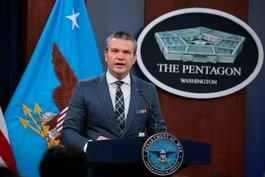
LEILA MOLANA-ALLEN: While, at the Pentagon, Secretary of Defense Pete Hegseth commented on the Pentagon's reported request for an additional $200 billion, nearly a quarter of annual defense spending, for the war.
PETE HEGSETH, U.S.
Defense Secretary: It takes money to kill bad guys.
So we're going back to Congress and our folks there to ensure that we're properly funded.
LEILA MOLANA-ALLEN: To date, the U.S.
has spent $15 billion over the first 19 days of this war.
But, in those 19 days, the toll and trauma on civilians in the region has been immense.
During Ramadan here in the Gulf, after breaking their fast, friends gather late into the night to talk and reflect.
But this year, there's just one topic of conversation.
At this majlis, or gathering place, in downtown Doha, Arabs from across the region have come together.
Brahim Al Rumaihi is a catering engineer and entrepreneur.
He fears an escalating conflict could destroy the success Gulf nations have worked so hard to build.
BRAHIM AL RUMAIHI, Doha, Qatar, Resident (through translator): I really hope that these events will not affect the economy of our country.
In peacetime, we can innovate, but, in wartime, we stop innovating, as we can only think about survival.
LEILA MOLANA-ALLEN: As Eid approaches, usually a time of joyful celebration and presence, civilians under fire across the Middle East pray for just one gift, peace.
For the "PBS News Hour," I'm Leila Molana-Allen in Doha, Qatar.
GEOFF BENNETT: And we are joined on the phone now by "News Hour" special correspondent Reza Sayah in Tehran.
Reza, what's the atmosphere on the ground right now?
Are people bracing for escalation?
Are they trying to carry on with some sense of normalcy?
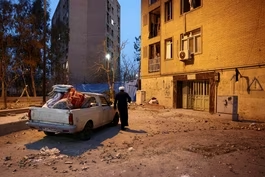
REZA SAYAH: Well, it's been relatively quiet today here in Tehran.
This is day 20 of this war.
Almost every day, Tehran has been bombed.
We have often seen and heard, sometimes felt the bombings and the shockwaves that follow.
But the past two days have been relatively quiet here, with the exception of what sounded like some anti-aircraft fire a couple of times tonight.
And the streets have been quiet too.
Over the past three weeks, my guess is millions have left the capital.
Many of them are obviously exhausted and scared and don't feel safe.
There is a heavy security presence in the streets, including uniformed military personnel with weapons visible who stand guard at major intersections and squares.
And every night at some of those squares, you have pro-government rallies where you have people come out and show their support.
And that's something the government here is pushing for.
GEOFF BENNETT: And how are people reacting to the targeted killings of senior leaders there?
REZA SAYAH: Obviously, Tehran has had some of his most senior leaders taken out in this war, including the supreme leader, including the head of the Revolutionary Guard, and this week the most senior security adviser in Ali Larijani.
But their approach has been next man up.
Their message has been that we mourn the loss and move on to keep fighting.
They say they have been prepared for this and they have several layers of individuals ready to replace leaders, and, so far, at least, no sign that the loss of these leaders has been fatal for the government.
GEOFF BENNETT: Here in the U.S., the growing question seems to be how and when does this end.
What are people there saying about whether there's an off-ramp in sight?
REZA SAYAH: Yes, it's impossible to say when this war is going to end.
Obviously, it ends when the two sides connect, talk, and agree to end this with some sort of agreement.
What's noteworthy is Tehran's position.
Their message, both from military and political officials, has been consistent, and that is this war was imposed on us, we didn't start this war, but now that it's started, we're going to fight and exact cost on Washington.
And the message is this war is going to end when they receive a guarantee that they will not be attacked again.
So it's a message that's designed to project strength and stability,.
And I think, the longer this war drags on, the more confident Tehran will be that it will survive this.
GEOFF BENNETT: And, Reza, as you well know, this moment coincides with both Eid al-Fitr and Nowruz, typically major celebrations there.
How are those holidays being observed this year, and what does that tell you about the public mood?
REZA SAYAH: Yes, they're being observed with big challenges, obviously.
This is a rare occasion where you have these two holidays coincide.
These are holidays where families get together with their new spring clothes, exchange gifts, and enjoy feasts and festivities together.
But, obviously, things are going to be different this year, and you see it in the streets.
I think many people are going to make an effort to make these -- mark these holidays at home with their families.
But with so many people worried about this war, it's going to be very, very hard to celebrate.
GEOFF BENNETT: Reza Sayah, "News Hour" special correspondent reporting for us from Tehran.
Reza, thank you.
REZA SAYAH: Thank you.
GEOFF BENNETT: Well, as the attacks on energy facilities continue across Gulf countries, we look now at the effects of those strikes and get some insights on the nation's in the crosshairs.
Ambassador Susan Ziadeh spent much of her 20-year Foreign Service tenure focused on the Middle East, including serving as U.S.
ambassador to Qatar.
She is now senior adviser at the Center for Strategic and International Studies.
That's a think tank here in Washington.
Thank you for being with us.
SUSAN ZIADEH, Former U.S.
Ambassador to Qatar: Thank you.
GEOFF BENNETT: In the last few days, as you well know, the Iranians have struck a Saudi Arabian oil facility on the Red Sea, a natural gas complex belonging to Qatar, and oil facilities belonging to the UAE.
Our viewers can see them all there on the map.
What stands out to you as being significant about those facilities?
SUSAN ZIADEH: Well, first of all, the breadth of the number of countries that have been hit.
This isn't directed at one country, but at all -- a number of countries in the Gulf Cooperation Council, known as the GCC.
The one -- the hits against the SAMREF, which is the Saudi Aramco refinery, which is jointly owned with ExxonMobil, is in Yanbu.
Yanbu is on the Red Sea, and that's at the end of the east-west pipeline, which was designed to get around the problems of the Strait of Hormuz and shipping out of the Strait of Hormuz.
So, in essence, the Iranians have hit plan B by hitting Yanbu on the Red Sea.
In terms of some of the other facilities, they struck in Fujairah, which is also a port at the end of the pipeline in the United Arab Emirates, which is also outside of the Straits of Hormuz, and tankers have been unable to go and fill up there at the Port of Fujairah due to strikes.
Now, the hit on Ras Laffan in Qatar is a whole different issue.
GEOFF BENNETT: In what way?
SUSAN ZIADEH: All right.
Well, first of all, it is the lifeline for Qatar in terms of its exports of liquefied natural gas, LNG.
Twenty percent of the world's LNG exits from the Strait of Hormuz from Qatar.
And so it's a huge complex, maybe $26 billion to build it up over the last 20 years.
It was hit.
Two of the 14 trains, the trains which produced the LNG were hit.
Interestingly enough, two of those trains had investments from ExxonMobil as well, so it does affect U.S.
companies, and one GTL facility, which is the facility that does jet fuel and other kinds of fuels.
GEOFF BENNETT: I also want to ask you about the South Pars gas field, which we heard our correspondent report about.
These Iranian strikes were preceded by an Israeli strike on that gas field.
How important is that complex, the South Pars complex?
SUSAN ZIADEH: OK.
So the South Pars gas field is part of a larger gas field, which is jointly owned between Qatar and Iran, about two-thirds Qatar, one-third Iran.
The South Pars produces gas mostly for domestic use in Iran.
So, 90 percent of Iran's electricity comes from the gas that's produced in South Pars, as well as cooking gas, heating fuel, et cetera.
The other part of the gas field, which is the Qatari side, is the one that is more productive.
And 20 percent of the world's LNG is produced there and exported through the Straits of Hormuz, in addition to not only liquefied natural gas, but fertilizers and, interestingly enough, 30 percent of the world's helium, and helium used not only for medical imaging, but most importantly for semiconductors in technology.
GEOFF BENNETT: How are Gulf leaders broadly viewing the war at this point?
SUSAN ZIADEH: They didn't want it.
They argued vociferously against it, because they could foretell what was going to happen.
And exactly as they laid it out, this is what has happened.
So they're very angry about it.
And now, of course, they are at odds, to put it mildly, with Iran in this situation.
And so they're in a place where they didn't want to be, for sure.
GEOFF BENNETT: Could the nature of how the U.S.
launched this war fundamentally change the long-term relationship with Gulf countries?
SUSAN ZIADEH: Well, I think the Gulf countries have invested a lot of energy and time and money in their relationship with the United States, the establishment of bases, a lot of military training, a lot of joint exercises under CENTCOM, which is Central Command.
So they have a long-term view of their relationship with the United States.
And I don't think that that fundamentally will change at this point in time.
What might change is a little bit of hedging.
In other words, if they have all their eggs in the U.S.
basket, should they maybe develop relations with a few other countries, whereby they could have an additional layer of security or engagement, either from Europe, like France or the U.K., or perhaps from the adjoining countries in the world?
GEOFF BENNETT: In your view, these strikes by Iran on these oil fields, which we spoke about, is this a deliberate broadening of the battlefield by Iran, or is this in some ways a sign of desperation?
SUSAN ZIADEH: It could be both, but definitely it's a broadening of the battlefield.
I think Iran wants to put pressure on the United States and put pressure on these countries to stop.
They're looking at the economic leverage that bombing these areas would bring and closing off the Straits of Hormuz.
And they understand what affects the global economy.
And I think they're looking at this as a possibility of trying to push towards a better solution for Iran.
GEOFF BENNETT: What are the red lines for the Gulf states?
Can we see a direct war between Iran and its Arab neighbors here?
SUSAN ZIADEH: That's a tough question, in the sense that they didn't start this war, they didn't want this war, and now they're in the middle of it.
I think what goes into their thinking is, they want to best position themselves to not have to endure this kind of situation in the future, but also they're mindful of geography.
And they're mindful that, at some point in time, the United States, when the war is over and they pick up and they go home, and they're left kind of holding the mess.
And what does that mean in terms of their relations with Iran?
So I think they would like to move to a more diplomatic solution, and they would like to find a modus vivendi with Iran that secures their interests and make sure that this doesn't happen again.
GEOFF BENNETT: Ambassador Susan Ziadeh, great to speak with you.
Thank you for your insights.
SUSAN ZIADEH: My pleasure.
Thank you.
GEOFF BENNETT: We start the day's other headlines in California, where lawmakers are trying to rename Cesar Chavez Day following explosive allegations that the late labor leader sexually assaulted women and girls decades ago.
Governor Gavin Newsom is backing a proposal to rename the March 31 holiday as Farmworkers Day.
It follows Washington state's Governor Bob Ferguson saying he won't issue a proclamation honoring Chavez this year.
There are also canceled celebrations in Texas and in Chavez's home state of Arizona.
The fallout comes after The New York Times first reported about his history of sexual abuse and assault yesterday.
That includes Dolores Huerta, the civil rights leader and co-founder of his union who says Chavez raped her back in the 1960s.
Transportation Secretary Sean Duffy is the latest official to warn that small airports in the U.S.
may have to close if the partial government shutdown continues.
It comes as the TSA says that about 10 percent of its airport security officers failed to show up to work yesterday.
The agency employs some 50,000 such workers.
And Duffy says things will only get worse if and when those workers miss another paycheck next week.
Such absences have led to long lines at airports across the country with little warning for travelers, and that's led to confusion and frustration.
MARTY MORALES, Air Traveler: It was three hours and 45 minutes, so missed our flights.
We're stuck trying to figure out, what are we going to do now, try to get another flight to -- our luggage is there, but we're not.
SHAWN WALKER, Air Traveler: Well, I had the plan to come here early.
And I showed up four hours early, and the line looked like this.
(LAUGHTER) SHAWN WALKER: Maybe I didn't have to.
GEOFF BENNETT: The delays come as a record number of air travelers are expected this spring, with an industry group saying more than 170 million people will take to the skies this March and April.
A small community in Southern California has tied the record for the highest temperature ever recorded in the U.S.
in the month of March.
And forecasters say other places could get even hotter in the coming days.
North Shore, California, which is outside of Palm Springs, reached 108 degrees on Wednesday.
Only Rio Grande City in Texas has gotten that hot this early, and that was more than 70 years ago.
The National Weather Service says Las Vegas, Los Angeles, and Palm Springs also tied or topped their own March temperature records.
And they expect this summerlike heat wave to last through early next week.
Two dozen Democratic-led states are suing the Trump administration over its decision to repeal a scientific finding that had been central to the fight against climate change.
The states, along with about a dozen cities and counties, say the EPA acted illegally when it rescinded what's called the Endangerment Finding.
That conclusion formed the legal basis to regulate emissions from cars, power plants, and other sources.
New York Attorney General Letitia James, who is helping lead the suit, said -- quote -- "Instead of helping Americans face our new reality, the Trump administration has chosen denial."
An EPA spokeswoman dismissed the lawsuit, saying it's, in her words, clearly motivated by politics.
An immigration judge denied the asylum claim of the family of Liam Conejo Ramos today.
He's the 5-year-old boy photographed in a blue bunny hat and a Spider-Man backpack as he was detained with his father earlier this year.
A family lawyer said the judge ordered that they be deported to Ecuador.
The boy and his father were held at a Texas detention center after being taken into custody in a Minneapolis suburb back in January.
A judge ordered them released 10 days later.
His case fielded an outcry over the administration's immigration crackdown in Minnesota.
The family's lawyers are appealing the ruling.
On Wall Street today, stocks struggled following the latest spike in oil prices.
The Dow Jones industrial average lost around 200 points on the day.
The Nasdaq fell roughly 60 points.
The S&P 500 continued its downward trend, shedding nearly 20 points.
And, once again, the Finns have cracked the code of contentment.
The 2026 World Happiness Report ranked Finland as the happiest country for the ninth year in a row.
Fellow Nordic countries Iceland and Denmark rounded out the top three, with Costa Rica in fourth place.
That's the highest ranking ever for a Latin American country.
The U.S.
landed further down the list, in 23rd place, though, that's up one spot from last year.
The findings from the Wellbeing Research Center at Oxford University were based on a poll of around 100,000 people across 140 countries who were asked to rate their lives on a scale of 0 to 10.
Well, still to come on the "News Hour": we speak with Republican Senator Rick Scott about the war with Iran; the war creates growing fissures within the MAGA movement; and we speak with the mother of a U.S.
citizen fatally shot by ICE agents in Texas.
Last night, we spoke with Democratic Senator Chris Murphy of Connecticut about the war with Iran.
Tonight, we get a Republican perspective.
Our congressional correspondent, Lisa Desjardins, picks it up from here.
LISA DESJARDINS: As the war with Iran nears the end of its third week, the Pentagon is considering asking Congress to approve $200 billion to fund the ongoing military operation.
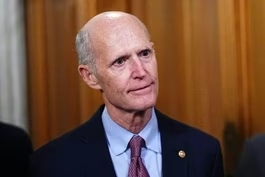
To discuss this and more, I'm joined by Republican Senator Rick Scott of Florida, who serves on the Armed Services Committee.
Senator, thank you for joining us.
Yesterday, we heard from your Democratic colleague Chris Murphy.
He said the Iranian regime is still intact and that he has not seen a plan from the president for ending this war.
Is there a plan?
How do you see this?
SEN.
RICK SCOTT (R-FL): Well, first off, I don't think the commander in chief of our armed forces ought to be telling the enemy, which is the Iranian government here, what our plan is.
So I don't think it's appropriate for our commander in chief to be telling anybody what the plan is.
But the plan is, when do we have -- make sure that their nuclear capabilities are destroyed, and when can we make sure that they don't have a ballistic missile that they can kill either our troops in the Middle East or Americans here in the United States?
So I think the plan will be -- it will be finished when that happens.
So... LISA DESJARDINS: There are many people raising the Iraq War, which was intended to be a short-term U.S.
operation, but went much longer than the Bush administration planned for.
Are you thinking about that?
Are you concerned that could happen?
SEN.
RICK SCOTT: Well, this is a president that doesn't like forever wars.
He's talked about that.
I think the American public is not happy about forever wars.
So I don't think there's a much of a chance that we will have a forever war here.
And, on top of that, there's a president that hates war and hates putting troops on the ground.
So I think what he's doing is trying to fulfill his mission of destroying their capability of nuclear weapons and ballistic missiles.
LISA DESJARDINS: I mentioned that $200 billion figure.
We will see what the Pentagon ultimately requests.
That's what they're considering.
But I did the math on that.
That's about $1,200 per taxpayer.
Going back to this first question, though, that amount of money was enough to fund two years of the Iraq War.
Can we take away that they're expecting money to need to last for a long time for this operation?
SEN.
RICK SCOTT: Well, we don't have any detail.
I think, like in my case, I want to watch how we spend our money.
So I want to see the detail of what they're asking for.
At the same time, I do not want Iran to have nuclear weapons or the ability to use ballistic missiles to kill our troops or Americans.
And so we have got to figure out, what do we need to do this?
We have got to make sure we demolish their ability to do this.
And we have got to watch our money.
We have got to do all of those things.
LISA DESJARDINS: What about the national debt, though?
Is there a limit to what we should be spending here?
SEN.
RICK SCOTT: Oh, absolutely.
We have $39 trillion worth of debt.
We're borrowing money that our kids and our grandkids are going to have to pay off.
It causes inflation.
This is -- we have to balance our budget.
Our families balance our budget.
When I was governor of Florida, Florida had not balanced the budget but once in 40 years.
I balanced it every year.
We all know we have to do this.
It's the thing that's going to get inflation under control.
At the federal level, what we ought to be spending our resources on is protect our liberty, which means our military, and make sure we have a great economy.
Most of the other things, other than some of our safety nets, we could be doing at the state and local level.
LISA DESJARDINS: I want to talk about the DHS shutdown that we're also in the middle of right now.
Now, Democrats have done this to -- they say over ICE conduct that they would like to change.
They're blocking DHS funding.
But they have made an offer.
They say they're willing to fund TSA and some other subagencies.
Do you consider that a serious offer and why not take it?
SEN.
RICK SCOTT: Well, they don't have a serious offer.
And, by the way, I'm not going to do anything to defunds police.
I mean, what they're saying is that they're OK with open borders and they're saying with they're OK with criminals robbing our country and killing people like Laken Riley and Jocelyn Nungaray and Rachel Morin.
I mean, this is -- you can't do this.
Look, I want to make sure that everybody gets paid.
Here's what makes me mad.
I have had a bill since I got up here called No Budget No Pay.
That means if we don't pass our budgets, senators and congress just shouldn't get paid.
But guess what?
Everybody up here wants to get paid.
I'm -- and the Democrats are sitting here saying, oh, they want to get paid, but there's 260,000 people I think part of Homeland Security.
TSA agents aren't getting paid.
Just in Florida, 200 TSA agents have already quit.
They're tired of this.
They didn't get paid last fall.
This is not fair.
Secret Service is not getting paid.
It just makes sense.
It's so unfair to Americans.
And so if Democrats don't want to pay these people, then they should say they didn't get paid either.
I mean, it's just completely unfair.
LISA DESJARDINS: But why not support funding TSA, as Democrats say they would do?
SEN.
RICK SCOTT: I support funding TSA, but I'm not going to -- I'm not going to as part of that never fund ICE.
I mean, they're never going to -- look, for whatever reason, right, Democrats don't want ICE to do its job.
I want a secure border, right?
I don't want criminals in this country.
I have got grandkids.
I have got daughters.
I have got a wife.
I want them to be safe.
I mean, the fact that they're OK with criminals roaming our country and they don't care, ICE is trying to do its job.
Are there reasonable things?
Sure.
The White House has proposed some things.
But the Democrats, they -- this -- for whatever reason, they do not want ICE to be able to get rid of criminals and other people that might rape or kill our daughters or our granddaughters.
LISA DESJARDINS: Senator, I have to push back a little bit.
You said Democrats are OK with criminals roaming around the country.
What I hear from Democrats is that they too want safe borders and that they are OK with detaining criminals who are in the country illegally, and that they're concerned -- you may have seen these videos as well -- is about aggressive tactics by ICE and CBP against including American citizens.
SEN.
RICK SCOTT: This is the same group of people that were completely OK with completely open borders under Biden, completely open borders, criminals flocking across.
They never said a word.
They never pushed back on what Biden was doing.
So when they come now and say, oh, they want to have a secure border, where were they in those four years?
When they say they're worried about criminals, where were they those four years?
LISA DESJARDINS: I want to also ask you about the SAVE America Act, which is on the Senate floor right now.
You're a co-sponsor of that.
That is about election I.D.s.
Now critics, however, I know you have heard this, they insist it's a suppressive law.
For example, to register to vote, you need a passport, a birth certificate, or maybe an affidavit.
It would make it harder to register for some people.
But how do you explain how it would work?
Do you disagree?
SEN.
RICK SCOTT: Well, first off, here's what's crazy.
Chuck Schumer and the Democrats supported Real ID.
That does the same thing.
You had to show you're an American citizen to be able to get a Real ID.
So I don't know what the deal is.
You have to have an I.D.
to go to the doctor or get on an airplane or buy a six-pack of beer.
Don't you think the sacred right to vote is important?
LISA DESJARDINS: If I may, my understanding is the concern that you would need a passport or original birth certificate specifically, and not every American has it.
SEN.
RICK SCOTT: No, there's a whole list.
Listen, there's a whole list of things.
You can have Real ID.
You can have a passport.
You can have a birth certificate.
And if you don't have those, you can do it an affidavit.
So that's not true at all.
If people would read the bill, we have tried to make sure that no one gets disenfranchised.
We want people to vote.
Vote.
I want people to vote.
I have run for election.
I want people to be able to vote, all right?
But I don't want people -- I don't want fraud.
I don't want people that don't have a right to vote.
I don't get to vote in France or England or Canada or anyplace else.
If you're not an American citizen, you don't get to vote here.
It's so simple.
LISA DESJARDINS: Senator Rick Scott of Florida, thank you so much for your time.
SEN.
RICK SCOTT: All right, take care.
Bye-bye.
GEOFF BENNETT: From video game clips to cartoon characters to blockbuster movie scenes, the administration's Iran messaging has embraced a style that critics say blurs the line between propaganda and entertainment and risks reducing a real war to spectacle.
White House correspondent Liz Landers reports.
LIZ LANDERS: As the war continues in the skies over Iran, the Trump administration has opened an usual front here at home, the Internet meme battlefield.
ROBERT DOWNEY JR., Actor: Wake up.
Daddy's home.
LIZ LANDERS: A post titled Justice the American Way that features a montage of movie clips from films like "Iron Man," "Gladiator," "Top Gun" and other action movies has been viewed more than 64 million times on X since it was posted two weeks ago.
ACTOR: Time to find out.
LIZ LANDERS: Other videos feature rap songs... ACTOR: You want to see me do it again?
LIZ LANDERS: ... and cartoon characters.
The White House has also turned to sports, sharing videos featuring baseball stars hitting home runs and football tackles interspersed with battlefield explosions set to music.
ROGER STAHL, Professor of Communication Studies, University of Georgia: What we're seeing from the White House is what you might call a sizzle reel of weapon strikes footage.
LIZ LANDERS: Roger Stahl is a professor of communication studies at the University of Georgia specializing in propaganda, war and pop culture.
ROGER STAHL: There are no human beings.
There are no schoolchildren to be incinerated.
There's no suggestion that people are suffering on the other end.
So you get on the one hand fantasy material that is framing the weapon strikes and kind of sanitization of war as it's being presented through the gun camera.
LIZ LANDERS: The videos are amplified across social media by both official government accounts and Trump supporters.
One of the most controversial posts opens with imagery from the video game "Call of Duty" and then cuts to actual U.S.
war footage.
The video was eventually taken down, but not before it was viewed more than 50 million times.
ACTOR: We're winning this fight.
LIZ LANDERS: Kristopher Purcell served in the Bush White House communication shop during the run-up to the Iraq War in 2003.
KRISTOPHER PURCELL, Former Bush White House Aide: "Call of Duty" is not real life.
It's a game.And war has very, very real consequences, not just for our service members, but for Iranian civilians.
And this gamification of war is really appalling, especially when you consider the administration's typical response to mass shootings, which is to blame violent video games and movies.
LIZ LANDERS: The White House defends the strategy as a modern way to communicate with younger audiences and highlight military successes.
They told us in a statement in part -- quote -- "The legacy media wants us to apologize for highlighting the United States military's incredible success, but the White House will continue showcasing the many examples of Iran's ballistic missiles, production facilities, and dreams of owning a nuclear weapon being destroyed in real time."
And social media videos are only part of the Trump administration messaging.
PETE HEGSETH, U.S.
Defense Secretary: We're winning decisively with brutal efficiency, total air dominance, and an unbreakable will to accomplish the president's objectives on our timeline.
We stay locked on the target because here at the Department of War that's our job.
LIZ LANDERS: In contrast to Secretary Hegseth, Chairman of the Joint Chiefs of Staff General Dan Caine offers a more sober tone.
GEN.
DAN CAINE, Chairman, Joint Chiefs of Staff: To our Gold Star families, to our wounded warriors and their loved ones, we will never forget your sacrifice.
LIZ LANDERS: The meme videos are an effort to generate public support for a war that polls say remains unpopular.
Our PBS News/NPR/Marist poll this month found that a majority of Americans, 56 percent, oppose U.S.
military action in Iran.
Do you think part of the intention behind these videos is to distract the public from what's happening?
ROGER STAHL: This war is presenting all kinds of problems with shipping lanes and the economy and gas prices and dead troops and civilians.
And the Trump administration would not like to talk about any of these.
And so they want to change the topic and distract as much as possible.
And I think getting the media and the American public talking about an unconventional messaging campaign might be the best way to do that.
LIZ LANDERS: The messaging strategy is a sharp departure from past presidents like George W. Bush.
KRISTOPHER PURCELL: In the lead-up to the Iraq War, of course, the Bush administration spent many, many months building coalition support, going through the U.N.
There was significant discussions with Congress.
All of these things took a lot of time and a lot of effort.
And what we have seen from the Trump administration is really no warning, no public discussion, no public debate, no gathering of allies.
LIZ LANDERS: As the war drags on, so do ceremonies like this.
In all, 13 American service members have died since the fighting began in Iran and nearly 200 wounded, according to U.S.
Central Command.
For military families, the war isn't just headlines.
It's personal.
Karee and Jim White, both Army veterans themselves, know the toll of war firsthand.
Seven of their nine children have served.
Their daughter, Kimmy (ph), was severely injured in Afghanistan in 2014, requiring full-time care.
Their son, Campion (ph), just graduated from Army Ranger school.
KAREE WHITE, Military Family Member: You can't have a clean war.
Wars can get messy fast.
And I think this administration -- I want to think this administration values, that we can't have a lengthy war.
JIM WHITE, Military Family Member: There's no question that this -- going down this path has a -- has massive consequences for the people who participate in it.
LIZ LANDERS: Karee White says she hopes the social media images the administration is using don't dismiss the dangers of war.
Karee, have you seen any of those videos?
KAREE WHITE: A little bit.
And what would be disturbing to me is if it's perceived as a gaming kind of event.
It really comes home when you have loved ones that are involved.
And I don't like to see it reduced to some sort of a gaming strategy type of event, if that's been in fact what's happening, because it's really real to the families that are involved, like ours.
LIZ LANDERS: Her husband, Jim, worries the war's low casualty count is keeping it out of the public view.
JIM WHITE: I think, in a way, the more dangerous thing is the fact that we have had so little loss, right?
It's been so easy that it makes you feel like you can go a little bit further than you probably should.
That's the real risk.
LIZ LANDERS: As we just heard, more than half of Americans do not support U.S.
military action in Iran, despite the Trump administration's efforts.
For more on that, we're joined by Curt Mills, executive director of "American Conservative" magazine.
He's been outspoken against U.S.
involvement in Iran.
Curt, thank you for joining the program.
CURT MILLS, Executive Director, "The American Conservative": Thank you for having me.
LIZ LANDERS: Let's start with President Trump ran on this notion of no more forever wars.
We just heard from Rick Scott earlier in this program, the senator from Florida, saying that Trump has said that he doesn't like them.
And he acknowledges that Americans don't like these long, protracted wars.
Is this conflict with Iran America first?
CURT MILLS: No.
No, it's transparently a betrayal.
And the Republican rhetoric is increasingly becoming Orwellian.
This is a war.
Iran feels this war.
The late supreme leader of Iran knows it's a war.
The denial of this, the denial that this is not a complete, frankly, about-face or volte-face from what Trump was saying in 2016 and 2024 particularly, it just defies credulity.
It's the equivalent of George H.W.
Bush breaking his no new taxes pledge.
It's a campaign betrayal for the ages.
LIZ LANDERS: What are you hearing from inside the administration from people reacting to this conflict?
CURT MILLS: You know, the administration thing is very curious.
I think the president drove this decision, and I don't think there was a long series of consultations.
And I think that's why you see the helter-skelter nature of the rationales that they're citing.
They don't know why they went to war because there wasn't an all-of-the-administration discussion, frankly.
And I think also -- especially because you saw the counterterrorism chief, Joe Kent resign, I think it would not be surprising if more members of the administration resigned in the coming weeks if the conflict continues.
LIZ LANDERS: OK.
I wanted to ask you about that.
So we heard that the National Counterterrorism Center director, Joe Kent, he resigned on Tuesday and he cited in his resignation letter a lack of an imminent threat from Iran.
This is the first major ideological departure from this second term, second Trump administration.
You think this may open the door to more of these?
CURT MILLS: For sure.
And, look, and I don't think we should just brush Kent aside.
It's already the biggest -- a bigger resignation in this administration for Iran than there were for the Democrats under Gaza in two years.
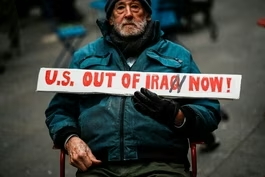
LIZ LANDERS: Do you see a generational divide right now among MAGA and conservatives over this Iran war?
CURT MILLS: For sure.
And respectfully to the older viewers, but this is a war that is driven by Baby Boomer conservatives.
It is plain to say.
LIZ LANDERS: What are you hearing from the younger MAGA set about why they don't support this?
CURT MILLS: I think it's demoralizing.
And I think, well, first of all, they reject the casus belli such as it is.
There was not an imminent threat.
The messaging from Speaker Johnson and others that there was an imminent threat to the Iranians getting some form of nuclear enrichment is just twisting the words.
This is - - there was not an imminent threat.
The Iranians could -- did not have nuclear weapons that could hit the homeland, did not have missiles that could hit the homeland.
The Iranians were at the negotiating table.
It's not to say that we should trust everything they wanted to do.
But if Trump wanted a better deal than even Obama's JCPOA, that was on offer last spring, that was on offer this spring.
He rejected it and went to war.
LIZ LANDERS: The magazine that you work for was founded in response to the Iraq War and U.S.
involvement in that conflict.
How does foreign policy rank now for conservatives?
CURT MILLS: Yes, the magazine was founded in 2002 by Pat Buchanan and others, very much the Tucker Carlson of his day, against the Iraq War.
I think foreign policy is of a piece of what Trump ran on in 2016 and 2024.
Foreign policy is part of a, I would say, troika of issues with immigration and trade, the idea that the country has been sold out, deindustrialized and flooded with unassimilated immigration, that the average man has been forgotten, that they have been shipped -- their jobs been shipped overseas and their sons and daughters have been shipped off into wars that nobody voted for.
I think it's all of a piece.
LIZ LANDERS: We were talking earlier about Joe Kent and some of the reaction to his resignation.
There were Jewish organizations like the Anti-Defamation League that criticized him and his resignation letter, saying that some of the language in that echoed antisemitic tropes.
We looked at a poll the Manhattan Institute did last year; 25 percent of Republicans under 50 years old say that they hold antisemitic views.
Do you think that this conflict is going to magnify or amplify those kinds of voices within the party?
CURT MILLS: Well, the Manhattan Institute has an agenda, so I distrust that data, frankly.
They want to equate principal criticism of the Israeli government with antisemitism.
And I think that should be rejected on both left and right.
It's the most cynical type of politics.
It's the type of politics that, frankly, Republicans were put back into power to reject.
People were tired of speech policing and woke mind games, frankly.
And the Republicans are doing the exact same thing with antisemitism and the Israel debate.
That's not to say that there's no antisemitism in the country, but I believe it is being willfully conflated with principled criticism of this war for the war's aims.
LIZ LANDERS: How do you see this Iran conflict impacting the midterm elections later this year in November and also looking ahead, influencing the Republican presidential primaries, which will really start within the next year or so?
CURT MILLS: First of all, the president can declare victory now and come home.
He doesn't seem like he's going to do that, but if he doesn't do that, I think they're going to lose Congress and they're going to lose both houses of Congress.
And I think that's going to be pretty dramatic.
As to the primary, I think it is going to be the leading issue.
I mean, the reality is that whoever is in power now has the Israel bag.
You saw it in the Democratic primary.
Everyone forgot because of Joe Biden's disastrous performance in June of 2024 is the debate what was going on weeks and months before.
There were campus protests roiling the country over Israel.
The reality is that both parties, the bases are fed up with this relationship that is driving us into war.
LIZ LANDERS: Curt Mills, thank you so much for joining us.
CURT MILLS: Thank you.
GEOFF BENNETT: A year ago this week, Ruben Ray Martinez, a 23-year-old U.S.
citizen, was shot and killed by an ICE agent in Texas.
But it was not until this past February, 11 months after the shooting, that ICE confirmed its involvement.
It's now become the first publicly known instance of ICE fatally shooting a U.S.
citizen as part of President Trump's immigration crackdown.
While the Department of Homeland Security says Martinez intentionally rammed his vehicle into an agent, recently released bodycam footage, which shows shots being fired into Martinez's vehicle, calls that narrative into question.
And one year later, Martinez's family is still searching for answers.
We're joined now by Ruben Martinez's mother, Rachel Reyes, and her attorney, Charles Stam.
Thank you both for being with us.
Rachel, we will start with you.
It's been a year since you lost your son.
Tell us about him.
What was he like?
And when you think of him now, what most stands out?
RACHEL REYES, Mother of Ruben Ray Martinez: His presence.
He was so funny and humble and the light of our house.
He was always very laid back and just a really good kid.
He was trying to figure things out.
Yes, he was -- became - - he's dearly missed.
I'm sorry.
It's emotional.
GEOFF BENNETT: Well, take us back to that day.
How did you first learn that your son had been killed?
And in the early hours, what were you told had happened?
RACHEL REYES: So an official came to my home and told me that he -- my son had passed away.
And the way he described the incident was that he got -- there was an accident ahead of him that slowed down the traffic, and then that Ruben was going so slow that an officer saw a container in the vehicle.
But he told me he was going to let him go anyway, so he let him go forward.
And then the other officer yelled for him to not go.
Well, he told me that what happened was, he got tapped.
My son was going forward and tapped an officer, and that that's why they shot him just for that reason.
And I just couldn't understand this.
Since day one, it never made any sense to me.
GEOFF BENNETT: Well, tell me more about that.
At what point did you start to feel like you weren't getting the full story?
RACHEL REYES: That same day.
It just didn't make any sense to me-, because he wouldn't -- I don't understand why they had to do that, because I know my son wouldn't use his vehicle as a weapon.
And it just didn't make any sense at all.
And I knew something was not right.
It just never made any sense since day one.
GEOFF BENNETT: Charles, I want to bring you in and ask you to respond to this statement we received from DHS.
They say -- quote -- "We stand by the grand jury's unanimous decision that found no criminality.
The incident was investigated from every possible angle by an independent body and it cleared our officer."
You have now reviewed the body camera footage released by the Texas Department of Public Safety.
What does that video show and to what extent does it call into question the government's account?
CHARLES STAM, Martinez Family Attorney: I think it calls it completely into question.
Nothing we saw on any of the video suggested that Ruben posed a threat to members of the public, to law enforcement, to anyone, period.
If you look at the video right before the fatal shots were fired, Ruben yielded at a crosswalk to allow several young ladies to pass.
I mean, it's no laughing matter.
Bluntly, people who are using their vehicles as weapons, people who are looking to commit acts of terror, they don't yield to people to cross the street, all right?
And although there are gaps in the video, although that there are periods of the video that are difficult to make out, there is nothing that we have seen on the video that remotely justifies the use of force against Ruben.
GEOFF BENNETT: Well, what do you believe happened in those final moments, based on your own investigation?
Well, we believe that Ruben entered a confusing scene.
It was a scene that a lot of other drivers had difficulty navigating.
It wasn't clear to me in viewing the body camera whether the cops were indicating that there was a lane closed or an entire roadway that was closed.
So a lot of people besides Ruben got confused and may have tried to enter too far.
So we start with a problematic scene and omissions in terms of traffic safety.
And that's really what this is.
This is South Padre spring break.
There's nothing political about this.
There's nothing to do with immigration operations.
It's really what happens when you bring highly militarized federal police and federal officials into do everyday, basic police work.
GEOFF BENNETT: And, Rachel, the mention of spring break, your son was there celebrating his birthday.
Is that right?
RACHEL REYES: Right.
Yes, he was.
GEOFF BENNETT: Charles, it took nearly a year for ICE to publicly acknowledge its role in all of this.
What do you think accounts for that delay?
CHARLES STAM: You know, I would hate to speculate without any basis in reality.
But what I can tell you is that it's concerning to us.
This demands complete accountability, complete transparency.
Sunshine must be allowed to enter the process.
You mentioned earlier that a grand jury investigation, no, no, no, a grand jury process is, first of all, confidential.
So we shouldn't even be talking about those deliberations.
But the fact that this was even given to a grand jury, that's about assessing criminal charges against some of these officers.
That's not what -- that's not what's called for in a civil investigation, which involves law enforcement or the U.S.
attorney's office or the DOJ or whoever to actually conduct a thorough investigation to determine the root cause of this incident in a manner that is not politicized.
GEOFF BENNETT: And, Charles, there was a key witness, Joshua Orta, who was in the car.
He disputed the government's account.
Mr.
Orta later died in a car crash.
What did he say happened that night?
CHARLES STAM: Mr.
Orta gave my law firm a statement that largely corroborates what we saw in the video.
Mr.
Orta was also subject to interrogation by law enforcement in the wake of this incident before his tragic death.
And what I can tell you is that Mr.
Orta was adamant Ruben may have been confused or frightened.
He would never, ever, ever try to strike or hit or let alone run over a law enforcement officer.
So I think that Josh's statements across all of them emphasized that Ruben did not pose a threat.
GEOFF BENNETT: Rachel, what is your family asking for now that you still have not received?
RACHEL REYES: Accountability.
Before, we were searching for answers.
And now that we have seen the videos, now we want justice and accountability, because, based on the video, Ruben was not at that night -- he was the only one trying to de-escalate.
He had his foot on the brake.
And Jack Stevens impulsively and aggressively took his life for no reason.
So my son died based on -- I think everyone involved in that scene is somehow responsible because of the commotion, the chaos and the conflicting commands.
And I think everyone played a part in this chaos.
It should have been a routine traffic encounter that turned into a tragic event for nothing.
So he took my son's life for nothing.
So I really want justice for that.
GEOFF BENNETT: Accountability, justice, what does that look like?
RACHEL REYES: My son's death certificate says homicide, so whatever would be appropriate for that would have been just.
But since the grand jury failed us, now we're going to have to look at other options, whatever that may be.
It's definitely something needs to change.
They can't keep doing this to people.
He took my son's life.
And then DHS protects him with their misrepresentation of my son.
And that's another harm caused by them.
And it's just awful.
It's just -- this whole situation is wrong.
It should never happened.
GEOFF BENNETT: May I ask how you're holding up in this moment?
How are you doing?
RACHEL REYES: It's been hard.
It's been incredibly overwhelming.
It's hard.
It's been really hard, just the dealing with everything.
And then it seems like it keeps adding on and combining, like, the more the harm they cause.
It's just -- it's been rough for all of us.
GEOFF BENNETT: Yes.
Well, I certainly wish you peace.
And my condolences on the loss of your son.
RACHEL REYES: Thank you.
GEOFF BENNETT: Rachel Reyes, Charles Stam, our thanks to you both.
CHARLES STAM: Thank you, Geoff.
GEOFF BENNETT: And that's the "News Hour" for tonight.
I'm Geoff Bennett.
For all of us here at the "PBS News Hour," thanks for spending part of your evening with us.
 New
NewHow Iranians are navigating daily life as war drags on
Video has Closed Captions
How Iranians are navigating daily life as war drags on (3m 39s)
 New
NewIran war creates growing cracks within Trump's MAGA movement
Video has Closed Captions
Iran war creates growing cracks within Trump's MAGA movement (6m 18s)
 New
NewIsraeli, Iranian strikes on energy facilities rattle markets
Video has Closed Captions
Israeli and Iranian strikes on oil and gas facilities rattle global markets (7m 16s)
 New
NewMother of man killed by immigration agent demands justice
Video has Closed Captions
'He took my son's life for nothing,' says mother of man killed by immigration agent (8m 57s)
 New
NewNews Wrap: California seeks to rename César Chavez Day
Video has Closed Captions
News Wrap: California seeks to rename César Chavez Day following sexual abuse revelation (5m)
 New
NewPentagon seeks up to $200 billion to fund Iran war
Video has Closed Captions
Pentagon poised to ask Congress for up to $200 billion to fund Iran war (5m 46s)
 New
NewSen. Scott says U.S. should demolish Iran's nuclear ability
Video has Closed Captions
Sen. Scott says U.S. should balance budget but also 'demolish' Iran's nuclear ability (8m 22s)
 New
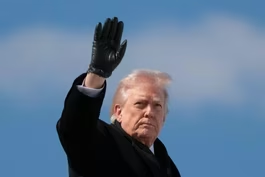
NewWhite House turns to internet memes to promote Iran war
Video has Closed Captions
White House's use of internet memes to promote Iran war sparks criticism (6m 45s)
Providing Support for PBS.org
Learn Moreabout PBS online sponsorship
- News and Public Affairs

FRONTLINE is investigative journalism that questions, explains and changes our world.

- News and Public Affairs

Amanpour and Company features conversations with leaders and decision makers.












Support for PBS provided by:
Major corporate funding for the PBS News Hour is provided by BDO, BNSF, Consumer Cellular, American Cruise Lines, and Raymond James. Funding for the PBS NewsHour Weekend is provided by...