
June 10, 2026 - PBS News Hour full episode
6/10/2026 | 57m 46sVideo has Closed Captions
June 10, 2026 - PBS News Hour full episode
June 10, 2026 - PBS News Hour full episode
Problems playing video? | Closed Captioning Feedback
Problems playing video? | Closed Captioning Feedback
Major corporate funding for the PBS News Hour is provided by BDO, BNSF, Consumer Cellular, American Cruise Lines, and Raymond James. Funding for the PBS NewsHour Weekend is provided by...
June 10, 2026 - PBS News Hour full episode
6/10/2026 | 57m 46sVideo has Closed Captions
June 10, 2026 - PBS News Hour full episode
Problems playing video? | Closed Captioning Feedback
Where to Watch PBS News Hour
PBS News Hour is available to stream on pbs.org and the PBS app.
Providing Support for PBS.org
Learn Moreabout PBS online sponsorshipGEOFF BENNETT: Good evening.
I'm Geoff Bennett.
AMNA NAWAZ: And I'm Amna Nawaz.
On the "NewsHour" tonight: The U.S.
launches new strikes against Iran after President Trump accused it of dragging its feet on negotiations to end the war.
GEOFF BENNETT: As the conflict goes on, prices at home rise at their fastest rate in three years, driven by high gasoline costs.
And Judy Woodruff explores whether the United States was founded as a Christian nation 250 years ago and what one nation under God means for Americans today.
JOHN FEA: There had been no country that had been built upon these radical ideas of separating church and state, of religious liberty, of religious freedom.
(BREAK) AMNA NAWAZ: Welcome to the "News Hour."
As we come on the air tonight, the U.S.
is again striking targets in Iran after President Trump and Defense Secretary Hegseth both said today that the U.S.
would hit Iran hard.
GEOFF BENNETT: An Iranian state news agency today quoted officials warning that attacks would be met with retaliatory strikes against what it called new U.S.
interests.
Iran's ambassador to the U.N.
said a deal to end the conflict cannot be achieved through threats or military force.
Meantime, President Trump said the U.S.
has been helping stranded vessels transit the Strait of Hormuz, again asserting American control over that vital waterway.
Ali Rogin reports.
ALI ROGIN: From the Oval Office today, the president's patience with Iran apparently wearing thin.
DONALD TRUMP, President of the United States: They keep tapping us along.
They keep playing us for suckers.
But we hit them hard yesterday and we're going to hit them again hard today.
ALI ROGIN: That warning after violent overnight exchanges between the U.S.
and Iran.
This video released by Iran's Revolutionary Guard Corps today shows missile launches targeting U.S.
bases in the region.
Meantime, on the Strait of Hormuz, the U.S.
disabled another oil tanker, enforcing its blockade.
Following the fighting, Iran's president, in a rare appearance, said the country must choose a decisive path.
MASOUD PEZESHKIAN, Iranian President (through translator): We must get out of this no war, no peace state.
War is certainly not in the country's interest.
But if they think that, by violating our dignity, our territory and our homeland, we will surrender or back down, then let them only dream about it.
This is not something that we will back down from.
ALI ROGIN: And west of Iran, Israel today launched a series of strikes in Southern Lebanon, killing at least 17 people.
South of Beirut, in the coastal city of Sidon, sirens wailed and fire crackled after an Israeli drone strike struck several cars, killing two.
Lebanon says it's now been bombed nearly 3,500 times by Israel since a cease-fire was struck in mid-April, those strikes echoing throughout the region, as Turkey's president today fiercely denounced Israel.
RECEP TAYYIP ERDOGAN, Turkish President (through translator): The Zionist regime is truly a festering sore, a factory of discord, constantly producing unrest across a wide geography.
Israel must be stopped.
ALI ROGIN: Israeli Prime Minister Benjamin Netanyahu fired back in a statement, writing: "The antisemitic dictator Erdogan, who is committing genocide against the Kurds, supports the Hamas terrorist organization, oppresses his own people and imprisons his political rivals, is the last person who can lecture the state of Israel on morality.
Those ongoing strikes into Lebanon have now spurred the U.N.
to launch an on-the-ground investigation.
VOLKER TURK, United Nations High Commissioner for Human Rights: Prompt and independent investigations into alleged violations of international humanitarian law and international human rights law must be conducted.
This is why I have agreed with the government of Lebanon to conduct an impartial and independent assessment mission in the country.
ALI ROGIN: Back in the Oval, President Trump revealed a mission to move oil from the Gulf.
DONALD TRUMP: Every night we took out oil.
Millions of barrels of oil has come out, and that's why it's at $85, $90 a barrel, instead of $250.
ALI ROGIN: He later provided detail on social media, saying this effort has resulted in more than 100 million barrels of oil making its way through the strait, then wrote: "The United States of America controls the Strait of Hormuz, not Iran."
But, on the waterway, vessels dot the coast and deadlock persists, as prices around the world continue to climb.
For the "PBS News Hour," I'm Ali Rogin.
GEOFF BENNETT: And those spiking energy prices sent inflation to a three-year high in May, up 4.2 percent annually.
The Labor Department said the cost of energy was responsible for over 60 percent of the increase.
Core inflation, which strips out volatile food and energy prices, was up a more modest 2.9 percent.
It comes as renewed fighting in Iran threatens to extend disruptions in the Strait of Hormuz, the crucial energy choke point responsible for transit of roughly a fifth of the world's oil supply.
For more, we're joined now by Roben Farzad, host of public radio's "Full Disclosure."
Roben, it's good to see you.
ROBEN FARZAD, Host, "Full Disclosure": Thank you, Geoff.
GEOFF BENNETT: So inflation is now running at more than double the Fed's target rate of 2 percent.
What more does today's report tell us?
ROBEN FARZAD: It's a tough beast to kill, especially when you're trying to pull this off in Iran with the Strait of Hormuz.
I mean, you wonder if inflation would have gone down to the Fed's ideal 2 percent target, the better to cut interest rates, if Iran was not engaged, so to speak, this year.
But the entire nation saw we got in the springtime quite an oil shock.
And that obviously percolates down to everything, especially at a time when people were feeling it in food prices.
You have seen the misery index numbers, which really don't jibe with an economy that's still really buoyant and creating jobs and interest rates are low on the stock market is giddy.
So there's definitely pain and a disconnect and residual misery from the great inflation of '22.
GEOFF BENNETT: Residual misery.
You have got gas is up.
Gas is now up a dollar per gallon over last year.
Electricity prices are up almost 6 percent from a year ago.
Fruit and vegetables are up 6 percent, airline fares up 27 percent, apparel up 5 percent.
What's causing all of these prices to rise on so many fronts simultaneously?
ROBEN FARZAD: Clearly, energy is an input.
If we look at fertilizer, the price of tomatoes, beef, everything that goes into the inputs of soybeans and everything, there was a huge pinch point in the Strait of Hormuz.
I mean, you underestimate how vastly interconnected we are in the supply chain.
If you look, you go to a Wegmans, a Kroger and the grocery in the produce section, I mean, the things that you could take for granted, avocados, year-round mangoes, grapes, produce, all that stuff requires significant free trade, low barriers to trade, constant supplies of low-cost fuel and fertilizer.
And when that's pinched, especially after a time of opportunistic inflations where manufacturers, food manufacturers, retailers, car insurance companies, the automakers, they all used '22 and '23 as cloud cover to raise prices.
So you're not helping situation by exacerbating fuel and fertilizer, for example.
GEOFF BENNETT: I want to play you with what President Trump said today when he was asked about this report.
Take a look.
QUESTION: Are you concerned, Mr.
President, about the latest inflation number which came out this morning?
Could that be a... DONALD TRUMP, PRESIDENT OF THE UNITED STATES: No, I love it.
The numbers were great.
You know what I really love?
I love the inflation.
QUESTION: ... inflation to come down between now and.. DONALD TRUMP: Oh, when the war is over?
QUESTION: Yes.
DONALD TRUMP: It's coming down.
It's going to come down like a rock.
GEOFF BENNETT: It's remarkable to hear any president say, "I love the inflation."
But the White House argues that this is temporary pain and when the war is over, so will the inflation woes.
Do they have that right?
ROBEN FARZAD: It was a great pipe dream in January, if you think back to the extraction of Nicolas Maduro in Venezuela and Caracas.
It was so easy.
We can pull off something like that in Iran.
And can you imagine the deluge of easy oil, I mean, just flooding the system.
And we have all these refiners that are eagerly going to take it up, driving oil down -- back down to the 30s and 40s.
Obviously, it was a lot harder that way.
Obviously, they didn't do their homework with Hormuz and how much this would hurt the economy.
It's such a fungible commodity.
It was almost like a curse what happened with Venezuela so easily.
And I remember I was getting calls from people linked to the administration that, do you understand how much this is going to inundate the hemisphere with heavy crude?
And our refiners are at the ready to crush the price of gas.
So to be seen and remains to be seen if they could pull that feat off.
GEOFF BENNETT: And it's not just gas and food prices, also the cost of health care.
There was a report out today from the Robert Wood Johnson Foundation that found that nearly half of all working-age adults struggle to afford health care.
This was in 2025 and, even increasingly, those with insurance.
I mean, what does all of that suggest?
ROBEN FARZAD: Yes, I mean, if you look at the Affordable Care Act, and this administration has not been in love with it.
It hasn't been able to kill it with Congress several times.
So, at best, it gives it benign neglect.
I wouldn't even call it benign.
If you're cutting Medicaid options to the states and Medicare, you're giving it just neglect and ignoring it and making sign-ups difficult.
And there was a bottleneck.
And inflation is still running course and people are still getting older.
And parents are getting older and kids have various illnesses and we're coming out of this pandemic.
And, of course, you're going to see this disconnect.
Of course, you're going to see that inflation persist, because it's where demographics and kind of the physics of this economy finally catch up.
And that's something that we can't ignore forever.
Let's not forget that they were litigating this when Bill Clinton was first elected president.
And it's still something that the nation has not solved nearly 40 years later.
GEOFF BENNETT: And, as all of this unfolds, Roben, you have got the Fed set to meet next week under the new Fed chair, Kevin Warsh.
What kind of dilemma does all of this present for him as the Fed gets ready to set right?
ROBEN FARZAD: You have a president that's more than jawboning him.
I mean, he shamed Jerome Powell, his own handpicked man, out of office.
You remember the -- kind of the cringe hardhat scene at the Federal Reserve?
Like, you have cheated.
Get out of here.
You're not -- you waited too long to cut.
You can't cut into this environment.
Inflation has not been snuffed out.
And this is a problem.
If you're rules-based Fed and you have the dual mandate of full employment and price stability, prices are not quite stable yet.
Unfortunately, Geoff, it's a blunt instrument.
If they hike right now, some people at the lowest very end of this, you talk about health care, you talk about food inflation, the people who need credit card debt to pay for health care, to pay for foods, to pay for their monthly nut, they're going to disproportionately take the hit, where those who've been involved in asset markets, who have an abundance of savings, an abundance of stock and crypto and the like, they're not going to feel it nearly as much.
So it brings back that K-shaped economy theme.
GEOFF BENNETT: Roben Farzad of public radio's "Full Disclosure,.
Thanks, as always, Roben.
Good to see you.
ROBEN FARZAD: My pleasure.
Thank you.
AMNA NAWAZ: In the day's other headlines: Microsoft co-founder Bill Gates told a congressional panel he made a -- quote -- "grave error in judgment" by ever meeting with the late sex offender Jeffrey Epstein.
BILL GATES, Founder, Microsoft: I'm glad to be here voluntarily to testify to help with the committee's work.
AMNA NAWAZ: Prior to his testimony, Gates said he wanted to help -- quote - - "find justice for the victims."
And in an opening statement provided to the Associated Press, Gates said he was unaware of Epstein's crimes.
The tech billionaire has not been accused of any wrongdoing himself, but appeared multiple times in the Justice Department's Epstein files.
Their relationship began three years after Epstein pleaded guilty in Florida to soliciting sex from a minor.
Democratic lawmakers took aim at that time frame.
REP.
ROBERT GARCIA (D-CA): Mr.
Gates was aware that Jeffrey Epstein had been convicted, and for a horrific crime, and continued to interact with him to seek money for his foundation.
And I think that, obviously, I think we would agree, was a horrific judgment call.
AMNA NAWAZ: Just a day earlier, Epstein's longtime executive secretary Lesley Groff told the same House panel that he was a -- quote -- "master manipulator" and that she too was unaware of his crimes.
That's according to her prepare remarks and sources familiar with her testimony.
Transcripts of both interviews are expected to be released at a later date.
Defense Secretary Pete Hegseth warned the government of Cuba today not to seek out weapons that could strike the U.S.
or its military bases.
Hegseth touched down at the U.S.
Naval base at Guantanamo Bay in Cuba this morning and later visited with troops.
He told them if Cuba pursued such weapons, it would invite, in his words, a confrontation not only do they not want, but they could not stand.
His visit comes as the Trump administration has placed enormous pressure on the island, including a crippling oil blockade.
In Northern Ireland tensions remain high tonight with police out on the streets of Belfast following anti-immigrant violence brought on by a stabbing attack.
Sudanese national Hadi Alodid appeared in court today via video to face charges of attempted murder, among others.
The 30-year-old did not enter a plea.
Detectives say he partially blinded a man during a knife attack on Monday, which set off a wave of public anger.
Hundreds of masked individuals set fire to homes last night believed to house immigrants.
Firefighters worked to control the flames today as charred cars and debris lined the streets.
One local resident whose house was badly damaged expressed his frustration.
JAMIE CORRY, Belfast, Northern Ireland, Resident (through translator): What's this resolve, essentially destroying our own community?
And I had two people from the old community who lost their property.
So it's just a time to rebuild it all up.
AMNA NAWAZ: Appearing before lawmakers today, British Prime Minister Keir Starmer said his thoughts are with the stabbing victim.
And he criticized the violence that followed the attack, urging that order be restored.
KEIR STARMER, British Prime Minister: People are rightly sickened by the horrific attack on Monday night in North Belfast.
But let me be clear, Mr.
Speaker, the acts of violence and arson that followed are totally unjustified.
AMNA NAWAZ: The family of the victim, Stephen Ogilvie, called for peaceful protest today, adding - - quote -- "We do not want this terrible tragedy to be used to divide people or fuel hostility."
Authorities in Hong Kong have charged seven people and two companies for their alleged roles in the city's worst fire in decades.
The blaze engulfed seven apartment buildings at a residential estate last November, killing at least 168 people.
Authorities are charging the suspects with 25 counts, including manslaughter, money laundering and tax evasion.
Many of those stem from a major renovation project that was taking place at the time of the fire.
An update now on the Somali referee who was denied entry to the U.S.
and cut from the World Cup.
Omar Artan received a hero's welcome back in Somalia today, with fans packing a stadium for him in the capital of Mogadishu.
He was named Africa's best male referee in 2025, but was blocked from entering the U.S.
over what officials called vetting concerns.
Artan says he hopes to officiate at the next World Cup.
Also today, the U.N.
's top human rights official, Volker Turk, called for a massive rethink of U.S.
immigration policies as they relate to the World Cup.
The 39-day tournament starts tomorrow, with the U.S.
playing its first game on Friday.
In Spain, Pope Leo today blessed the Sagrada Familia Basilica in Barcelona, one of the most visited monuments in the world.
POPE FRANCIS, Leader of Catholic Church (through translator): We remember and give thanks this evening to all the supporters and benefactors, the artists and the workers who cooperated in the construction of an architectural masterpiece.
AMNA NAWAZ: During an evening mass, Pope Leo called the church a sign of unity and harmony for all of Spain and a marvel of stones, colors and light.
It comes exactly 100 years after the death of Antoni Gaudi, the Catalan architect who designed it.
The enormous church is still under construction many decades later.
Tonight's event was a highlight of the pope's weeklong visit to Spain, the first by a pontiff in 15 years.
On Wall Street today, another sell-off for A.I.
stocks dragged the broader markets lower.
The Dow Jones industrial average dropped nearly 1,000 points on the day.
The Nasdaq fell 500 points, or about 2 percent.
The S&P 500 also ended sharply lower.
And Glenn Close is finally getting an Academy Award after eight nominations and countless standout roles.
The Academy of Motion Picture Arts and Sciences announced today that the 79-year-old will receive an honorary Oscar at the annual Governors Awards in November.
These often go to artists who've had extraordinary careers, but have never won a competitive Oscar.
"Gladiator" director Ridley Scott will also be honored, as will animator Floyd Norman, who was the first Black animator for Walt Disney back in the 1950s.
Still to come on the "News Hour": Republican Congressman Mike McCaul weighs in on the fight over a key surveillance program; a look at the factions within the Republican and Democratic parties that are shaping this year's midterms; how the loss of USAID funding is worsening the spread of Ebola; plus much more.
This Friday is the deadline for Congress to reauthorize a key tool for collecting foreign intelligence, a deadline it is not on pace to meet.
Critics on the left and the right argue it's prone to abuse.
Some supporters say they won't back it until President Trump pulls his pick to oversee the intelligence community.
And all of that is unfolding as the president pledges more strikes in Iran and insists a cease-fire remains in place.
Congressman Mike McCaul of Texas is the former chairman of the House Foreign Affairs Committee and House Homeland Security Committee.
He joins us now.
Congressman, welcome back to the show.
Thanks for joining us.
REP.
MICHAEL MCCAUL (R-TX): Thanks for having me, Amna.
AMNA NAWAZ: So let's start with Section 702 of the Foreign Intelligence Surveillance Act, or FISA, expires at the end of the week if Congress doesn't reauthorize it.
You have worked on FISA applications as a former federal prosecutor.
Help us understand the stakes.
What's the impact if it's not reauthorized?
REP.
MICHAEL MCCAUL: The stakes are very high.
I would say the majority of the presidential briefing, intelligence briefing, comes from FISA-collected 702 information.
This gives us the ability to see out outside the country threats that could come inside the country.
And so what particularly bothers me is to go dark during a time we have a war with Iran, all the threats around the globe, but particularly also, we have the FIFA World Cup games coming up and also the 250th anniversary events that will happen on the Fourth of July.
This is a perfect storm.
If we go dark right before these games and something happens, there's going to be a political blame game all around the Hill.
And I think everyone will be at fault for this.
We have to get this reauthorized.
AMNA NAWAZ: Well, you have heard objections from Democrats, right?
They say they won't reauthorize it until Bill Pulte, who is the president's pick to lead the intelligence agencies, is pulled.
I should point out, you have said that you don't believe he's qualified for this role as DNI, director of national intelligence.
And you have also talked about the immense power that comes with overseeing this FISA program.
So why put that program in the hands of someone that you don't think is qualified for the job?
REP.
MICHAEL MCCAUL: Well, I can't speak for the president.
I can tell you he is not statutorily qualified.
The statute says extensive national security and intelligence background.
Mr.
Pulte has none of that.
I know that Senator Warner's called for the deputy director of national intelligence to assume that role.
That individual, Mr.
Lukas, has about 20 years in the intelligence community of five years, former chief of station with the CIA.
I think that's the kind of caliber you want in that job.
We're just asking for something bad to happen.
AMNA NAWAZ: Am I hearing you right in saying your concerns about going dark right now outweigh putting something as powerful as the FISA program in the hands of someone who's not qualified to lead that role?
Is that what you're saying?
REP.
MICHAEL MCCAUL: Well, he's an acting director of national intelligence.
AMNA NAWAZ: He would still oversee the program in an acting role, right?
(CROSSTALK) REP.
MICHAEL MCCAUL: Would I prefer to see someone else?
Sure.
I prefer to see someone who is -- who meets the definition under the statute, who is qualified, has extensive national security and intelligence background.
I hope we can resolve this for the American people, because they're the ones who are going to be the losers if Congress can't get its act together.
AMNA NAWAZ: While I have you, I want to ask you about the U.S.
war in Iran right now.
We have heard President Trump pledge more strikes tonight.
Secretary Hegseth has just recently repeated that as well.
We saw Iran and the U.S.
trade fire last night as well.
It's fair to say there's no longer a cessation in firing.
So is the cease-fire over, in your view?
REP.
MICHAEL MCCAUL: Well, of course, we had the helicopter, our helicopter shot down by an Iranian drone during a cease-fire.
That's not good.
It's not good faith on part of Iran.
I have to be honest with you, Amna.
All along, I have had very little faith in these negotiations.
Iran has a history of not negotiating in good faith and not being truthful, especially with inspections.
I worry with the wartime, war powers resolution passing last week that Iran feels a bit emboldened that the Congress is not in favor of this.
And so that only strengthens Iran's hand.
I personally think that they're going to try to negotiate this as long as they can all the way up to the midterms.
I think, at some point, the president's going to take action against them.
This ends only two ways, through a negotiation, which we're all hopeful for, or by force.
And it's only one or two options here.
AMNA NAWAZ: Well, the longer this goes on, as you know, the war continues to have an impact on the U.S.
economy.
Inflation is up.
Gas prices are up.
A year ago in Texas, the average price of gasoline was $2.75 a gallon.
Today it's $3.60 a gallon, which is still below the national average of $4.15.
So what about your constituents?
Do they support this war continuing on?
REP.
MICHAEL MCCAUL: You know, the majority do.
I don't think they support a very long-term getting bogged down the Middle East thing.
I don't think the president supports that either.
All the points you mentioned are playing right into Iran's hands and they're trying to manipulate this through negotiations, hoping that, by the time the midterms roll around, that the president will back down on his calculations.
I don't think that's going to happen, though, but we were all very aware back home any time gas prices go up, affordability goes up.
That's an indicator about the economy.
And we have seen in elections past that gas prices plays a heavy role.
The sooner the Straits of Hormuz get open, the better off for everybody.
And I hope our allies, despite the rhetoric that's been out there, help join us, because they are the beneficiaries of more than 50 percent of the energy coming out of the Straits of Hormuz.
We are a net gain producer, which means we don't really rely on anything coming out of the straits.
AMNA NAWAZ: That is Texas Republican Congressman Mike McCaul joining us tonight.
Congressman, thank you so much for your time.
Please come back again soon.
REP.
MICHAEL MCCAUL: Thanks, Amna.
Thanks for having me.
GEOFF BENNETT: Well, yesterday was a major day in the primary calendar, with voters in four states heading to the polls to choose their party's nominees.
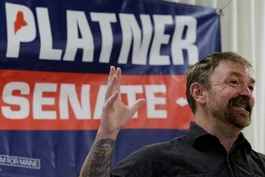
The most closely watched race was in Maine, where Democratic Senate candidate Graham Platner has faced intense scrutiny in a series of damaging headlines in recent weeks.
Meantime, voters in South Carolina, Nevada and North Dakota weighed in on key races for governor, Congress and other statewide offices, with results continuing to come in.
Lucky for us, our Lisa Desjardins joins us now with more.
So, Lisa, let's start in Maine with this pivotal U.S.
Senate race.
What did Democrats say about their choice to face Republican Susan Collins?
LISA DESJARDINS: What a race.
This was a statement from Maine Democrats that was against the establishment.
If you look at the results, you can see Graham Platner ended up with over 70 percent of the vote.
Now, his opponent, Governor Janet Mills, did get almost 20 percent, even though she suspended her campaign.
But look at the amount of votes there.
The number, the turnout there is much higher than 2020.
That was a COVID year, but it was also presidential.
So, essentially one of the conclusions here is that Platner did drive progressive turnout.
In fact, in some of the bluer towns, they ran out of ballots yesterday in Maine.
Now, he still does face, as you said, some calls about scandals.
He has a Nazi -- he had -- he acknowledged that there is a tattoo he's covered up that is a Nazi symbol, but he said he did not know exactly what it was.
In addition, there are -- there is a former girlfriend who says he intimidated her.
He has denied that.
He says he is a changed man.
And what we saw from Maine Democrats yesterday was embracing him and his unapologetically left agenda.
GEOFF BENNETT: And what did Maine suggest... GRAHAM PLATNER (D), Maine Senatorial Candidate: If we want to dismantle ICE, win back the Senate, check Donald Trump's power, and take back ours, as Maine goes, so goes the nation.
Together, we will defeat Susan Collins.
(CHEERING) LISA DESJARDINS: As for Collins, she's undaunted.
Her campaign said -- quote -- "Mainers aren't looking for bitter campaigns, grand promises are angry speeches riddled with lies.
They're looking for results."
This race, as you know, could determine the fate of the U.S.
Senate.
GEOFF BENNETT: Well, I was going to ask you that.
What do the results in Maine suggest about other political battles, including for the House?
LISA DESJARDINS: There's a big race regarding the House.
I want to show you where it is.
This is Maine's beautiful Second District.
Look at that.
This is rural Maine, the top of Maine.
In fact, this district is as large as the nation of Ireland.
Here is where we have Jared Golden, conservative, moderate Democrat right now, but he's retiring.
So this is a fight for Democrats.
Let's look at what happened in their primary yesterday.
That top name, State Senator Joe Baldacci, he's the more moderate of the candidates here who Washington Democrats want.
Beneath them, you see two other more liberal or progressives.
This is going to a run-off.
In Maine, that is done by ranked choice.
So we don't know exactly where that's going to end up.
Also, ranked choice will determine the candidates for Maine's governor.
GEOFF BENNETT: So let's shift our focus south to a red state, South Carolina.
What's the deal there?
LISA DESJARDINS: All right, some big headlines.
Let's look first at the governor's race there.
And let's look at who now will be moving on in the Republican race.
Lieutenant governor there on the left and the attorney general there on the right were the top two vote getters.
Also important, who didn't move on, two members of Congress, Nancy Mace, who placed fifth in that race, and Ralph Norman, who placed third in that race.
What's something else notable in South Carolina, the U.S.
Senate, Lindsey Graham was able to hold on and he has really gotten through one of his biggest Republican challenges in years.
He spent some $27 million just on this primary.
GEOFF BENNETT: Really?
Wow.
GEOFF BENNETT: Out West, we have got races in Nevada.
Bring us up to speed.
LISA DESJARDINS: Right.
OK, let's look at the Nevada governor's race, which could be a real test of the Trump economy and the mood of voters in the fall.
First of all, here's the Democrats.
They have selected attorney General Aaron Ford as their candidate.
He also won over a progressive candidate there in Nevada.
So he will take on Governor Joe Lombardo.
This could be a very big test for the Trump economy, as I said, housing shortages, large gas prices there in Nevada.
Finally, next door, the race for California governor is now finally set.
Xavier Becerra, the attorney general, which is a theme today, will be taking on as a Democrat the Republican Steve Hilton, former FOX News host, all of these races expected to be very expensive.
GEOFF BENNETT: Indeed.
Lisa Desjardins, our thanks to you, as always.
LISA DESJARDINS: You're welcome.
AMNA NAWAZ: A new report from the Pew Research Center says American politics are not as simple as red versus blue.
They're often messy, complicated, and hard to put into a box.
Pew surveyed more than 10,000 Americans and split the public into nine distinct groups along political and cultural values, among them, the faith first conservatives, the loyal liberals, and the tuned-out middle.
Despite a polarized political environment, the report finds just a minority of Americans are truly all in for either party.
Jocelyn Kiley is director of political research at the Pew Research Center.
She's one of the authors of this report.
She joins us now.
Welcome.
Thanks for being here.
JOCELYN KILEY, Director of Political Research, Pew Research Center: Thank you.
AMNA NAWAZ: So let's take some of these groups and turn here.
Among folks who are inclined to support Republicans, what is it that unites them and where are their sharpest disagreements?
JOCELYN KILEY: So we have a number of different groups that lean Republican.
Two, I would call the all-in groups.
We have a group called the no apologies right and the faith first conservatives.
And then we have what we call the unconventional right and the pragmatic and polite right.
They are united generally by a taste for a smaller government and also support for a strong military presence and concerns about things like crime and border security.
But what divides the groups on the right are some of the specifics on some of those issues.
So, for instance, those two all-in groups are really all in on the Trump administration's policies around deportations.
The other groups are not.
And that shows up in other areas as well, on some social issues, issues around -- things around race, also even what the role of government should be.
That group I mentioned called the pragmatic and polite right actually doesn't like a bigger government, but also does see a role for government in health care and so forth.
And we see similar dynamics on the left.
AMNA NAWAZ: Tell us more about that.
JOCELYN KILEY: Sure.
We have got our loyal liberals and our leftward progressives.
And then we have groups that we call our order and opportunity left and our left-out left.
And what we see is some traditional moderate and liberal divides on the Democratic side.
So those middle groups are still groups that want to see a secure border, but they're also quite economically liberal.
At the same time, our groups like leftward progressives and loyal liberals are much more liberal on economics, on immigration and so forth.
And we also see some divides when it comes to some social issues.
AMNA NAWAZ: So let's talk about -- more about the group in the middle, because, oftentimes, around political conversations, it's the loudest people, some of the more extreme voices that tend to dominate the conversation.
You identify this group called the tuned-out middle, who are somewhere in that middle there.
How big is that center group and what defines that?
JOCELYN KILEY: So, in general, we have -- all the groups in the middle tend to be less politically engaged, but the group we call the tuned-out middle is really very low political engagement.
Only about a third of them voted in 2024, and they pay attention to politics at a much lower level.
That's a group that's about one in 10 Americans.
But there are some of these other groups that are also in the middle, they may tilt to the left or tilt to the right, that also are not as engaged as some of the more ideological groups on both the left and the right.
AMNA NAWAZ: And for the groups that are sort of flanking the center, right, who tend to lean to the right or lean to the left, are some of those same issues like the immigration and economy issues, are those the things that divide them as well?
JOCELYN KILEY: They are to some degree.
So I will take the left as an example.
Our order and opportunity left, which is a moderate Democratic-leaning group, a little older, very racially and ethnically diverse, financially stressed, they really do want -- crime is a top concern.
They want a secure border.
And so they separate in some ways from the groups that are further to the left.
But there's a group also sort of in the middle on the left that we call the left-out left.
That group is fairly young.
But it's -- and it's not as conservative on those issues of immigration and crime.
So, even within the center-left, there are some divisions there, and we see a similar pattern on the right as well.
AMNA NAWAZ: It's a fascinating way to add nuance to this conversation, instead of just left and right and red and blue.
And you have done this before.
There was a similar sorting of ideologies and typologies five years ago you did.
Back then, you had groups like the stressed sideliners, the outsider left, the ambivalent right.
When you look at how the groupings have changed, what does it tell you about where our country has gone in the last few years?
JOCELYN KILEY: Yes, I mean, there's always -- there's a through line.
So some of the DNA is the same.
We do name the groups anew each time.
But one of the things I think that we're seeing, on the left, in particular, that group I mentioned called the leftward progressives, they are the most left.
They are about 7 percent of the public overall.
They're somewhat critical of the Democratic Party.
I wouldn't go so far as to say overly critical.
But that's a newish development.
There was maybe the hint of that in our last typology, but it's clearer now.
And on the right, I think some of what we have seen is a reshuffling that the coalition on the right -- we had a group last time around that we called the populist right.
It's not that group doesn't exist anymore, but it's been absorbed into these other groups in some way.
AMNA NAWAZ: So for candidates looking ahead to the midterms, they're going to have to appeal to some of those center groups, right, to build a winning coalition.
How do they do that?
JOCELYN KILEY: Midterms are really interesting because they're individual elections in 435 places.
So it's very hard, but I think one of the keys is that the people who are most active in the primaries tend to be on those ideological wings.
But in the general, you need to win over some of those groups that maybe aren't so well in on those issues.
And that's going to be a different thing both on the left and the right and honestly in different districts.
Do you need to -- on the left, you have got this group called the left-out left.
You need to motivate them.
They need to have a reason to vote, because they are younger.
They're less engaged in politics.
On the right, there's this group called the pragmatic and polite right.
They're quite -- they're the oldest group in the political typology.
And they do tend to turn out, but they are much more moderate in their position than a lot of other right individuals, so you will have to kind of persuade them that you are more moderate if you're trying to appeal to that group.
AMNA NAWAZ: All right, Jocelyn Kiley of the Pew Research Center, thank you so much.
JOCELYN KILEY: Thank you.
GEOFF BENNETT: The Ebola outbreak in the Democratic Republic of the Congo and Uganda is escalating quickly.
More than 120 people have died and health officials have reported over 630 cases.
Less than a month after the World Health Organization declared a global health emergency, experts fear the virus may already have spread far beyond the confirmed numbers.
And there are growing warnings that, without a stronger response, this outbreak could become one of the deadliest in Ebola's history.
Our William Brangham takes a closer look now -- William.
WILLIAM BRANGHAM: That's right, Geoff.
A combination of challenges is making this outbreak particularly tough to control.
It took months to recognize that the virus had already spread.
There's armed conflict in and around this outbreak.
And health workers are treated with suspicion.
And some have already been attacked.
The international response has also been criticized, with some experts arguing that America's dismantling of the U.S.
Agency for International Development, or USAID, has weakened the ability to respond to crises like this.
One of those voices is Jeremy Konyndyk.
He's the president of Refugees International.
But back in 2014, he ran USAID's foreign disaster assistance when Ebola broke out in West Africa.
Jeremy, great to have you back on that program.
JEREMY KONYNDYK, President, Refugees International: Thank you.
WILLIAM BRANGHAM: You saw the 2014 Ebola outbreak up close, when the U.S.
led the response with other international partners.
We saw another outbreak then in 2018.
Thousands of people died in both of those.
When you look at those cases, compared to what's happening now, how much worse does this seem to be?
JEREMY KONYNDYK: I see some really worrying parallels to what we had to -- what we were up against in 2014.
So that outbreak gained a lot of momentum once it began hitting urban areas.
Some of the most cases we have seen so far in this outbreak are in Bunia, which is a very large metropolitan area in Ituri province.
The number of cases is rising very rapidly.
Just from yesterday to today, they have added more than 30 new cases.
That's certainly an undercount, because they are not seeing all the transmission that's happening yet.
And that is -- that is right around the level of daily cases that we were seeing when the West Africa outbreak began to really spin out of control.
WILLIAM BRANGHAM: You wrote recently that some of the worst aspects of those previous epidemics are being echoed here.
What else -- what do you mean by that?
JEREMY KONYNDYK: Well, the momentum that it has, the fact that it's in urban centers.
We also -- we had no vaccine or other medical countermeasures at our disposal when we started that response in 2014, because Ebola had been such a rare and unusual disease.
This species of Ebola, the Bundibugyo species, likewise has no vaccine.
So they're kind of starting at that -- at that same point with a very limited toolkit for containing it medically.
WILLIAM BRANGHAM: You have argued that America is abdicating or has abdicated its responsibility in this regard.
How so?
JEREMY KONYNDYK: Yes.
Well, if you look back at the U.S.
response in 2014, we came in to support the work of the heroic Liberian and Sierra Leonean and Guinean health workers who were there on the front lines, but needed a lot of resources, a lot of backing, a lot of technical support, and not just from the U.S., really from the whole world.
And so President Obama went to the U.N.
General Assembly in September of 2014 to rally the world to mobilize a massive response, which then happened.
And, without that, it would have been very, very difficult to contain that outbreak.
There's nothing like that level of diplomatic ambition here.
There's a lot of disconnect between our government and the governments in the region.
And the capabilities that we had at USAID to mount that kind of a large, complex, whole-of-government response with DOD and CDC and all these others, that's simply gone.
WILLIAM BRANGHAM: So let's say you could be in the Ebola situation room, if such a thing exists today.
What would you like us to be doing that we are not doing today?
JEREMY KONYNDYK: Yes.
I think we need to -- we need to get American experts and global experts behind the -- behind the WHO and behind the Congolese Ministry of Health officials and the doctors in these clinics.
We need to be setting up Ebola treatment units, surging in protective equipment, conducting rapid research to try and develop the kind of vaccines and rapid tests and all of the other tools that will help to contain this, and putting a lot of emphasis into building trust, working with NGO partners, civil society partners, trusted voices in these communities to say, Ebola is real, here's how you can protect yourself.
WILLIAM BRANGHAM: And your sense is, that's not happening now?
JEREMY KONYNDYK: Not with the kind of scale and level of organization that would have been the case before.
One of the things that was really key in the West Africa outbreak were these were these were all countries where USAID had a long, established presence.
And so when we needed to go into a community and build trust there, we had partners there already.
WILLIAM BRANGHAM: Right, you knew them already.
And that's -- much of that has now been dismantled by DOGE and the aid cuts last year in Eastern Congo.
WILLIAM BRANGHAM: Jay Bhattacharya, the current director of the NIH and the acting director of the CDC, recently wrote in The Wall Street Journal, pushing back on this idea.
He said that America's response to Ebola is -- quote -- "scientifically justified, sensitive to the epidemiological facts, and specifically tailored to contain the outbreak."
What would you say to that?
JEREMY KONYNDYK: It's very vague, to be honest.
You can use those words.
What I want to know is, how many Ebola treatment units have we set up?
How many NGO partners are we funding?
What are the specifics of the response they're rolling out?
What are they doing to reengage with who?
Every past Ebola outbreak, particularly the large ones, was contained in part through a partnership between the U.S.
and WHO.
We're no longer a member of the WHO.
WILLIAM BRANGHAM: Separate from this issue, people might have seen that America had proposed setting up a Ebola isolation unit in Kenya to evacuate some people to put there.
The Kenyans have been resisting this.
There was certainly a great deal of protests we have seen breaking out on the streets.
What do you make of that effort to set up a separate facility in Kenya, rather than bring people here?
JEREMY KONYNDYK: It's important to understand, after the 2014 outbreak, the U.S.
invested for years in building up Ebola treatment facilities here in the United States that could treat Ebola or other novel pathogens.
We have a lot of capacity.
We have put a lot of time and effort into that.
The best place to get treated for Ebola, frankly, is in the United States, in these facilities.
And instead, we're saying to Kenya, this is such a disease that we do not dare bring it to the United States to these specially built facilities, but, hey, Kenya, it's fine for you to deal with this.
I can understand why that's not going over very well in Kenya.
WILLIAM BRANGHAM: Jeremy Konyndyk of Refugees International, always great to see you.
Thank you.
AMNA NAWAZ: As the nation nears her 250th anniversary next month, Judy Woodruff reports on the old questions about faith and the founding are once again being pushed to the forefront.
It's part of her series America at a Crossroads.
JUDY WOODRUFF: On a Sunday morning last month, the National Mall in Washington was converted into a place of worship, with Christian rock bands belting hallelujahs, the crowd demonstrating their devotion.
REV.
ROBERT JEFFRESS, Senior Pastor, First Baptist Church of Dallas: if being a Christian nationalist means loving Jesus Christ and loving America, count me in.
JUDY WOODRUFF: And a roster of speakers, most of them evangelical Christians, calling on Americans to consider the divine hand guiding our country through its history.
ERIC METAXAS, Author: Trusting the lord is how America came into being.
Washington knew it.
John Adams knew it.
They all knew it.
Even Benjamin Franklin knew it.
JUDY WOODRUFF: This was Rededicate 250, a day of prayer, praise and Thanksgiving organized by Freedom 250, the public-private partnership launched by the Trump White House to coordinate its anniversary celebrations.
DONALD TRUMP, President of the United States: Thus Solomon finished the house of the lord.
JUDY WOODRUFF: President Trump appeared in a previously recorded video to read a Bible passage.
DONALD TRUMP: Then will I hear from heaven and will forgive their sin and will heal their land.
SEN.
TIM SCOTT (R-SC): How many you love Jesus?
JUDY WOODRUFF: Many of his Cabinet officials and allies on the Hill appeared as well.
REP.
MIKE JOHNSON (R-LA): In this 250th year of American Indian independence, we hereby rededicate the United States of America as one nation under God.
J.D.
VANCE, Vice President of the United States: And the morality and religion that formed the American consciousness were decidedly Christian, founded upon the principles and the divinity of Jesus Christ.
WOMAN: I love our president.
I love his Cabinet.
JUDY WOODRUFF: I spoke with visitors who had traveled a long way to be there and who voiced little doubt about their Christian faith and our shared history.
Do you believe that the founders intended this to be a Christian nation?
WOMAN: Absolutely.
Our nation was founded on a Christian doctrine.
MAN: I believe our founding forefathers were Christian men who loved God, and that's why God made a covenant with this nation.
WOMAN: The country needs to return to the lord, to not just say that he is lord, but that he would genuinely be who dictates, who makes the decisions.
MAN: American is built on the Christian faith.
So right now, if we lose this faith, the whole country will collapse.
WOMAN: I love President Trump.
I love what he's doing.
I love this event.
It's a great honor to bring back Jesus into this nation, because America needs Jesus.
JUDY WOODRUFF: While clearly passionate, the people who gathered that day aren't alone.
A 2022 Pew Research survey found that 60 percent of Americans said they believed the founders originally intended for America to be a Christian nation, while 45 percent said they believed the country should be a Christian nation.
JOHN FEA, Senior Fellow in History, Lumen Center for the Study of Christianity and Culture: In some ways, this question, was America founded as a Christian nation, is really about the present, not the past.
JUDY WOODRUFF: Historian John Fea has been studying and writing about this question for a long time.
JOHN FEA: This is a really interesting Anglican church, because, here in Philadelphia, the Anglicans were split between patriotism and loyalism.
JUDY WOODRUFF: We met at Christ Church in Philadelphia, where some of those founding fathers, including George Washington and John Adams, attended services.
JOHN FEA: And this is where Washington and Martha, sometimes, their family, Martha's children, would come and worship.
JUDY WOODRUFF: This year, Fea is releasing a third edition of his book "In God We Trust: Was America Founded as a Christian Nation?"
It serves as a primer for readers interested in a historical assessment of the faith of the founders, the ways they thought about religion and public life, and how these questions have persisted throughout our history.
JOHN FEA: Every founder brought their own sort of religious beliefs to bear.
In some ways, talking about the founders' personal religious convictions is very unhelpful, because, sometimes, their religious convictions do not necessarily always translate in the way that they thought about the relationship between church and state.
JUDY WOODRUFF: For example, George Washington was an Anglican who reportedly abstained from taking communion after the revolution.
While he wrote often of Providence, Fea says he rarely mentioned Jesus Christ.
John Adams was a Unitarian, rejecting the notion of the trinity and was fiercely anti-Catholic.
Thomas Jefferson was a skeptic who created his own Bible that removed all references to miracles in the New Testament.
And though some lauded the role that religion could play in building a new country, they also believed there should be no established religion or religious test for federal office.
JOHN FEA: These were all radical ideas, new ideas in the Western world.
There had been no country that had been built upon these radical ideas of separating church and state, of religious liberty, of religious freedom.
And they saw all of the dangers, especially persecution of minorities, religious minorities.
And they were -- they wanted a nation built on religious liberty.
JUDY WOODRUFF: And how strongly do they feel about that?
JOHN FEA: Well, they -- every founding father would have embraced that idea.
There was really very little dissent at all on that question.
JUDY WOODRUFF: Even as the Freedom 250 event in Washington gained national attention last month, another group, Faith250, has been quietly meeting in churches, synagogues and mosques in Northern Virginia for the past year to discuss historical texts across lines of faith, the Declaration of Independence, "The New Colossus," the poem found on the Statue of Liberty, and the writing of Frederick Douglass.
Rabbi Michael Holzman founded Faith250.
RABBI MICHAEL HOLZMAN, Founder, Faith250: The idea of America, the narrative of America, the identity of being an American has always been aspirational, and it's always been connected to a vision for humanity, right?
And so we just turn to our different religious traditions to find the ways that we can talk about our vision for humanity and our vision for this country.
RIZWAN JAKA, Member, Faith250: Now, thank you all so much for getting to your tables.
JUDY WOODRUFF: Rizwan Jaka has been working within the interfaith community for decades in this area.
RIZWAN JAKA: As an American Muslim, it takes me back to where estimated one-third of enslaved Africans that were brought here were of Muslim descent.
And so the founding of this country also had Muslims that were a part of it in that journey, right, obviously coming from the foundings and how do we continue to create a more perfect union to live up to those ideals.
JUDY WOODRUFF: Miranda Hovemeyer is a humanist chaplain at American University.
She doesn't identify with any faith tradition, something she shares with more than a quarter of the country.
MIRANDA HOVEMEYER, Humanist Chaplain, American University: You need to be able as an American to follow your personal conscience.
And that is a really important founding principle of the United States, because we're acting out of -- in reaction to coming out of a place where church and state were not separate.
And a big value that we are trying to impart on this democracy going forward is that each human being has freedom of conscience to choose what is the right path for them in their own spiritual belief and development.
REP.
MIKE JOHNSON: Let your Holy Spirit descend upon this land.
JUDY WOODRUFF: John Fea says that this tension between claims of a Christian founding and a tradition of religious freedom and what they should mean for public life has shown up throughout our nation's past.
JOHN FEA: At every moment, whenever there is social demographic cultural change, there's always a backlash.
You could call it nativism, but there's always a backlash to try to preserve what the population believes America is all about.
JUDY WOODRUFF: Yet, as an evangelical Christian himself and a historian, he says one needn't choose between God and country.
JOHN FEA: But, for me, Christians believe that they're a part of the kingdom of God, an alternative kingdom, right, a kingdom that is -- transcends nations and these kinds of things.
So what does it matter whether or not we are -- America is founded as a Christian nation for a person of true Christian faith?
In other words, I do not tie my personal faith to American identity in any way, shape or form.
And I hope I'm willing to speak out against my country when it has to -- as a patriot and a Christian, speak out against my country when necessary, as well as praise it for the good things that it's done.
JUDY WOODRUFF: For the "PBS News Hour," I'm Judy Woodruff in Philadelphia.
GEOFF BENNETT: An update now to our lead story tonight, the United States' latest round of strikes on Iran.
The U.S.
launched strikes against multiple targets in what it said was a response to Iran's -- quote -- "unwarranted and continued aggression."
AMNA NAWAZ: Now Iran's top joint military command says it is closing the Strait of Hormuz completely and adds that any vessel that attempts to pass will be targeted, including oil tankers and commercial ships.
You can follow the latest updates to this developing story on our Web site.
That's PBS.org/NewsHour.
GEOFF BENNETT: Well, that is the "News Hour" for tonight.
I'm Geoff Bennett.
AMNA NAWAZ: And I'm Amna Nawaz.
On behalf of the entire "News Hour" team, thank you for joining us.
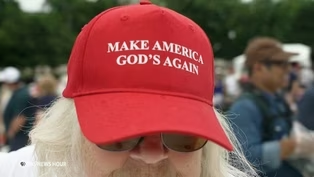
America's 250th renews questions on the founders and faith
Video has Closed Captions
America's 250th anniversary revives questions about religion and the founders (9m 52s)
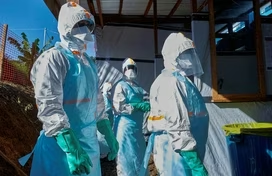
How the loss of USAID has weakened the fight against Ebola
Video has Closed Captions
How the loss of USAID has weakened the fight against Ebola (7m 2s)
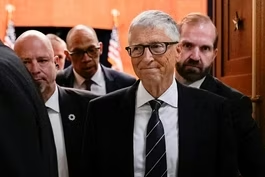
News Wrap: Gates says he made 'grave error' meeting Epstein
Video has Closed Captions
News Wrap: Bill Gates says he made 'grave error' by meeting with Epstein (6m 54s)
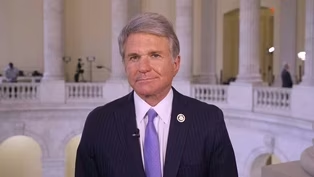
Pulte unqualified, but FISA must be extended, McCaul says
Video has Closed Captions
Pulte unqualified for DNI role, but FISA must be extended, Rep. McCaul says (6m 36s)
Spiking energy prices send inflation to 3-year high
Video has Closed Captions
As Iran war drags on, spiking energy prices send inflation to 3-year high (6m 41s)
Survey reveals political factions shaping the midterms
Video has Closed Captions
Survey reveals political and cultural factions shaping the midterms (6m 48s)
Takeaways from Tuesday’s primaries and the midterm landscape
Video has Closed Captions
Takeaways from Tuesday’s primaries and what they mean for November (4m 28s)

U.S. strikes Iran after missiles target American bases
Video has Closed Captions
U.S. launches new strikes in Iran after missiles target American bases (3m 51s)
Providing Support for PBS.org
Learn Moreabout PBS online sponsorship
- News and Public Affairs

Today's top journalists discuss Washington's current political events and public affairs.
 New Episode
- News and Public Affairs

FRONTLINE is investigative journalism that questions, explains and changes our world.



 New Episode


 New Episode
 New Episode
 New Episode
Support for PBS provided by:
Major corporate funding for the PBS News Hour is provided by BDO, BNSF, Consumer Cellular, American Cruise Lines, and Raymond James. Funding for the PBS NewsHour Weekend is provided by...