
How the loss of USAID has weakened the fight against Ebola
Clip: 6/10/2026 | 7m 2sVideo has Closed Captions
How the loss of USAID has weakened the fight against Ebola
The Ebola outbreak in the Democratic Republic of the Congo and Uganda is escalating quickly. There are growing warnings that, without a stronger response, this Ebola outbreak could become one of the deadliest. William Brangham takes a closer look with Jeremy Konyndyk, the president of Refugees International. In 2014, he ran USAID’s foreign disaster assistance when Ebola broke out in Africa.
Problems playing video? | Closed Captioning Feedback
Problems playing video? | Closed Captioning Feedback
Major corporate funding for the PBS News Hour is provided by BDO, BNSF, Consumer Cellular, American Cruise Lines, and Raymond James. Funding for the PBS NewsHour Weekend is provided by...
How the loss of USAID has weakened the fight against Ebola
Clip: 6/10/2026 | 7m 2sVideo has Closed Captions
The Ebola outbreak in the Democratic Republic of the Congo and Uganda is escalating quickly. There are growing warnings that, without a stronger response, this Ebola outbreak could become one of the deadliest. William Brangham takes a closer look with Jeremy Konyndyk, the president of Refugees International. In 2014, he ran USAID’s foreign disaster assistance when Ebola broke out in Africa.
Problems playing video? | Closed Captioning Feedback
Where to Watch PBS News Hour
PBS News Hour is available to stream on pbs.org and the PBS app.
Providing Support for PBS.org
Learn Moreabout PBS online sponsorshipGEOFF BENNETT: The Ebola outbreak in the Democratic Republic of the Congo and Uganda is escalating quickly.
More than 120 people have died and health officials have reported over 630 cases.
Less than a month after the World Health Organization declared a global health emergency, experts fear the virus may already have spread far beyond the confirmed numbers.
And there are growing warnings that, without a stronger response, this outbreak could become one of the deadliest in Ebola's history.
Our William Brangham takes a closer look now -- William.
WILLIAM BRANGHAM: That's right, Geoff.
A combination of challenges is making this outbreak particularly tough to control.
It took months to recognize that the virus had already spread.
There's armed conflict in and around this outbreak.
And health workers are treated with suspicion.
And some have already been attacked.
The international response has also been criticized, with some experts arguing that America's dismantling of the U.S.
Agency for International Development, or USAID, has weakened the ability to respond to crises like this.
One of those voices is Jeremy Konyndyk.
He's the president of Refugees International.
But back in 2014, he ran USAID's foreign disaster assistance when Ebola broke out in West Africa.
Jeremy, great to have you back on that program.
JEREMY KONYNDYK, President, Refugees International: Thank you.
WILLIAM BRANGHAM: You saw the 2014 Ebola outbreak up close, when the U.S.
led the response with other international partners.
We saw another outbreak then in 2018.
Thousands of people died in both of those.
When you look at those cases, compared to what's happening now, how much worse does this seem to be?
JEREMY KONYNDYK: I see some really worrying parallels to what we had to -- what we were up against in 2014.
So that outbreak gained a lot of momentum once it began hitting urban areas.
Some of the most cases we have seen so far in this outbreak are in Bunia, which is a very large metropolitan area in Ituri province.
The number of cases is rising very rapidly.
Just from yesterday to today, they have added more than 30 new cases.
That's certainly an undercount, because they are not seeing all the transmission that's happening yet.
And that is -- that is right around the level of daily cases that we were seeing when the West Africa outbreak began to really spin out of control.
WILLIAM BRANGHAM: You wrote recently that some of the worst aspects of those previous epidemics are being echoed here.
What else -- what do you mean by that?
JEREMY KONYNDYK: Well, the momentum that it has, the fact that it's in urban centers.
We also -- we had no vaccine or other medical countermeasures at our disposal when we started that response in 2014, because Ebola had been such a rare and unusual disease.
This species of Ebola, the Bundibugyo species, likewise has no vaccine.
So they're kind of starting at that -- at that same point with a very limited toolkit for containing it medically.
WILLIAM BRANGHAM: You have argued that America is abdicating or has abdicated its responsibility in this regard.
How so?
JEREMY KONYNDYK: Yes.
Well, if you look back at the U.S.
response in 2014, we came in to support the work of the heroic Liberian and Sierra Leonean and Guinean health workers who were there on the front lines, but needed a lot of resources, a lot of backing, a lot of technical support, and not just from the U.S., really from the whole world.
And so President Obama went to the U.N.
General Assembly in September of 2014 to rally the world to mobilize a massive response, which then happened.
And, without that, it would have been very, very difficult to contain that outbreak.
There's nothing like that level of diplomatic ambition here.
There's a lot of disconnect between our government and the governments in the region.
And the capabilities that we had at USAID to mount that kind of a large, complex, whole-of-government response with DOD and CDC and all these others, that's simply gone.
WILLIAM BRANGHAM: So let's say you could be in the Ebola situation room, if such a thing exists today.
What would you like us to be doing that we are not doing today?
JEREMY KONYNDYK: Yes.
I think we need to -- we need to get American experts and global experts behind the -- behind the WHO and behind the Congolese Ministry of Health officials and the doctors in these clinics.
We need to be setting up Ebola treatment units, surging in protective equipment, conducting rapid research to try and develop the kind of vaccines and rapid tests and all of the other tools that will help to contain this, and putting a lot of emphasis into building trust, working with NGO partners, civil society partners, trusted voices in these communities to say, Ebola is real, here's how you can protect yourself.
WILLIAM BRANGHAM: And your sense is, that's not happening now?
JEREMY KONYNDYK: Not with the kind of scale and level of organization that would have been the case before.
One of the things that was really key in the West Africa outbreak were these were these were all countries where USAID had a long, established presence.
And so when we needed to go into a community and build trust there, we had partners there already.
WILLIAM BRANGHAM: Right, you knew them already.
JEREMY KONYNDYK: Yes.
And that's -- much of that has now been dismantled by DOGE and the aid cuts last year in Eastern Congo.
WILLIAM BRANGHAM: Jay Bhattacharya, the current director of the NIH and the acting director of the CDC, recently wrote in The Wall Street Journal, pushing back on this idea.
He said that America's response to Ebola is -- quote -- "scientifically justified, sensitive to the epidemiological facts, and specifically tailored to contain the outbreak."
What would you say to that?
JEREMY KONYNDYK: It's very vague, to be honest.
You can use those words.
What I want to know is, how many Ebola treatment units have we set up?
How many NGO partners are we funding?
What are the specifics of the response they're rolling out?
What are they doing to reengage with who?
Every past Ebola outbreak, particularly the large ones, was contained in part through a partnership between the U.S.
and WHO.
We're no longer a member of the WHO.
WILLIAM BRANGHAM: Separate from this issue, people might have seen that America had proposed setting up a Ebola isolation unit in Kenya to evacuate some people to put there.
The Kenyans have been resisting this.
There was certainly a great deal of protests we have seen breaking out on the streets.
What do you make of that effort to set up a separate facility in Kenya, rather than bring people here?
JEREMY KONYNDYK: It's important to understand, after the 2014 outbreak, the U.S.
invested for years in building up Ebola treatment facilities here in the United States that could treat Ebola or other novel pathogens.
We have a lot of capacity.
We have put a lot of time and effort into that.
The best place to get treated for Ebola, frankly, is in the United States, in these facilities.
And instead, we're saying to Kenya, this is such a disease that we do not dare bring it to the United States to these specially built facilities, but, hey, Kenya, it's fine for you to deal with this.
I can understand why that's not going over very well in Kenya.
WILLIAM BRANGHAM: Jeremy Konyndyk of Refugees International, always great to see you.
Thank you.

America's 250th renews questions on the founders and faith
Video has Closed Captions
America's 250th anniversary revives questions about religion and the founders (9m 52s)
News Wrap: Gates says he made 'grave error' meeting Epstein
Video has Closed Captions
News Wrap: Bill Gates says he made 'grave error' by meeting with Epstein (6m 54s)
Pulte unqualified, but FISA must be extended, McCaul says
Video has Closed Captions
Pulte unqualified for DNI role, but FISA must be extended, Rep. McCaul says (6m 36s)
Spiking energy prices send inflation to 3-year high
Video has Closed Captions
As Iran war drags on, spiking energy prices send inflation to 3-year high (6m 41s)
Survey reveals political factions shaping the midterms
Video has Closed Captions
Survey reveals political and cultural factions shaping the midterms (6m 48s)
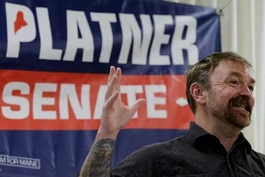
Takeaways from Tuesday’s primaries and the midterm landscape
Video has Closed Captions
Takeaways from Tuesday’s primaries and what they mean for November (4m 28s)
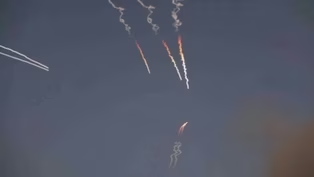
U.S. strikes Iran after missiles target American bases
Video has Closed Captions
U.S. launches new strikes in Iran after missiles target American bases (3m 51s)
Providing Support for PBS.org
Learn Moreabout PBS online sponsorship
- News and Public Affairs

Today's top journalists discuss Washington's current political events and public affairs.
 New Episode
- News and Public Affairs

FRONTLINE is investigative journalism that questions, explains and changes our world.



 New Episode



 New Episode
 New Episode
 New Episode
Support for PBS provided by:
Major corporate funding for the PBS News Hour is provided by BDO, BNSF, Consumer Cellular, American Cruise Lines, and Raymond James. Funding for the PBS NewsHour Weekend is provided by...