
July 2, 2026 - PBS News Hour full episode
7/2/2026 | 57m 46sVideo has Closed Captions
July 2, 2026 - PBS News Hour full episode
July 2, 2026 - PBS News Hour full episode
Problems playing video? | Closed Captioning Feedback
Problems playing video? | Closed Captioning Feedback
Major corporate funding for the PBS News Hour is provided by BDO, BNSF, Consumer Cellular, American Cruise Lines, and Raymond James. Funding for the PBS NewsHour Weekend is provided by...
July 2, 2026 - PBS News Hour full episode
7/2/2026 | 57m 46sVideo has Closed Captions
July 2, 2026 - PBS News Hour full episode
Problems playing video? | Closed Captioning Feedback
Where to Watch PBS News Hour
PBS News Hour is available to stream on pbs.org and the PBS app.
Providing Support for PBS.org
Learn Moreabout PBS online sponsorshipGEOFF BENNETT: Good evening.
I'm Geoff Bennett.
Amna Nawaz is away.
On the "NewsHour" tonight: Russia hammers Ukraine's capital with a massive attack in retaliation for strikes against its oil infrastructure.
A stunning rescue.
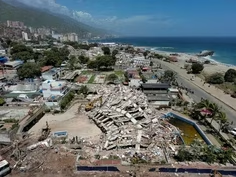
A man is pulled from the rubble eight days after the Venezuelan earthquakes.
We speak with humanitarian Jose Andres about efforts to find and support the survivors.
JOSE ANDRES, Founder, World Central Kitchen: They will not give up until they are 100 percent certain that nobody is alive under the rubble.
GEOFF BENNETT: And 250 years ago, the Second Continental Congress declared independence from Britain.
Judy Woodruff looks back on America's history from the place where it all started.
JUDY WOODRUFF: Here we are, Philadelphia, and we are standing in front of Independence Hall.
I don't know about you, but I have goose bumps.
It's so cool.
It's so cool.
(BREAK) GEOFF BENNETT: Welcome to the "News Hour."
Ukrainian President Volodymyr Zelenskyy today vowed a forceful response after an overnight barrage of Russian missiles and drones killed at least 25 people in Kyiv and wounded many more.
Ukraine has also intensified its own campaign, launching waves of drones deep inside Russia and striking military sites and oil refineries.
Those attacks have contributed to fuel shortages in parts of Russia.
Yet, despite the escalating strikes on both sides, the front lines have changed little nearly 4.5 years into this war.
Stephanie Sy reports.
STEPHANIE SY: In Kyiv today: the aftermath of another night of Russian aggression.
Workers dig through the charred husks of what were once homes carrying out bodies.
Elsewhere, rescue workers rush to recover the living, pinned down in pain by the rubble, the latest devastation a lot even for the battle-worn emergency workers.
Neighbors gathered with forlorn faces, the flurry of Russian attacks that occurred overnight among the heaviest and deadliest on the Capitol since the war began, lighting up the early morning sky and carving craters outside apartment blocks.
NADIA, Kyiv, Ukraine, Resident (through translator): We ran inside and then heard the explosion.
We were able to take cover, but everything is destroyed.
I don't even know what to say.
People are still trapped under the rubble.
STEPHANIE SY: Ukrainian President Zelenskyy today visited the sites, urging an end to the war and calling out U.S.
negotiators.
VOLODYMYR ZELENSKYY, Ukrainian President: They have to come to see, to understand and to explain to the president and then to answer in a very polite manner, how Steve Witkoff can, to Russia, what they have to do.
Quickly, sit, negotiate, stop this war.
STEPHANIE SY: The Kremlin spokesperson today was unmoved.
DMITRY PESKOV, Spokesman for Vladimir Putin (through translator): Russia will continue to intensify pressure on the Kyiv regime in order to achieve the goals it has set.
STEPHANIE SY: The attacks in Kyiv come a few days after Ukraine launched its own strikes on Russia, Russian citizens now subjected to the terror of drone warfare in their own territories.
A Ukrainian drone Tuesday struck an apartment building outside Moscow, injuring four and killing a 6-month-old baby, the awful consequence of a Ukrainian attempt to turn tables in the 4-year-long war that's killed tens of thousands of Ukrainian civilians.
Its long-range drones have hit military installations and oil refineries across the nation.
Ukraine has struck 24 Russian oil refineries over the past month, and Russians are feeling the consequences.
Lines for gas stretch for hours, with 55 of Russia's 83 federal districts reporting severe fuel shortages, the gas crunches fueling calls for an end to the war.
WOMAN (through translator): I don't know what I can do, of course, I'm not a politician, but I think the end of the war, peace.
QUESTION (through translator): This is the only way to stop this deficit from developing?
WOMAN (through translator): Of course, to come to some kind of agreement somehow.
I don't know.
This has been going on for a while, after all.
STEPHANIE SY: On Sunday, Russian President Vladimir Putin acknowledged the fuel shortage for the first time.
VLADIMIR PUTIN, Russian President (through translator): You are well aware that problems persist for both drivers and businesses.
Lines at gas stations, unfortunately, also remain.
STEPHANIE SY: But Russia's mounting losses haven't just been economic.
Analysts estimate there have been well over one million Russian military casualties, including hundreds of thousands of dead.
And with military recruitment down 20 percent from this time last year, Russia, for the first time, is losing more soldiers than it can recruit, according to a February report by Bloomberg.
So deadly are sections of the front line that pro-Russian military bloggers have been circulating a shocking estimate.
"The average life expectancy of a soldier on the front line during an assault is 20 to 35 minutes," one post reads.
It is not possible to verify that with public data.
At the front, over the past three months, Russia has lost 100 square miles of territory to Ukraine.
Kremlin spokesperson Peskov said Monday that Russia's demands remain the same.
DMITRY PESKOV (through translator): Our position is well-known.
In fact, our position has not changed.
STEPHANIE SY: Russia wants Ukraine to cede four regions, cap its military and abandon its bid for NATO.
The demands insult Ukraine's sovereignty, so the war grinds on.
In its latest air assault, Russia launched nearly 500 drones and 74 missiles.
The terror in Kyiv lasted 11th hours.
Ukraine is pleading with allies for more air defenses to defend its capital and its people.
For the "PBS News Hour," I'm Stephanie Sy.
GEOFF BENNETT: We start today's other headlines in Washington, D.C., where a former U.S.
Olympian faces a felony charge for allegedly vandalizing the newly refurbished Reflecting Pool.
Former canoe racer David Hearn has denied wrongdoing, saying he reached into the water after noticing a partially detached piece of the pool's sealant.
At a press conference today, U.S.
attorney Jeanine Pirro called Hearn's actions deliberate.
JEANINE PIRRO, U.S.
Attorney for the District of Columbia: They are an affront to the dignity of our shared history, and we will not allow our sacred monuments to be roped off, defaced, or diminished or in any way impacted by disgruntled individuals.
GEOFF BENNETT: President Trump has blamed vandals for the pool's problems following a quick and costly makeover.
In a statement, Hearn's lawyers called the charges outrageous.
As we head into the July 4 holiday weekend, nearly 200 million Americans remain under heat warnings ahead of what's expected to be for many one of the hottest Independence Day holiday is on record.
In Atlanta, where the heat and humidity made it feel around 106 degrees, cooling stations brought much-needed relief.
On the sweltering streets of Manhattan, fans were out in full force, fighting against temperatures that felt as high as 110 degrees.
And in the nation's capital... WOMAN: Yes, so I was in the house all day.
This is terrible.
This is too hot for me right now.
GEOFF BENNETT: For many, fountains offered an oasis from the 111-degree heat index.
And while the East endures the heat, the West battles red flag warnings and wildfires.
In Colorado, the Aspen Acres Fire has nearly doubled in size in just the span of a day, and, at last, check was completely uncontained.
Several communities there have been ordered to evacuate.
A new report shows that hiring slowed significantly in the U.S.
last month as businesses remain uneasy about the state of the economy.
The Labor Department says employers added just 57,000 jobs in June, less than half of May's total.
The unemployment rate declined slightly to 4.2 percent.
That comes as 720,000 people left the labor force altogether, pushing the participation rate to a five-year low.
At the White House today, President Trump's director of the National Economic Council brushed off the weaker-than-expected numbers.
KEVIN HASSETT, Director, National Economic Council: I think that if you smooth through the ups and downs over the last three or four months, we're on a really steep upward trajectory.
GEOFF BENNETT: Some economists say the slowdown was a delayed response to the war in Iran, which drove up gasoline prices, fueling broader inflation.
The Vatican has excommunicated a group of ultra-traditional Catholics after they defied the pope and consecrated four new bishops.
The Society of Saint Pius X held the ceremony yesterday in Switzerland despite an order from Pope Leo to desist.
Today's sanctions include a ban on officiating marriages and hearing confessions, and the Vatican warned that all formal followers of the society -- quote -- "are to be considered schismatic and excommunicated."
It's Pope Leo's biggest internal crisis since taking on the role last year.
The group has opposed modern reforms going back decades, but insisted today that they remain part of the church.
And, as one member put it, "The pope remains our pope."
In the U.K.
Prime Minister Keir Starmer issued a formal apology today for the British government's role in separating unmarried mothers from their children in the decades following World War II.
KEIR STARMER, British Prime Minister: The shame was never yours.
The shame is ours.
And I say that on behalf of the whole country.
GEOFF BENNETT: Along with an apology, Starmer also said affected mothers and children would be provided with better access to adoption records and mental health support.
Between the 1940s and 1970s, an estimated 185,000 babies of unmarried mothers were adopted in England and Wales.
Advocates say the mothers were often pressured into giving up their children.
Starmer called the practice a stain on the country's history.
KEIR STARMER: These harms were compounded by the actions and failures of the state.
The state bears responsibility for the systems it funded and legitimized, which enabled these practices to occur.
GEOFF BENNETT: Earlier in the day, Starmer met with and personally apologized to a group of advocates.
Today's actions follow similar apologies from governments in the Netherlands, Australia, and Ireland, among others.
Well, a day after scaling the Empire State Building and getting engaged, two daredevil climbers were charged with multiple felonies today, including burglary and reckless endangerment.
The Russian couple told reporters as they left court that they -- quote -- "believe in love."
They were released without bail.
ANGELA NIKOLAU, Defendant: The fear never goes away.
You just get better at facing it.
GEOFF BENNETT: The pair's previous climbing exploits were the focus of the 2024 Netflix documentary "Skywalkers: A Love Story" about their illegal climbs and their then-budding romance.
The NYPD is now reviewing surveillance from the Empire State Building.
They believe the pair entered through a locked maintenance hatch on the observation deck of the 102nd floor.
On Wall Street today, stocks ended mixed ahead of the July 4 holiday weekend.
The Dow Jones industrial average jumped nearly 600 points to close at a new all-time high, but the Nasdaq lost ground, giving back around 200 points.
The S&P 500 ended virtually unchanged.
Still to come on the "News Hour": how a host of legal challenges are complicating the upcoming midterm elections; journalists Maggie Haberman and Jonathan Swan discuss their new book on Donald Trump's unconstrained second term; and a hard-fought win in the World Cup knockout round raises hopes for the U.S.
men's team.
More than a week after Venezuela's devastating earthquakes, today, there was a rare moment of hope.
A security guard was pulled alive from the rubble after eight days trapped underground following a painstaking multinational rescue effort.
But, for most, the crisis is only deepening.
The official death toll has climbed to nearly 2,300, with thousands more injured and tens of thousands still unaccounted for.
As rescue efforts continue, overwhelmed morgues, growing humanitarian needs, and mounting frustration over the pace of the response are compounding the crisis.
Amid that effort is chef Jose Andres, whose organization, World Central Kitchen, is on the ground delivering meals to survivors and first responders.
Chef Andres, welcome to the "News Hour."
You have responded to disasters from Haiti and Puerto Rico, from Ukraine to Gaza.
No two disasters are alike.
What are you seeing on the ground there in Venezuela that the cameras simply can't capture?
What's striking you the most?
JOSE ANDRES, Founder, World Central Kitchen: What is striking me the most right now is, with a window of maybe two, three days, where all the amazing search-and-rescue teams are working every single minute of the day, 24 hours a day, to try to find people that they may be alive under the rubble.
Today, I was able -- we were able to be delivering food in many different places.
And, today, at least, I was in five places where the teams will not give up, because they have hope that somebody may be alive under the rubble.
And this is only five buildings, I know.
I'm sure there's a few others.
So what is amazing is that these people don't give up.
Even when someone already one or two days ago said, maybe nobody's here, when you have dogs that they specialize in knowing if there's life, people alive, when those dogs bark and when you send not only one dog, but two, three, four other dogs from different teams, in that moment, everybody thinks it's worth to keep working, even is going to be hard work.
And this is what is amazing.
But it doesn't surprise me, because many of the teams, search-and-rescue, are good at what they do, that they will not give up until they are 100 percent certain that nobody is alive under the rubble.
GEOFF BENNETT: When we have spoken in the past, you have said that a hot meal is more than just about the food.
It offers people hope.
It offers people a sense of dignity.
What are you and your teams hearing from the families that you're serving there?
What are they telling you?
What kind of stories are they sharing?
JOSE ANDRES: The people of Venezuela are the most thankful people in the history.
Unfortunately, I have been here a few times because of emergencies during COVID, before, when was one of the biggest refugee crises.
We need to remember that Venezuela is one of the groups in the world that has the most people outside the country, all around Latin America and the United States.
And so the people cannot be obviously more thankful.
Obviously, those families that they are not moving from the building, that they are hoping and praying that they will find their families alive, but, if not, they will not move until they don't recuperate the body of their loved ones.
Today, unfortunately, I was in a few buildings in the moment that they rescue the body of some family members.
And that's probably one of the most powerful moments that you see in an earthquake.
It's kind of a bittersweet moment, because the people knew that already they were not alive.
But it's kind of some joy to know that they are not going to be doing a mass in the rubble of the building, but that they're going to be able for one last time to say goodbye and to know that they're going to be bringing them home to pay respects one last time.
Right now, the world's attention is focused on the rescue effort, but you have been through enough of these disasters to know that the next phase can be in some ways more dangerous.
What are you worried the most about in the coming days and weeks?
JOSE ANDRES: Well, listen, in some of these situations, you will always hear about cholera.
But I think, overall, the situation is hard.
But people know that, if you have clean water and you keep people with clean water in clean kitchens, you minimize any risk of that.
We could see it yesterday.
It's a lot of insects.
It's a lot of mosquitoes.
That's obviously a problem.
But the biggest question is all the people that lost their homes.
Some of them they have ways and means, but many of them don't.
What is going to happen with them?
Where is going to be home for them next in these situations, beyond even earthquakes?
That's obviously the biggest one.
World Central Kitchen, we're getting ready for what is going to be already this phase two.
As government and other agencies, U.N.
and others are setting up the camps, most important is to make sure that we are able to be taking care of the needs of all (AUDIO GAP) GEOFF BENNETT: Chef Jose Andres of World Central Kitchen speaking to us tonight from La Guaira, Venezuela, thanks again for your time this evening, sir.
We appreciate it.
JOSE ANDRES: Thank you, Geoff.
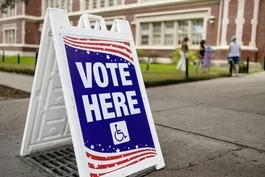
GEOFF BENNETT: As President Trump pushes for a greater federal role in election administration ahead of the midterms, dozens of legal challenges are moving through the courts.
And their outcome could shape this fall's elections.
Our Liz Landers has more on the constitutional questions now before judges.
LIZ LANDERS: In the last few days, there have been a number of judicial rulings related to election cases across the country.
On Wednesday, a judge in Washington blocked the U.S.
Postal Service from changing its delivery of mail ballots.
This came after the president signed an executive order requiring states to provide lists of eligible voters that intend to vote by mail.
The judge this week said that order was not legal based on a 2021 agreement the agency struck with the NAACP.
I'm joined now by Ben Ginsberg.
He spent decades working as a Republican election lawyer, including on the landmark Bush v. Gore dispute after the 2000 election.
Ben, thank you for joining "News Hour."
BEN GINSBERG, Republican Election Attorney: Thank you, Liz.
Nice to be here.
LIZ LANDERS: Let's start with that mail vote ruling yesterday about the president's executive order that he signed in March, which that judge determined is not legal.
The White House and the president keep losing when these election executive orders are challenged.
How much authority does the president and executive branch have over election administration?
BEN GINSBERG: Well, according to the courts, not as much as they think they have.
The Constitution of the United States is very clear that the time, place, and manner, in other words, how to conduct an election, is up to the states.
And there's a provision in the Constitution that gives Congress the ability to do nationwide rules in some cases and rules for their own federal elections in others.
Nowhere in the Constitution is there any mention of executive authority, the president's authority.
And that's why he's losing so many of these cases in so many areas.
LIZ LANDERS: It seems possible that the Postal Service could try to skirt this in some way, based on statements that the postmaster general has made in recent weeks.
What's your advice to voters who prefer to cast their ballot by mail?
BEN GINSBERG: I think that voters can rest assured that Postal Service overreach is not going to be tolerated by the courts.
The Postal Service is currently engaged in a rulemaking process, which they think will give them the authority to go ahead with what the president wants on mail-in ballots.
However, that's been enjoyed by a court.
The rulemaking itself is, I think, on really weak grounds.
And once the rulemaking is finalized, it will be taken to court.
So I don't think there's much of a chance of this being able to be done.
Having said that, I think there will be an increased responsibility on voters who want to vote by mail to get their ballots in the mail early.
LIZ LANDERS: Turning to the Supreme Court, a majority of justices ruled this week that states must be allowed to receive and count ballots in an election up to five days after the actual Election Day.
Does this ruling settle the mail ballot deadline question for 2026?
BEN GINSBERG: Yes, I think that it does.
I think that there is little room for any sort of challenge against that as a legal matter in court.
The decision you're referring to, the Watson decision, also contains some interesting language about who has authority over elections.
And like a lot of other lower courts have been saying regarding the cases brought by the administration, the president does not have authority over elections.
So the Supreme Court went and described that states do and Congress can, but it was silent about any authority for the president to determine policy on elections.
LIZ LANDERS: For months now, the attorney general has been asking individual states to turn over their voter rolls.
Many have refused and have challenged this in court.
On Monday, the Department of Justice lost their 11th such case when a judge in New Hampshire struck this down, saying that the Justice Department did not prove why it needed that voter information.
As a Republican election lawyer yourself, what do you think that the Department of Justice is getting wrong here legally?
BEN GINSBERG: I think the Department of Justice is losing all those cases because their client, the president of the United States, is insisting on the Justice Department bringing those cases.
But the authorities we have been talking about before simply don't extend to this sort of attempt to get massive voter lists.
Not only is there a question about the authority of the president to ask for this information, in fact, these voter rolls include very sensitive private information about people, your most sensitive information, like Social Security numbers and date of birth.
And in this era of identity fraud and theft, states are particularly cognizant of needing to enforce the privacy rights of their citizens, so are opposing these attempts.
LIZ LANDERS: And what kinds of post-election lawsuits are you anticipating from both the Republicans and Trump world and also Democrats here now that we're seeing a lot of this litigation and the groundwork for this being laid right now?
BEN GINSBERG: I think that, if the elections are close, you will see a lot of attempts to challenge elections.
Remember that, in 2020, supporters of President Trump brought some 64 cases, alleging all manner of fraud and irregularities.
And, as a factual matter, they were unsuccessful in 63 of those 64 cases, and the 64th was a fairly minor matter.
So I think you can anticipate lots of suits if one side or another doesn't like the outcome.
But those suits are rarely successful, unless they can produce hard evidence of some sort of irregularity or fraud.
LIZ LANDERS: Ben Ginsberg, thank you for your expertise.
BEN GINSBERG: Thank you, Liz.
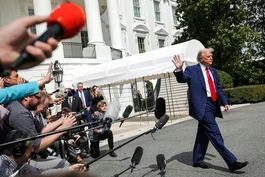
GEOFF BENNETT: For one of the most revealing looks to date inside the second Trump White House, we turn now to a new book by veteran reporters, Maggie Haberman and Jonathan Swan.
It's called "Regime Change: Inside the Imperial Presidency of Donald Trump."
And Amna Nawaz spoke recently with its authors.
She started by asking Haberman why those close to the president were willing to speak with her and Swan and what those sources wanted readers to understand.
MAGGIE HABERMAN, Co-Author, "Regime Change: Inside the Imperial Presidency of Donald Trump": So I can't speak to what people's motives are, but I will say that a number of people took risks to try to help us get reporting accurate, and we want to be very careful here.
I think part of why this book is resonating with people, and we have been very, very gratified by the interest in it, is because there has been so little inside-the-room reporting in this administration.
It is really hard to get the level of detail that we got.
It is really hard to get inside these rooms.
It is really hard to check and recheck and make sure that you're confident in the scenes that we are describing.
And it is one of the many ways in which this term is just unrecognizable to Trump's first term.
And for in term one, Jonathan has this line about walking around with a slop bucket to people receiving their leaks here and there.
MAGGIE HABERMAN: Because it was just constant in fighting.
Everybody was at each other's throats.
Trump was new to Washington, didn't know most of his government.
This is a very different White House.
It is a very different administration.
Loyalty is the premier characteristic that they looked for in the transition.
And we tried to show exactly how this government is being run.
AMNA NAWAZ: And, Jonathan, the use of the word regime in this case, that's one we usually use when we're talking about foreign governments, one I have used a lot as a foreign correspondent previously.
You talk about the remaking of the presidency under this presidency of Donald Trump.
Tell us about that.
JONATHAN SWAN, Co-Author, "Regime Change: Inside the Imperial Presidency of Donald Trump": So we actually came up with the title for the book, regime change before Trump launched his regime change operation in Venezuela, before they started what looked like a regime change war in Iran.
Didn't turn out to be.
It occurred to Maggie and I a few months into covering this second term that, A, it was, as Maggie said, unrecognizable from the first term.
But, B, it was also unrecognizable from any American presidency in our lifetime and, in some respects, from any American presidency full stop in the way that he was using power.
So it occurred to us that we were covering a form of regime change in this country, in the United States.
AMNA NAWAZ: Maggie, you talk about the difference between the first Trump presidency and the second.
And I recall in the first all the conversations about the adults in the room, some of the moderating forces who would sometimes restrain the president's impulses.
This time, you document and report times in which there are people in the room who seem to be pushing him even further, like trying to get him to suspend habeas corpus, for example.
What's happening in the room now?
Who are the moderating forces, if there are any?
MAGGIE HABERMAN: It's a totally different presidency.
And one thing we wanted to show in this book is how this is a government that is basically being run by a half-a-dozen people who are in these meetings with Trump, give or take a few, depending on the subject matter.
But it is a tiny, tiny group of people who are all around Trump.
And if you are at agencies across this government, if you are at the State Department, if you are at the Pentagon, if you are at the CIA, and a number of others, if you are not in the room, you often have no idea what's going on because the decisions are being made that quickly.
JONATHAN SWAN: We both felt pretty strongly that last year we were living through the most consequential year of an American presidency in our lifetime.
And we were trying to capture that history while memories were fresh.
And to help people understand, people who are curious about how their country is being run, the purpose of this book is to help pull back the curtain a little bit and to help people understand how decisions are being made.
AMNA NAWAZ: There is the Epstein issue, Maggie, which continues to bedevil this White House, and you document how they use the Situation Room, which has been used in President Obama's term to monitor the bin Laden raid, for example, that is where his top team gathers to try to figure out what to do about this.
What does that say to you about how they're looking at this issue even now?
MAGGIE HABERMAN: So, a couple of things.
It has been just working backwards.
Among the documents that we got our hands on in reporting this book were secret polling memos within the Trump team, political team.
They get circulated to about a half-dozen to a dozen people.
What they found in those focus groups was that voters were proactively talking about Epstein.
So it has broken through to a degree that this administration absolutely never, or at least most members of this administration didn't think that it would.
But it also was the moment, and we tried to lay this out in the book, when you could start to see Trump losing political altitude with his own base and credibility with his own base last summer, because he wanted nothing to do with Epstein.
There were a number of people in the MAGA movement who had been very vocal about releasing all files related to Jeffrey Epstein.
The administration had a president who just wanted the issue to go away.
And they found themselves in a series of meetings in the Situation Room.
Now, as you say, this is a place where national security decisions, including in this administration, get made.
But, here, it turned into a crisis comms center for one specific issue, which was get us out from under this matter that was beginning to consume them.
And we got deep inside some of these meetings.
The president was not part of them, but some members of these meetings would later say that it was just surreal to be discussing some aspects of the Epstein files in this room.
And it paralyzed that administration almost as much as the special counsel investigation into Russia did years earlier in terms one, and we tried to lay that out.
AMNA NAWAZ: Jonathan, what should we take away about the role of Vice President Vance so far?
Because you tell the story in the book about how he does challenge the group on how they should approach the Epstein issue.
He speaks out against the potential for war against Iran, but says he will support the president.
You also write: "He knew the next four years came down to one thing, securing Trump's blessing as his successor."
What should we take away from the book about him?
JONATHAN SWAN: Well, it's a nuanced picture, right?
It's not sort of black and white.
What's true about Vance is, he is ideologically more consistent than Trump and feels more passionately about the MAGA issues than Donald Trump himself does.
He's far more anti-interventionist than Donald Trump.
He was the only one in our reporting that in the room with Trump made a vocal case against the Iran war.
There were others on the team -- in fact, almost everyone had some level of skepticism about this operation.
But Vance was the one who took it to Trump directly.
And it cost him.
It irritated Trump.
AMNA NAWAZ: You have probably seen the president has reacted to the book.
He's come after you and the book, saying... JONATHAN SWAN: We didn't see that.
What happened?
AMNA NAWAZ: ... it's mostly made up, is his quote.
And, Maggie, specifically about you, he calls you "a third-rate writer and intellect who made a first-rate income because of your favorite president, me," as he writes.
And we should point out you have covered Donald Trump for years, going back to very early days in New York.
What's your response to that?
And also that man that you covered back then, did you see him becoming the president he is today?
MAGGIE HABERMAN: That's a tricky question, because there's a difference between did I see him becoming president and did I see him becoming this version of the president?
Once he had become president, it was actually pretty easy to see him becoming this version of the president, if the conditions allowed.
In terms of the response, he's attacked both of us before.
It's nothing new, and it doesn't impact our reporting.
So... AMNA NAWAZ: Jonathan, what should people take away from year one in terms of what it means for the remainder of the presidency?
JONATHAN SWAN: Well, we have seen Trump show people that the checks and balances that we thought existed in this system in many cases don't actually exist.
In many cases, they're not laws.
They're norms.
And when you have a president who's willing to blow through them, and even sometimes when there are laws, one thing that people others much better than us have documented in this area, they have ignored tons of legal rulings when it comes to immigration at the lower court level.
They haven't defied the Supreme Court yet, but this is an administration that is operating without much restraint and a president that is trying to make his mark on the world.
So I think, look, we don't want to start speculating, but it's pretty clear that he has designs on regime change in Cuba.
I don't think he's going to retire quietly into the night and become a lame-duck.
I think Donald Trump is going to be very, very active through the last 2.5 years of his presidency.
MAGGIE HABERMAN: And after.
JONATHAN SWAN: Yes, I agree with that.
MAGGIE HABERMAN: He's not ceding the stage and going off to write books and give speeches.
Maybe he will give speeches, but he's not going to disappear.
AMNA NAWAZ: The book is "Regime Change: Inside the Imperial Presidency of Donald Trump," the authors, Jonathan Swan and Maggie Haberman.
Thank you so much to you both.
JONATHAN SWAN: Thanks for having us.
MAGGIE HABERMAN: Thank you.
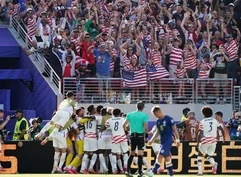
GEOFF BENNETT: Well, let's turn now to the World Cup, where last night the U.S.
men's team punched their ticket to the round of 16 with a 2-0 win over Bosnia and Herzegovina.
Soccer fans across the country celebrated the win, despite a controversial red card that will keep the team's top goal scorer out of the next game.
It was the first victory for the American men in a knockout round of the World Cup since 2002, and it sets the stage for a Monday night matchup against Belgium.
To break it all down, we are joined once again by Leander Schaerlaeckens.
He is soccer columnist at The Guardian and author of "The Long Game: U.S.
Men's Soccer and Its Savage, Four-Decade Journey to the Top or Thereabouts."
Leander, always good to see you.
You got those books well placed behind you on that counter, friend.
So let's talk about this big win, this big U.S.
win last night.
How did the team get it done?
And what does it mean for the men's team going forward?
LEANDER SCHAERLAECKENS, The Guardian: Well, it's obviously huge, because if you don't win that game, you're out.
Going into this World Cup, the U.S.
had entered a knockout game at the World Cup where losing would send them home eight times, won only once.
And as you mentioned, that was 24 years ago.
So they really, really needed this, but also they kind of had to break that spell a little bit.
They'd also gone 13 games without beating a European team.
I think there was a pretty good sense that Bosnia was eminently beatable.
And I think, on the whole, the U.S.
outclassed them last night.
They were just better all over the field.
But there was that complication of the red card handed out by the Brazilian referee to Folarin Balogun, who had scored the first goal for the U.S., who was an absolute pest up and down the field, and who's going to be very badly missed in that Round of 16 game against Belgium, because I don't think they have another player like him who can bring that kind of energy and those goals.
GEOFF BENNETT: Yes, I mean, he, I think it's fair to say, is the best, most consistent attacking player on that team.
What did you make of the call?
And I should also ask, is there any realistic path for that decision to be overturned by Monday?
LEANDER SCHAERLAECKENS: Second part first.
No, there is not.
There is no appealing this decision.
So, unfortunately, they will be without Balogun.
They have other strikers in Haji Wright and Ricardo Pepi, but Balogun had been the hot hand, or the hot foot, I suppose, since we're talking soccer.
He'd been the guy who was in form.
He was really combining beautifully with Christian Pulisic and Malik Tillman.
The attack was flowing really well.
And the play -- the call is really dubious.
More often than not, I think that wouldn't be a red card.
It's maybe a yellow card.
He went up for a ball.
He wasn't looking at the -- at his marker.
He accidentally kind of rakes his cleats down the back of his calf and onto his ankle.
But he didn't mean to.
It was a dangerous play, but it was really a very tough call to give him a red there and to send him home and to really meaningfully affect the rest of this tournament for the U.S., because now they face Belgium, a team that actually knocked the U.S.
out of the 2014 World Cup with a bunch of players who are still there.
It's a very veteran team, very experienced team.
And the last time the U.S.
faced Belgium was in a friendly game in March, when the Belgians actually won 5-2.
GEOFF BENNETT: So, let's talk about France, because France, they seem to be the team to beat.
If there's any other team that's going to stop them, what might that team be?
What do they have to do?
(LAUGHTER) LEANDER SCHAERLAECKENS: You may have to compile some kind of all-star team from players from other teams to go up against this France, because they have just been fantastic in this tournament.
They have won -- they have scored at least three goals in all of their games.
They won very, very comfortably against Sweden in their own Round of 32 game.
They are cruising.
Mbappe is scoring.
Michael Olise is possibly the best player of the tournament.
And if it's not him, then it's Ousmane Dembele.
So, really the three best players we have seen so far are all on France.
They are on autopilot and they're doing really well.
Spain is looking good too.
They beat Austria really comfortably earlier today.
They're rounding into form, but they have a fairly tough path into the semifinals.
They will face the winner of Croatia-Portugal, and after that, they would face the winner of Belgium against the United States.
Argentina, meanwhile, is possibly not as talented as the rest of some of the contenders, but they're very experienced.
Messi is doing super well, and they have a much clearer path to the semifinals than any of the other heavyweights do in this tournament.
GEOFF BENNETT: Leander, we have got about 30 seconds left, and I want to get to this question, because, leading up to the Cup, there was all of this skepticism about access and attendance and the atmosphere.
I remember a conversation on this very program with you about that very topic.
We have now gotten some terrific soccer, some unforgettable moments.
How did the World Cup change the narrative?
LEANDER SCHAERLAECKENS: You know, the World Cup is always redeemed by the World Cup itself.
That's the amazing thing about it.
No matter how much controversy there is, somehow, once the games start and once we see all the beautiful goals and all the fun in the stands, everything else is forgotten.
And maybe that's not ideal, but that's how it goes every four years.
GEOFF BENNETT: Leander Schaerlaeckens, author of "The Long Game: U.S.
Men's Soccer and Its Savage, Four-Decade Journey to the Top or Thereabouts," always good to be with - - speak with you.
Thanks for being with us.
LEANDER SCHAERLAECKENS: Thank you.
GEOFF BENNETT: On this day in 1776, the Second Continental Congress officially voted to sever political ties with Great Britain and declare itself independent.
And in this week celebrating 250 years since the founding of the nation, and just ahead of Independence Day, Judy Woodruff brings us a conversation from a site synonymous with the founding fathers.
It's part of her series Crossroads: America at 250.
JUDY WOODRUFF: So here we are, Philadelphia, and we are standing in front of Independence Hall.
I don't know about you, but I have goose bumps.
It's so cool.
It's so cool.
RON CHERNOW, Presidential Biographer: We're walking in the footsteps of history literally here.
JUDY WOODRUFF: It's a building that holds a nation's history within its four walls.
I wanted to hear about that history from two of the best, presidential biographer Ron Chernow, also renowned for his biography of Alexander Hamilton, and presidential historian Lindsay Chervinsky.
Both have studied the founding fathers and the time they spent here debating the Declaration and, 11 years later, the Constitution, in both cases creating something entirely new in the world.
We sat down in the Assembly Room, the room where the United States began.
LINDSAY CHERVINSKY, Presidential Historian: And 250 years ago, they would have been here debating whether or not to take that final step to actually declare independence and make the break with Great Britain official.
And that was a remarkable thing to do because they knew the consequences if they lost would be death.
And so that -- I mean, gosh, that choice, what an amazing moment.
RON CHERNOW: Absolutely.
Just to pick up on Lindsay's point, George Washington knew for certainty that he would be hanged if he was caught.
He made the fascinating statement that during the revolution "We were fighting with ropes around our neck."
In fact, he had a secret plan, if it looked like his arrest was imminent, that he was going to flee to properties that he owned out in the Ohio country.
So it's amazing.
They were risking everything in doing this.
And you have to realize, at the time, treason was a capital crime.
That is, the punishment was death for sure, and certainly for the leadership.
JUDY WOODRUFF: By setting in motion this new system of government consent of the governed, not a king, not a dictator, were they aware how different it was from what had come before?
LINDSAY CHERVINSKY: They were.
They called it this great experiment, and I think that's a really great term for it, because, at the time, if they looked around the world, governments were ruled by monarchies and military dictators.
There really wasn't much else.
So they knew they were doing something that no one alive had seen.
RON CHERNOW: The Declaration of Independence, we all tend to focus on, of course, what Jefferson wrote in the preamble, all men are created equal.
That received very little attention at the time.
For them, the significant thing Jefferson listed, I think it was 27 different grievances against George III.
This was really an indictment.
This was their legal brief against George III.
And I think it tells you a lot about these rebels that they felt the need to make the case.
There was almost a slight defensiveness about it.
It says in the Declaration that governments should not be abolished for light or transient causes.
And lest anyone accused them of light and transient causes, there was this very, very long list of grievances.
LINDSAY CHERVINSKY: These were very well educated men.
They had a lot of experience, but they were also operating within an international political community and tradition.
So there was a British tradition of petition, in which there was almost a formula in which you would open and then you would have your grievances and your demands at the end.
And so they were plugging the Declaration into that tradition and using it to speak to potential allies around the globe.
And I think this is so important, because the war had already been taking place for over a year at this point.
For a domestic audience, it was sort of after the fact.
They were speaking to France and Spain, trying to convince them that they were not trying to destroy all monarchies, just this one monarchy.
JUDY WOODRUFF: I want to ask you about the central figures here.
George Washington was off fighting the British.
He was in New York.
Here were among the central figures Thomas Jefferson, John Adams, Benjamin Franklin.
Why was Jefferson chosen to write the Declaration?
LINDSAY CHERVINSKY: Well, this is where I think John Adams' brilliance really comes into play.
He was in a lot of ways the stage manager of the early years of the revolution.
He engineered George Washington's nomination as the commander in chief of the Continental Army the year prior, and then he engineered Jefferson's authorship of the Declaration.
RON CHERNOW: It was this great lucky break for Thomas Jefferson, who is only 33, not nearly as famous as John Adams and Benjamin Franklin.
And I think that John Adams and certainly Benjamin Franklin, if they had realized the significance that would be attached to this by later generations, they would have realized they really blew it letting Jefferson do it.
JUDY WOODRUFF: How -- I mean, how would you describe the debate and disagreement over the Declaration?
LINDSAY CHERVINSKY: It was definitely less heated than the Constitution.
The most famous change that they made was to take out the grievance that king George III had basically saddled the colonies with slavery.
And that was the big change that I think Jefferson lamented at that moment, but they felt would be too controversial and potentially too divisive for the various colonies.
RON CHERNOW: The slavery was going to indeed be the glaring contradiction to the idea that all men are created equal and would bedevil the country right to the present day.
We're all taught in school that the major division at the Constitutional Convention was between the large states and the small states.
No, said James Madison, who was sitting right in the middle of the front row here taking notes of the Constitutional Convention, the major split was between the slaveholding states of the South and the Northern states.
JUDY WOODRUFF: And it wasn't just slavery that they left out, Lindsay.
It was Native -- what happened to Native American.
Women, who were half the population, completely left out.
Even though they said all men are created equal, how much was that an issue inside of them?
LINDSAY CHERVINSKY: Well, this is a matter of great historical debate.
I would argue that it matters a lot less what he was thinking at the time and much more how we read it and how successive generations have read it as almost a mission statement to try and live up to, imperfectly, of course, but trying to get a little closer with each passing generation.
RON CHERNOW: But I think that the important thing, and it was kind of one of the great gifts from the founders, is that they gave us the tools, they gave us the principles that have allowed us to criticize them.
We can take that line of Jefferson that all men are created -- and turn it around and use it against him.
But I think that they saw themselves as initiating a process that would require constant change and constant self-improvement.
I think it's one of the reasons why we have endured so long.
But, again, they gave us the principles that we have been able to not only turn back against them, but to correct these inequities.
JUDY WOODRUFF: This has been a living document.
I mean, it's a document that we live by as Americans.
RON CHERNOW: Yes.
JUDY WOODRUFF: It defined our system of government, but it's also been interpreted and reinterpreted, just as the Constitution certainly has been.
(CROSSTALK) LINDSAY CHERVINSKY: Yes.
I think this is so important.
And Ron mentioned Washington.
Everyone who was in this room for the Constitutional Convention left disappointed.
They didn't get something they wanted, and everyone had to make compromises.
So the Constitution is really just a hodgepodge of compromises.
And Washington, when he left, he wrote a letter and he basically said to his friend Benjamin Harrison, it's the best that could be had at the moment.
That is not a declaration of triumph or success.
It was, can we make a stronger foundation for the next generation to pick up our work and move forward?
And they were not afraid of failure.
They were afraid of inaction.
RON CHERNOW: Yes, in fact, the preamble to the Constitution, "We the people in order to create a more perfect union," it doesn't say we the people in order to create a perfect union.
RON CHERNOW: So already it's just kind of an approximation of where they hope to be.
JUDY WOODRUFF: Good point.
So, Lindsay, you run the George Washington Library at Mount Vernon.
Ron, you have written a Pulitzer Prize-winning biography of George Washington.
He wasn't here, but he played a big role in what happened here.
LINDSAY CHERVINSKY: You know, I do think George Washington made one important contribution that we sometimes forget about, which is that the Continental Army had a massive victory earlier that year, that they had forced the British out of Boston.
And the British then came down to New York City, where, of course, Washington met them.
I am not sure that so many people would have been willing to vote for independence if the army hadn't proven that victory was possible.
JUDY WOODRUFF: Why were we so lucky as Americans to have these men, Ron Chernow, at that particular moment?
What do you think?
RON CHERNOW: I have thought about this question a lot.
And I think that, at a time when in American society we were creating constitutions, new institutions, laying down principles, forging new governments, all of the best and most creative minds were swept into the political arena.
I sometimes think, if an Alexander Hamilton were alive today, maybe he'd be working in Silicon Valley, maybe he'd be doing buyouts on Wall Street, maybe he'd be doing biotech research, but he would be an uncomfortable figure in our political system.
LINDSAY CHERVINSKY: There was an expectation that, if you could be a leader, there was an expectation that you would.
And, today, there's so many disincentives to public service.
There's so much potential vitriol or even violence.
There are so many other things people of incredible intellect and talent would rather do.
And so, as a society, we are not encouraging the best and brightest to go into a political service role.
And I think, as a nation, we have lost as a result.
JUDY WOODRUFF: Which leads me to ask, if these men, these great men we're talking about were to come back today, what would they make of what we have done with the American experiment, Ron?
What do you think?
RON CHERNOW: Well, they'd be very impressed by kind of the size and wealth of the country, the dynamism of the economy.
But, in general... LINDSAY CHERVINSKY: The fact that we exist.
RON CHERNOW: The fact that we exist, because they -- Washington thought the Constitution would last for 20 years.
Ditto for Hamilton.
So that they would be amazed that we were still around and existing under the Constitution that they wrote.
But I think that there would be vast dismay about our condition.
For one thing, they had created a governmental structure where there was supposed to be three co-equal branches of government.
I don't think anyone would say today that we have three functioning branches, much less co-equal branches of government.
Washington in his farewell address had warned of the bane of factions, in other words, the bane of political parties.
And we certainly are living through an era of extreme partisanship and hostility.
LINDSAY CHERVINSKY: You know, I think that they would be stunned that Congress, over the course of several decades, has so willingly laid down in front of the executive branch and also the judiciary.
Congress is supposed to exercise a very vibrant role in oversight of the other two branches, and they have willingly given up power in a way that the founders did not see in the course of human history, because, typically, humans and institutions are jealous of their own authority.
JUDY WOODRUFF: Finally, why do you think the system has persisted?
Why do we still have a democratic republic?
LINDSAY CHERVINSKY: And so I think we have been incredibly fortunate to live in a nation where we are inherently choosing to be Americans, that our initial founders were choosing this identity, and with each passing generation, that choice is both required of us and gifted to us.
JUDY WOODRUFF: And I'm asking this question, Ron, at a time when many Americans feel the country hasn't lived up to its promise.
RON CHERNOW: The founders bequeathed to us this great, but flawed system.
And we have had to keep repairing it and improving it, but they left us with the tools to do that.
They left us with the institutions that have allowed us to do it, left us with the principles that have animated it.
And so we're always kind of striving, always moving towards that more perfect union, which we will never achieve.
But as long as we're moving in the right direction, we will be OK.
JUDY WOODRUFF: Ron Chernow, Lindsay Chervinsky, thank you both so much for talking with us on this 250th birthday of the country and in this room.
LINDSAY CHERVINSKY: Well, thank you for the privilege of being here.
JUDY WOODRUFF: Thank you.
RON CHERNOW: It's been a thrill.
Thank you, Judy.
GEOFF BENNETT: This weekend, the team here at PBS News premieres a new special, "Bruce Springsteen: Finding America in Song."
It's an expanded version of a report we brought you a few weeks ago featuring a conversation with Springsteen himself about music, history, and the new Springsteen Center for American Music, opening as the country approaches its 250th anniversary.
That's Sunday at 6:30 Eastern on PBS stations.
Check your local listings.
And that is the "News Hour" for tonight.
I'm Geoff Bennett.
For all of us here at the "News Hour," thanks for spending part of your evening with us.
Chef José Andrés feeds Venezuelan survivors and search teams
Video has Closed Captions
As Venezuela crisis deepens, Chef José Andrés feeds earthquake survivors and search teams (5m 49s)
Haberman and Swan on Trump's unconstrained 2nd term
Video has Closed Captions
Haberman and Swan on 'Regime Change,' their book on Trump's unconstrained 2nd term (9m 34s)
Hard-fought win raises hopes for U.S. in World Cup
Video has Closed Captions
Hard-fought win raises hopes for U.S. in World Cup (5m 31s)
Legal battles across country could complicate midterms
Video has Closed Captions
How legal battles across the country could complicate the midterms (6m 38s)
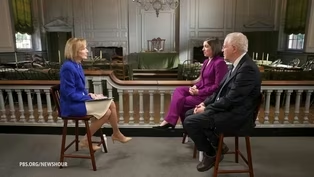
A look at America's founding from Independence Hall
Video has Closed Captions
A look at America's founding from the room where independence was declared (13m 9s)

News Wrap: Olympian faces Reflecting Pool vandalism charge
Video has Closed Captions
News Wrap: Former U.S. Olympian faces felony charge for alleged Reflecting Pool vandalism (6m 15s)
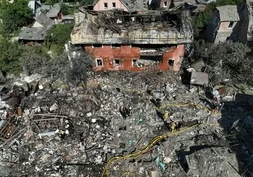
Russia pounds Kyiv with missile and drone strikes
Video has Closed Captions
Russia pounds Kyiv with missiles and drones after Ukraine's strikes on oil infrastructure (5m 12s)
Providing Support for PBS.org
Learn Moreabout PBS online sponsorship
- News and Public Affairs

Today's top journalists discuss Washington's current political events and public affairs.

- News and Public Affairs

FRONTLINE is investigative journalism that questions, explains and changes our world.

 New Episode

 New Episode

 New Episode


 New Episode
Support for PBS provided by:
Major corporate funding for the PBS News Hour is provided by BDO, BNSF, Consumer Cellular, American Cruise Lines, and Raymond James. Funding for the PBS NewsHour Weekend is provided by...