
A look at America's founding from Independence Hall
Clip: 7/2/2026 | 13m 9sVideo has Closed Captions
A look at America's founding from the room where independence was declared
In July of 1776, the Second Continental Congress officially voted to sever political ties with Great Britain and declare independence. In this week celebrating 250 years since the founding of the nation, and just ahead of Independence Day, Judy Woodruff brings us a conversation from a site synonymous with the Founding Fathers. It’s part of her series, Crossroads: America at 250.
Problems playing video? | Closed Captioning Feedback
Problems playing video? | Closed Captioning Feedback
Major corporate funding for the PBS News Hour is provided by BDO, BNSF, Consumer Cellular, American Cruise Lines, and Raymond James. Funding for the PBS NewsHour Weekend is provided by...
A look at America's founding from Independence Hall
Clip: 7/2/2026 | 13m 9sVideo has Closed Captions
In July of 1776, the Second Continental Congress officially voted to sever political ties with Great Britain and declare independence. In this week celebrating 250 years since the founding of the nation, and just ahead of Independence Day, Judy Woodruff brings us a conversation from a site synonymous with the Founding Fathers. It’s part of her series, Crossroads: America at 250.
Problems playing video? | Closed Captioning Feedback
Where to Watch PBS News Hour
PBS News Hour is available to stream on pbs.org and the PBS app.
Providing Support for PBS.org
Learn Moreabout PBS online sponsorshipGEOFF BENNETT: On this day in 1776, the Second Continental Congress officially voted to sever political ties with Great Britain and declare itself independent.
And in this week celebrating 250 years since the founding of the nation, and just ahead of Independence Day, Judy Woodruff brings us a conversation from a site synonymous with the founding fathers.
It's part of her series Crossroads: America at 250.
JUDY WOODRUFF: So here we are, Philadelphia, and we are standing in front of Independence Hall.
I don't know about you, but I have goose bumps.
It's so cool.
It's so cool.
RON CHERNOW, Presidential Biographer: We're walking in the footsteps of history literally here.
JUDY WOODRUFF: It's a building that holds a nation's history within its four walls.
I wanted to hear about that history from two of the best, presidential biographer Ron Chernow, also renowned for his biography of Alexander Hamilton, and presidential historian Lindsay Chervinsky.
Both have studied the founding fathers and the time they spent here debating the Declaration and, 11 years later, the Constitution, in both cases creating something entirely new in the world.
We sat down in the Assembly Room, the room where the United States began.
LINDSAY CHERVINSKY, Presidential Historian: And 250 years ago, they would have been here debating whether or not to take that final step to actually declare independence and make the break with Great Britain official.
And that was a remarkable thing to do because they knew the consequences if they lost would be death.
And so that -- I mean, gosh, that choice, what an amazing moment.
RON CHERNOW: Absolutely.
Just to pick up on Lindsay's point, George Washington knew for certainty that he would be hanged if he was caught.
He made the fascinating statement that during the revolution "We were fighting with ropes around our neck."
In fact, he had a secret plan, if it looked like his arrest was imminent, that he was going to flee to properties that he owned out in the Ohio country.
So it's amazing.
They were risking everything in doing this.
And you have to realize, at the time, treason was a capital crime.
That is, the punishment was death for sure, and certainly for the leadership.
JUDY WOODRUFF: By setting in motion this new system of government consent of the governed, not a king, not a dictator, were they aware how different it was from what had come before?
LINDSAY CHERVINSKY: They were.
They called it this great experiment, and I think that's a really great term for it, because, at the time, if they looked around the world, governments were ruled by monarchies and military dictators.
There really wasn't much else.
So they knew they were doing something that no one alive had seen.
RON CHERNOW: The Declaration of Independence, we all tend to focus on, of course, what Jefferson wrote in the preamble, all men are created equal.
That received very little attention at the time.
For them, the significant thing Jefferson listed, I think it was 27 different grievances against George III.
This was really an indictment.
This was their legal brief against George III.
And I think it tells you a lot about these rebels that they felt the need to make the case.
There was almost a slight defensiveness about it.
It says in the Declaration that governments should not be abolished for light or transient causes.
And lest anyone accused them of light and transient causes, there was this very, very long list of grievances.
LINDSAY CHERVINSKY: These were very well educated men.
They had a lot of experience, but they were also operating within an international political community and tradition.
So there was a British tradition of petition, in which there was almost a formula in which you would open and then you would have your grievances and your demands at the end.
And so they were plugging the Declaration into that tradition and using it to speak to potential allies around the globe.
And I think this is so important, because the war had already been taking place for over a year at this point.
For a domestic audience, it was sort of after the fact.
They were speaking to France and Spain, trying to convince them that they were not trying to destroy all monarchies, just this one monarchy.
JUDY WOODRUFF: I want to ask you about the central figures here.
George Washington was off fighting the British.
He was in New York.
Here were among the central figures Thomas Jefferson, John Adams, Benjamin Franklin.
Why was Jefferson chosen to write the Declaration?
LINDSAY CHERVINSKY: Well, this is where I think John Adams' brilliance really comes into play.
He was in a lot of ways the stage manager of the early years of the revolution.
He engineered George Washington's nomination as the commander in chief of the Continental Army the year prior, and then he engineered Jefferson's authorship of the Declaration.
RON CHERNOW: It was this great lucky break for Thomas Jefferson, who is only 33, not nearly as famous as John Adams and Benjamin Franklin.
And I think that John Adams and certainly Benjamin Franklin, if they had realized the significance that would be attached to this by later generations, they would have realized they really blew it letting Jefferson do it.
JUDY WOODRUFF: How -- I mean, how would you describe the debate and disagreement over the Declaration?
LINDSAY CHERVINSKY: It was definitely less heated than the Constitution.
The most famous change that they made was to take out the grievance that king George III had basically saddled the colonies with slavery.
And that was the big change that I think Jefferson lamented at that moment, but they felt would be too controversial and potentially too divisive for the various colonies.
RON CHERNOW: The slavery was going to indeed be the glaring contradiction to the idea that all men are created equal and would bedevil the country right to the present day.
We're all taught in school that the major division at the Constitutional Convention was between the large states and the small states.
No, said James Madison, who was sitting right in the middle of the front row here taking notes of the Constitutional Convention, the major split was between the slaveholding states of the South and the Northern states.
JUDY WOODRUFF: And it wasn't just slavery that they left out, Lindsay.
It was Native -- what happened to Native American.
Women, who were half the population, completely left out.
Even though they said all men are created equal, how much was that an issue inside of them?
LINDSAY CHERVINSKY: Well, this is a matter of great historical debate.
I would argue that it matters a lot less what he was thinking at the time and much more how we read it and how successive generations have read it as almost a mission statement to try and live up to, imperfectly, of course, but trying to get a little closer with each passing generation.
RON CHERNOW: But I think that the important thing, and it was kind of one of the great gifts from the founders, is that they gave us the tools, they gave us the principles that have allowed us to criticize them.
We can take that line of Jefferson that all men are created -- and turn it around and use it against him.
But I think that they saw themselves as initiating a process that would require constant change and constant self-improvement.
I think it's one of the reasons why we have endured so long.
But, again, they gave us the principles that we have been able to not only turn back against them, but to correct these inequities.
JUDY WOODRUFF: This has been a living document.
I mean, it's a document that we live by as Americans.
RON CHERNOW: Yes.
JUDY WOODRUFF: It defined our system of government, but it's also been interpreted and reinterpreted, just as the Constitution certainly has been.
(CROSSTALK) LINDSAY CHERVINSKY: Yes.
I think this is so important.
And Ron mentioned Washington.
Everyone who was in this room for the Constitutional Convention left disappointed.
They didn't get something they wanted, and everyone had to make compromises.
So the Constitution is really just a hodgepodge of compromises.
And Washington, when he left, he wrote a letter and he basically said to his friend Benjamin Harrison, it's the best that could be had at the moment.
That is not a declaration of triumph or success.
It was, can we make a stronger foundation for the next generation to pick up our work and move forward?
And they were not afraid of failure.
They were afraid of inaction.
RON CHERNOW: Yes, in fact, the preamble to the Constitution, "We the people in order to create a more perfect union," it doesn't say we the people in order to create a perfect union.
RON CHERNOW: So already it's just kind of an approximation of where they hope to be.
JUDY WOODRUFF: Good point.
So, Lindsay, you run the George Washington Library at Mount Vernon.
Ron, you have written a Pulitzer Prize-winning biography of George Washington.
He wasn't here, but he played a big role in what happened here.
LINDSAY CHERVINSKY: You know, I do think George Washington made one important contribution that we sometimes forget about, which is that the Continental Army had a massive victory earlier that year, that they had forced the British out of Boston.
And the British then came down to New York City, where, of course, Washington met them.
I am not sure that so many people would have been willing to vote for independence if the army hadn't proven that victory was possible.
JUDY WOODRUFF: Why were we so lucky as Americans to have these men, Ron Chernow, at that particular moment?
What do you think?
RON CHERNOW: I have thought about this question a lot.
And I think that, at a time when in American society we were creating constitutions, new institutions, laying down principles, forging new governments, all of the best and most creative minds were swept into the political arena.
I sometimes think, if an Alexander Hamilton were alive today, maybe he'd be working in Silicon Valley, maybe he'd be doing buyouts on Wall Street, maybe he'd be doing biotech research, but he would be an uncomfortable figure in our political system.
LINDSAY CHERVINSKY: There was an expectation that, if you could be a leader, there was an expectation that you would.
And, today, there's so many disincentives to public service.
There's so much potential vitriol or even violence.
There are so many other things people of incredible intellect and talent would rather do.
And so, as a society, we are not encouraging the best and brightest to go into a political service role.
And I think, as a nation, we have lost as a result.
JUDY WOODRUFF: Which leads me to ask, if these men, these great men we're talking about were to come back today, what would they make of what we have done with the American experiment, Ron?
What do you think?
RON CHERNOW: Well, they'd be very impressed by kind of the size and wealth of the country, the dynamism of the economy.
But, in general... LINDSAY CHERVINSKY: The fact that we exist.
RON CHERNOW: The fact that we exist, because they -- Washington thought the Constitution would last for 20 years.
Ditto for Hamilton.
So that they would be amazed that we were still around and existing under the Constitution that they wrote.
But I think that there would be vast dismay about our condition.
For one thing, they had created a governmental structure where there was supposed to be three co-equal branches of government.
I don't think anyone would say today that we have three functioning branches, much less co-equal branches of government.
Washington in his farewell address had warned of the bane of factions, in other words, the bane of political parties.
And we certainly are living through an era of extreme partisanship and hostility.
LINDSAY CHERVINSKY: You know, I think that they would be stunned that Congress, over the course of several decades, has so willingly laid down in front of the executive branch and also the judiciary.
Congress is supposed to exercise a very vibrant role in oversight of the other two branches, and they have willingly given up power in a way that the founders did not see in the course of human history, because, typically, humans and institutions are jealous of their own authority.
JUDY WOODRUFF: Finally, why do you think the system has persisted?
Why do we still have a democratic republic?
LINDSAY CHERVINSKY: And so I think we have been incredibly fortunate to live in a nation where we are inherently choosing to be Americans, that our initial founders were choosing this identity, and with each passing generation, that choice is both required of us and gifted to us.
JUDY WOODRUFF: And I'm asking this question, Ron, at a time when many Americans feel the country hasn't lived up to its promise.
RON CHERNOW: The founders bequeathed to us this great, but flawed system.
And we have had to keep repairing it and improving it, but they left us with the tools to do that.
They left us with the institutions that have allowed us to do it, left us with the principles that have animated it.
And so we're always kind of striving, always moving towards that more perfect union, which we will never achieve.
But as long as we're moving in the right direction, we will be OK.
JUDY WOODRUFF: Ron Chernow, Lindsay Chervinsky, thank you both so much for talking with us on this 250th birthday of the country and in this room.
LINDSAY CHERVINSKY: Well, thank you for the privilege of being here.
JUDY WOODRUFF: Thank you.
RON CHERNOW: It's been a thrill.
Thank you, Judy.
Chef José Andrés feeds Venezuelan survivors and search teams
Video has Closed Captions
As Venezuela crisis deepens, Chef José Andrés feeds earthquake survivors and search teams (5m 49s)
Haberman and Swan on Trump's unconstrained 2nd term
Video has Closed Captions
Haberman and Swan on 'Regime Change,' their book on Trump's unconstrained 2nd term (9m 34s)
Hard-fought win raises hopes for U.S. in World Cup
Video has Closed Captions
Hard-fought win raises hopes for U.S. in World Cup (5m 31s)
Legal battles across country could complicate midterms
Video has Closed Captions
How legal battles across the country could complicate the midterms (6m 38s)
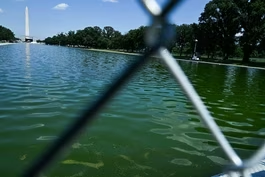
News Wrap: Olympian faces Reflecting Pool vandalism charge
Video has Closed Captions
News Wrap: Former U.S. Olympian faces felony charge for alleged Reflecting Pool vandalism (6m 15s)
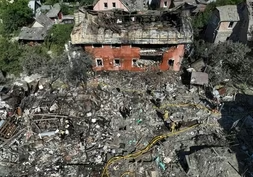
Russia pounds Kyiv with missile and drone strikes
Video has Closed Captions
Russia pounds Kyiv with missiles and drones after Ukraine's strikes on oil infrastructure (5m 12s)
Providing Support for PBS.org
Learn Moreabout PBS online sponsorship
- News and Public Affairs

Today's top journalists discuss Washington's current political events and public affairs.

- News and Public Affairs

FRONTLINE is investigative journalism that questions, explains and changes our world.

 New Episode
 New Episode

 New Episode

 New Episode
 New Episode
Support for PBS provided by:
Major corporate funding for the PBS News Hour is provided by BDO, BNSF, Consumer Cellular, American Cruise Lines, and Raymond James. Funding for the PBS NewsHour Weekend is provided by...