
January 30, 2026 - PBS News Hour full episode
1/30/2026 | 57m 46sVideo has Closed Captions
January 30, 2026 - PBS News Hour full episode
January 30, 2026 - PBS News Hour full episode
Problems playing video? | Closed Captioning Feedback
Problems playing video? | Closed Captioning Feedback
Major corporate funding for the PBS News Hour is provided by BDO, BNSF, Consumer Cellular, American Cruise Lines, and Raymond James. Funding for the PBS NewsHour Weekend is provided by...
January 30, 2026 - PBS News Hour full episode
1/30/2026 | 57m 46sVideo has Closed Captions
January 30, 2026 - PBS News Hour full episode
Problems playing video? | Closed Captioning Feedback
How to Watch PBS News Hour
PBS News Hour is available to stream on pbs.org and the free PBS App, available on iPhone, Apple TV, Android TV, Android smartphones, Amazon Fire TV, Amazon Fire Tablet, Roku, Samsung Smart TV, and Vizio.
Providing Support for PBS.org
Learn Moreabout PBS online sponsorshipAMNA NAWAZ: Good evening.
I'm Amna Nawaz.
GEOFF BENNETT: And I'm Geoff Bennett.
On the "News Hour" tonight: Protests continue against the Trump administration's immigration crackdown in Minneapolis, as federal authorities arrest reporters who say they were covering a protest inside a church.
AMNA NAWAZ: The president nominates inflation hawk Kevin Warsh to lead the Federal Reserve, prompting concerns about the Central Bank's future independence.
GEOFF BENNETT: And after a massive Republican funding bill cut more than a trillion dollars from Medicaid and children's health services, people with disabilities are bearing a disproportionate burden.
ALICE BURNS, KFF: This is the single biggest rollback in federal support for health care that we have ever seen.
And people with disabilities are much more likely to rely on programs like Medicaid.
(BREAK) GEOFF BENNETT: Welcome to the "News Hour."
The Justice Department said today it has opened a federal civil rights investigation into the shooting of Alex Pretti, the ICU nurse killed by immigration officers in Minneapolis.
AMNA NAWAZ: The FBI will conduct that probe.
That's a change from the department's stance earlier this week, when it only agreed to a more narrow inquiry into the use of force.
That news followed more arrests in Minnesota over a protest at a church.
Special correspondent Fred de Sam Lazaro has our report.
PROTESTERS: You can't kill us all!
FRED DE SAM LAZARO: Another wave of protests swept through Minneapolis today and echoed in cities across the country... (CHANTING) FRED DE SAM LAZARO: ... as tensions grow over federal immigration enforcement and the Trump administration's response to dissent.
Federal agents today arrested former CNN anchor Don Lemon and three others in connection with a January 18 protest at a church in St.
Paul where an ICE official serves as a pastor.
Lemon, who was fired from CNN in 2023, now hosts an independent show on YouTube.
The Justice Department has charged Lemon with federal civil rights crimes.
The National Association of Black Journalists, along with other news organizations, have condemned the move.
DON LEMON, Former CNN Anchor: We're here just chronicling and reporting.
We're not part of the activists, but we're here just reporting on them.
FRED DE SAM LAZARO: Lemon's lawyer says he was there strictly in a journalistic role.
DON LEMON: So this is what the First Amendment is about, about the freedom to protest.
FRED DE SAM LAZARO: Lemon has a history of voicing his disdain for President Trump.
GEORGIA FORT, Journalist: I wanted to alert the public that agents are at my door right now.
FRED DE SAM LAZARO: Independent Twin Cities journalist Georgia Fort was also arrested after federal agents arrived at her home this morning.
GEORGIA FORT: I don't feel like I have my First Amendment right.
FRED DE SAM LAZARO: Fort livestreamed the moments before her arrest, saying agents had a grand jury indictment.
After her release hours later, Fort called for the truth to be -- quote -- "amplified."
GEORGIA FORT: Do we have a Constitution?
That is the pressing question.
FRED DE SAM LAZARO: Also arrested, Black Lives Matter activist Trahern Jeen Crews and Minnesota state legislature candidate Jamael Lydell Lundy.
Attorney General Pam Bondi said the four were arrested because they violated people's ability to worship -- quote -- "freely and safely."
PAM BONDI, U.S.
Attorney General: And if I haven't been clear already, if you violate that sacred right, we are coming after you.
FRED DE SAM LAZARO: Meanwhile, the Justice Department said today it has opened a civil rights investigation into the shooting of Alex Pretti.
At the same time, Deputy Attorney General Todd Blanche said the Justice Department is looking at left-wing groups as part of the investigation into Pretti's killing.
TODD BLANCHE, U.S.
Deputy Attorney General: It means looking at documentary evidence, sending subpoenas if you have to, and I expect that investigation will proceed with that -- with those parameters in mind.
FRED DE SAM LAZARO: Blanche notably dodged multiple questions about whether an investigation is being opened into the shooting of another U.S.
citizen in Minnesota, Renee Good.
Despite hints from administration officials of a de-escalation, there's little to suggest any let-up in the aggressive and widespread enforcement in the Twin Cities area.
Just yesterday, two Minnesota children, a second grader and a fifth grader, were taken into custody at the request of their mother and sole caretaker, who was arrested while the children were in school.
Their principal, who'd witnessed another of his pupils taken last week, became emotional after seeing a picture of 5-year-old Liam Conejo Ramos, now detained in Texas.
JASON KUHLMAN, Principal, Valley View Elementary School: Open your eyes.
Believe your eyes.
Believe what you see.
He's not a criminal.
It's not politics.
It's about treating people like humans.
FRED DE SAM LAZARO: Meantime, there were calls nationwide for peaceful disruption, school closures and work and shopping boycotts aimed to draw attention to the Trump administration's immigration crackdown.
And back in Minneapolis, as protesters were out in the streets, musician Bruce Springsteen made a surprise appearance at a benefit concert singing his newly recorded song, "Streets of Minneapolis," a rally cry for many as uncertainty and fear persist.
For the PBS "News Hour," I'm Fred D. Sam Lazaro in the Twin Cities.
AMNA NAWAZ: Today, President Trump announced Kevin Warsh as his pick to be the next chairman of the Federal Reserve.
A conservative economist at the Hoover Institution, Warsh is a former adviser to President George W. Bush and was a member of the Federal Reserve's Board of Governors from 2006 until 2011.
In a post on Truth Social, Trump said -- quote -- "He will go down as one of the great Fed chairmen, maybe the best.
On top of everything else, he is central casting and will never let you down."
The president went on to praise his pick this afternoon.
DONALD TRUMP, President of the United States: He's got the whole package.
He's got the whole package.
And I think he's going to do a great job.
AMNA NAWAZ: If confirmed by the Senate, Warsh will succeed current chair Jerome Powell, whose term ends in May.
Joining me now is David Wessel.
He's director of the Hutchins Center on Fiscal and Monetary Policy at the Brookings Institution.
David, welcome back.
And let's just start with your brief take on what you make of this selection.
What should we know about Kevin Warsh?
DAVID WESSEL, Brookings Institution: Well, Kevin Warsh is actually a lawyer.
He's not an economist.
He's a very ambitious guy who has been an excellent networker.
He was appointed to the Federal Reserve Board by George W. Bush at age 35, younger than anybody else.
He is a man who understands the markets.
He's very good with people.
I think that'll serve him well.
And he has sort of changed his stance on monetary policy over the years.
He was what is generally called a hawk, an inflation fighter, when he was on the board.
But in recent years, particularly as he's been campaigning, auditioning, if you will, to be Fed Chair, he's become more in sync with President Trump.
He's very critical of the Fed.
He's very critical of their staff.
And he's promising regime change, but we don't really know what that means.
AMNA NAWAZ: Well, to that point, David, we know the current Fed Chair, Jay Powell, has faced a steady stream of criticism and insults from President Trump.
Here is how Warsh himself assessed the Fed and their work last summer.
Take a listen.
KEVIN WARSH, Federal Reserve Chair Nominee: I think the Fed has done a very good job of blaming others for their mistakes.
It's been very popular to blame the president because he's being so mean to them.
Well, most of the Fed's mistakes are because of choices they've made.
I have strongly believed for 20 years and history tells us that the independent operations in the conduct of monetary policy is essential.
But that doesn't mean the Fed is independent in everything else it does.
AMNA NAWAZ: David, as you mentioned, he's currently called for regime change at the Fed.
What does all of this tell us about how Kevin Warsh might lead the Central Bank?
DAVID WESSEL: Well, I think we know that he believes that the economy is capable of growing faster than a lot of economists think because A.I.
will increase the productivity of the economy.
So I think we expect him to be prone to cut interest rates.
In the clip you played, what he's talking about is bank regulation, where I think he'll be in sync with the deregulatory instincts or policies of the Trump administration.
And he's been critical of them for being interested in things like climate or inequality.
He thinks the Fed should narrow its focus to interest rates, inflation, the economy, and not do anything else.
AMNA NAWAZ: As we know, the Central Bank was designed to be insulated from political interference.
When you hear him say there that the Fed isn't independent in everything it does, does that worry you?
DAVID WESSEL: No, it doesn't worry me because I think he's talking about things other than monetary policy.
But the real question is, which Kevin Warsh is going to show up?
Is he going to be independent, focused on delivering stable prices and maximum employment, and doing what the economy and his staff tells him is essential?
Or is he going to be prone to lean in the direction of President Trump, who inevitably will be criticizing him on social media, no matter what he does?
The president has talked about huge rate cuts, one full percentage point, two full percentage points.
That's lunacy.
And I can't imagine that Kevin Warsh is going to do that.
We will have to see, how does he stand up if the president starts to put the screws to him, as he did to Jay Powell?
AMNA NAWAZ: Well, this is the central question, isn't it, David, that if he's confirmed, he wouldn't preside over a Fed meeting until June.
The economy could be in a different state by then.
We have no idea of knowing, but the president wants to see lower interest rates.
Can Kevin Warsh deliver those?
DAVID WESSEL: Well, the financial markets have been predicting that the Fed would cut interest rates at least one or two times later this year.
And I suspect he can deliver that.
He will probably have a bit of a honeymoon at the Fed, and the other policymakers will go along with him.
I think the test will come probably in 2027 and 2028, when he will have to decide if the president's view of the economy matches his, and will he prove to be independent there?
I'm sure, in his confirmation hearings, he will assert his independence.
He understands what a Central Bank is.
In a way, the president picked one of the candidates who knows what it's like to be at the Fed, and that will serve him well.
But, really, we will have to see how he acts when there's conflict between the economy, what the economy needs, and what the president and his political needs are.
AMNA NAWAZ: In the minute or so we have left, I have to ask you about conversations we have had before about the fact that the world is watching when it comes to the Fed, when it comes to its perceived independence in monetary policy.
What's at stake if he is confirmed and takes the helm?
DAVID WESSEL: In general, the United States has benefited from having a strong independent Central Bank, not a perfect one, but global investors believed that the Central Bank, the Ben Bernanke, Jay Powell, Janet Yellen Central Banks were doing their best to deliver on the congressional mandate, and they were standing up, and Jay Powell has done this very effectively, to political pressure.
The world will watch whether Kevin Warsh does the same thing.
And if they think he isn't, then we're going to have to pay more to borrow.
And we're the world's largest borrower, so a little bit of increase in interest rates if people are worried about the independence of the Fed will cost taxpayers a lot of money.
AMNA NAWAZ: David Wessel of the Brookings Institution, thank you so much for your time.
Great to speak with you.
DAVID WESSEL: You're welcome.
GEOFF BENNETT: We start today's other headlines in New York.
A judge ruled that federal prosecutors cannot seek the death penalty against Luigi Mangione in the killing of UnitedHealthcare CEO Brian Thompson.
U.S.
District Judge Margaret Garnett dismissed murder and weapons charges that carried the death penalty.
She said they were legally incompatible with separate stalking charges.
WOMAN: We're all very relieved.
GEOFF BENNETT: Outside the courthouse, Mangione's lawyers welcomed today's decision.
Prosecutors have 30 days to appeal.
It comes a day after authorities say a 36-year-old man claiming to be an FBI agent tried to get Mangione released from Brooklyn's Metropolitan Detention Center.
He was arrested and is now being held there too.
The U.S.
Senate moved to pass a spending package this evening that would fund many federal agencies through the end of the fiscal year.
As part of an agreement between Republicans and Democrats, funding for the Department of Homeland Security would only be extended for two weeks.
That's meant to give lawmakers time to hash out a deal on how to fund the DHS amid efforts by Democrats to rein in President Trump's immigration crackdown.
The House is then set to pick up the measure as soon as Monday, meaning a partial government shutdown is expected to run at least through the weekend.
More than 200,000 homes and businesses across the South have now gone six straight days without electricity after last weekend's debilitating winter storm.
And there's little relief in sight.
Temperatures are expected to plummet this weekend.
More than 200 million Americans are under alerts for extreme cold for the next several days.
And weather officials say a rapidly deepening storm is expected to bring heavy snow and wind from the Southern Appalachians across the Carolinas and into Virginia.
At a news conference today, North Carolina's governor said people should prepare for the worst.
GOV.
JOSH STEIN (D-NC): If the snowfall comes in at the high end and communities experience 15 inches of snow, that's a lot of weight.
And that will knock over trees and that will knock over power lines.
GEOFF BENNETT: Authorities say nearly 90 people have died in areas suffering from extreme cold from Texas to New York.
Roughly half of those deaths were in Tennessee, Mississippi and Louisiana, where power outages have been the worst.
Russia says its temporary halt on attacking Ukraine's capital will only last until Sunday, just when temperatures there are expected to get even colder.
President Trump said yesterday that he got Russia's Vladimir Putin to agree to a one-week pause in strikes due to the frigid temperatures, but the Kremlin was instead vague on such terms.
And Ukrainian President Volodymyr Zelensky said today that Russian forces struck energy-related targets in several other regions yesterday.
Meantime, on the icy streets of Kyiv today, generators sat outside businesses providing power, and residents voiced their doubts that any pause would last.
KOSTIANTYN, Kyiv Resident (through translator): I trust neither Putin nor Trump, so I think that, even if Putin complies now, he will stockpile missiles and will still keep firing.
Putin's goal is the destruction of Ukraine.
GEOFF BENNETT: Ukraine has often accused Moscow of weaponizing winter by intentionally knocking out power and heat as temperatures plummet.
Panama's Supreme Court has ruled that lease contracts for two major ports at opposite ends of the Panama Canal, held by a Hong Kong-based company, are unconstitutional.
The decision is being seen as a political win for President Trump, as the White House looks to limit China's influence in Latin America.
And it comes as the administration leans into a renewed national security focus on the Western Hemisphere, a strategy aimed at expanding U.S.
primacy in the region.
President Trump announced today that an IndyCar race will be held in the streets of Washington, D.C.
later this year as part of the nation's 250th birthday celebration.
DONALD TRUMP, President of the United States: Congratulations.
This is really exciting.
(APPLAUSE) GEOFF BENNETT: Mr.
Trump signed an executive order in the Oval Office establishing the event, alongside Roger Penske, owner of the Indianapolis Motor Speedway and IndyCar itself.
The White House has dubbed it the Freedom 250 Grand Prix.
It's set to be held on August 23.
Officials say the route will include the National Mall, though no further details have been announced.
On Wall Street today, stocks ended lower after President Trump announced Kevin Warsh as his pick ahead the Federal Reserve.
The Dow Jones industrial average lost nearly 180 points on the day.
The Nasdaq fell more than 220 points.
The S&P 500 also ended the week in negative territory.
And the entertainment world is mourning the loss of one of its comedy greats.
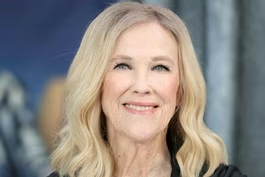
Catherine O'Hara has died.
She leaves behind a body of work that ranges from cult classics to blockbuster films and some small screen gems.
CATHERINE O'HARA, Actress: Hello.
I'm Moira Rose.
GEOFF BENNETT: She was the wacky, wealthy matriarch in "Schitt's Creek."
CATHERINE O'HARA: You will remember the experience and you will remember the name, Herb Irvlinger.
Burt Herngeif.
Irv Hermlinger.
GEOFF BENNETT: A role which earned Catherine O'Hara an Emmy and a Golden Globe.
CATHERINE O'HARA: Next step is to fold in the cheese.
DAN LEVY, Actor: What does that mean?
What does fold in the cheese mean?
CATHERINE O'HARA: You fold it in.
GEOFF BENNETT: And captivated an entire generation of fans.
DAN LEVY: You fold it in.
CATHERINE O'HARA: David!
GEOFF BENNETT: But O'Hara got her start decades earlier.
Born in Toronto, she launched her sketch comedy career with the legendary "Second City" troop and starred in its TV offshoot alongside her later "Schitt's Creek" co-star Eugene Levy.
EUGENE LEVY, Actor: Our next topic is music.
Margaret Mehan, Central.
CATHERINE O'HARA: ABBA?
EUGENE LEVY: No, it is not ABBA, Margaret.
It is not ABBA.
GEOFF BENNETT: Her writing on the series secured her first prime-time Emmy Award back in 1982.
She'd go on to play characters in some of the most beloved films of all time, like the avant-garde artist Delia Deetz in "Beetlejuice."
CATHERINE O'HARA: Kevin!
GEOFF BENNETT: The devoted mother whose frantic journey home gives the holiday classic "Home Alone" its heart.
CATHERINE O'HARA: If I have to sell my soul to the devil himself, I am going to get home to my son.
GEOFF BENNETT: And she was a staple in Christopher Guest's mockumentary-style films, including "Best in Show."
O'Hara's colleagues today paying tribute.
"Home Alone" star Macaulay Culkin writing: "I thought we had time.
I had so much more to say.
I love you."
Meryl Streep said O'Hara "brought love and light through whip-smart compassion for the collection of eccentrics she portrayed."
ACTRESS: Are those wigs real hair?
I just want to reach out and touch it.
CATHERINE O'HARA: Please don't.
No, Maureen does not like to be manhandled.
GEOFF BENNETT: In 2017, the height of "Schitt's Creek"'s popularity, O'Hara was recognized with the Order of Canada.
It's one of the country's highest honors.
And just last year, she received an Emmy nomination for her role in Seth Rogen's TV series "The Studio."
Her talent agency did not cite a cause of death, but said she suffered from a brief illness.
Catherine O'Hara was 71 years old.
Still to come on the "News Hour": The Justice Department releases three million pages of documents related to the Jeffrey Epstein case; election officials cry foul on the FBI's raid of a Georgia voting facility over the president's 2020 election loss; and Jonathan Capehart and Gary Abernathy weigh in on the week's political headlines.
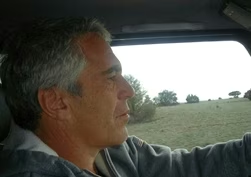
AMNA NAWAZ: The Department of Justice released its latest and likely last major batch of files related to investigations into the late convicted sex offender Jeffrey Epstein.
This comes more than a month after the DOJ missed a deadline set by Congress and signed into law by President Trump.
It includes more than three million pages, 2,000 videos and 180,000 images.
The DOJ says there are redactions, including the personally identifiable information of victims.
The department has not provided a full explanation of what's excluded.
The deputy attorney general said the White House did not have oversight over the review or redactions.
TODD BLANCHE, U.S.
Deputy Attorney General: We complied with the statute, we complied with the act, and there is no -- we did not protect President Trump.
We didn't protect or not protect anybody.
There's a hunger or a thirst for information that I do not think will be satisfied by the review of these documents.
And there's -- it's not -- there's nothing I can do about that.
AMNA NAWAZ: Our team has been going through that document dump today.
And "News Hour" justice correspondent Ali Rogin joins me now with what we know.
So, Ali, what did we learn today?
ALI ROGIN: Amna, this was a massive document dump, as you said, three million pages.
As you can imagine, our team is still sifting through them.
Before today, for comparison, the DOJ had released about 500,000 pages.
So this is orders of magnitude bigger.
And the person making this announcement today is also notable.
Todd Blanche, now deputy attorney general, he was President Trump's former personal attorney.
He was emphatic, though, that the White House had no involvement in any of the preparation of the documents.
He also said that between this release and a forthcoming report to Congress, once that's out, the DOJ's obligations under this law that Congress passed, the Epstein Files Transparency Act, will come to an end.
AMNA NAWAZ: So I know you're still going through the files, but what do we know about what is inside the files themselves so far?
ALI ROGIN: I think most notably what people are looking for is mentions of President Trump.
And there are thousands of them in these documents.
Many of them, we should note, are news clippings.
But there are some lists and summaries of unsubstantiated claims made against him from individuals alleging wrongdoing, including graphic depictions of alleged sexual abuse, including of underage girls.
Some of those complaints date back to the '90s, others from more recently around when he was campaigning for president.
What we don't know, though, is whether any of these claims have been substantially investigated.
But the Department of Justice says that they were required by law to release everything, including those documents that were fake or falsely submitted.
There's also a new diagram we saw today that shows basically an organization chart of Epstein's inner circle.
Some employees were blacked out, but we see the connections between him and co-conspirators like Ghislaine Maxwell, as well as several attorneys and an accountant.
There's also what appears to be a new picture of a desk or a table filled with photos of Epstein, Maxwell, and public figures, including Trump, as well as one with Pope John Paul II.
We have also seen in past releases some pages are entirely redacted and others are completely mundane things like schedule updates.
Amna, I also want to note that we have reached out to the White House for comment and they have provided none.
AMNA NAWAZ: We should also note, I understand there are other members of the administration mentioned in some of these documents.
What do we know?
ALI ROGIN: Yes, we already knew that Commerce Secretary Howard Lutnick had a relationship with Epstein, which he claims had ended in the early aughts.
But new documents indicate that they made plans to meet for lunch in 2020 -- in 2012 on Epstein's private island in the Caribbean while Lutnick was also vacationing in the Caribbean elsewhere with his family.
And it does seem in those documents like they followed up and had that lunch.
AMNA NAWAZ: We should underscore here just being mentioned in the documents is no indication of any kind of wrongdoing.
But we should also double down on this idea the deadline to release those documents was more than a month ago.
Why has it taken so long?
ALI ROGIN: It was indeed.
It was on December 19.
The Department of Justice says they sent more than 500 lawyers to go through these documents and meticulously redact these things.
In a letter today, Attorney General Pam Bondi said they'd identified more than six million pages that needed review, which resulted in the three million today.
They say they redacted personally identifiable information of victims and sexually explicit material.
She also said that approximately 200,000 pages have been withheld or redacted because of various privileges, including attorney-client privilege, and that within 15 days they're going to give Congress a more detailed look at government officials and -- quote -- "politically exposed" persons in this document, although there's no definition of what politically exposed means.
AMNA NAWAZ: Speaking of Congress, how is all this landing on Capitol Hill?
ALI ROGIN: Well, we heard today from one of the authors of the Epstein Files Act, Congressman Ro Khanna.
He says he has outstanding questions about why, by the DOJ's account, 2.5 million of these documents remain out of public view.
He said he was looking for victim interview statements, many of which were included in today's tranche.
He's also looking for additional documents from Epstein's computers.
But, of course, this massive tranche was just released today, so there could be more revelations in the hours and days to come.
AMNA NAWAZ: Justice correspondent Ali Rogin, thank you very much.
ALI ROGIN: Thank you.
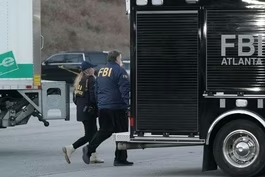
GEOFF BENNETT: The FBI's move this week to execute a warrant at voting offices in Fulton County, Georgia, to seize records from the 2020 election and the presence of National Security Director Tulsi Gabbard on the ground there has ignited a fierce debate over election security and federal authority.
Joining us to discuss some of these issues is Rick Hasen, professor of law and political science at UCLA and author of "A Real Right to Vote."
Rick, thanks for being with us.
What legitimate legal purpose could this raid serve at this stage more than five years after the election?
RICK HASEN, UCLA School of Law: It's really hard to say.
We have seen the search warrant.
It does suggest the potential for criminal charges, including for interfering with an election, as well as for destroying documents.
It would appear that these claims would be beyond the statute of limitations.
It's not clear who's being investigated.
This seems to be potentially -- and maybe this is the most optimistic reading -- just trying to indulge in the president's statements about him being concerned that the 2020 election was stolen and just perpetuating the look by the government and by others into what happened in the election, not even the last presidential election, but the one before this one.
GEOFF BENNETT: And the president continues to suggest that prosecutions are coming stemming from what he says is fraud connected to the election.
Based on what we know, how plausible are federal charges?
RICK HASEN: Well, with the statute of limitations likely having run, without knowing of any wrongdoing, there's been a lot of investigation not just of the 2020 election generally, but of Fulton County, Georgia, in particular.
They have been investigated by the secretary of state there, who's a Republican, even though Fulton County is a Democratic county.
It's hard to know who might be implicated.
I'm much more worried about the signal this sends to election administrators and others for 2026 looking forward than I am about what might happen to those looking backward.
GEOFF BENNETT: Another flash point here is the presence of the director of national intelligence, Tulsi Gabbard.
The deputy attorney general today defended her presence, defended her role in all this, saying that it was consistent with her job.
TODD BLANCHE, U.S.
Deputy Attorney General: I think her presence shouldn't be -- it shouldn't be questioned, of course, and that's a big part of her job.
And so the fact that she was present in Atlanta that day is something that shouldn't surprise anybody.
GEOFF BENNETT: So the fact that she was present in Atlanta that day, is something that shouldn't surprise anybody.
Why would the DNI be involved in a local election matter?
Is there any reason for her to have been there?
RICK HASEN: Well, the director of national intelligence should be looking at problems coming from outside the United States.
To the extent that they want to claim that there's something happening outside the United States, I suppose that's plausible.
But there was reporting in The Wall Street Journal that Gabbard has been put in charge of the administration's look into voter fraud across the country.
And so it may be, regardless of what portfolio she has, that this is going to be something that she's going to be moving forward with in the future.
She was supposed to appear before secretaries of state today and address a kind of skeptical crowd, from what I understand.
And she was a no-show.
At the last minute, she said she had a scheduling conflict.
GEOFF BENNETT: Could all of this function as a precedent -- excuse me -- a precedent or even a rehearsal for what could come in the 2026 midterms, more aggressive federal involvement?
RICK HASEN: Yes, I'm very concerned about the future, especially the idea of seizing ballot materials.
There are extensive chain of custody requirements to make sure that nobody tampers with ballots.
And, look, what happens if the FBI tries to go in while they're still tabulating votes during the midterm elections?
I think we're going to have to be very proactive in thinking about steps that states and localities might have to take to protect the integrity of their elections from the federal government.
And the idea that we have to do that just tells you how far things have deteriorated with democracy in the United States.
GEOFF BENNETT: Are states prepared?
RICK HASEN: Well, I think it varies based on the state.
And I think some people don't realize how far things could go.
I think right now it's not just the states and not just local election administrators.
It's going to have to involve courts.
It's going to have to involve the people being prepared to stand up to make sure we can continue to have free and fair elections in 2026 and 2028.
GEOFF BENNETT: Rick Hasen, thanks, as always, for your insights.
RICK HASEN: Thank you.
AMNA NAWAZ: President Trump's massive tax and funding bill, known as the One Big Beautiful Bill, was passed into law last summer.
And according to the nonpartisan Congressional Budget Office, it will slash more than a trillion dollars in federal spending from Medicaid and the Children's Health Insurance Program by 2034.
Senior correspondent Judy Woodruff examines what those cuts could mean for home and community care providers who serve adults with special needs.
It's part of her ongoing series Disability Reframed.
JUDY WOODRUFF: Sidikie Kamara's mornings are often filled with fist bumps and high-fives.
SIDIKIE KAMARA, President, Bright Center: What's the plan for today?
JUDY WOODRUFF: He's the president of Bright Center, a day program for special needs adults in Manassas, Virginia.
SIDIKIE KAMARA: So this is our main sanctuary.
This is where we do a lot of our activities.
JUDY WOODRUFF: Five days a week, the center provides education and a host of activities for participants like exercise class, arts and crafts, and meditation.
In 2014, Kamara started the center with his wife, Naomi (ph), who was born with sickle cell anemia.
At the time, she told him she'd always dreamed of creating a center like this.
SIDIKIE KAMARA: So when she came to me with that idea, at first, I was like, why do you want to do that?
(LAUGHTER) SIDIKIE KAMARA: But then after her explaining to me, it's her passion.
She wants to help.
She wants to give back to the community.
She wants to make a difference.
JUDY WOODRUFF: Kamara says, by 2021, he was working three jobs to help that vision become a reality.
And Bright Center moved to a larger building, so they could help more special needs adults.
But then his wife's condition took a turn for the worse.
SIDIKIE KAMARA: June 3 was like the worst day of my life, the worst phone call of my life.
Even to this day, I can picture it.
JUDY WOODRUFF: His wife's doctor had called to tell him that she had died unexpectedly while in the hospital, leaving Kamara with two young children.
SIDIKIE KAMARA: I wasn't even able to function for at least a month-and-a-half, because I didn't even know what to do, because it's like she was everything.
And I'm kind of like, I can't -- I can't do this without her.
You got 10 plus eight minus five.
What is that?
JUDY WOODRUFF: But, today, more than four years later, Kamara says he is still committed to keeping his late wife's dream alive for people like Imani Bush, who has an intellectual disability.
What kinds of things do you do when you're here?
IMANI BUSH, Participant, Bright Center: What kinds of things?
Well, I like to color.
I like to do meditation.
I like to sleep during meditation.
I like to watch movies.
I like to just hang out with all my friends.
JUDY WOODRUFF: In 2020, Bright Center was serving nearly 30 special needs adults.
But once the pandemic hit and forced Kamara to close for about four months.
WOMAN: Good job, Francisco.
JUDY WOODRUFF: ... he says it's been a steady decline in enrollment.
Today, just 14 individuals regularly attend.
All of them pay with Virginia Medicaid waivers, which allow for care outside of institutions.
And while the bulk of the cuts to Medicaid aren't expected to kick in until next year, states, which administer the federal funds, are bracing to lose more than $900 billion over the next decade.
ALICE BURNS, KFF: This is the single biggest rollback in federal support for health care that we have ever seen.
And people with disabilities are much more likely to rely on programs like Medicaid than people without disabilities.
Even though the bill did not directly cut their services, it's highly unlikely that there won't be some effects.
JUDY WOODRUFF: Alice Burns studies Medicaid and the uninsured for KFF, an independent health research group.
She says Virginia is expected to lose nearly 20 percent of its federal Medicaid funding by 2034, and that day programs like Bright Center could be especially vulnerable.
ALICE BURNS: With this level of a funding cut, states are going to have to make some tough choices about how to deal with the loss of federal funds.
And we know that home and community care for people with disabilities is a significant source of Medicaid funding.
And almost all the services are optional for states to cover.
ROBERT F. KENNEDY JR., U.S.
Health and Human Services Secretary: There's no cuts to Medicaid.
There's simply restrictions in the growth of Medicaid over the next decade.
JUDY WOODRUFF: The Trump administration has repeatedly said there would be no cuts to Medicaid and that it's committed to rooting out waste, fraud and abuse in the program.
The Department of Health and Human Services also provided the "News Hour" with this statement, which reads in part: "The One Big Beautiful Bill removes quote illegal immigrants from eligibility, implements work requirements for able-bodied adults and safeguards Medicaid for the vulnerable populations it was created to serve, pregnant women, children, low-income seniors, people with disabilities and struggling families."
But Laurie Sills is worried about what those changes will mean for her 28-year-old son, Nicholas.
LAURIE SILLS, Mother of Nicholas Sills: Quite frankly, Nicholas, he's a wonderful kid.He really is.
But he needs some support in just about everything he does.
JUDY WOODRUFF: As a young boy, Nicholas was diagnosed with cerebral palsy and then autism.
He's been coming to Bright Center since 2019.
LAURIE SILLS: He's here with people his own age.
He's here with people that he is involved with.
He's got staff that cares for him and he loves the staff here.
So it's a place that I know that he's comfortable coming to and that I'm comfortable bringing him to every day.
So it means a lot to me.
Can you scoot over a little bit more?
JUDY WOODRUFF: Sills says Bright Center is the only nearby day program that accepts the Virginia Medicaid waiver she relies on to pay for these services.
And without the center, she'd be forced, she says, to shoulder even more of her son's round-the-clock care.
LAURIE SILLS: He's never left alone.
He likes to go into the kitchen and he will press buttons.
He will go to the stove.
I don't in general have babysitters.
I don't have any family in the area.
So I really don't have any other care for him but me right now.
JUDY WOODRUFF: It's a common story for parents at Bright Center, says Sidikie Kamara.
SIDIKIE KAMARA: Once they graduate from high school, it's kind of like the state kind of just washes their hands.
It's kind of like you're on your own now.
So that's where we come in.
JUDY WOODRUFF: Virginia's Medicaid program currently reimburses Bright Center $69 per student per day.
But Kamara says that's barely enough to keep going.
And while he's already relying on donations and his own savings to stay open, it's what could come next that worries him most.
We're at a moment now where the federal government is making some changes.
SIDIKIE KAMARA: Right.
JUDY WOODRUFF: How is that affecting what your outlook is?
SIDIKIE KAMARA: It will affect a lot of the families and it will affect us as a facility, because then we may end up losing the small students that we have now.
JUDY WOODRUFF: For parents like Laurie Sills, she's already feeling the impact of budget cuts.
She says, last fall, the state reduced the number of hours she will be reimbursed as her son's primary caregiver going forward.
LAURIE SILLS: I'm sure there is some waste, fraud and abuse.
I'm sure there is throughout the system, but every case is not waste, fraud and abuse.
Some individuals really need the care.
and, quite frankly, that's my son that really does need the care.
JUDY WOODRUFF: Care that could become even harder to find for so many families across the country.
For the "PBS News Hour" I'm Judy Woodruff in Manassas, Virginia.
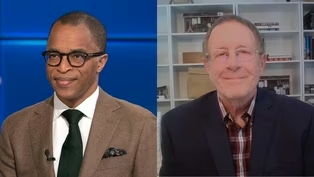
AMNA NAWAZ: For more on the political fallout from a hectic week in Minneapolis and in Washington, we turn tonight to the analysis of Capehart and Abernathy.
That's Jonathan Capehart of MS NOW and Gary Abernathy, author and editor of the Abernathy Road newsletter on Substack.
David Brooks is away this week.
Gary, it's great to have you with us.
Jonathan, good to see you here.
We need to start in Minnesota, because a lot happened in this last week.
There seems to be a consensus that something shifted after the killing of two U.S.
citizens by federal agents.
And FOX's latest poll reflects that.
Take a look at these numbers.
When asked about ICE, whether they were too aggressive, about right or not aggressive enough, 59 percent of Americans said they were too aggressive; 24 percent said about right; 17 percent said they're not being aggressive enough.
So, Jonathan, let's just start with that.
Is there agreement that ICE, that the president's immigration crackdown have gone too far?
JONATHAN CAPEHART: When it comes to the ICE enforcement yes.
You cannot have the killing of two U.S.
citizens by federal agents and then have the administration lie about what happened, and then continue to lie about what happened, despite multiple videos, recordings coming out showing each incident from multiple angles, and think that that's going to fly with the American people.
And this is an incident, particularly the shooting of Alex Pretti -- gosh, was that last week?
AMNA NAWAZ: That was last week.
JONATHAN CAPEHART: Just last week -- broke through in ways that people have been commenting on -- folks who don't even pay attention to politics.
It's broken through to them.
And this 59 percent too aggressive does not surprise me.
But I have also seen -- and I want to make this distinction, because I do think the American people make a distinction between ICE enforcement and securing the border.
And those are two separate things.
And the American people, in the polls, you will see they're all for securing the border, do what's necessary to secure the border.
But when it comes to federal agents roaming through American cities, roughing up U.S.
citizens and others, and in the case of Renee Good and Alex Pretti, killing them, that's too far.
AMNA NAWAZ: Gary, what about you?
Do you agree with the majority in this poll here that ICE has been too aggressive?
What's your take?
GARY ABERNATHY, Freelance Journalist: I'm sure that that's what they have been hearing.
That's what -- that's kind of the media narrative about it.
But let's remember why there's a lot of ICE enforcement going on in Minnesota and in Minneapolis in particular, because people are led to believe that these sanctuary cities are a real thing.
And I'm not -- they're not a real thing.
By the way, it's good to be back with you and Jonathan tonight.
Sanctuary cities, there's no sanctuary for being in the country illegally.
Federal agents are allowed to come in and do their job and enforce the law.
The only thing sanctuary cities does is, it allows local leaders not to cooperate with them, with the law enforcement, not to -- they can tell law enforcement, we're not going to cooperate with them.
And when that happens -- and I thought Tom Homan did a really good job yesterday of laying this out -- when that happens, it requires ICE, Border Patrol, federal agents to also then do law enforcement and to do crowd control.
And these are not things that they're good at.
And, to me -- and I know people look at this so differently whether you're kind of from the left or whether you're more conservative, as I am.
I look at this and I say, why is Governor Walz and Mayor Frey, why are they encouraging people to come out and confront law enforcement and to confront ICE agents, to confront federal agents?
You know, we were told back on January 6, 2021, how horrible it was that officers, that law enforcement had been attacked on that day of that riot.
And I agree with that.
I'm with you on that.
But I'm also with you on it now.
I'm saying it's terrible to confront these folks who are just trying to do their jobs to enforce the law that Congress passed.
And we need governors and mayors to encourage citizens, stay out of the way while they do this enforcement.
Don't put yourself in harm's way.
AMNA NAWAZ: Jonathan?
JONATHAN CAPEHART: Tell that to Chongly Thao, U.S.
citizen who everyone has seen the picture of him being hauled out of his home by federal agents clad in just boxer shorts and Crocs and a blanket thrown over his shoulder.
Tell that to the -- I can't remember the name of the young woman who had federal agents surround her car.
And all she was trying to do was to get out of the way so she could get to a doctor's appointment, and had her window broken, forcibly removed from her car, cut -- the seat belt cut away and hauled off by her arms and legs by federal agents.
Look, the governor and the mayor are concerned about the people who live in their state and the people who live in their city.
I'm coming at this as an American.
There is no way you can expect people to see their friends, their neighbors, their co-workers, maybe even people they don't know, but who live around them, being abused, treated roughly by a government that folks are paying taxes to pay for.
You're going to expect them to stay home and not exercise their First Amendment right to be, one, constitutional observers?
Because that's what the folks in Minneapolis are doing when they're recording what's happening.
They are making sure that people's rights aren't violated, even though they are right there on recordings.
They're there standing at bus stops.
They're there standing in front of restaurants ensuring that their neighbors can at least have some semblance of safety.
The level of siege that is felt by the people in Minneapolis, and not just Minneapolis, down in Northfield, Minnesota, where my alma mater is.
ICE has been roaming around the town.
The level of fear that is out there cannot be underestimated and cannot be discounted.
And I think that the governor and the mayor when they're telling people to exercise their First Amendment rights to protest and have their voices be heard, they are also saying in the same voice, do so peacefully.
We saw it today in Minneapolis, when thousands of people took to the streets and in really cold temperatures in Minneapolis to make their voices heard.
We saw it last Friday when thousands of people took to the streets of Minneapolis to make their voices heard.
AMNA NAWAZ: Gary, what about this idea that we are hearing from some Republican lawmakers as well that it's time for a reset?
That's the language I have heard from some Republican senators, right?
GARY ABERNATHY: Yes.
AMNA NAWAZ: That the mission was supposed to be targeting the worst of the worst.
That's what they want to see happen.
GARY ABERNATHY: Yes.
AMNA NAWAZ: That's not what's been happening.
What do you make of that?
GARY ABERNATHY: Well, it is what's been happening.
And that's what Tom Homan came in and said yesterday.
This is what's happening.
But illegal immigrants are not going to be off the hook.
Donald Trump was elected with a mandate to do what he's doing.
But let's be clear.
Let's be clear about protest.
It's not peaceful protesting to be pushing police barricades back.
It's not peaceful protesting to be throwing rocks and ICE and fireworks at officers.
It's not peaceful protest to drive your car in the middle of the street and block traffic or to confront officers as they're doing their job in their face with cell phones, provoking them and trying to get a reaction out of them.
This is not peaceful protesting.
This is dangerous behavior.
And, yes, I know that there are always sad cases that can be pointed to, but people should also go to the DHS Web site and look up the list of the violent murderers, child rapists, and so on that are being taken off the street.
This is the job that federal law enforcement officers are supposed to be doing.
AMNA NAWAZ: Gary, can I ask, does the president acknowledging even calling for de-escalation, whether or not we see that on the ground, but the president acknowledging he reached out to Governor Walz, they spoke, he mentioned de-escalation and now backing a compromise deal when it comes to this funding deal, right?
It stalled the Senate, but it looks like it will pass.
Does that say to you that the president himself acknowledged something needed to shift?
GARY ABERNATHY: Oh, I think so, yes.
And isn't it interesting?
We don't usually talk about Donald Trump as the guy being the voice of reason in any given stretch of time.
And yet I would say, this week, he really has.
I have been proud of him.
I'm often very, very critical of the way Donald Trump goes about doing things, even when I support what he's trying to accomplish.
But while you have got Tim Walz and Jacob Frey and others, I think just being -- they represent the height of irresponsibility, Trump has actually been trying to lower the temperature and move the ball forward a little bit.
Even when people are coming back at him and criticizing them, even in Davos a few days ago, he was complimentary of Governor Newsom, who was there ripping on Trump.
So I don't know what's going on.
I'm sure this will change very quickly, but, yes, Amna, I do think that President Trump realizes -- he's a master at understanding public opinion and he can read the tea leaves.
He knows when the winds have shifted a little bit and he's very good at resetting things.
And I do think he's trying to do that a little bit.
AMNA NAWAZ: Well, I will say we haven't seen the action on the ground match the rhetoric just yet, but he has shifted in terms of what he is saying.
GARY ABERNATHY: Well, but Tom Homan said the action will happen when the cooperation begins, right?
I mean, there's not going to be a reset until the Minnesota and Minneapolis officials begin to cooperate with ICE.
JONATHAN CAPEHART: You know, yes, sure, the president is a master of whatever it is that Gary just said.
He is a master of saying what he needs to say in the moment.
This is the same person, President Trump, who just overnight or early this morning called Alex Pretti a -- quote, unquote -- "insurrectionist."
So the idea that the president is lowering the temperature is -- it's not a thing.
And also the idea of going to the DHS Web site to look at the folks who they have arrested to say that these are the worst of the worst, tell that to the school officials who had to watch 5-year-old Liam Ramos be used as bait for his father.
GARY ABERNATHY: That's not true.
JONATHAN CAPEHART: And then -- I'm sorry, Gary -- and then have them both shipped off to a prison camp in Texas.
How are they the worst of the worst?
How is Liam the worst of the worst, when his own mother was inside and other relatives were inside saying, please let him stay?
AMNA NAWAZ: Gary, this has gotten a lot of attention.
I will give you a chance to respond.
What do you make of that case?
GARY ABERNATHY: No, that's OK, but we know there's a different story about the 5-year-old.
We know that that narrative is not true, that what the officials say is that the father actually abandoned that child and the officer took -- was taking care of that child, making sure he was safe, not running into traffic or anything.
(CROSSTALK) AMNA NAWAZ: Well, we do know the child is now in federal custody with his father at the detention center.
Please continue.
GARY ABERNATHY: Yes, right, right, with his father.
If he was separated, they'd be complaining that he separated from his family.
So he's with his father.
AMNA NAWAZ: We have just a few seconds left, gentlemen, and I want to get you take very quickly on this, but there's also the arrest of journalists that we saw just in the last couple of days.
And press freedom groups have obviously spoken out about it.
There's very little time left.
But, Jonathan, very quickly, how worrying a signal is that for you?
JONATHAN CAPEHART: Oh, this is very worrying.
I'd like to remind people that there's only one profession that is protected in the Constitution of the United States, and that is a free press.
And that is because the founders understood that, for a democracy to survive, it needs to have an informed citizenry, and that informed citizenry gets its information from a free -- from journalists who are able to report without fear or favor.
And, right now, the president has tried to inject some fear into journalists, but he will not succeed in stopping journalists from doing their jobs.
AMNA NAWAZ: Gary, I apologize.
Just 20 or 30 seconds left, but I will give you the last word, please.
GARY ABERNATHY: That's OK.
Very quickly -- I can do it very quickly, because I think Don Lemon quit being a journalist a long time ago.
He became an activist.
He became a political activist.
He's on the scene basically participating in the invasion or in the incursion into that church... JONATHAN CAPEHART: That's not true.
GARY ABERNATHY: ... which is also a First Amendment issue.
AMNA NAWAZ: Gary Abernathy, Jonathan Capehart, lots more to talk about.
We hope to have you back again soon.
Thank you so much.
GARY ABERNATHY: Thank you very much.
GEOFF BENNETT: Online right now, my conversation earlier today with Congressman Joaquin Castro of Texas, who visited 5-year-old Liam Ramos, now held with his father at a family detention center in Texas.
On the "News Hour," we have reported on the conditions at Dilley, reports of food being served that's been contaminated with mold and in some cases worms.
Did his father describe anything like that?
REP.
JOAQUIN CASTRO (D-TX): Yes, his father said that he hasn't taken to the food.
There were other kids there who said that they had food allergies, for example, that are not taken seriously, that they're served the same food over and over again.
People did complain of things like worms occasionally in their food.
And, remember, these are jails.
They're a type of prison.
And we shouldn't have a 5-year-old who's committed no crime and a 2-month-old baby, we should not have them in prison in the United States of America.
GEOFF BENNETT: Castro also discusses the broader impact of the Trump administration's aggressive immigration enforcement.
That's on our YouTube channel and on our Web site.
AMNA NAWAZ: And be sure to tune into "Washington Week With The Atlantic" later tonight right here on PBS.
Jeffrey Goldberg and his panel discuss President Trump's susceptibility to bad optics and why he backtracked on major issues twice in as many weeks.
GEOFF BENNETT: And watch "Horizons" with William Brangham tomorrow for a look at why PFAS, also known as forever chemicals, are so persistent.
And on "Compass Points" this weekend, Nick Schifrin and his guests examine President Trump's options for dealing with Iran.
And that is the "News Hour" for tonight.
I'm Geoff Bennett.
AMNA NAWAZ: I'm Amna Nawaz.
On behalf of the entire "News Hour" team, thank you for joining us.

Arrests of journalists fuel backlash as ICE protests spread
Video has Closed Captions
Clip: 1/30/2026 | 4m 50s | Arrests of journalists fuel backlash as anti-ICE protests spread from Minneapolis (4m 50s)
Capehart and Abernathy on the backlash against ICE raids
Video has Closed Captions
Clip: 1/30/2026 | 13m 10s | Capehart and Abernathy on the backlash against Trump's immigration operation (13m 10s)
FBI raid of election offices ignites voting security debate
Video has Closed Captions
Clip: 1/30/2026 | 4m 51s | FBI raid of election offices ignites debate over voting security and federal authority (4m 51s)

News Wrap: Mangione will not face death penalty
Video has Closed Captions
Clip: 1/30/2026 | 4m 35s | News Wrap: Mangione will not face death penalty after federal murder charge dismissed (4m 35s)

People with disabilities could bear burden of Medicaid cuts
Video has Closed Captions
Clip: 1/30/2026 | 8m 9s | How people with disabilities could bear the burden of Medicaid funding cuts (8m 9s)
Remembering the life and career of Catherine O'Hara
Video has Closed Captions
Clip: 1/30/2026 | 3m 6s | Remembering the life and career of Catherine O'Hara (3m 6s)
What's revealed in the latest Epstein files release
Video has Closed Captions
Clip: 1/30/2026 | 5m 33s | What's revealed in the latest Epstein files release – and what's redacted (5m 33s)
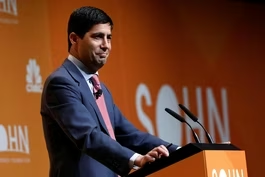
What Trump's nomination of Kevin Warsh means for the Fed
Video has Closed Captions
Clip: 1/30/2026 | 6m 34s | What Trump's nomination of inflation hawk Kevin Warsh means for the Federal Reserve (6m 34s)
Providing Support for PBS.org
Learn Moreabout PBS online sponsorship
- News and Public Affairs

FRONTLINE is investigative journalism that questions, explains and changes our world.

- News and Public Affairs

Amanpour and Company features conversations with leaders and decision makers.












Support for PBS provided by:
Major corporate funding for the PBS News Hour is provided by BDO, BNSF, Consumer Cellular, American Cruise Lines, and Raymond James. Funding for the PBS NewsHour Weekend is provided by...