
Pentagon faces another legal challenge over new media rules
Clip: 3/24/2026 | 7m 45sVideo has Closed Captions
Pentagon faces another legal challenge over new media rules
The Pentagon issued a revised policy for credentialing media after a judge struck down the Defense Department’s previous rules that determined access to its headquarters. But a spokesperson for The New York Times, which sued the Defense Department, said the new policy does not comply with the judge’s order, and they will be going back to court. Liz Landers discussed more with lawyer Ted Boutrous.
Problems playing video? | Closed Captioning Feedback
Problems playing video? | Closed Captioning Feedback
Major corporate funding for the PBS News Hour is provided by BDO, BNSF, Consumer Cellular, American Cruise Lines, and Raymond James. Funding for the PBS NewsHour Weekend is provided by...
Support provided by:

Pentagon faces another legal challenge over new media rules
Clip: 3/24/2026 | 7m 45sVideo has Closed Captions
The Pentagon issued a revised policy for credentialing media after a judge struck down the Defense Department’s previous rules that determined access to its headquarters. But a spokesperson for The New York Times, which sued the Defense Department, said the new policy does not comply with the judge’s order, and they will be going back to court. Liz Landers discussed more with lawyer Ted Boutrous.
Problems playing video? | Closed Captioning Feedback
How to Watch PBS News Hour
PBS News Hour is available to stream on pbs.org and the free PBS App, available on iPhone, Apple TV, Android TV, Android smartphones, Amazon Fire TV, Amazon Fire Tablet, Roku, Samsung Smart TV, and Vizio.
Providing Support for PBS.org
Learn Moreabout PBS online sponsorshipGEOFF BENNETT: Last night, the Defense Department issued a revised policy for credentialing media to enter the Pentagon.
It comes after a judge on Friday struck down the Pentagon's previous rules that determined access to the building.
But a spokesperson for The New York Times, which sued the Pentagon, said the new policy does not comply with the judge's order and the newspaper has filed a new motion this evening to compel the Defense Department to do so.
Our Liz Landers is here with more -- Liz.
LIZ LANDERS: That's right, Geoff.
For decades, journalists who have covered the Defense Department were issued press credentials that allowed them to come and go into the Pentagon.
But, last year, the vast majority of reporters who cover the building walked out en masse after losing their workspace and refusing to agree to new Trump administration rules for credentialing reporters.
Those rules demanded reporters sign a document saying they would not seek information from Pentagon employees, something most reporters would not agree to.
In December, The New York Times filed a lawsuit challenging these restrictions.
And its lead attorney, Ted Boutrous, joins me now.
Ted, thank you so much for joining the "News Hour."
THEODORE BOUTROUS, Attorney for The New York Times: Thank you.
LIZ LANDERS: Let's begin first by asking about the merits and the legal argument that you made in this case.
You said that the Pentagon's policy was a violation not only of the First Amendment, but also of the fifth.
What did the judge's opinion find?
THEODORE BOUTROUS: The judge's opinion powerfully found that the Pentagon's policy was meant to engage in viewpoint discrimination, that it was meant to purge reporters who wanted to independently ferret out information from sources and from the Pentagon independently and only get reporters in there who would report the party line from the department, authorized information, which, as you know, is directly counter to the way journalism works and the way the government works.
That violated the First Amendment.
And then, on due process, the court found that the standards were so vague in terms of when the department could take away a credential or deny a press credential that it gave what the Supreme Court called unbridled discretion to government officials at the Defense Department to pick and choose whichever reporter they wanted for whatever reason they wanted, to boot them out of the Pentagon.
And all of that frustrated the First Amendment rights of the reporters, but also the American people's ability to get information they need, particularly in a time of war.
LIZ LANDERS: We mentioned at the top of the segment that the Pentagon has issued this new guidance yesterday, saying that they disagree with the judge's opinion that came out yesterday and they are going to appeal that decision.
But they claim that they're going to abide by it and that they have now issued this revised policy.
What is objectionable in this latest Pentagon guidance from yesterday?
Why did you file this motion just a few minutes ago?
THEODORE BOUTROUS: We filed it because, instead of abiding by and following the judge's order and opinion, they're defying it, brazenly defying it.
It reinstates, in the words of one of the lawyers for the government, the same standards, but using different words and using more words.
He literally said that in an interview.
And so it's creating the same constitutional problems regarding reporting on unauthorized information.
It's vague.
And then they added new restrictions that the court barred them from enforcing these instructions.
So they doubled down.
They for the first time in history have barred reporters with press credentials from going into the Pentagon without an escort, which is just shocking, I must say.
And then they have said that it's presumptively evidence that a reporter is violating the policy and engaging in wrongful conduct if they promise anonymity or confidentiality to a source, which, again, is a First Amendment violation of the first order, unheard of.
No government entity does that, not the White House, not the Justice Department.
It's inexplicable, and it really shatters a longstanding tradition at the Pentagon and in our government of getting information to the public.
LIZ LANDERS: One of those provisions was that idea of not soliciting information.
And, originally, the Pentagon said that reporters could not solicit classified or non-public.
So, even nonclassified information, they were told not to solicit.
That's a basic way that reporters do their jobs.
We ask for tips and information from the public.
Does the new policy that was issued yesterday get and solve this problem?
Does it get at that issue?
THEODORE BOUTROUS: It does not solve that problem.
And, as the judge pointed out, reporters, their job is to ask questions.
And you can't have a government policy that prohibits that or criminalizes it.
In some ways, they are now saying that asking for information that's not been authorized to be disclosed implicates the criminal laws, which is, again just wrong.
It's what reporters do.
They have changed the words.
They have now said induce, intentionally induce the disclosure of unauthorized information, even if it's unclassified.
And that, again, flies in the face of the judge's order.
It was very clear that this type of restriction violated the due process clause, violated the First Amendment.
So they haven't made it better.
They have taken out some provisions, but then added in others that really are meant to defeat the order and defy the order.
LIZ LANDERS: Do you think that the judge's ruling applies to more than just The New York Times' reporters that you were representing?
THEODORE BOUTROUS: We do.
We specifically asked for the court to vacate the offending unconstitutional provisions in the new policy.
And the government argued that the court shouldn't do that, that it should remand it back to the government, the department, so they could revise the policy.
And the judge rejected that and vacated it and said that the ruling and its injunction apply to all reporters, all regulated parties.
But that's part of the problem with what the government has done here.
They have done exactly what they asked the judge to do, and he rejected it.
And they're really just flying in the face of what the court ordered and what the court intended.
That's why we filed the motion.
LIZ LANDERS: We have just a few moments left, but The New York Times has continued to robustly report on the Pentagon and this current conflict that we're seeing with Iran.
Why does it matter if they have access to the building itself?
THEODORE BOUTROUS: We put in declarations from longtime journalists who covered the Pentagon for decades and for years, and from Pete Williams, who was also not just a journalist, but a spokesman for the Department of Defense.
And all of them agreed that the benefits to the public and to reporters, even if you can report outside the Pentagon, are immense and that it's a great loss, because reporters establish relationships with the department officials.
Officials trust the reporters.
They exchange information.
That benefits the department because they can get the truth out to the American people and explain themselves.
It benefits the public because they get more information.
And, as the judge put it, in a time of war and running up to elections, people need as much information as they can get to try to determine whether to support those policies, to protest and who to vote for.
And that's what the First Amendment is all about.
LIZ LANDERS: OK, attorney Ted Boutrous, thank you so much for joining the "News Hour."
THEODORE BOUTROUS: Thank you for having me.
 New
NewChicago Fed president breaks down economic risks of Iran war
Video has Closed Captions
Chicago Fed president breaks down economic risks of Iran war (7m 5s)
 New
NewCivilians find no refuge from strikes as Mideast war widens
Video has Closed Captions
Civilians find no refuge from strikes as Middle East war widens (8m 57s)
 New
NewJakarta sinks as climate change and overdevelopment collide
Video has Closed Captions
Jakarta rapidly sinks as climate change and overdevelopment collide (7m 3s)
 New
NewMultiple failures likely led to deadly LaGuardia collision
Video has Closed Captions
Investigators believe multiple failures led to deadly LaGuardia Airport collision (6m 14s)
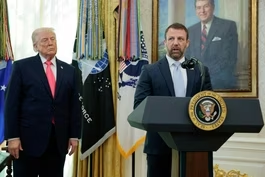 New
NewNews Wrap: Mullin sworn in as Homeland Security secretary
Video has Closed Captions
News Wrap: Mullin sworn in as Homeland Security secretary (6m 5s)
 New
NewTrump’s plans for D.C. draw backlash and court challenges
Video has Closed Captions
Trump’s vision for D.C. draws design backlash and court challenges (8m 58s)
Providing Support for PBS.org
Learn Moreabout PBS online sponsorship
- News and Public Affairs

FRONTLINE is investigative journalism that questions, explains and changes our world.

- News and Public Affairs

Amanpour and Company features conversations with leaders and decision makers.












Support for PBS provided by:
Major corporate funding for the PBS News Hour is provided by BDO, BNSF, Consumer Cellular, American Cruise Lines, and Raymond James. Funding for the PBS NewsHour Weekend is provided by...