
April 16, 2026 - Full Show
4/16/2026 | 26m 49sVideo has Closed Captions
Watch the April 16, 2026, full episode of "Chicago Tonight."
The city’s watchdog reflects on her tenure as it comes to a close. And Steppenwolf’s new play examines the money that follows a father’s loss.
Problems playing video? | Closed Captioning Feedback
Problems playing video? | Closed Captioning Feedback
Chicago Tonight is a local public television program presented by WTTW
WTTW video streaming support provided by members and sponsors.
April 16, 2026 - Full Show
4/16/2026 | 26m 49sVideo has Closed Captions
The city’s watchdog reflects on her tenure as it comes to a close. And Steppenwolf’s new play examines the money that follows a father’s loss.
Problems playing video? | Closed Captioning Feedback
How to Watch Chicago Tonight
Chicago Tonight is available to stream on pbs.org and the free PBS App, available on iPhone, Apple TV, Android TV, Android smartphones, Amazon Fire TV, Amazon Fire Tablet, Roku, Samsung Smart TV, and Vizio.

WTTW News Explains
In this Emmy Award-winning series, WTTW News tackles your questions — big and small — about life in the Chicago area. Our video animations guide you through local government, city history, public utilities and everything in between.Providing Support for PBS.org
Learn Moreabout PBS online sponsorship>> And thanks for joining us on Chicago tonight.
I'm Nick Blumberg.
Brandis Friedman is on assignment.
Here's what we're looking at.
Chicago's Inspector General Deborah, which reflect on her tenure and shares her thoughts on the work ahead.
How much have Chicago taxpayers spent on police misconduct lawsuits so far this year?
>> In this we're interrogating what we believe.
>> Oscar winning playwright Tarell Alvin McCraney on his latest production Commission for Steppenwolf Theatre's 50th anniversary.
>> I think it's really critical that we create opportunities for young women.
>> And meet the women powering their own mechanic shop.
First off tonight as Chicago's top watchdog prepares to step down, she leaves behind a series of sharp critiques of police oversight and accountability >> including new findings that raised concerns about how misconduct is investigated and documented within the Chicago Police Department Inspector General Denver, which Berg's departure comes at a pivotal moment as the city faces ongoing scrutiny and of the federal consent decree and questions about whether reforms are on track.
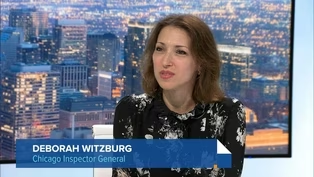
And joining us is Deborah, What's Bird inspector general for the city of Chicago.
Thanks for coming back on the program.
Thanks for having So you've often said Chicago operates at deficit of legitimacy and that a lot of your work was aimed at correcting that imbalance.
How do you the value the progress that you made?
>> This is something I worry about a lot.
you know, the the fact that Chicago earns every bit of its reputation, you know, that has been generations in the making >> and we are not going to fix what's wrong with city government while any one of us is here.
And so in that world where there's no finish line in sight.
Mile markers are hard come by.
And so I've spent a lot of time thinking and worrying about this question of how we know if we are making progress, how we know if it's working.
I think that we have made progress.
I think that we have held people in power to account in a way that historically didn't happen.
And I think that matters to people.
I'm also really encouraged by the fact that get more in takes.
We hear from more Chicagoans more often than the office ever have has before.
So we getting any one quarter we get between 2004 1000 in takes and that number has gone up really consistently over time.
I think that's a good news story.
I don't think that's because more things are going wrong in the city of Chicago.
I think that's because more people know who we are and what we do and where to find us.
And maybe most importantly, I think that more people are willing to believe that if something goes wrong in the city there, someone who will listen and can help.
So.
So I think we've made some progress.
I also think there's a great deal left to do.
>> Well, your time in the inspector general's office that spanned 3 mayoral administrations, Mayor Lori Lightfoot said she wanted an IG who would stand her You've called Mayor Johnson's administration reflects of Lee hostile to oversight.
Do you think that friction was because of those mayor specifically or is it more so a trade among executive executives to resist that oversight?
There is certainly some structural tension between and IG and the entity they oversee.
>> If if in this situation, if the mayor felt entirely warm and fuzzy about the Office of Inspector General, we wouldn't be doing our job.
That said, I think there's a great deal of room for improvement to say the least in the city's cooperation with oversight.
What does that cooperation look like any?
What do you think sort of the?
>> The best case of a working relationship between and I G S office and a Merrill administration.
A city hall should Well, I think.
>> I've given that some thought will say one of the things I'm proudest of about this term is that we have built very productive, very positive working relationships with many people and many departments across city government.
That's not to say that.
Everybody's glad to see us coming or agrees with us.
In fact, so often than not, but we have come to a place with a lot of people in city government where I think there's a shared recognition that if we are not all pulling in generally the same direction, if we are not all working in the direction of building a government that more closely resembles the one Chicagoans deserve that, at least some of us are in the wrong line of work.
And so actually think there are a lot of models for what a good and productive relationship can look like when everybody recognizes the value, albeit sometimes uncomfortable of effective and independent oversight.
>> You mentioned Chicago's not always so great reputation when it comes to corruption.
You said before that the high-profile convictions of folks like former Alderman Ed Burke for House Speaker Michael Madigan, that they should have been a catalyst for systemic reform.
A lot of folks would agree that that hasn't necessarily happened.
think that was a missed chance there.
>> I think that Chicago has historically done a lot of public policy by crisis response.
I think much of what we've seen as we look back over history in the city as we've seen efforts at various kinds of reforms, including police in public safety reform, which have been generated in the wake of a crisis.
I think the release of a local McDonald's video was one of those catalyst events the murder of George Floyd was another again on the public safety front.
And so I think I think some of these catalysts events open this window of opportunity and we certainly have not seized all of those opportunities.
>> You know, you announced that you wouldn't seek a second term after the city Council expanded.
The IG is power in part to block the city's top lawyer from stepping in when their investigations that risked embarrassment or political consequences.
told a city council today the law department has not complied with those new rules.
Are you concerned the mayor might pick a successor who won't as aggressively challenge his administration on that issue and on others.
I think the process for the selection of a new inspector general is one that is fought fully built to guard against the risk to not just this mayor, but any mayor mayor might.
>> Select someone who would who would be sort favorable to them all circumstances.
And so, you know, I believe in the process, I appreciate the folks who've been working on it.
I think we should all all of us who have a stake in a more accountable, more effective government should be watching that process and its outcome closely, as you said, not necessarily a good fit for someone who is a warm and fuzzy relationship with the floor.
>> All right.
Well, let's take a look at some findings from your office's report that came out last week.
In one instance, it says CPD leadership consistently removed police powers when officers were arrested.
But not only not always when they were accused of other serious misconduct.
The CPD doesn't track cases where officers were considered but not ultimately stripped of their police powers also found a black and Latino male officers were disproportionately stripped of police powers.
What do you think CPD needs to do to make things right?
These instances?
>> With the questions around whether and when someone's police powers are removed.
While a misconduct investigation is pending is is part of a really important set of questions that we have looked at around the transparency and robustness of Chicago's police disciplinary system.
If we are ever going make any progress in fostering public trust in policing, we need a disciplinary system in which both members of the public and members of the department have reason to be confident things go wrong in law enforcement, even good law enforcement is messy and difficult work and we need to have a system in place to deal with things that go wrong.
And so this work is part of that larger view.
And we found here, as you say, we found some inconsistent season practice and we found kind of minimal record keeping for how these decisions get made about whether and when to remove police powers in order for us or anyone else that up even the department itself to be able to assess whether those decisions are being made in a fair and consistent manner.
We need more information about the decision-making process.
So that's the spirit of the recommendations we made to Chicago Police Department to which the department was, I think very receptive.
>> Well, speaking to that issue, I mean, currently the ID's role is to make those policy recommendations to suggest fixes to city agencies departments but doesn't necessarily have the authority to force officials to act.
Do you think that should change?
>> Well, we have recommendation making authority, as you say, and and city departments, including the Chicago Police Department are obligated to respond to our recommendations.
And then we kind of publish that whole conversation that's designed to happen in the light of day.
We conduct the public's business in public.
>> you know, I think on any anyone recommendation, anyone question there, sometimes some room for for good faith disagreement.
And I always appreciate those those engagements in those conversations with city departments.
>> This is an opportunity for public scrutiny and for legislative oversight when city departments do not accept our recommendations.
And as you said, the public at least it is more interested in reporting things, too.
So hopefully that that scrutiny is a piece of that as The latest report also examined crash where a Chicago fire department employee struck and killed someone while behind the wheel.
>> You found responding officers and supervisors failed to take key investigative steps.
Do you think those findings point to a training issue?
Is there a culture problem?
Is a bit of both perhaps?
I think it's really hard to tell.
And that's really what matters in that case.
>> It's really hard to tell what happened in this underlying incident because critical information was never collected.
And that's that's what drives our observations about the shortcomings in that death investigation.
>> You've warned that the consent decree aimed at reforming Scott Police Department is in danger of failing and so that it hasn't yet resulted in meaningful change for Chicagoans, many of whom have had a fraught relationship with the department for decades.
Who do you think it is is responsible for that potential failure where you know where we be looking?
Well, I think that's a difficult question.
We are 7 years Chicago's consent decree and, you know, the observation I made before is that if you're riding your bicycle to slowly, it tips over.
And that's I think that that's the danger here.
That's the risk.
I think it's important to say that the Chicago Police Department's current leadership has presided over a sharp increase in in compliance efforts with the consent decree.
And that's really important to say.
>> Meaningful public safety reform, which happens on the street and not on the paper.
>> Is an effort which, you know, goes beyond the 4 walls of the police department.
That isn't an effort that needs to be appropriately resourced appropriately supported by other city departments.
That's an all hands on deck in Denver.
And what do you think needs to be done?
You know, in that all on deck endeavor to prevent the reform effort from collapsing.
>> Reform takes resources.
And so if we're going to get the work done of complying with the consent decree and meeting the city's other reform mandates to be people in place to do that work and they need appropriate resources to do it.
>> And do you feel like those are all necessarily in place right now?
>> I think seen in the last couple of budget cycles.
A lot of conversation about this.
Do we have the right number of positions in in reform, focused jobs.
We have people in those positions or are they vacant what that what that kind of workforce allocation looks like?
I think all those are important questions.
>> We are 10 years at the end of the month to know what's next for you.
Sum up at the end of next next week.
It's yeah, I kind of the mindset saying counting the days.
>> You know, I am.
>> I've spent an entire career in government service.
It's been a tremendous privilege to work in the public service.
And I will I will steal from Rahm Emanuel when I say that I'm not done with public service and I hope public services and done with me.
All right.
We've got just about 30 seconds left piece of advice.
Might you pass along to successor, whoever that should >> Good luck >> I think the best piece of advice I would offer is to pick your battles.
And when the ones you pick.
>> All right, Deborah, what's Congratulations on 10 years with the office and thank you for joining us.
We appreciate it.
Thank you very much.
Up next, how much of Chicago taxpayers spent on police misconduct lawsuits so far this year?
The Sharon has an answer to that right after this.
>> Chicago tonight is made possible in part why the Alexander and John Nichols family.
The Pope Brothers Foundation.
And the support of these donors.
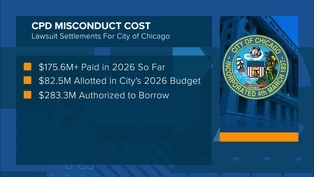
>> Chicago taxpayers paid more than 175 million dollars to resolve lawsuits alleging Chicago police officers committed a wide range of misconduct.
That's according to a W T Tw News analysis from the first 4 months of the year.
Our Heather Sharon joins us now from City Hall with more.
So Heather, remind us how much money the city's 2026 budget set aside to resolve these lawsuits.
>> So the city council set aside just 82.5 million dollars to resolve these lawsuits, which could become a source of increasing pressure on the city's already cracked cash, strapped finances.
They did authorize officials to borrow an additional 283 million dollars acknowledging that this cost of these lawsuits has grown significantly between 2024 2025.
The cost to resolve police misconduct lawsuits doubled.
And there's no doubt that 2026 will set a new record once again >> so the latest massive settlement will go to a man who spent 19 years in prison for a murder he didn't commit.
How much is the city going to pay him?
>> Carl Reed will get 9.5 million dollars after he spent, as you said, nearly 2 decades in prison, convicted of murdering his neighbor back in Now there's no physical evidence that ever tied read to the murder.
And the police detective who helped convict him has been found by Illinois Torture Justice Commission to have abused other suspects in Chicago.
Police custody >> and do we have any sense of how much more the city will spend to resolve police misconduct lawsuits in the coming months.
>> We don't a lot of the final tally will depend on what juries do in the coming months.
But we do know it will cost at least another 45 million dollars.
And that will go to more than 200 people who spent decades in prison saying after they said that they were convicted on false evidence from now convicted former Sergeant Ronald Watts as part of a global settlement approved by the city Council last year in all the city will pay 90 million dollars to those men and women.
The city's pay.
Just half of that in January.
So they've got a bit more to >> Yeah, a long time coming that settlement.
All right, Heather, sure around.
Thanks very much.
>> Thanks, Nick.
>> And you can read Heather's full story on our website.
It's all at W T Tw Dot com slash news.
>> A son lost in a clash with the police.
A huge cash settlement on the table and a father torn between staying put in Chicago or starting a new that all too real dilemma is what underpins the plate windfall.
A new work written by Oscar-winning Steppenwolf ensemble member.
Terrell Alvin McCranie.
And it's a work that McCranie says he didn't take on lightly.
>> It that someone who lived here has had criminal record.
>> I did stupid, but it >> Windfall was commissioned as part of Steppenwolf Theatre's 50th anniversary season.
And it's the first play written specifically for its ensemble theater with the audience seated in the round and immersive experience that befits the play's emotional weight.
>> The money, It's all Cast member Glenn Davis is also Steppenwolf Co-artistic director, along with Audrey Francis.
Usually actors don't run theater companies.
I think here at Steppenwolf because it's an ensemble theater made up mostly of actors.
We also have directors.
>> Writers, but we started as an acting company and very much still it is hard and it will today among the cast Davis, Alana Arenas and Jon Michael Hill, all of whom appeared in Twenty-twenty Four's purpose, which opened at Steppenwolf and eventually moved to Broadway, winning the 2025, Tony, for best play.
>> The Secret weapon of step of our fun say is the fact that you have these relationships that of traverse time and space over so many years.
>> Including Davis's relationship with fellow ensemble member and windfall playwright Tarell Alvin McCraney.
>> Not only my best friend but also.
One of the great drama NCIS of his generation often talk about the spiritual aspects of theater that we come into a room and we believe together and therefore something act of faith is happening.
In this play.
We're interrogating what we believe.
And I we believe as a society, more than anything that money.
>> Coors more things and we'd like to admit.
Glen Davis told us that this was the play.
You said you were most afraid to write most anxious about why was that?
>> Money is the thing that some people say the root of all evil is based on that wars are started about.
>> Here I was wanting to make a play about the ways in which money are attributed to black bodies, particularly those who are harmed by the city.
>> The challenging material appealed to longtime New York based actor Michael Potts who is making his Steppenwolf debut.
I wanted to work here for a very, very time.
was wondering why at math?
>> take it.
What drew you to this role?
I love.
Puzzles and I love this is kind of.
So he's created about this character about these characters of the end.
This store.
And how it fits in the human experience.
>> The play's infused with the joy of community, the joy of tackling something to gather.
Actor Alana Arenas has no McCranie since high school and the Arts Community Center in Miami.
They both went on to study at the Paul where they met Glen Davis.
>> Maybe more than once our directors looked at us and had to say to have this every 2 there's a lot of there's a lot playfulness and the room.
But it's it's.
>> Cozy, you know, like the old comforting sweater.
As I said, we have not done anything wrong and do not admit to doing anything.
Terrell is very masterful in knowing that we need to have a serious conversation.
But choosing a tone that makes it palatable for us to all engaged.
>> Stephen Wolf has previously staged several of muck.
Rainey's works.
He's also well known as the writer of the Oscar-winning film Moonlight Adapted from one of his own plays.
>> We just saw Ryan Coogler join a club that you're a part black artists recognized with a screenplay Oscar.
What did it feel like to see him up there on that stage man.
>> I Yeah.
It was.
It was extraordinary.
It was extraordinary.
And the way in which he holes his community so close.
>> And that he's a leader in the community felt it was astonishing to see.
>> As Stephen Wolf marks its 50th season, the artist working on windfall are cognizant of the history they're carrying on and helping right.
>> That initial group of ensemble members who started in the Mid 70's.
They've played husband and wife, brother and sister brother on brother, father signed mother daughter.
All the things over 50 years now.
And so to be even know someone that well.
>> Is a gift.
>> The play is directed by away Tempo and also features ensemble member Smallwood just appeared in bug on Broadway with Carrie.
Windfalls Grand opening is on Sunday.
It begins its regular run on Tuesday and is scheduled to run through May 31st.
Up next, meet the woman behind a Chicago repair car repair shop, rather looking to make our care more inclusive.
>> Reflecting the people and perspectives that make up our communities.
This story is part of Chicago tonight.
Black voices.
>> In Ravenswood, a new kind of mechanic shop is breaking the mold.
Joiner.
Hernandez recently stopped by to see how the garage is opening its doors to help more women enter the industry.
Here's another look.
>> Ever pop the hood of your car and have no idea what you're looking at.
>> For some drivers walking into a mechanic shop can feel intimidating.
>> It is not a safe really included space.
When so it kind of talks in.
Vehicle jargon and makes a way over complicated when it's actually really simple.
Do you need this or do >> Meet Ray Shaffer and she's a lead mechanic at Megan Estep, a nonprofit repair stop aimed at making auto care more inclusive for women and non-binary folks.
>> The whole time military of us only female.
It wasn't until right before actually retired out that I got to train my first female in job.
To pull out check in with >> This is actually looks pretty new shift in spent nearly a decade and the Air Force has a heavy mobile equipment.
Mechanic said she knows her way around cars I was.
I was working on my hands hours, probably handed some >> tool at the age of 2 and was like, go play with this outside.
Take a department, put it back together.
And then.
While you're checking level.
Also check in the fluid, making sure the it's it looks clean is not burn.
2% of all mechanics are women and it's a problem because we have all these openings everywhere.
>> Lisa Thompson is the founder of Mecca.
Nice to an idea.
She says came after research in conversation with people in the industry.
That's when she first heard about the 2% problem.
And so I said, oh, what are you doing?
Like, what are some of the things that people are doing to try to solve this 2% problem?
He said.
>> I really think that anyone's doing anything about it.
So I Rachel, my husband, I was like I think I have to do this.
I think I have to start a program for this.
>> And the garage doesn't look like an ordinary mechanic shop.
>> I wanted the space to look like some place.
I would feel comfortable.
Curling up with a book in a cup of coffee.
>> The auto shop has plenty of space for parents to bring their kids or anyone wanting to get some work done while their cars being serviced.
>> I want them to walk out feeling like, wow, that was fun.
That was a pleasant hour.
And I know what's going on with my car.
It could possibly just beer bill.
If it's getting more like that.
>> Besides offering car services, Thompson says they're developing a 12 Week Apprentice program for ages 16 to 24 a chance for girls and non binary people to jump into a career in the automotive industry.
I think it's really critical that we create opportunities for our young women to work in a garage and to learn in a place that they feel safe, that they feel included, that they feel is equitable because otherwise they may not stay in the field and you never want to open that when a car just pulled in here because pressurize and very pink.
I'm getting an opportunity to create that safe space and that.
>> Opportunity to.
Give people the confidence and show them that we can do this.
We are so capable as a human beings got absolutely as women women >> For Chicago tonight, I'm joined on this.
>> Make a nice to also hosts occasional workshops where people can learn the basics of car care.
For more on that and how to make an appointment, you can visit our website.
And that's our show for this Thursday night.
You can stream Chicago tonight on our W T Tw YouTube channel every evening and catch up on any programs you may have missed.
Join us tomorrow night at 5.37, for the week in review.
Now for all of us here in Chicago tonight, I'm Nick Lambert.
Thank you for watching.
Stay healthy and safe tonight.
>> Closed captioning is made possible by Robert a cliff and Clifford law offices, a Chicago personal injury and wrongful death that is a
 New
New4 Months Into the Year, Chicago Has Spent at Least $175.6M to Resolve Police Misconduct Lawsuits
Video has Closed Captions
The city’s 2026 budget set aside just $82.5 million for police misconduct settlements. (2m 31s)
 New
NewInspector General Deborah Witzburg Reflects on Her Tenure
Video has Closed Captions
The city faces scrutiny over the federal consent decree and whether reforms are on track. (11m 7s)
 New
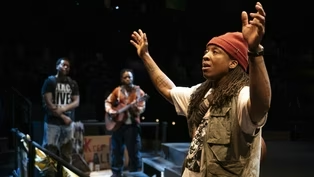
NewOscar-Winning Playwright Tarell Alvin McCraney on New Steppenwolf Play
Video has Closed Captions
“Windfall” was commissioned as part of Steppenwolf Theatre’s 50th anniversary season. (5m 32s)
Providing Support for PBS.org
Learn Moreabout PBS online sponsorship
- News and Public Affairs

Top journalists deliver compelling original analysis of the hour's headlines.

- News and Public Affairs

FRONTLINE is investigative journalism that questions, explains and changes our world.












Support for PBS provided by:
Chicago Tonight is a local public television program presented by WTTW
WTTW video streaming support provided by members and sponsors.