
April 14, 2026 - PBS News Hour full episode
4/14/2026 | 57m 46sVideo has Closed Captions
April 14, 2026 - PBS News Hour full episode
April 14, 2026 - PBS News Hour full episode
Problems playing video? | Closed Captioning Feedback
Problems playing video? | Closed Captioning Feedback
Major corporate funding for the PBS News Hour is provided by BDO, BNSF, Consumer Cellular, American Cruise Lines, and Raymond James. Funding for the PBS NewsHour Weekend is provided by...
April 14, 2026 - PBS News Hour full episode
4/14/2026 | 57m 46sVideo has Closed Captions
April 14, 2026 - PBS News Hour full episode
Problems playing video? | Closed Captioning Feedback
How to Watch PBS News Hour
PBS News Hour is available to stream on pbs.org and the free PBS App, available on iPhone, Apple TV, Android TV, Android smartphones, Amazon Fire TV, Amazon Fire Tablet, Roku, Samsung Smart TV, and Vizio.
Providing Support for PBS.org
Learn Moreabout PBS online sponsorshipAMNA NAWAZ: Good evening.
I'm Amna Nawaz.
Geoff Bennett is away.
On the "NewsHour" tonight: The U.S.
facilitates peace talks between Israel and Lebanon in the hopes of finding a solution to the decades-old conflict reignited by the war with Iran.
The resignations of two congressmen over separate sexual misconduct allegations spark broader ethics concerns.
And new data show how the Trump administration has cut legal immigration much more than illegal immigration.
DAVID BIER, Director of Immigration Studies, Cato Institute: These are people who are actually going to contribute to the country through work and entrepreneurship.
Many of them are prime-age adults ready to enter the labor force who we need right now to revitalize our economy.
(BREAK) AMNA NAWAZ: Welcome to the "News Hour."
Mediators are racing to bring the U.S.
and Iran back to the negotiating table amid a standoff over the Strait of Hormuz and a precarious cease-fire.
Historic talks, however, did happen today.
The U.S.
hosted the first face-to-face meeting between Israel and Lebanon in decades to discuss the shared goal of ending the war between Israel and Iran-backed Hezbollah and Lebanon.
William Brangham begins our coverage.
WILLIAM BRANGHAM: The funeral marches seem endless in Beirut.
Red Cross volunteers carried the body of one of their own, 31-year-old Hassan Badawi killed this weekend by an Israeli drone strike.
His family wept.
His Red Cross colleagues embraced.
And then it was back to work, joining other first responders defined bodies under the mountains of rubble that remain from Israel's relentless attacks against what it says are Hezbollah targets.
Many victims were civilians.
That includes the devastating strike last week that Lebanese health officials say killed more than 400 people in a span of just 10 minutes.
Israel claimed hundreds of those killed were Hezbollah militants.
More smoke from strikes clouded the horizon today in Southern Lebanon, as Israel presses ahead with its air campaign and ground invasion, despite the cease-fire in Iran and despite Tehran's demands that Lebanon be included in that pause.
A world away, today in Washington, a historic meeting.
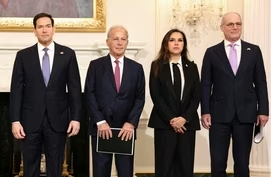
Secretary of State Marco Rubio stood alongside Israeli and Lebanese diplomats, gathering them for the first face-to-face talks between the two countries in more than 30 years.
MARCO RUBIO, U.S.
Secretary of State: This is a historic opportunity.
We understand we're working against decades of history, complexities that have led us to this unique moment.
And the opportunity here, I know you some of you were shouting questions about cease-fire.
This is a lot more than just about that.
This is about bringing a permanent end to 20 or 30 years of Hezbollah's influence.
WILLIAM BRANGHAM: Hezbollah was not part of today's talks and the group said it wouldn't abide by any agreement, including renewed demands to disarm.
Lebanon's ambassador reiterated the country's calls for a cease-fire which Israel has so far ruled out.
But following the two-hour talks, Israel's ambassador said there was a commitment toward a common enemy.
YECHIEL LEITER, Israeli Ambassador to the United States: We discovered today that we're on the same side of the equation.
And that's the most positive thing we could have come away with.
We are both united in liberating Lebanon from an occupation power dominated by Iran called Hezbollah.
WILLIAM BRANGHAM: Consequences are also mounting for Israel following more than a month of war.
Italian Prime Minister Giorgia Meloni today said she would suspend a defense cooperation agreement with Israel.
But while the Israelis and Lebanese engaged in talks today, no such talks occurred between Iran and the United States, and the U.S.
Naval blockade of Iranian ports along the critical Strait of Hormuz entered its second day.
The U.S.
military claims no ships made it past them so far as it hopes to pressure Iran's main economic engine, oil exports.
Meanwhile, pressure is mounting for international mediators, namely, Pakistan, to try and arrange a new round of talks while the fragile cease-fire still holds.
For his part, President Trump today told The New York Post he felt talks could be imminent, saying they could be happening over the next two days in Islamabad, Pakistan's capital.
For the "PBS News Hour," I'm William Brangham.
AMNA NAWAZ: Now, for the view from Tehran, we're once again joined by special correspondent Reza Sayah.
So, Reza, the cease-fire between the U.S.
and Iran is shaky, at best, set to expire in another week or so.
Tell us what the atmosphere is like in Tehran right now and how worried Iranians are that a war could restart.
REZA SAYAH: Yes, this is a country of 92 million people.
They don't have one voice.
They don't have one emotion.
But I think if there was one overarching emotion, it would be one of suspense.
Why?
Because no one here knows what's going to happen in the coming days.
They don't know what's going to happen when the cease-fire is over.
Is there going to be a war again?
Is there going to be an agreement?
People simply just don't know.
What I can tell you is, no matter where you go in Tehran, people are talking about this war, this conflict, these negotiations.
Everyone has a view, an opinion, a thought about the war, where things stand and what should happen.
So everyone's being a political analyst and a war strategist.
I would say many Iranians are naturally worried.
They just went through six weeks of bombings and airstrikes.
They're worried that that's going to start again.
And I think, increasingly, you're hearing many ask the question about Mr.
Trump, whether he is in a state of mind that he would actually use a nuclear bomb.
And that's what you hear a lot of people asking.
There's a lot of Iranians who are showing support and solidarity for their armed forces.
These are staunch supporters of the government and Iranian nationalists who may not have supported the domestic policies of this government, but they did not like the fact that this country was attacked by the U.S.
and Israel.
And a lot of people are curious about the opponents of the government, those who wanted U.S.
intervention and regime change.
And I can tell you, ever since this war started, they've been absent and silent publicly, at least, but no question they're watching too.
AMNA NAWAZ: Reza, as we've been reporting, those peace talks in Pakistan on Saturday between Iranian and U.S.
officials went over 20 more hours, but they ended with no deal.
And we just saw today President Trump hint that talks could resume within a matter of days.
We saw the U.N.
Secretary-General Antonio Guterres also say after meeting with Pakistani officials it was highly probable those talks would resume.
What are you hearing from Iranian officials?
Do they want to reengage in peace talks?
REZA SAYAH: They're open to reengaging in peace talks.
They're also ready for war again.
I think the messaging and the position of Tehran has been remarkably consistent.
They say that they were very close to making progress in the talks in Islamabad.
Abbas Araghchi, Iran's foreign minister, explicitly said that they were close to signing a memorandum of understanding, which would be tangible progress.
But according to Mr.
Araghchi, Washington moved the goalposts and the talks fell apart.
But you get the sense that this negotiating team, this Iranian negotiating team, did not come back to Tehran disappointed, frustrated, and desperate for a deal.
And that speaks to the mistrust Tehran has of Washington.
Iran's position is they're willing to discuss and negotiate for a fair agreement, one that recognizes Iran's sovereignty and international right.
But Iran's view is that the U.S.
doesn't want these type of negotiations.
Tehran has repeatedly suggested the U.S.
is being influenced by Israel, that the U.S.
wants to demilitarize Iran, they want a servile Iran to a region that's dominated by the U.S.
order, and they simply won't give in to those conditions.
Tehran says, if Washington's approach changes, they're willing to negotiate.
And we know Tehran says there's been messages exchanged with Washington for the possibility of another round.
AMNA NAWAZ: That is special correspondent Reza Sayah reporting for us from Tehran tonight.
Reza, thank you.
Good to speak with you.
For more on the wider war, we turn now to Barbara Leaf.
She was assistant secretary of state for Near Eastern affairs during the Biden administration.
She's now a senior international policy adviser at the law firm Arnold & Porter.
Barbara Leaf, welcome back to the "News Hour."
Let's start with that meeting today here in Washington between the Israeli ambassador and Lebanese ambassador hosted by U.S.
Secretary of State Marco Rubio.
How significant was that meeting today between these two parties?
BARBARA LEAF, Former U.S.
Assistant Secretary of State: Well, on the one hand it is significant, but it's significant more in symbolic terms than in substantive terms.
I found it interesting that Secretary Rubio said at the front end of the meeting that he emphasized that it was -- this was the start of a process, not just a single meeting.
That was not even the framing that the U.S.
accorded the Islamabad talks over the weekend.
But, in fact, this is a very fragile start.
AMNA NAWAZ: Well, we know Lebanese officials have been asking for this kind of a meeting for a while.
What's your understanding of why this happened now?
BARBARA LEAF: Well, I think, look, in fact, it was an important way to off-ramp a very volatile issue for the talks over the weekend in Islamabad.
In fact, leading from Wednesday all the way through to Saturday, when the two sides actually finally sat down, there was a great deal of volatility about the question of whether the cease-fire would hold and whether the Iranians would, in fact, show up because of this dispute that went on for days over whether or not Lebanon was supposed to have been agreed to be part of the cease-fire region, if you will.
And the U.S.
eventually took the position alongside Israel that it was not part of the deal, although, strangely, the Pakistani foreign minister said that it was.
AMNA NAWAZ: Well, we know Israel says that it continues to fight the war in Lebanon, that it has a stated goal of disarming Hezbollah, right, of removing them from any position of power and influence there.
The Israeli ambassador even said after the meeting that he called it a crushing victory over Hezbollah.
What about for Lebanese officials?
What is the goal for them here?
BARBARA LEAF: Well, look, it's true that President Joseph Aoun and Prime Minister Nawaf Salam have been asking since early March, since the onset of the war, and the devastating campaign, Israeli campaign, in Lebanon, they have been asking for direct negotiations or discussions with Israel hosted by the U.S.
or supported by the U.S.
And Israel had waved that off.
But given this friction point that the campaign in Lebanon was providing to the main game, the effort to bring an end to the war, a negotiated end to the war with Iran, the U.S.
did essentially lean on the Israelis for this off-ramp.
And you see in the statement that was issued sort of the variance of goals, if you will.
The ambassador, Lebanese ambassador, had no room to negotiate.
She simply was there to show up to show the goodwill of the Lebanese government.
But she has absolutely no leeway to negotiate over the terms of disarmament.
And, indeed, disarmament is really a political task.
It's not going to be achieved from the air or through ground incursions.
AMNA NAWAZ: Well, help us understand that, that tension a little bit more, because we have seen the Lebanese president in the past make very clear, at least rhetorically, that Hezbollah is not the state, that they believe that the armed force should only reside with the state, not with a militia group, a militant group like Hezbollah.
What is that tension on the ground?
Why has it been so difficult for them to contain or control or disarm Hezbollah?
BARBARA LEAF: The tension on the ground is pretty simple.
Hezbollah has overwhelming means to coerce, to threaten, and actually to kill those who would stand in its way, whether they are in uniform, as Lebanese armed forces, or they are politicians.
And they have a -- Hezbollah has a very bloody track record of tracking people down and their families and killing them, punishing them through coercive means.
The task for the Lebanese government is really, as I said, a political one.
And it would eventually be also going in and taking arms.
But, in the first instance, the Lebanese government has to corral the political chieftains of the Lebanese political camp, spectrum and, most importantly, the speaker of the Parliament, Nabih Berri, who, as head of Amal -- Amal is the non-Hezbollah Shia party that is closely aligned and supportive of Hezbollah.
And Nabih Berri has been key to Hezbollah's ability to regenerate financially and otherwise.
And so the Lebanese government has its job to do, but it will need help from the U.S.
and it will need help of a different kind from Israel.
AMNA NAWAZ: In the minute or so we have left, what can and should be, in your view, the U.S.
role in all of this moving forward?
BARBARA LEAF: Well, look, the thing that concerns me is that every day of this really ferocious military assault on Hezbollah targets accrues more and more civilian casualties.
And it undermines the standing of the Lebanese government.
They are made to look more -- weaker and weaker and unable to do anything.
The other thing is, if the U.S.
is really serious about this being the start of a process, Secretary Marco is going to have to put together a team and develop some real staff and leadership commitments to it.
And, frankly, given the really dire state of the State Department, the ranks of the Foreign Service and civil service, I think that's a very hard call.
AMNA NAWAZ: That's former Assistant Secretary of State Barbara Leaf joining us tonight.
Barbara, thank you so much.
Good to speak with you.
BARBARA LEAF: Thank you.
AMNA NAWAZ: In the day's other headlines: The Justice Department asked a federal appeals court to throw out the seditious conspiracy convictions of a number of Proud Boys and Oath Keepers, including founder Stewart Rhodes.
They were convicted and sent to prison for their actions on January 6.
The request was made in a filing signed by U.S.
attorney Jeanine Pirro.
Trump commuted the sentences of several of the group's leaders as part of his broad clemency from more than 1,500 defendants charged in the attack.
This would go a step further, erasing the convictions.
It's part of President Trump's ongoing efforts to rewrite the history of the Capitol attack, during which his supporters tried to stop the transfer of power after his loss to Joe Biden.
Super Typhoon Sinlaku battered a group of remote U.S.
islands in the Pacific Ocean today.
The storm slammed the Northern Mariana Islands and Guam, forcing residents to seek shelter from flying debris and flash flooding.
Sinlaku is the strongest tropical typhoon so far this year, with sustained winds above 150 miles an hour.
Meantime, back on the U.S.
mainland today, a cleanup was under way after severe storms hammered communities in the Plains and Midwest, toppling power lines and damaging buildings.
Forecasters say more bad weather could be in store for the region.
In Gaza, health officials say Israeli strikes killed at least six people today in separate attacks, including two children.
In Gaza City, an Israeli missile struck a police vehicle, setting it ablaze.
Emergency workers say an officer is among the dead, as well as a 3-year-old boy.
A family member says he was returning from a wedding when the strike hit.
HADER AL-MALAHI, Cousin of Child Killed in Israeli Strike (through translator): This child, what is his fault?
What is his crime?
He should be wearing a wedding suit today at his cousin's wedding.
Instead, he is stained with blood.
He was just a child.
AMNA NAWAZ: Israel's military has yet to comment on today's strikes.
Health officials in Gaza say around 750 Palestinians have been killed since a fragile cease-fire took effect last October.
Israel says Hamas militants have killed at least four Israeli soldiers during that same period.
The leaders of Ukraine and Germany say they're working together on plans to develop drones and other defense systems, as Kyiv seeks support for its ongoing war with Russia.
President Volodymyr Zelenskyy and German Chancellor Friedrich Merz made the announcement during Zelenskyy's visit to Berlin today.
Germany's leader said the cooperation is, as he put it, a very clear signal to Russia of Berlin's efforts to defend Ukraine.
Merz also addressed the need for Europe to be involved in any peace process between Ukraine and Russia.
FRIEDRICH MERZ, German Chancellor (through translator): I remain firmly convinced that there will be no deals struck with Russia behind Europeans' backs.
The U.S.
government knows that, if it wants Europe's signature on any agreement whatsoever, then Europe must be involved.
AMNA NAWAZ: The deal comes even as violence continues on the ground.
Ukrainian officials say a Russian missile strike killed at least five civilians today in the southeastern city of Dnipro.
Also, Ukraine's military published drone footage that it says shows strikes on Russian facilities in the Eastern Donetsk region overnight.
In Canada, Prime Minister Mark Carney is vowing to address the nation's cost of living after securing a majority government for the first time since taking office last year.
Speaking to reporters today, Carney says he accepts the popular support with, in his words, humility, determination, and a clear understanding of what this moment demands.
Carney's Liberal Party swept three special elections yesterday, giving them a total of 174 seats in Canada's 343-seat House of Commons.
That means Carney won't need support from opposition parties to pass legislation, and he himself is likely to stay in power until at least 2029.
The Pittsburgh Post-Gazette will be able to continue publishing after a nonprofit journalism group stepped in to buy the newspaper.
The Post-Gazette was due to shut down in may after more than two centuries in business.
Its closure would have made Pittsburgh one of the largest metropolitan areas without a major newspaper.
The Venetoulis Institute for Local Journalism said today it will buy the paper and run it as a nonprofit.
It's a rare bit of good news for an industry that's been marked by consolidation and closures.
Financial terms of the deal were not made public.
In Massachusetts, Hampshire College is closing its doors this fall due to financial problems and declining enrollment.
The shutting of the small liberal arts school comes as other such colleges have closed or downsized in recent years for similar reasons.
Filmmaker Ken Burns attended Hampshire College in the 1970s.
He called the decision an incalculable loss, adding that -- quote -- "The thousands of lives transformed by this miraculous, improbable place will carry its revolutionarily generative spirit forward."
School officials say they will help current students transfer to other schools and that incoming students will have their deposits returned.
On Wall Street today, stocks rallied amid hopes that the U.S.
and Iran may return to the negotiating table.
The Dow Jones industrial average climbed more than 300 points on the day.
The Nasdaq jumped 455 points, or nearly 2 percent.
The S&P 500 closed just shy of its all-time record.
And a new class of music legends is heading to the Rock and Roll Hall of Fame.
They include big name acts from the world of rock, of course, but also R&B and hip-hop.
It is the second such honor for Phil Collins, who enters this time as a solo artist.
In 2010, he was inducted as part of the Britain band Genesis.
He will be joined by fellow British artist Sade, New Order, and Oasis, plus, Luther Vandross and the Wu-Tang Clan, among others.
More than 1,200 artists, historians, and music industry experts voted on the selections.
The 18 honorees will be officially inducted at a ceremony in November.
Still to come on the "News Hour": ahead of the tax-filing deadline, who benefits most from recent tax cuts?
; the Rhode Island artist behind the beloved Paddington Bear; and writer, actor, and director Lena Dunham joins our podcast to discuss her new memoir.
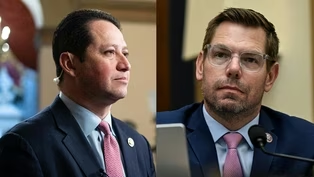
After separate allegations of sexual misconduct, two members of Congress are resigning.
Democrat Eric Swalwell faced multiple allegations of sexual assault, including a new accuser today.
Swalwell denies the accusations.
He dropped out of the California governor's race this weekend, before stepping down from his congressional seat this afternoon.
Republican Congressman Tony Gonzales' resignation takes effect tonight.
Earlier this year, he admitted to sleeping with a staffer who later took her own life.
Lisa Desjardins joins us now with more.
So, Lisa, these new allegations against Eric Swalwell, what do we know?
LISA DESJARDINS: They come from a woman named Lonna Drewes.
And I want to warn our listeners and viewers that they are quite graphic.
Now, Drewes says she met Swalwell in 2018.
She had a boyfriend at the time.
She saw him as a political and business contact.
At one point, she said she had a glass of wine with him.
And she said, in her account, Swalwell told her he needed to get some papers from his hotel room.
She went with him to the hotel room.
And because of what happened after that, she believes she was drugged.
LONNA DREWES, Swalwell Accuser: When I arrived at his hotel room I was already incapacitated and I couldn't move my arms or my body.
He raped me.
And he choked me.
And while he was choking me, I lost consciousness and I thought I died.
LISA DESJARDINS: An attorney for Swalwell told The New York Times that he unequivocally denies every allegation of assault against him.
Now Drewes' attorney says that there are more women who have contacted them.
She is the fifth woman to come forward and reporting publicly.
Two others of those women say that they described getting drinks with Swalwell and also not remembering how they got to the hotel room.
In their versions, though, they said that they were drunk at the time.
Now, Swalwell's political career appears to be over.
However, he could now face criminal charges.
Lonna Drewes and her attorney presented her testimony and evidence to the police.
AMNA NAWAZ: Swalwell, meanwhile, has now resigned, as you pointed out.
Where does all of this leave the balance of power in the House.
LISA DESJARDINS: Right.
Let's talk about it.
Actually, there is -- there are two members who are leaving.
There is one who is coming.
We have a new member about to be sworn in.
That is Clay Fuller of Georgia.
He's replacing Marjorie Taylor Greene, who resigned at the beginning of this year.
So after the resignations basically tomorrow and that new member coming in, here's where things stand, 216 Republicans, 213 Democrats.
There's one independent, though, who generally votes Republicans.
So add all this up, Amna, and what you got is that Republicans now have a two-vote margin, which wildly large for this Congress, meaning that they can lose two Republican votes on anything and still pass legislation without help from Democrats.
AMNA NAWAZ: You have been reporting on other members of Congress who are also under scrutiny.
What do we need to know about that?
LISA DESJARDINS: Let's update on that.
There are two.
First, let's talk about Florida Congresswoman Sheila Cherfilus-McCormick.
She is accused of massive fraud, allegedly using half-a-million in COVID funds for her own personal and campaign expenses.
The House Ethics Committee has found her essentially guilty.
They are due to issue their punishment recommendation a week from today.
Now, her case is also in criminal courts, but in this atmosphere, we have to watch to see if they recommend expulsion.
That ultimately will be up to the full House.
Now, also Cory Mills, the other lawmaker involved here from Florida, he's accused of a list of misconduct, including financial and campaign funding violations.
The Ethics Committee is investigating him, but, as we have reported, sometimes, those investigations can take years.
AMNA NAWAZ: Meanwhile, amid all this, you have been talking with current and former staffers about the culture on the Hill.
What are they telling you?
LISA DESJARDINS: I'm having a lot of conversations.
And this kind of reporting takes a lot of time.
But I will say, even for my expectations, I'm hearing much more widespread concerns than I expected.
I did bring this up with some members of Congress today.
And one of them, Andy Kim, senator from New Jersey, said this that I thought was notable.
He said: "Whatever we are doing when it comes to misconduct on Capitol Hill, it's not working."
The question is, will lawmakers actually change the way that they and their senior staff are scrutinized?
AMNA NAWAZ: Congressional correspondent Lisa Desjardins, thank you, as always.
LISA DESJARDINS: You're welcome.
AMNA NAWAZ: A new analysis takes a closer look at how immigration is changing under President Trump and it paints a more complicated picture than the political rhetoric often suggests.
Liz Landers has more on how the Trump administration is reshaping the nation's immigration policy.
LIZ LANDERS: Amna, the president often touts a sharp drop in illegal entries to the country, which have gone down by 50,000 entries per month since the end of 2024.
But a new analysis from the Cato Institute suggests that's only part of the story.
Legal immigration has fallen even more dramatically under the Trump administration, with 132,000 fewer people being admitted per month through legal pathways.
For more on what's behind those numbers, I'm joined by that study's author, David Bier.
He's the director of immigration studies at the Cato Institute.
David, thanks for coming back on "News Hour."
DAVID BIER, Director of Immigration Studies, Cato Institute: Thanks for having me on.
LIZ LANDERS: This study shows that legal immigration has dropped sharply under this Trump administration.
What specific policy changes are driving that gap?
DAVID BIER: Well, the biggest one by far is the suspension of immigrant visa processing for 75 countries around the world.
These are -- mainly for family members of U.S.
citizens who are coming to reunite with their family members here.
Many are spouses and minor children of U.S.
citizens.
In addition to that, they have also suspended all entries from about 40 countries.
So, 92 countries now face a de facto legal immigration ban by this administration, encompassing about half of all legal immigrants to the United States.
In addition to that, he's banned almost all refugees, except for white South Africans.
But even them -- even that group are being admitted at just about 10 percent of the rate that was previously being admitted before under the Biden administration.
So those are some of the main ones.
But every category -- you look at H-1B visas for high-skilled workers, international students, also facing very severe restrictions through a variety of different policy means to reduce legal immigration to the United States.
LIZ LANDERS: The president has been eager to tout this major drop in border arrests since he took office, going from about 47,000 arrests at the end of Biden's term to only about 8,600 last month.
Illegal immigration, as you know, it was already dropping under President Biden.
So how much credit does President Trump get here?
DAVID BIER: Well, look, it's a continuation of a trend.
So that's one of the main things that people need to understand.
If you look at the peak and compare it to now, look, it's been an over 90 percent reduction.
But almost 90 percent of that reduction happened under President Biden's administration before President Trump took office.
And so that is in stark contrast to these cuts to legal immigration, where illegal immigration was falling and legal immigration was rising under Biden.
The trends are now both down under President Trump.
LIZ LANDERS: You mentioned asylum and refugee status.
A big part of this administration's approach has been focused on restricting access to asylum.
Your study shows that asylum seekers have essentially been completely blocked from entering at the U.S.-Mexico border and fell 99.9 percent in the course of a few months.
Who are these people that are getting turned away?
And, also, are they finding other ways to legally enter the United States or are they just turned away completely?
DAVID BIER: Yes, they're turned away completely.
So these are people who are trying to come in, request asylum at legal ports of entry.
They're not trying to evade Border Patrol or cross the border illegally.
This is something that every administration prior to this one had allowed people to do.
In fact, even in 2019, Secretary -- DHS Secretary Nielsen had encouraged people who were applying for asylum to go to ports of entry to apply, rather than cross the border illegally.
And what ended up happening is now we have completely eliminated that option for people to apply to enter legally.
The only way to get into the United States now is illegally if you're one of these people seeking protection from persecution in their home country.
LIZ LANDERS: When you step back and look at the broader picture here, what do these trends tell us about the direction of U.S.
immigration policy right now?
Is this about reducing immigration as a whole?
DAVID BIER: Absolutely.
And you can even look at what the president himself has said.
He said he wants to block immigration from the Third World.
This is the type of rhetoric that we see from the far right online and in various policy forums.
They want a reduction in both legal and illegal immigration.
Many of the responses that I have received to my study are cheering it on and saying this is a great thing for the country.
But it's really quite different from what President Trump sold his entire campaign around as being focused on illegal immigration and being in favor of legal immigration.
LIZ LANDERS: What are the potential economic impacts of this drop in legal immigration too in terms of the deficit, the birth rate, the social safety programs that we have in this country?
DAVID BIER: Well, our analysis shows that, over the last 30 years, immigrants have reduced the deficit by $14.5 trillion.
Almost all of that came from legal immigration.
So, illegal immigrants did also help reduce the deficit by about $1.7 trillion, but most of it came from the legal immigrants.
And if you look at the people who are specifically being targeted by these bans, they are not people who are likely to burden the country with deficits and debt.
These are people who are actually going to contribute to the country through work and entrepreneurship.
Many of them are prime-age adults ready to enter the labor force who we need right now to revitalize our economy.
LIZ LANDERS: David Bier of the Cato Institute, thank you so much.
DAVID BIER: Thanks for having me.
AMNA NAWAZ: Tax Day, the deadline for filing your taxes, is tomorrow.
And the president and Republican lawmakers are trying to draw voters' attention to new tax cuts and increased deductions approved last year in the so-called One Big Beautiful Act.
But with the war, higher prices for gas and other economic costs, some polls suggest many Americans don't feel they're benefiting much from the new law.
Stephanie Sy gets some detail now on what's changed.
STEPHANIE SY: Amna, one of the main things the new law did was keep in place many tax cuts established back in 2017 that were due to expire.
But it also included some significant changes, including a boost in the standard deduction to $31,500 for married couples filing jointly and $15,750 for single filers.
A new senior bonus deduction for people 65 and older worth up to $6,000 a person.
A big jump in the deduction for state and local taxes known as SALT.
That's back up to a cap of $40,000.
New limits on taxes on tips capped at a deduction of $25,000, as well as new deductions for overtime.
Eligible workers can now deduct up to $12,500 of overtime pay.
To help walk us through some of these changes, I'm joined now by Andrew Duehren, who covers tax policy for The New York Times.
Andrew, let's just jump right in because there's a lot.
Some of these policies really do seem significant, the senior bonus, the raising of the SALT deduction.
But I also understand from reading your reporting that there are limitations on how much the average taxpayer may benefit.
So who really stands to gain the most from these changes and who might not get the impact that they're expecting to get in their refund?
ANDREW DUEHREN, The New York Times: Yes, so, it's a great question.
I think one of the main things, obviously, these tax cuts depend on whether you're eligible for them in the first place.
So something like the senior deduction, for example, only people who are 65 and older will be able to benefit from that.
But more broadly across all of these tax cuts, the biggest winners are going to be people who have made enough money to have income and therefore taxes to cut in the first place.
All of these changes are structured as deductions, which means that people who already make below the standard deduction or who do not have any taxable income to begin with, these are the lowest of low-income Americans, they won't gain anything from these tax cuts, because they don't pay any federal income taxes to begin with.
So, yes, there are lots of specific rules for all of these tax cuts.
It depends on, obviously, if you earn tips or work overtime, but, in general, you need to have taxable income to be able to benefit from them.
STEPHANIE SY: And we're going to get into some of those details in a moment.
But, in general, Andrew, on average, are people going to see bigger refund checks this year than they did in years prior?
ANDREW DUEHREN: Yes, so far, again, despite all of the ins and outs and the rules, the average refund so far this year has been larger than in the past.
The average size -- the average refund is about 11 percent bigger this year compared to last year.
And that does reflect these changes that Republicans made last year.
So, again, there are rules and there are restrictions on these tax cuts.
But for the people who do qualify, they are still seeing in some cases potentially significant tax savings as a result.
And so it's a mixed landscape.
There are definitely -- it's uneven in terms of some people maybe seeing big savings.
Some people may not be seeing anything.
But, overall, the average refund has gone up.
STEPHANIE SY: How much are these potentially bigger refund checks being offset by other rising costs?
We see higher gas prices right now.
There have been cuts to welfare programs and higher medical insurance.
What is your reporting telling us about the importance of these tax cuts in relation to other parts of Trump's economic agenda?
ANDREW DUEHREN: Yes, so, certainly, they are just a piece of things.
And there are other costs that are going up.
You mentioned gas prices.
There are also higher costs across the economy, in part because of the tariffs that President Trump has imposed over the course of his administration.
There have been some studies and some estimates from economists that the total amount of economic relief or dollars that go into the economy from this tax season are roughly the same as the extra costs that are being imposed by higher gas prices since the war in Iran started.
And so, overall, there might be kind of a net-net no change basically in terms of stimulus to the economy.
But for individual Americans, it will depend on their situation.
So for folks who got particularly big tax refunds, they may kind of come out on the positive.
For folks who don't drive much, maybe higher gas prices are not as significant.
But then there will be people who maybe do drive a lot and maybe didn't see any -- much change on their taxes, and this could be overall a negative for them.
STEPHANIE SY: Well, a lot of the people we're talking about this tax season is people who receive tips.
And that has received a lot of attention, Trump's policy on supposedly tax-free tips.
That, of course, reached a fever pitch yesterday when the president received a special DoorDash delivery at the White House.
Let's replay that.
DONALD TRUMP, President of the United States: The reason for this is the fact that I heard you picked up an extra $11,000 that you didn't think you would -- because the tax bill was so big.
The refund was the biggest you have ever had.
Is that a correct saying?
SHARON SIMMONS, DoorDash Driver: It definitely was.
DONALD TRUMP: Wow.
SHARON SIMMONS: Yes, I saved over $11,000 by not having the claim.
DONALD TRUMP: Was that surprising to you also?
SHARON SIMMONS: It was very surprising.
STEPHANIE SY: Sharon Simmons there, the so-called DoorDash grandma, Andrew, she's receiving a lot of attention for what she did and did not say in that exchange, which was clearly staged.
But let's focus on those tax deductions for tips.
And I should say, by the way, Simmons clarified in an interview I heard today that she makes $11,000 in tips a year.
That's not the amount she's claiming to have saved in taxes.
But, Andrew, what should we know about this policy and is it what the president is billing it as?
ANDREW DUEHREN: Right.
So I guess, first off, I mean, definitely, this policy could result in significant tax savings for people like the DoorDash grandma, who much of their earnings takes the form of tips.
For them, they might be able to save -- if you are -- if you have $11,000 in tips, I mean, that could still translate into several thousand dollars in tax savings, kind of depending on the rest of your tax situation.
That said, there are some things about this tax break that aren't what they seem.
I mean, President Trump has called it no tax on tips, but that's not really the policy that Republicans passed.
So, even for people who can claim this tax break, they will still be paying taxes on their tips.
They will still owe payroll taxes on their tips.
They may still owe state income taxes on their tips.
And so it's not a complete and total exemption from taxes the way that President Trump likes to describe it, but it could still and can still result in significant tax savings for the people who are able to deduct their tips.
STEPHANIE SY: OK, we will have to leave it there.
That is Andrew Duehren with The New York Times.
Thank you.
ANDREW DUEHREN: Thanks for having me.
AMNA NAWAZ: Well, he's been a familiar children's figure for decades, but the origin story of Paddington Bear is one born of darker times and one worth noting on this Holocaust Remembrance Day.
Paddington's creator, author Michael Bond, recalled seeing Jewish refugee children during World War II arriving in Britain with name cards around their necks and suitcases in their hands.
Those memories inspired the bear so beloved by generations.
Bond died in 2017, but, for the past 30 years, it's been an artist in Rhode Island helping to keep Paddington's story alive.
Ocean State Media's Pamela Watts has more as part of our arts and culture series, Canvas.
ACTOR: Hello.
PAMELA WATTS: For almost 70 years, Paddington Bear has entertained generations in books, on stage, on TV, and in live-action movies.
Even the late queen of England herself was bemused by the beloved bear.
However, Paddington Bear hibernates here in Barrington.
That's because illustrator R. W. Alley has been looking after this bear, as the story goes, for decades.
R.W.
ALLEY, Illustrator: There are very few children's literature characters who have Paddington's range and depth.
I think it's because the basis is kindness and acceptance.
PAMELA WATTS: That warm spirit of inclusion incubates in Alley's sun-drenched book-lined art studio at his Barrington home where he gets into the storybook.
R.W.
ALLEY: I have to be the character I'm drawing.
I have to be in my head saying the things that the character is saying to get the expression on the face.
PAMELA WATTS: In order to do that, Alley uses pen and ink, colored pencils, watercolors, and: R.W.
ALLEY: Sometimes, for Paddington's fur, some coffee.
PAMELA WATTS: Is that legit?
R.W.
ALLEY: Well, sometimes, it is a mistake, I have to say, because a coffee cup in the water jar are sometimes too near each other.
PAMELA WATTS: Coffee-stained, furry Paddington Bear was first created by the late British author Michael Bond in 1958.
R.W.
ALLEY: This is the original story that you see.
PAMELA WATTS: Translated into dozens of languages, Paddington's adventures charm families worldwide.
Alley is the fifth illustrator for the series and the longest-serving.
He currently draws reissued stories or Bond's unpublished works.
Did you always want to be a children's literature illustrator?
R.W.
ALLEY: I'm an only child.
And I would make up stories.
And before I could read, I drew out the stories.
PAMELA WATTS: He was illustrating for Hallmark, but then: R.W.
ALLEY: There is a card company in Pawtucket called Paramount Greetings, and they were looking for someone to oversee their humor department.
PAMELA WATTS: Alley finally decided to try his hand at book illustration full-time while working on the "Detective Dinosaur" series, he had a fateful meeting with the creator of Paddington.
R.W.
ALLEY: I had discussions with the author, who gave me some insight into his vision of the character.
PAMELA WATTS: What do you think is Paddington's enduring appeal?
R.W.
ALLEY: I think it's really simple.
I think that he's not a character who judges.
I think he's a character who we would -- who the reader would like to be.
PAMELA WATTS: Which inspired a new chapter in Alley's career, writing and illustrating his own "Breezy Valley" comic book-style series, with animals representing the workers in your neighborhood.
R.W.
ALLEY: What I'm trying to do is explain to young kids how important that a whole variety of jobs in their community is and how all these jobs interact with each other and how they're all necessary to building this whole community.
And to do all this, I relied on local experts.
This is fun.
I really enjoy drawing the little tools here and trying to fit all the human construction gear onto an elephant.
PAMELA WATTS: The third edition in the series will be published in June.
It's based on a real local construction project that happened once upon a time.
And back to that staple of children's libraries, Alley says he's drawn a lot from Paddington Bear.
Has he influenced you?
R.W.
ALLEY: I think so.
It makes you less cynical about the world.
It makes you more optimistic about the people you meet.
It makes you feel kinder and gentler to the folks you may disagree with.
PAMELA WATTS: For the "PBS News Hour," I'm Pamela Watts in Barrington, Rhode Island.
AMNA NAWAZ: More than a decade ago, Lena Dunham rose to fame as the comedic force behind the HBO hit series "Girls."
In her new memoir, "Famesick," out today, Dunham candidly, hilariously and sometimes painfully explores how she balanced her sudden celebrity with chronic illness, addiction, and trauma.
I spoke with Dunham for the latest episode of our PBS News podcast "Settle In."
Here's a clip of our conversation.
LENA DUNHAM, Actor and Screenwriter: I think that there were moments, like -- and this is -- I feel extremely grateful for my job and I'm certainly not throwing a pity party for myself about what happened.
But, at the same time, I was looking around at my friends' lives who were still maybe having the chance to figure things out in a more private way, to have more spontaneous experiences, to travel, to sort of live a more quintessentially 20-something life.
And I was recreating a 20-something life on screen, but I was basically never not at work.
AMNA NAWAZ: You're also not getting to live your 20s and make the mistakes of your 20s that all of us make in the privacy of your own life, right?
It's a very public experience and a highly scrutinized experience.
And all of this, we should remind people, it's all unfolding at a time when blogging is taking off and social media is taking off and everyone on the Internet has a hot take and an opinion that they really want to share in that moment.
And you bore the brunt of a lot of that, right?
A lot of it was focused at you in a really intensely, a lot of at times unkind personal way.
I wonder how you dealt with that at the time, how you navigated that on top of managing the responsibility of a successful show and running a team and trying to be creative in the moment.
LENA DUNHAM: Well, I think, firstly, I'm going to hook onto two things you said.
One is I think talking about the fact that this was the rise of blogging.
I mean, I have said, I remember joining Twitter the year that "Girls" started.
I remember posting my first Instagram photo.
This was sort of the Wild Wild West.
And now we're sort of -- we have become used to -- I don't know.
The Grammys happen and then everybody gets on with like 57 opinions about Sabrina Carpenter's shorts.
And we are used to that cycle, but it was new.
And people were trying to figure out what it was and what it meant.
And we happened to be in New York at a moment when New York media was really the center of that.
And we were sort of adjacent to the people who were writing, but just far enough away that they could be pretty hypercritical, but just close enough that it could sort of feel a little like eating your own.
And it was -- looking back, it's a kind of a fascinating cultural moment.
It's a fascinating study in so much about creativity, human behavior, how we adapt to new technologies.
I wouldn't say, in the moment, it felt like an incredible cultural study.
In the moment, it felt like I was just fighting to survive, truly.
And in terms of how I dealt with it, I loved what you said about holding on to your creativity.
That was always the most important thing to me, which is, what do I have to do to be able to continue to do this thing that got me here, which is write and direct and make this work?
And I think, in terms of how I dealt with it, is that I didn't deal with it.
And that was part of what was so, I think -- I think unmanaged trauma, unhandled stress, we know is a deep sort of - - it's like pouring an accelerant on illness.
And so these things that I had always dealt with, I'd always sort of been like a sickly kid or someone who had my -- who had my rough moments.
But suddenly that was neck and neck with the rest of my life as the most - - kind of the loudest theme.
AMNA NAWAZ: I wonder what all of that means for your relationship with social media today.
How would you describe that?
LENA DUNHAM: How would I describe my relationship with social media?
I'm really lucky because I have some people.
I have a production company.
And the young folks who work for me are very online.
So they let me know if there's things that I have to know about or things that are special or amusing or really good memes, scandalous TikToks that one must see.
At the same time, I really treat it more like a part of my job.
I have a social media manager.
I have a creative director.
And those are people that I sort of engage with in terms of like, what is an interesting and new way for us to use social media?
But I'm not actually on the apps dealing every day with people's perceptions, which I recognized was a pretty unhealthy cycle for me,and I'd argue a pretty unhealthy cycle for anyone.
And I look at what it means to be a young celebrity today, which is you don't just have to be an actor or a singer or -- you also have to be a content creator.
And that means engaging with all of these voices.
And I do think we will find, sort of the same way that we're learning how spending so much time on a screen is affecting the human brain, we're going to learn what this is doing.
But it's going to take a little bit of time.
And I think about it the way we think about the fact that, like, we didn't know in the 1940s that smoking was bad for you.
And so, for a while, you just get to smoke cigarettes with impunity until one day we discover the truth.
And I think we will learn the same thing about social media.
And it's certainly not going away, but learning how to mediate it in our lives, so that we can actually engage with what's in front of us.
Whenever I talk about this, I feel like I sound like I'm -- I sound like my father talking to me when I was 23, but I'm going to be 40 in a month, and we all get here.
AMNA NAWAZ: It happens fast, doesn't it, Lena?
It happens fast.
LENA DUNHAM: It's wild.
I suddenly hear myself saying things where I just go, oh, my gosh.
Like, I sound like when my mom and her friends would say, like, but what is it you like so much about the Backstreet Boys?
(LAUGHTER) LENA DUNHAM: Like, I'm so mortified.
AMNA NAWAZ: And you can watch that full conversation and all episodes of "Settle In" on YouTube or wherever you get your podcasts.
And that is the "News Hour" for tonight.
I'm Amna Nawaz.
On behalf of the entire "News Hour" team, thank you for joining us.
 New
NewEx-State Dept. official: Israeli-Lebanese talks symbolic
Video has Closed Captions
Israeli-Lebanese talks more symbolic than substantive, former State Dept. official says (6m 34s)
 New
NewIllustrator R.W. Alley on bringing Paddington Bear to life
Video has Closed Captions
Illustrator R.W. Alley on how he brings Paddington Bear to life (5m 15s)
 New
NewIsraeli strikes on Lebanon continue as U.S. hosts talks
Video has Closed Captions
Israeli strikes on Lebanon continue as U.S. hosts historic diplomatic talks (4m)
 New
NewLena Dunham joins Amna Nawaz on 'Settle In'
Video has Closed Captions
Lena Dunham and Amna Nawaz explore public stress and trauma on 'Settle In' (6m 29s)
 New
NewNews Wrap: DOJ seeks to erase Jan. 6 convictions
Video has Closed Captions
News Wrap: DOJ seeks to erase Jan. 6 seditious conspiracy convictions (6m 51s)
 New
NewSexual misconduct claims trigger resignations in Congress
Video has Closed Captions
Sexual misconduct claims trigger resignations and broader ethics concerns in Congress (4m 28s)
 New
NewTalk of war dominates Tehran as ceasefire deadline nears
Video has Closed Captions
Talk of war dominates daily life in Tehran as ceasefire deadline nears (4m 12s)
 New
NewTrump cut legal immigration far more than illegal crossings
Video has Closed Captions
Study finds Trump administration cut legal immigration far more than illegal crossings (6m 8s)
 New
NewWho is benefiting the most from Trump's tax cuts
Video has Closed Captions
Who is benefiting the most from the Trump administration's tax cuts (7m 44s)
Providing Support for PBS.org
Learn Moreabout PBS online sponsorship
- News and Public Affairs

FRONTLINE is investigative journalism that questions, explains and changes our world.

- News and Public Affairs

Today's top journalists discuss Washington's current political events and public affairs.












Support for PBS provided by:
Major corporate funding for the PBS News Hour is provided by BDO, BNSF, Consumer Cellular, American Cruise Lines, and Raymond James. Funding for the PBS NewsHour Weekend is provided by...