
Sam Roberts joins Geoff Bennett on 'Settle In'
Clip: 8/12/2026 | 4m 25sVideo has Closed Captions
Sam Roberts and Geoff Bennett discuss the art of obituary writing on 'Settle In'
Journalist Sam Roberts has written some 1,600 obituaries in his decades-long career at The New York Times. His new book, "Are They Dead Yet?" is about the art of obituary writing, how the Times chooses who's worthy of an obit and what that work has taught him about life. Geoff Bennett spoke with Roberts for the latest episode of our PBS news podcast, "Settle In."
Problems playing video? | Closed Captioning Feedback
Problems playing video? | Closed Captioning Feedback
Major corporate funding for the PBS News Hour is provided by BDO, BNSF, Consumer Cellular, American Cruise Lines, and Raymond James. Funding for the PBS NewsHour Weekend is provided by...
Sam Roberts joins Geoff Bennett on 'Settle In'
Clip: 8/12/2026 | 4m 25sVideo has Closed Captions
Journalist Sam Roberts has written some 1,600 obituaries in his decades-long career at The New York Times. His new book, "Are They Dead Yet?" is about the art of obituary writing, how the Times chooses who's worthy of an obit and what that work has taught him about life. Geoff Bennett spoke with Roberts for the latest episode of our PBS news podcast, "Settle In."
Problems playing video? | Closed Captioning Feedback
Where to Watch PBS News Hour
PBS News Hour is available to stream on pbs.org and the PBS app.
Providing Support for PBS.org
Learn Moreabout PBS online sponsorshipWILLIAM BRANGHAM: Sam Roberts has written some 1,600 obituaries as a reporter for The New York Times.
His new book "Are They Dead Yet?"
details the art of obituary writing, what his work has taught him about life.
Geoff Bennett spoke to Roberts for the latest episode of our PBS News podcast "Settle In."
GEOFF BENNETT: You start the book with this wonderful contradiction.
You have spent more than a decade writing about death, but you say you have been afraid of death for most of your life.
So how does someone who has had this lifelong aversion to death end up on the obit desk?
SAM ROBERTS, Author, "Are They Dead Yet?
: The Art of the Obit": Well, I wouldn't say afraid of death as much as coming from a family growing up in Brooklyn that -- where death was denied at all the time.
I remember, when my dad died, about six months later, his sister, my aunt, was asked by a neighbor how he was, and she at best could reply, so-so.
That was the kind of culture I came from.
And I wasn't particularly pleased when The Times asked me to write advanced obituaries to help reduce the backlog of people we should have been doing advances of.
But then I realized that obituaries are not about death.
Death is mentioned in one sentence, and, in fact, they are about people's lives, what made them interesting, why they were transformational, what they were emblematic of in terms of transformation and the impact on society.
And they're mini-biographies, and that's what makes them so fascinating.
Most of the people I have written about at The Times and mentioned in the book are people I had never heard of.
Obviously, we do obituaries of celebrities and prominent people and politicians, but there's so many interesting, quirky people who you would just never know had existed.
Those are the people I love writing obituaries about the most.
GEOFF BENNETT: How long did it take you to realize and when did you realize that writing obituaries might be one of the greatest jobs in journalism?
SAM ROBERTS: It didn't take long.
Some people think of obituary writing as a dead end at the end of a career or something for neophytes at the beginning.
I think it is one of the most coveted positions in journalism.
We now have nine reporters at The New York Times writing obituaries, and they get on line to be hired for that department.
They are mini-biographies.
They are stories about people's lives, what makes them interesting.
And one of the things I discovered, Geoff, in doing this assignment is, there really are no ordinary lives.
People have impact each in his or her own way.
After 9/11, when we did our series of portraits of grief of the victims of the World Trade Center attack, and during COVID, when we wrote about those we have lost, we did little obits on people who might ordinarily be considered routine, who we never would have done obituaries of.
And the impact they had on people's lives was substantial.
As one obituarist said, who would you miss more, your mayor or your mailman?
Well, we take a lot of people for granted, and these ordinary people really do have an impact on our own lives.
Thomas Carlyle, who is the originator of the Great Man theory of history, said himself, who is more important, Hannibal, who drove his elephants across the Alps, or some poor anonymous character who invented the spade?
Well, I would go with the spade man, who probably had a much greater impact over centuries than Hannibal did.
So these are important things to take into consideration, that everyone is intrinsically interesting in his or her own way, and that the -- collectively, those obituaries reflect what our culture cares about, what we value in people.
WILLIAM BRANGHAM: You can watch that full episode wherever you get your podcasts.
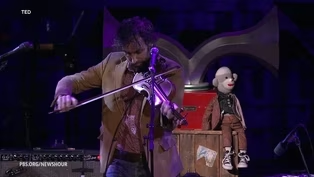
Andrew Bird takes eclectic compositions to symphony stages
Video has Closed Captions
Andrew Bird takes eclectic compositions to symphony stages (6m 21s)
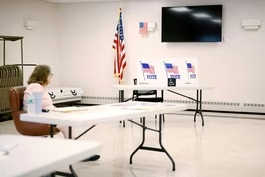
Democratic, Republican strategists on direction of parties
Video has Closed Captions
Democratic and Republican strategists on the direction of both parties (7m 24s)

Federal judges describe threats amid attacks from leaders
Video has Closed Captions
Federal judges describe violent threats amid 'dehumanizing attacks' from political leaders (9m 3s)
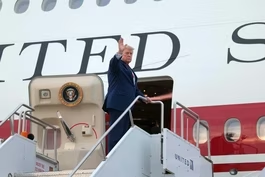
News Wrap: Trump confirms he was whisked away in Turkey
Video has Closed Captions
News Wrap: Trump confirms he was secretly whisked away from Air Force One in Turkey (6m 30s)
Primaries yield mixed results for moderate, progressive Dems
Video has Closed Captions
Latest primaries yield mixed results for moderate and progressive Democrats (3m 14s)
Spain's plan to give undocumented migrants legal status
Video has Closed Captions
A look at Spain's plan to give undocumented migrants legal status (8m 7s)
Providing Support for PBS.org
Learn Moreabout PBS online sponsorship New Episode
- News and Public Affairs

Today's top journalists discuss Washington's current political events and public affairs.

- News and Public Affairs

FRONTLINE is investigative journalism that questions, explains and changes our world.


 New Episode
 New Episode
 New Episode
 New Episode
 New Episode
 New Episode

 New Episode
Support for PBS provided by:
Major corporate funding for the PBS News Hour is provided by BDO, BNSF, Consumer Cellular, American Cruise Lines, and Raymond James. Funding for the PBS NewsHour Weekend is provided by...