
October 6, 2026 - PBS News Hour full episode
10/6/2026 | 57m 46sVideo has Closed Captions
October 6, 2026 - PBS News Hour full episode
October 6, 2026 - PBS News Hour full episode
Problems playing video? | Closed Captioning Feedback
Problems playing video? | Closed Captioning Feedback
Major corporate funding for the PBS News Hour is provided by BDO, BNSF, Consumer Cellular, American Cruise Lines, and Raymond James. Funding for the PBS NewsHour Weekend is provided by...
October 6, 2026 - PBS News Hour full episode
10/6/2026 | 57m 46sVideo has Closed Captions
October 6, 2026 - PBS News Hour full episode
Problems playing video? | Closed Captioning Feedback
Where to Watch PBS News Hour
PBS News Hour is available to stream on pbs.org and the PBS app.
Providing Support for PBS.org
Learn Moreabout PBS online sponsorshipGEOFF BENNETT: Good evening.
I'm Geoff Bennett.
Amna Nawaz is away.
On the "NewsHour" tonight: Another arrest is made over a security incident at a U.S.-run military base in the U.K.
What we know about the suspected terror plot that's been linked to Iran.
The Justice Department charges more immigrants with illegally voting in the 2024 election.
The implications for the upcoming midterms.
And we continue our deep dive into GLP-1s with a closer look at who has access to the prescription drugs and how those who are priced out are finding work-arounds to get them.
LIONEL LENOIR, Former GLP-1 User: It makes total sense that you get to the point where you're willing to do anything just to be a little more comfortable in your own skin.
(BREAK) GEOFF BENNETT: Welcome to the "News Hour."
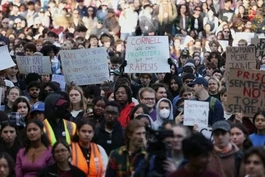
More than a quarter-million people poured into the streets of France today, a dramatic development in a student-led movement that started at one single high school.
In some cities, clashes erupted between police and protesters, and French officials condemned what they called extreme violence.
Our Deema Zein reports.
DEEMA ZEIN: Along the grand promenades of Paris, police in riot gear, firing tear gas at protesters, many of them young teens.
Authorities said 300 hostile individuals attempted to confront officers on a day where 56,000 students, parents, and teachers marched through the French capital.
Similar scenes broke out across the country from Strasbourg in the east to Lyon farther south, the biggest day yet after weeks of student-led demonstrations.
Prime Minister Sebastien Lecornu weighed in on the chaos from France's National Assembly.
SEBASTIEN LECORNU, French Prime Minister (through translator): Extreme violence has knocked on the doors of these high schools, and this extreme violence must be condemned unconditionally.
DEEMA ZEIN: Since the protests began in mid September, roughly 6,000 people have been arrested.
About 300 students and staff have been injured, as have some 700 police officers.
France's interior minister says the police response has been proportionate in -- quote -- "almost all cases."
But it's also fueling defiance and anger, leading to today, as union activists joined 250,000 protesters nationwide, demanding more education funding amid understaffed schools, overcrowded classrooms, and dilapidated academic buildings.
Students vowed to continue to mobilize as more blockades formed around hundreds of high schools.
ETIENNE, Student (through translator): It's important to protest to make our voices heard.
Despite the repression, the strikes, and the tear gas, we have to continue fighting because it's not over.
DEEMA ZEIN: Among the crowds, parents shielding their children from police lines, chanting to their faces: "There is no danger.
You are the ones creating it."
EMILIA SICHILI SURIAM, Member, Parent Association FCPE (through translator): We all share the same goal, the protection of children's rights.
And it is a legitimate right to demonstrate and to make demands.
LEA MONIMART, Early Childhood Professional (through translator): They're 17 years old.
They're not completely clueless, and they know what they're talking about.
It's important to show that there are adults who support them.
DEEMA ZEIN: For the "PBS News Hour," I'm Deema Zein.
GEOFF BENNETT: Also today, Cornell named former U.S.
Deputy Attorney General Sally Yates to lead what it's calling a comprehensive independent review of how the school handles sexual assault on campus.
Her appointment comes as the Ivy League school tries to address a surge of anger on campus over a former student's claims that she was raped by multiple men at a fraternity house in 2024.
The men she's accused deny any wrongdoing.
Yates spent decades with the Justice Department and was the deputy attorney general under then-President Obama in 2015.
Last week, New York's Attorney General Letitia James was tasked with carrying out her own review to determine if criminal charges should be filed.
In Tennessee, lawyers for inmate Christa Pike say she's awake and speaking after surviving a botched execution attempt last week.
In a statement, they say -- quote -- "Her recovery is medically unprecedented.
Her prognosis remains unclear, but, at a minimum, we expect a long recovery."
The 50-year-old was sentenced to death for the 1995 torture and killing of classmate Colleen Slemmer.
After Pike survived two lethal injections, Tennessee's governor paused further executions for the year and ordered an investigation into the state's capital punishment system.
President Trump is facing bipartisan backlash today after comments at a campaign rally in which he suggested that Iran could take out two cities in California.
DONALD TRUMP, President of the United States: It's a small price to pay for keeping the world safe, keeping our country safe.
They can take out a city.
Let them take -- let them take out Los Angeles.
Let them take out San Diego.
DONALD TRUMP: That's -- this is a very small price to pay, and it's going to be over very soon.
GEOFF BENNETT: California's Democratic lawmakers condemned the remarks.
And Republican congressional candidate and Navy veteran Jim Desmond said he vehemently disagrees, saying -- quote - - No American city is expendable."
The White House countered that Mr.
Trump was misunderstood and was arguing that the war is preventing Iran from ever having such capability.
Paramount officially closed its multibillion-dollar deal for Warner Bros.
Discovery today, creating one of Hollywood's most valuable properties.
The combined company is called Skydance, and it folds such titles as HBO Max and CNN under the same umbrella as CBS and Paramount+.
Incoming boss David Ellison called it an historic day, not just for Skydance, but for the entire industry.
But critics have said the merger will lead to job losses and fewer options for consumers.
The Emmy Awards are moving off broadcast TV.
The Academy of Television Arts and Sciences announced today that Amazon's Prime Video will broadcast the ceremony for a period of six years starting in 2027.
Amazon says the show will be free with no Prime membership required.
It's a major shift for the Emmys, which have rotated among the four broadcast networks since the 1950s.
And it's just the latest move to streaming, with the Oscars heading to YouTube starting in 2029.
The 2026 Nobel Prize in Physics was awarded to Francis Halzen for developing a pioneering telescope to detect high-energy neutrinos, sometimes called ghost particles.
Researchers believe these high-energy minuscule particles can offer clues into how the universe evolved.
Halzen, who is from Belgium, is now a professor at the University of Wisconsin Madison.
He first conceptualized his South Pole observatory back in the 1980s, but it was not operational until 2011.
The Nobel Committee said the 82-year-old's -- quote -- "tenacity and scientific vision has paved the way for a new kind of astronomy."
On Wall Street today, stocks ticked higher once again, despite worries over Iran and inflation.
The Dow Jones industrial average added around 250 points.
The Nasdaq rose nearly half-a-percent.
The S&P 500 climbed to a new all-time high.
And we have three passings of note tonight, starting with one of the last survivors of Hollywood's golden age.
Legendary actress Eva Marie Saint has died.
She's perhaps best known as the seductive secret agent in Alfred Hitchcock's 1959 thriller "North by Northwest."
Before that, she won an Academy Award for best supporting actress for "On the Waterfront" opposite Marlon Brando.
Her career spanned seven decades, including roles later in life on TV and in movie "Superman Returns," among many others.
Eva Marie Saint was 102 years old.
Also, R&B singer Freddie Jackson has died.
A master of the romantic ballad, Jackson started as a gospel singer at a Baptist church in his native Harlem and became one of the great voices of the genre.
Songs like "You Are My Lady" and "Rock Me Tonight" helped Jackson dominate the R&B charts in the 1980s and early '90s with 10 number one hits.
He was also nominated for two Grammys.
His family said he died yesterday.
And Jim Bakker, the television evangelist who later went to prison for financial crimes, has died.
Bakker and his first wife, Tammy Faye, built a huge following with the PTL Club in the 1970s and 80s.
It stood for Praise the Lord.
At its peak, the show drew 13 million daily viewers.
Their empire began to unravel in 1987 when a church secretary accused Bakker of sexual assault.
He maintained the encounter was consensual, but still tried to buy her silence.
In an interview on ABC's "Nightline," Bakker and his wife asked for forgiveness.
JIM BAKKER, Televangelist: The Bible says, ye without sin cast the first stone.
I don't want to throw stones at anyone.
But yet people are asking questions.
And I want to tell that I love them, that I'm sorry for what's been happening, and that we have asked God to forgive us, and we ask them to forgive us.
GEOFF BENNETT: A year later, Bakker's downfall continued when he was indicted on fraud and conspiracy charges tied to PTL's finances.
He was sentenced to 45 years in prison, but ended up serving around five years.
Bakker's second wife, Lori, announced his death on social media last night.
Jim Bakker was 86 years old.
Still to come on the "News Hour": the funeral of a Haitian man who died by suicide shines a light on the impact of the Trump administration's immigration crackdown; Afghan refugees are forced back to their home country, despite the Taliban's rule; and longtime diplomat Brett McGurk pulls back the curtain on the Biden administration's negotiations to free the October 7 hostages in Gaza.
Today, British police arrested a 22-year-old on suspicion of Terrorism offenses connected to a possible plot against the British air base at Fairford.
Over the weekend, the U.S.
Air Force evacuated bombers from that base for fear of an attack.
Nick Schifrin has been following all of this and joins us now.
So, Nick, based on your reporting, what more do you know about this latest arrest?
NICK SCHIFRIN: Geoff, this was the seventh arrest, but a senior British official points it out to me that this was the first arrest in one week, meaning it was the result of Britain's counterterrorism investigation, rather than the rushed initial police response.
And it was last Sunday when we saw police arrest five men on the suspicion of terrorism, who were subsequently released on bail.
They didn't have any weapons or explosives, although they did have gasoline, leading some officials to suggest to me it was a dry run or perhaps a diversion.
But a U.S.
official tells me that, even before that arrest, the U.S.
was informed of a possible -- quote -- "imminent attack."
The base went on lockdown and families were moved.
Since then, British and American officials have said to me and in public that this was an Iranian-backed attack on the base from which U.S.
B-1 bombers have attacked Iran.
And the U.S.
evacuated those bombers over the weekend.
You see some of the bombers leaving Fairford right there.
A U.S.
official points out the bombers were so close to the fence, you could practically throw a rock at them.
And we heard yesterday from Vice President Vance and President Trump acknowledging Iran's connection and delivering a new threat.
J.D.
VANCE, Vice President of the United States: We do feel with some confidence that the Iranians are -- they're trying to do what the Iranian state has done for 49 years, which is engage in acts of terrorism against the United States.
DONALD TRUMP, President of the United States: And we actually know the people that made the threat, and they got themselves with a big problem.
NICK SCHIFRIN: And, today, those bombers are back in the U.S., Geoff, from which they have attacked Iran in the past.
GEOFF BENNETT: And, Nick, what more is known about the threat that was posed?
NICK SCHIFRIN: So, a senior British official tells me that one of the threats was a possible drone attack.
Now, that's a threat that American officials have acknowledged even in the United States at U.S.
bases in the U.S., simply because the war in Ukraine has proven that drones are so cheap and so easily can deliver explosives.
And in this case, there is a direct precedent.
It was in June 2025 that Ukraine launched an audacious attack with more than 100 drones that had been hiding inside Russian shipping containers.
And you see there, Ukraine says it destroyed 40 Russian bombers on four military bases thousands of miles from Ukraine's border.
Vice President Vance said yesterday that the moving of the bombers was -- quote -- "out of an abundance of caution."
But American and British authorities have been warning about Iranian attacks on Britain, on the United States for years.
The head of Britain's domestic spy agency, MI5, Ken McCallum, last summer said the U.K.
had responded to 20 Iranian-backed plots in the previous three years.
And a senior British official tells me tonight, Geoff, that the counterterrorism operations against Iranian-backed plots have been going for years and are ongoing today.
GEOFF BENNETT: Nick Schifrin, our thanks to you, as always.
NICK SCHIFRIN: Thank you.
GEOFF BENNETT: Ahead of the midterm elections, the Department of Justice is leading a high-profile effort to catch and prosecute people they say illegally cast ballots, sometimes holding televised press conferences to make the announcements.
TODD BLANCHE, U.S.
Attorney General: Voter fraud erodes the public's trust in our electoral system, and it's vital to our democratic process that we do everything that we can to restore that trust.
GEOFF BENNETT: But there is no evidence to support President Trump's claims of widespread voter fraud that skew election results.
Our justice correspondent, Ali Rogin, is here with more.
So, Ali, help us understand the scope of the DOJ effort so far.
ALI ROGIN: Yes, so far, they have announced indictments or charges of voter fraud against about 100 individuals.
They say there are hundreds more of these cases that they are investigating, and they have been releasing information on these handfuls at a time.
So, last week, it was 10 individuals out of Minnesota.
This week, so far it's been six from a number of states.
And they also note that they have done more on this issue so far than the Biden administration did over four years, Geoff.
GEOFF BENNETT: And what sorts of cases are they prosecuting?
ALI ROGIN: Most of these charges come against noncitizens who tend to be green card holders, but those people cannot vote in federal elections.
And the allegations are that they falsely claimed citizenship in order to vote.
The DOJ is also going after people who they say deliberately tried to block access to or destroy ballots, and that includes one former postal worker in Utah who allegedly destroyed 300 mail-in ballots that he was supposed to deliver.
GEOFF BENNETT: And none of this is evidence supporting President Trump's unfounded claims of widespread voter fraud.
ALI ROGIN: That's correct.
Even though the DOJ is stepping up the scope and the tempo of these allegations and of the charges, they don't amount to anything close to the widespread voter interference that would actually change the election results.
And these are well-fact-checked claims.
After the 2020 election, the AP investigated claims that the Trump team had filed of voter fraud in six states.
And what they found was that there were 475 potential instances out of more than 25 million votes cast.
That's potential, not definite cases of voter fraud.
And, of course, that would not have made a difference in the outcome of the election.
But a DOJ spokesperson tells me, Geoff, that each vote that is cast illegally cancels out an American citizens' vote, and that federal races often share the ballot with downballot races for state and local candidates, where the margins are sometimes much closer.
GEOFF BENNETT: And, Ali, what's the DOJ's track record in successfully prosecuting these cases?
ALI ROGIN: Well, so far, our own review shows that they are announcing far more charges than they are convictions.
And I asked David Becker from the nonpartisan nonprofit Center for Election Innovation and Research about this.
And he said it's not surprising that we're hearing more about charges than successful convictions, because it's tricky to prosecute and determine whether people deliberately voted when they shouldn't have.
DAVID BECKER, Executive Director, Center for Election Innovation and Research: It's going to be difficult for the DOJ to take some of these cases where some -- where a noncitizen might have been misled by a government employee or misunderstood what was happening and accidentally got registered, and then received something in the mail saying that they could vote and here's where to go vote.
And if they might have done that once out of a misunderstanding, it's going to be really difficult to convince a jury that they should be convicted of the crime of noncitizen voting.
GEOFF BENNETT: And, Ali, what else is the administration doing to address what they see as a systemic problem in election administration?
ALI ROGIN: Yes, we're learning more about efforts to deploy up to 1,000 election monitors on Election Day this year, which would be about double the number of DOJ election monitors that were out in the field in 2024.
Also, yesterday, President Trump reportedly met with former Colorado county clerk Tina Peters, who was convicted after allowing unauthorized access to voting equipment after the 2020 elections, and that was in an effort to prove unsubstantiated election fraud, because she believes that President Trump rightfully won the election.
She was convicted and released this year after her sentence was commuted.
And our colleague Liz Landers asked the White House about this meeting, and they didn't confirm it directly.
But what they did do was send her a raft of information about these alleged cases of voter fraud that the DOJ is investigating, and they told her -- quote -- "The evidence of voter fraud keeps piling up."
So this is clearly something that the White House is really trying to push ahead of the elections, Geoff.
GEOFF BENNETT: Justice correspondent Ali Rogin.
Ali, thanks, as always.
ALI ROGIN: You bet.
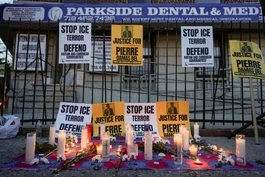
GEOFF BENNETT: Over the weekend, the family of Pierre Damas Bel laid him to rest.
The 20-year-old Haitian student lost his legal immigration status in July after the Supreme Court cleared the way for the Trump administration to end temporary protections for hundreds of thousands of Haitians.
Bel died by suicide a month later.
William Brangham As the story.
WOMAN: Pierre's legacy leaves a mark in our lives forever in how the criminalization of Haitian immigrants can be an unnecessary death sentence.
WILLIAM BRANGHAM: In a church in Springfield, Ohio this Saturday, mourners gathered to remember a young man's life and one whose death by suicide has come to symbolize the toll of America's immigration policy.
Pierre Damas Bel was a 20-year-old from Haiti, an honor student, a member of Junior ROTC, a young man just starting college with dreams of going into medicine.
PATRICIA BLAIR, Former Teacher of Pierre Damas Bel: Pierre was probably one of the most hardworking and dedicated students I have ever worked with in my 30 years of teaching.
WILLIAM BRANGHAM: Patricia Blair was Bel's English teacher at Springfield High.
PATRICIA BLAIR: Always so happy to be there, and I always felt like he was happy to see me.
And it was just one of those moments in your teaching career where you knew that this was a student who was going to succeed.
WILLIAM BRANGHAM: But, in July, Bel, along with hundreds of thousands of other Haitians in the U.S., were told that TPS, their Temporary Protected Status to live in America, was being ended by the Trump administration.
In a statement to the "News Hour" in August, ICE officials emphasized: "Temporary Protected Status is exactly that, temporary."
So Bel was summoned to an ICE processing center and fitted with an ankle monitor.
PATRICIA BLAIR: Pierre was very proud.
He always was very immaculately dressed.
He cared about how people perceived him.
And the ankle monitor for him was a shackle.
WILLIAM BRANGHAM: Bel wrote on social media: "I came to this country to pursue my education.
I didn't come here to commit a crime or hurt anyone.
Yet now I'm walking through the streets of the United States with a GPS monitor on my leg, carrying a feeling of shame and humiliation that I never imagined I would experience."
Hundreds of other Haitians in Springfield, a town with a large number of TPS holders, were also given ankle monitors, which allow authorities to track their whereabouts while the administration plans their deportations.
Bel's father, Pierre Ronal Bel, said he spoke with his son right before he died.
He said his son complained of being treated like an animal, being bullied and called a criminal.
Quote: "He called me at 8:03 on a video call.
'I'm not feeling OK mentally because of the bullying.'
And I told him to come home so we can talk."
A short while later, Bel stepped out into oncoming highway traffic and was killed.
WOMAN: Let them see Pierre Damas Bel.
Let them see.
WILLIAM BRANGHAM: His family displayed many of his personal belongings at his funeral and welcomed in the media, an echo of what Emmett Till's mother did back in 1955 to show the world the reality of the racist killing of her son, and thereby help galvanize the civil rights movement.
MAN: Like Emmett Till, Pierre Damas Bel died under the weight of a racialized system that did not provide him with equal liberty and equal justice.
And this is a story that we must continue telling.
Among those gathered was Ohio's Republican Governor Mike DeWine, who has publicly criticized the Trump administration for ending TPS.
GOV.
MIKE DEWINE (R-OH): This is a personal tragedy for the family and for the community here in Springfield.
But it's also a tragedy for the state of Ohio and our country.
We need people like Pierre.
So the policy is what's wrong.
We want to get rid of anybody who's violent and committing offensively.
I think we all agree on that.
But someone like Pierre, who all he wanted to do is live the American dream, I mean, he was -- that's what he wanted to do, and now he's gone.
WILLIAM BRANGHAM: That same day, about 25 miles away, President Trump defended his immigration policy at a rally for Republican Senator Jon Husted, who is in a tight race against former Democratic Senator Sherrod Brown.
DONALD TRUMP, President of the United States: In Ohio, Democrats are running radical left phony Sherrod Brown, who was a disaster when he was in.
(BOOING) DONALD TRUMP: He helped dump thousands of migrants into communities like Springfield, Ohio, and destroyed those communities, and we're now bringing those communities back.
WILLIAM BRANGHAM: President Trump hasn't commented on Bel's death, but in a statement to the "News Hour," a DHS spokesperson said -- quote -- "Any attempt to blame ICE for the death of Pierre Damas Bel are false.
No one is required to stay in the United States illegally and wear a GPS monitor."
In the weeks since Bel's death, immigration authorities have reportedly begun ordering Haitian immigrants to download a phone app that tracks their location, instead of requiring an ankle monitor.
It's an enforcement shift that might have made a difference for Bel, one of many painful what-ifs, says his former teacher.
PATRICIA BLAIR: It just haunts me.
Had I e-mailed him one more time, had I reached out, would that have made a difference?
And we won't know.
But I'm hoping that what comes out of this is that I don't have to worry about any other student suffering that same kind of indignity and trauma.
WILLIAM BRANGHAM: For the "PBS News Hour," I'm William Brangham.
GEOFF BENNETT: Afghanistan is now in its sixth year of Taliban rule.
Their return has brought economic collapse and deep uncertainty, especially for the country's young people.
Many Afghans are still trying to flee in search of safety in another country.
At the same time, more than six million people who had escaped are now returning, some of them deported from neighboring countries.
Special correspondent Leila Molana-Allen and videographer Eric O'Connor traveled across Afghanistan, from its western border with Iran to its Eastern frontier with Pakistan, at the famed Khyber Pass, speaking with Afghans struggling each day to build a future or simply survive.
LEILA MOLANA-ALLEN: It's one of the largest forced migrations of human beings in the world.
But here in Afghanistan, millions of people are being pushed back into the country they risked everything to leave.
Amir has just been forcibly deported from Iran with his sister, nephew and niece, who he looks after as his own kids.
AMIR, Deported From Iran (through translator): I didn't come back to Afghanistan willingly.
I have nothing here, no job, no life, no home.
In Iran, at least I had some income.
LEILA MOLANA-ALLEN: He lived there for 20 years, eking out a living doing casual labor.
But after the war with the U.S.
and Israel began, with jobs in short supply and food prices rocketing, Afghans were no longer welcome.
AMIR (through translator): They often said, go back to your own country.
We'd go to and from the bakery in fear.
Even those who had documents were afraid.
LEILA MOLANA-ALLEN: Eventually, Amir was arrested at work.
Many men picked up and deported suddenly like this are separated from their families.
Amir begged police to at least let his know and take them with him.
AMIR (through translator): My biggest concern right now is that I have no money.
I keep thinking, how am I going to live?
LEILA MOLANA-ALLEN: The vast majority of Afghans going to and being pushed back from Iran are unemployed young men desperately seeking work to escape Afghanistan's foundering economy.
Wakil is queuing to register to return to a country he tried to flee just days ago.
He and his friends walked for eight hours through the burning desert, led by smugglers demanding a steep fee, cash they had to borrow in the first place to make the journey.
Before they could make it to the nearest city, they were caught.
WAKIL, Deported From Iran (through translator): They caught the six of us and beat us severely from 8:00 in the morning until noon.
They kept us under the sun and tortured us.
LEILA MOLANA-ALLEN: Many of them were injured.
WAKIL (through translator): My ears hurt a lot.
My brother was also beaten and his eardrum was torn.
LEILA MOLANA-ALLEN: He says the Iranian border police stole whatever they had left before dumping them back at the border.
It's an accusation we heard from many here.
WAKIL (through translator): They search us and take whatever money we have.
They even search inside our clothes.
They leave us without any money to return home.
LEILA MOLANA-ALLEN: Now he's back, injured, in debt, and with even less than he started with.
International aid cuts have had a devastating impact here, just as they face greater need than ever.
The U.N.
refugee program's budget in 2022 was $240 million.
This year, they will be lucky to get a third of that.
Those funding cuts have decimated cash support for refugees.
Returnees used to get $350 per person.
Now they get a mere $170 for an entire family.
And Iran's authorities have made clear to the Taliban if it can't or won't stop Afghans crossing into Iran, they will.
We have just been told that we can't go and film at the border because Iranian border guards have just opened fire at some Afghans trying to cross into the country.
A young woman who's been shot is rushed to the clinic by Taliban border guards.
They won't let us follow her inside.
Is she OK?
Twenty-year-old Ahmad faced that wall of bullets trying to sneak across the border into Iran last week.
He made it across, but was arrested almost immediately.
AHMAD, Deported From Iran (through translator): They fired a burst of gunfire at the ground beneath our feet.
One of the fragments hit here.
They beat us with their fists and feet, rifle butts, sticks, and stones.
They put a gun to my head.
LEILA MOLANA-ALLEN: After spending a week in a detainment camp in horrendous conditions, he's developed a nasty case of scabies too.
AHMAD (through translator): They brought us to the camp.
They kicked us and punched us.
I fell to the ground and my hand became like this.
It keeps getting infected.
And then it starts bleeding.
LEILA MOLANA-ALLEN: This isn't the first time he's tried to get to Iran.
I asked him why he'd take such a risk, knowing he likely won't make it and could die in the attempt.
There's no life here anyway, he says.
AHMAD (through translator): I had no choice.
There was no other way.
And I have no choice but to go again.
When there isn't even food for us to eat, what are we supposed to do?
Aren't I only young?
Aren't these other people so young?
We're all forced to do this.
This is life, misery.
LEILA MOLANA-ALLEN: The destitution here is so inescapable that this boy, severely injured and barely able to walk, will endure beatings and bullets again and again with a chance to make a few dollars to send back to his family.
Wakil says it's the same story for every young man he knows.
WAKIL (through translator): Millions of young people have gone to the borders because of poverty.
We never know whether these young people will return safely or not.
They risk their lives for a piece of bread.
LEILA MOLANA-ALLEN: Wakil doesn't have any money left to get home, and the budget cuts are so severe the NGOs here can no longer even provide transport to the city.
There's nothing more they can do for him.
With evening closing in, Wakil walks out onto the endless highway to try and hitch a ride.
If he can't find one, along with many others, he will have to walk 75 miles through the boiling sandstorm of the day and the freezing desert night to get there.
On the other side of the country, a different border, an equally dire crisis.
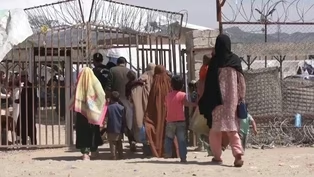
More than six million Afghan refugees have crossed back into Afghanistan over the last three years, 600,000 of them just this year across this border with Pakistan.
They have been pushed back by a crackdown by the Pakistani authorities and the reigniting of the conflict between the two countries.
Many of these people haven't lived in Afghanistan for years.
They arrive exhausted and penniless with no idea how they will rebuild their lives here.
They enter through this cage, heading towards the reception center just a half-mile away, Omari Camp.
Charlie Goodlake is the U.N.
High Commissioner on Refugees' head of fund-raising in Afghanistan.
CHARLIE GOODLAKE, Senior Executive Assistant to U.N.
High Commissioner for Refugees: Things couldn't be more difficult here.
It's nearly 40 degrees.
The weather's dry,.
It's arid, and people are living in tents with no air conditioning, with no electricity, sometimes for weeks at a time.
I have been doing this work for many years, and rarely have I seen such difficult circumstances as this, and such concern and uncertainty for people's futures.
And I think that's particularly the case for women and girls who are coming back.
LEILA MOLANA-ALLEN: Jamila sits in the reception tent waiting for her papers.
She and her nine children crossed the border this morning after hiding from the Pakistani authorities for months.
JAMILA, Deported From Pakistan (through translator): The situation in Pakistan was very bad.
Because of the police, we had to hide in different places every day.
They would catch people and deport them.
LEILA MOLANA-ALLEN: At night, they'd wake to the sound of Pakistani police trying to break down the door, hunting their husbands.
JAMILA (through translator): Whenever they came, they insulted the women and told us: "Get out of the house."
They said: "If you don't leave tonight, we will pour fuel and burn your belongings and your house."
We couldn't sleep from fear.
My nine children were crying day and night.
LEILA MOLANA-ALLEN: Eventually, staying became even harder than coming back after her 8-year-old son, Yunus, was targeted.
JAMILA (through translator): When they couldn't find the adult men and fathers, they take their children instead.
One day, they dragged my little child into a vehicle.
He told them he was from Kabul and they beat him and left bruises all over his body.
LEILA MOLANA-ALLEN: Jamila was born in Pakistan.
She mourns the happy life she had there before the authorities began targeting Afghans.
Afghanistan is a place she only knows from stories.
Now she must raise her kids here.
JAMILA (through translator): Before, our life was very good.
We built a beautiful house.
But now it's all gone.
Now we have nothing.
Thank God we are safe.
But we have nothing.
LEILA MOLANA-ALLEN: Leila has just been forced to cross the border with her six daughters.
The youngest is just 10.
Abandoned in a country they barely know, they have nothing and no one.
BASRA, Daughter of Leila (through translator): We can't survive here.
Back home, we worked in people's homes to support ourselves and get by.
But, here, we can't make a living.
There's no water, no electricity.
LEILA MOLANA-ALLEN: No more high school or university for Basra and her sisters.
And finding work as a woman in Afghanistan is getting harder every day; 14-year-old Maryam was preparing for her first year of high school back in Pakistan.
Suddenly, she faces a future locked inside a country where educating teenage girls is now a crime.
MARYAM, Daughter of Leila (through translator): I want to go to school and have a better life.
I want to study so that I can become a doctor.
Sometimes, we go two or three days without having anything to eat.
Now that we have come back here, where can we go?
We don't have a tent or a house.
"Are you afraid?"
I ask her.
They can stay at the camp for a few days, but after that, they're on their own.
Leila is terrified.
After working menial jobs day and night to earn money to feed her kids, her body is a wreck, covered in rashes, scars, and scabs.
It still wasn't enough to save her girls.
LEILA, Deported From Pakistan (through translator): We have nothing.
What can we do?
It's so difficult here.
It's getting colder.
And they're so young.
LEILA MOLANA-ALLEN: Days later, Basra tells me they're now living under a top, which is flooding as the seasonal rains start.
Her little brother is sick, not having eaten in days.
And there's no help coming.
The U.N.
estimates two million more refugees could be pushed back into the country and the deprivation and misery that awaits them here by the end of this year, helpless, hopeless, a generation of families with nowhere to go, desperate to be anywhere but here.
For the "PBS News Hour," I'm Leila Molana-Allen on the Pakistan-Afghanistan border.
GEOFF BENNETT: Brett McGurk served under four presidential administrations, ultimately working as President Biden's lead on foreign policy in the Middle East.
During that time, the terrorist group Hamas attacked Israel, killing over 1,000 people and taking hundreds hostage, including several Americans.
McGurk chronicles the high-stakes negotiations he led to secure the hostages' release in his new book, "Brink: Inside the Race to Free the October 7th Hostages."
Amna Nawaz spoke with him recently.
AMNA NAWAZ: Brett McGurk, welcome to the "News Hour."
Thanks for being here.
BRETT MCGURK, Author: Thanks so much for having me.
AMNA NAWAZ: Most of your book focuses on efforts to secure the hostages after that October 7 Hamas attack.
That day in 2023, as you lay out, more than 1,000 Israelis killed, nearly 250 taken hostage, the largest mass hostage event in modern history, and you're in the room with President Biden and when others as he's speaking to those hostage families.
Many of them are frustrated and upset.
What do you remember about that?
What stands out to you?
BRETT MCGURK: Well, it was a few days after the attack.
He had a call with the families of American missing, and -- because we didn't know who was alive, who was dead.
It was very -- I describe it as this all comes together.
We see little jagged pieces as the whole picture comes together.
And parents, loved ones, like, wailing into the screen at the president to do something, to bring their loved ones home, and, in the middle of that call, because it's about three days into the crisis, one of the -- I remember one of the family members left the screen, came back, and she had learned that her loved one was killed.
And that call was scheduled on the president's calendar for half-hour or so.
It went on for I think almost an hour-and-a-half.
And it was after that he said to me, "Do whatever you can to get these guys home."
AMNA NAWAZ: You write specifically in the book, "Inside the Biden administration, this caught us completely by surprise," when you're talking about the October 7 attack.
You said: "We had no clear warnings, nor did the Israelis, from what they told us.
There'd been no advance warning of Hamas' attacks."
And I'm sure you have seen the reporting in recent weeks, right... AMNA NAWAZ: ... both from Haaretz and from The New York Times, that UAE's leader had gone to Netanyahu and said Hamas was planning a major attack.
Vivian Salama at "The Atlantic" reported that Egypt's intelligence chief days before October 7 went and told Netanyahu that Hamas appeared to be mobilizing for a major attack.
Were those reports the first time you learned about those meetings and what Netanyahu knew?
BRETT MCGURK: Yes, well, I know the Egyptian intelligence chief quite well.
He's a character in the book, Mohammed Bin Zayed, the president of UAE, I also know quite well.
So I was -- we were not aware of those meetings.
And we did not -- and we looked through all of our intelligence information.
We did not have a -- what you call a warning or indicator.
AMNA NAWAZ: You describe a near breaking point between President Biden and Prime Minister Netanyahu, which is the spring of 2024, and on a call with Netanyahu, Biden says: "Bibi, man, what the eff are you doing?"
What led him to that point?
BRETT MCGURK: Well, that was on April 4.
The president is just frustrated.
He's running for president now.
He's in his reelection.
The hostage talks have broken down, and I describe in the book why.
And we had a horrific Israeli drone strike, killed a number of aid workers with World Central Kitchen, Jose Andres' organization.
And Biden was just fed up.
We all want this to somehow stop.
But also on that call -- that's why it's so important -- and we had intelligence information that Iran was preparing to launch the largest ballistic missile attack almost in history.
At the same time, the frustration is boiling over because we can't find a way to get the hostages out.
And Biden is taking criticism from the right that we're not supporting Israel enough and putting enough pressure on Hamas and from the left that we're not restraining Israel enough.
And what he did in that call, which is very important, was, yes, he said that.
He also said to Netanyahu: "I'm going to help defend Israel from this Iranian attack.
I'm going to deploy military assets.
And after I help defend you, we're going to get a hostage deal on the table, bring this war to a close."
And as it played out, I think that was the right message at that time.
AMNA NAWAZ: But also on that call, you mention, at that time, that Biden threatened to cut off military aid... AMNA NAWAZ: ... that he said he would go so far.
And he did not.
You were among those arguing against it.
Why?
What do you think would have happened if he'd actually cut off military aid to Israel?
BRETT MCGURK: Well, I think the private -- the private messaging was very effective.
And President Biden used some more colorful language than that, that you just mentioned.
He did very selectively curtail munitions after this period.
AMNA NAWAZ: If there was a real threat to cut off military aid, could that have changed Israel's war conduct?
BRETT MCGURK: Well... AMNA NAWAZ: Could it have saved thousands of Palestinian lives?
At this point in the war, tens of thousands of Palestinians had been killed, over 30,000, by some estimates.
BRETT MCGURK: So how do you stop it?
That's right.
So how do you stop it?
This is what was the consuming question.
There's a complete disconnect between the view that we could have made a decision like that at that period at that time, and somehow the war would have stopped, lives would have been saved, hostages would have come home.
AMNA NAWAZ: You don't believe it would have had an impact?
BRETT MCGURK: No, and I think the record reflects that.
But I reflect in the book, if there was a shortcut, Biden would have taken it.
If there was a shortcut, Biden would have taken it.
We all would have taken it.
AMNA NAWAZ: You do get to a cease-fire and hostage release deal, one that you reach alongside president-elect Trump and his adviser Steve Witkoff.
I'm just curious because you have seen Steve Witkoff in his negotiating mode.
AMNA NAWAZ: He's now negotiating, trying to negotiate the end to two other conflicts.
What do you think he brought to the table as a negotiator, given his background and skill, and will he succeed in Iran and Russia's war in Ukraine?
BRETT MCGURK: At that moment, so many things in the region had changed.
So the table was set.
I thought, being so close to this, now's the time to push for a deal.
And I knew we could not push for a deal without having the incoming Trump administration working hand in glove with us, because the nature of a transition, as time goes by, the incumbent president who's leaving, the power just wanes.
I have felt this before.
So I called Jared Kushner after the election.
I eventually met Steve Witkoff.
And I just -- we described the situation, that we think we can stop this war and get the hostages home.
And Steve, I can't give the direct quote here because there's some colorful language, but he says: "I'm here to save lives.
Let's save lives."
And Steve and I worked hand in glove in those final weeks to close that deal.
AMNA NAWAZ: You document in the book how hard you worked to avoid a wider regional war, in addition to trying to get the hostages released and a cease-fire in Gaza.
Has this new war, U.S.
and Israeli war in Iran, has that undone that ability to stop a regional war?
BRETT MCGURK: I think, if you go through the book, and there's a number of moments in which we're debating the use of American military power in the middle of this broader regional crisis.
And President Biden was always very clear, the American people understand the use of American military power to protect American personnel, protect American interests.
They would not understand being dragged into a broader Middle East war.
And I think, in President Trump's term here, the campaign that began February of this year, I think, suffered from the same fatal flaws that I have seen in the past, with an infinite, unclear objective, which looked to be a regime change objective early on, and without articulating to the American people exactly what we're trying to do.
However, once you're engaged in this, there's always the bit of a trap.
How do you actually find your way out of it without getting drawn into another major military confrontation, tit for tat, which I think plays into Iran's hands?
We will see.
AMNA NAWAZ: The book is "Brink: Inside the Race to Free the October 7th Hostages."
The author is Brett McGurk.
Brett, thank you so much.
Good to see you.
BRETT MCGURK: Thank you so much for having me.
Thank you.
GEOFF BENNETT: We return now to our series exploring GLP-1 medications, tonight, a look at the challenges around access.
Despite some recent improvements, millions of Americans still face significant barriers to affording these powerful drugs.
So, many patients have found alternative, cheaper ways to get their hands on unregulated versions.
Stephanie Sy has the story, part of our GLP-1s: Reshaping America series.
STEPHANIE SY: Robin Washington does her best these days to keep up with her 2-year-old grandson.
ROBIN WASHINGTON, Maryland Resident: He keeps me on my toes, but by the time it's time to go to bed, I'm done.
ROBIN WASHINGTON: And when he takes a nap, sometimes, I take a nap.
W for what?
STEPHANIE SY: For the 67-year-old, that exhaustion is a reminder of a nearly lifelong struggle with her weight.
ROBIN WASHINGTON: I had my second kid, and then that's when I could not get the weight off.
I weigh like, what, 255?
If I could just get past the 200.
(LAUGHTER) STEPHANIE SY: In the past few years, Washington started hearing a lot about weight loss medications like Ozempic and Wegovy.
ROBIN WASHINGTON: I know it's a big fad, kind of, but it's not a fad.
It's really a revolution.
Yes, we have corn back there.
STEPHANIE SY: She wondered whether the drugs could jump-start her weight loss and help ward off future health problems like diabetes.
So she asked her doctor about them.
ROBIN WASHINGTON: She said, yes, that's an option.
She gave me some names, brand names, and I looked them up on the app for my insurance.
And it came up not covered, not covered, not covered.
And then she -- so then I asked her, how much would it be a month?
And she was like $1,000, $1,500.
I was like, whoa.
STEPHANIE SY: So that was a nonstarter.
ROBIN WASHINGTON: Yes, right.
That was like, oh, well.
CHARLES BARKLEY, Former NBA Player: I have lost 45 pounds.
STEPHANIE SY: Now, amid a sea of celebrity endorsements and before-and-after photos online, Washington thinks GLP-1s have become another example of America's haves and have-nots.
Despite a high prevalence of obesity, Black Americans were almost 50 percent less likely to be on obesity medications like GLP-1s than white Americans.
But issues with access and affordability are widespread.
Out of an estimated 30 million American adults currently on a GLP-1, more than half said paying for the medication is difficult.
RYAN DEWALT, Former GLP-1 User: I was at the time unemployed and on -- literally on having to make a decision between taking care of my family or getting the medication.
MELANIE BARRETO, GLP-1 User: I am going through bankruptcy.
I haven't filed yet, but I do have a lawyer.
For the quality of life change that I have had by being on this drug, to me, it's really worth going through any financial challenges.
LIONEL LENOIR, Former GLP-1 User: It makes total sense that you get to the point where you're willing to do anything just to be a little more comfortable in your own skin.
STEPHANIE SY: Most insurance plans still cover GLP-1s for conditions like type 2 diabetes.
But as more and more people get on the drugs, companies are dropping coverage for weight loss, citing soaring costs.
By one estimate, the number of employers covering GLP-1s for obesity fell 17 percent over just the last year.
DR.
BETTY WANG, BW Primary Care: The carve-outs are going to remove the ones who are on the edge.
But the problem at hand is that there are lots of people with prediabetes and other clues who should have access to this medication.
STEPHANIE SY: Dr.
Betty Wang is one of the co-founders of BW Primary Care, a practice outside Baltimore where Robin Washington is a patient.
Right now, about half of the calls coming into the clinic are from people curious about GLP-1s.
Discussions about access and cost can be all-consuming and frustrating.
NARRATOR: Get started for a lower price.
DR.
BETTY WANG: Often, a person will come in with a sound bite or a coupon in hand thinking it's going to be a very quick conversation and that it's going to be something like $25 a month.
We have seen people be irate, almost to the point of being very upset with us, as if we have more control in the process than we do.
STEPHANIE SY: At the same time, many Americans are finding easy access to GLP-1s, especially to compounded versions of the drug they can get through telemedicine.
These less expensive options, which can have the same active ingredient as the brand names, but are often mixed with other substances, are not approved by the Food and Drug Administration.
SALLY BRALLIER, GLP-1 User: It was very easy.
Just went online, answered maybe 10 questions about your health.
As far as I know, nobody checked to see if I was telling the truth or not.
RYAN MILLIKEN, GLP-1 User: It was very surprising.
I was expecting a consultation with a lot of medical history being discussed.
That was all absent.
It felt almost as though they were trying to get me through the process as quickly as possible.
STEPHANIE SY: Now, this is really different.
But another avenue has emerged for getting cheaper GLP-1s, the so-called gray market.
ELIZABETH ZIBILICH, GLP-1 User: This is the Tirzepatide.
This is a 10 milligram vial.
STEPHANIE SY: Elizabeth Zibilich is among the thousands of people who currently mix their own GLP-1s at home.
ELIZABETH ZIBILICH: I go slow because it tends to dissolve a little bit easier that way.
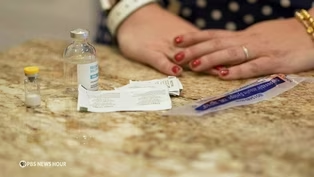
STEPHANIE SY: Zibilich buys peptide powder from China, labeled for research purposes only, not human consumption, and mixes it with sterile water before injecting herself once a week.
ELIZABETH ZIBILICH: You really don't feel it because it's such a small needle.
STEPHANIE SY: That's it.
ELIZABETH ZIBILICH: And that's it.
STEPHANIE SY: In 2015, Zibilich was hit by a truck while crossing the street.
She suffered a serious back injury, which led to weight gain.
At one point, she reached nearly 430 pounds.
She underwent bariatric surgery, which helped her lose weight and keep it off for years, but the weight came back during the pandemic.
So, at this point, you talk to your doctor?
ELIZABETH ZIBILICH: I did.
We decided to try Ozempic.
I lost 20 or so pounds, finally feeling like I'm getting on track.
And then, because I am on Medicaid, it was ripped away from me.
Medicaid at that time in Louisiana was only covering GLP-1 for type 2 diabetes.
STEPHANIE SY: So, at that point, you're starting to game out like, what, how am I going to get this?
Like, are you feeling like this is -- this drug is so important in your life that you have got to find a way to keep... ELIZABETH ZIBILICH: At that point, I was starting to give up.
STEPHANIE SY: After about nine months off Ozempic, Zibilich, a self-employed artist, discovered the gray market.
She's now paying about $100 a month, far less than the up to $500 she'd pay for a brand name GLP-1.
ELIZABETH ZIBILICH: I go through a friend who orders it for several people.
They are not doing it to make money.
They're not doing it for their own benefit.
They are doing it to help others.
And the batches that they get, they will have it tested so that you can see, is it truly this thing?
ELIZABETH ZIBILICH: And we have not had any trouble any time.
STEPHANIE SY: The FDA has warned that products on the gray market are illegally sold and of unknown quality and may be harmful to consumers' health.
But Zibilich has been on this version for over two years and has kept the weight off.
Do you wish that you did not have to go through the gray market?
ELIZABETH ZIBILICH: I do.
But this was for my health.
If I had continued again on that path after I gained another 100 pounds back during COVID, I was going to die.
STEPHANIE SY: Yes.
ELIZABETH ZIBILICH: More people with access to this means healthier bodies.
WOMAN: How are you?
ROBIN WASHINGTON: I'm good.
How are you?
WOMAN: Good.
STEPHANIE SY: Back in Maryland, Robin Washington found out she's eligible for a national pilot program that allows certain Medicare recipients to access GLP-1s for $50 a month.
We followed Washington to her appointment at BW Primary Care, when she finally received her first injection of Zepbound.
How does it feel to all of a sudden be there at the point?
ROBIN WASHINGTON: It was crazy.
I'm glad that I was able to have that chance, because, like I said, I thought I wasn't going to be able to do it.
That's very good.
STEPHANIE SY: In just three weeks, she lost about five pounds, saw her blood pressure drop, and had less inflammation in her knees.
But Washington is aware that the Medicare pilot program is set to end next year.
And since most people lose the benefits of these drugs when they stop taking them, she knows she may be right back where she started.
For the "PBS News Hour," I'm Stephanie Sy.
GEOFF BENNETT: Tomorrow night, our series continues with a look at the promise GLP-1s have shown in treating addiction.
And that's the "News Hour" for tonight.
I'm Geoff Bennett.
Thank you, as always, for spending part of your evening with us.
 New
NewAs Afghans try to flee Taliban, some are forced to return
Video has Closed Captions
As some Afghans escape the Taliban, other refugees are forced to return (10m 50s)
 New
NewDOJ ramps effort to prosecute non-citizens accused of voting
Video has Closed Captions
Examining the DOJ's effort to prosecute non-citizens accused of voting (4m 54s)
 New
NewFrench students lead massive protests across country
Video has Closed Captions
French students lead massive protests against education policies (2m 40s)
 New
NewHaitian's suicide shows human toll of immigration crackdown
Video has Closed Captions
Haitian student's suicide reveals human toll of immigration crackdown (6m 3s)
 New
NewHigh cost of GLP-1s push some to seek unregulated versions
Video has Closed Captions
High cost of GLP-1s drives some to seek cheaper, unregulated versions (8m 48s)
 New
NewMcGurk chronicles talks to free Oct. 7 hostages in 'Brink'
Video has Closed Captions
Brett McGurk chronicles negotiations to free Oct. 7 hostages in 'Brink' (8m 34s)
 New
NewNews Wrap: Yates to review Cornell sexual assault reports
Video has Closed Captions
News Wrap: Cornell says Sally Yates will review handling of sexual assault reports (6m 52s)
 New
NewSuspected Iranian plot pushed U.S. to move bombers from UK
Video has Closed Captions
Suspected Iranian drone plot pushed U.S. to evacuate bombers from British air base (3m 12s)
Providing Support for PBS.org
Learn Moreabout PBS online sponsorship New Episode
- News and Public Affairs

Today's top journalists discuss Washington's current political events and public affairs.

- News and Public Affairs

FRONTLINE is investigative journalism that questions, explains and changes our world.

 New Episode
 New Episode
 New Episode
 New Episode
 New Episode

 New Episode
 New Episode
Support for PBS provided by:
Major corporate funding for the PBS News Hour is provided by BDO, BNSF, Consumer Cellular, American Cruise Lines, and Raymond James. Funding for the PBS NewsHour Weekend is provided by...