
July 9, 2026 - PBS News Hour full episode
7/9/2026 | 57m 46sVideo has Closed Captions
July 9, 2026 - PBS News Hour full episode
July 9, 2026 - PBS News Hour full episode
Problems playing video? | Closed Captioning Feedback
Problems playing video? | Closed Captioning Feedback
Major corporate funding for the PBS News Hour is provided by BDO, BNSF, Consumer Cellular, American Cruise Lines, and Raymond James. Funding for the PBS NewsHour Weekend is provided by...
July 9, 2026 - PBS News Hour full episode
7/9/2026 | 57m 46sVideo has Closed Captions
July 9, 2026 - PBS News Hour full episode
Problems playing video? | Closed Captioning Feedback
Where to Watch PBS News Hour
PBS News Hour is available to stream on pbs.org and the PBS app.
Providing Support for PBS.org
Learn Moreabout PBS online sponsorshipGEOFF BENNETT: Good evening.
I'm Geoff Bennett.
Amna Nawaz is away.
On the "NewsHour" tonight: a return to open hostilities with Iran.
What the latest U.S.
strikes mean for efforts to negotiate an end to the war.
Democrats search for a replacement Senate candidate in Maine after sexual assault allegations force Graham Platner to drop out of the race.
We speak with former White House Chief of Staff and potential 2028 presidential candidate Rahm Emanuel about his warning to Israel that it can no longer expect unconditional support from the U.S.
RAHM EMANUEL, Former White House Chief of Staff: This is at a tipping point.
America has been on your journey with you for 78 years since the founding and Harry S. Truman.
But you have taken yourself under this prime minister straight into a wall and crashed the car.
GEOFF BENNETT: And the band Hermanos Gutierrez joins us to talk about the stories they tell through music and perform their new single.
(BREAK) GEOFF BENNETT: Welcome to the "News Hour."
A return to open hostilities between the U.S.
and Iran.
Late last night, U.S.
Central Command said it completed a new round of strikes against Iran.
Neither side appears ready to return to talks, and Iran has not said it will allow free passage through the Strait of Hormuz.
Our Liz Landers starts our coverage.
LIZ LANDERS: Overnight.
U.S.
airstrikes knock out a maritime control tower in Southern Iran, and a burst of orange dots the horizon.
In total, U.S.
Central Command says it struck roughly 90 targets across Iran last night, targeting military assets to -- quote -- "further degrade Iran's ability to attack commercial shipping," an uptick from the 80 targets that were hit the night before.
By day, Iran's coast billowed with plumes of fire off the water, boats set ablaze.
In retaliation, Iran fired volleys across the Gulf, targeting American military sites.
Air raid sirens echoed over Kuwait city, a missile with a message -- quote -- "To the memory of the clenched fist of the martyred leader."
Another violent night and a second cycle of bombing pulling at the seams of a cease-fire already threadbare.
DONALD TRUMP, President of the United States: We just hit them very hard.
LIZ LANDERS: And last night aboard Air Force One, little appetite for diplomacy.
DONALD TRUMP: I say we hit them 20 to 1.
Every time they hit us, we're going to hit them 20.
LIZ LANDERS: In turn, Iran made threats of its own.
Parliamentary leader Mohammad Bagher Ghalibaf warned on social media -- quote -- "America still hasn't learned that bullying and breaking promises are no longer cost-free.
Let me put it plainly.
If you strike, you will get hit."
The return to open hostilities follows Iran striking three commercial oil tankers in the Strait of Hormuz, spurring this week's round of wide-scale U.S.
strikes against the Islamic Republic.
That fighting, the U.N.
said today, is trapping over 6,000 sailors in the partially blocked waterway.
As the passage remains perilous, some of the remaining ships transiting go dark, turning off their signal before navigating.
VICE ADM.
ROBERT HARWARD (RET.
), Former CENTCOM Deputy Commander: In Afghanistan and Iraq, we had boots on the ground, which really becomes a great differentiator.
Are we willing to take that risk here?
LIZ LANDERS: Retired Vice Admiral Robert Harward was the deputy commander of CENTCOM from 2012 to 2014.
He's now a senior fellow at the Jewish institute for National Security of America.
He says sending military troops into Iran to destroy Iranian forces that threaten shipping is necessary.
VICE ADM.
ROBERT HARWARD (RET.
): If we don't know if we have completely eradicated drones and missiles from Bandar Abbas, Jask, Kharg Island, anywhere else, going in bombing it and then following it with a raid, temporary raid to put boots on the ground to ensure we have accomplished that mission is another option available to the president.
But we did it in the case of a downed pilot.
I think this is a strategic and necessary requirement to do it again now, to verify and ensure they cannot threaten the straits.
ALAN EYRE, Middle East Institute: The problem is, you put boots on the ground, they're targets.
LIZ LANDERS: Alan Eyre, former negotiator for the Iranian nuclear deal under Obama, says sending U.S.
troops into Iran would not enable the United States to eliminate Iran's ability to threaten shipping in the Strait of Hormuz.
ALAN EYRE: Iran, at least in terms of all the assessments I have seen in open-source media, has significant remaining quantities of missiles and drones, these small boats that could be quickly deployed, fast attack craft.
So even with boots on the ground, unless you're going to stay there, I don't think we could sufficiently degrade their ability to threaten maritime shipping in the strait.
LIZ LANDERS: Meantime, on the ground in Iran, the concluding steps in a weeklong march for the funeral of the late Ayatollah Ali Khamenei.
The procession reached its climax today, entombing the coffin of the Islamic Republic's former leader in his hometown, his body followed by those of his family carried by truck.
Thousands of mourners lined the streets to bid farewell and call for revenge, the final burial for the assassination that ignited the war now approaching its fifth month as a return to all-out conflict rears its head.
For the "PBS News Hour," I'm Liz Landers.
GEOFF BENNETT: In the day's other headlines: Three-time Olympic canoe racer David Hearn today pleaded not guilty to deliberately damaging the Reflecting Pool in Washington, D.C.
The 67-year-old was met with cheers as he left the courthouse this morning.
He was indicted on a single felony count of property destruction last week.
Hearn says he reached into the pool to examine the peeled liner, but let go when told to do so by a park worker.
His lawyer says the case against him is based on a concocted narrative.
NORM EISEN, Attorney For David Hearn: Every American should be alarmed about this prosecution.
This indictment reflects the administration's effort to scapegoat Davey and to shift blame for their own failures.
GEOFF BENNETT: President Trump's multimillion-dollar renovation of the pool has been plagued with issues, including freshly formed algae and sealants peeling off.
The president has claimed without evidence that vandals slashed the pool sealant with a box cutter, and U.S.
attorney Jeanine Pirro has said that six others were arrested on related charges.
Hearn's next hearing is scheduled for early August.
As of today, travelers flying in or out of Palm Beach, Florida, will pass through President Donald J. Trump International Airport.
The change follows a law Governor Ron DeSantis signed back in March renaming Palm Beach International Airport after nearly half-a-century under that name.
It's part of a broader push to put Mr.
Trump's name or image on public buildings and other institutions.
About a dozen U.S.
airports are named for presidents, but it's rare for an airport to be named after someone still living.
And this is the first named for a sitting president.
President Trump also took the unusual step of registering trademarks for the airport's new name, raising questions about whether he stands to profit.
Turning overseas now, Ukraine struck more energy targets inside Russia today with long-range drones.
Its military released these videos of strikes on tankers and other vessels in the Sea of Azov.
They also hit oil refineries elsewhere.
A day earlier, President Trump pledged to grant Ukraine a license to build its own patriot air defense systems.
In response, the Kremlin largely downplayed that development and instead focused on U.S.
diplomatic efforts to end the war.
DMITRY PESKOV, Spokesman for Vladimir Putin (through translator): Unlike the unlike the Europeans, the United States retains a desire to facilitate a move toward a peace process.
They may be misguided or mistaken at times, but that desire strikes us as sincere.
We welcome it.
GEOFF BENNETT: Meantime, a top Ukrainian official cautioned it could take a year or longer to actually produce the Patriot interceptor missiles.
In Southern China, authorities say flooding has killed at least 39 people after days of record rainfall.
A massive rescue and relief operation is under way as entire communities are underwater in the region of Guangxi.
Officials there say the partial collapse of a local dam is responsible for most of the fatalities.
And they warn that many other structures could be compromised.
CHEN RUNDONG, Deputy Director, Water Resources Department, Guangxi Regional Government (through translator): Currently, more than 300 reservoirs across the region are operating above their flood limit water levels.
Extreme torrential rainfall has triggered critical emergencies, including dam overtopping and breaches.
GEOFF BENNETT: Meantime, E.U.
climate watchers confirmed today that Western Europe endured its hottest month of June ever.
That's as here in the U.S.
another heat wave is expected across much of the country.
Turning to the nation's housing market now, U.S.
home prices hit an all-time high last month.
The National Association of Realtors said today that the median price for existing homes rose nearly 2 percent to around $440,000.
Those elevated prices and high mortgage rates are adding pressure to would-be homebuyers.
Meantime, on Wall Street, stocks ended higher as oil prices eased a bit.
The Dow Jones industrial average added around 140 points on the day.
The Nasdaq jumped more than 300 points.
The S&P 500 also closed the session with a solid gain.
Trailblazing aviator Mary Wallace, or Wally Funk, has died.
In the early 1960s, she was among the Mercury 13, a privately funded effort intended to train women to fly in space.
The 13 women in the program undertook the same training and testing required of the seven men selected by NASA for the Mercury space flight program.
Funk continued to fly and later served in high-level roles at the FAA and the National Transportation Safety Board.
Then, at age 82, she was chosen for Blue Origin's New Shepard rocket crew and became the oldest woman ever to reach space.
Wally Funk was 87 years old.
And in the music world, Welsh singer-songwriter Bonnie Tyler has died.
Her anthem "Total Eclipse of the Heart" was a huge hit of the '80s, earning Tyler one of her three Grammy nominations.
It's been streamed more than a billion times on both Spotify and YouTube.
Born Gaynor Sullivan, she brought her distinctive gravelly voice to other hits, including "It's a Heartache" and "Holding Out For a Hero."
In 2022, she was honored as a member of the Order of the British Empire for her services to music.
Bonnie Tyler's family said she died unexpectedly in Portugal, where she was being treated for an illness.
She was 75 years old.
Still to come on the "News Hour": the Trump administration expands Medicare coverage for increasingly popular weight loss drugs; the sister of a formerly imprisoned Iranian-American businessman speaks out about Americans still detained in Iran; plus, an in-studio performance by the band Hermanos Gutierrez.
Maine Democrats are scrambling to pick a new U.S.
Senate candidate as the scandal-plagued winner of last month's primary says he's withdrawing from the race.
Graham Platner announced his decision to step away last night following new sexual assault allegations.
GRAHAM PLATNER (D), Former Maine Senatorial Candidate: I know that some will think it's an admission of guilt, and it most certainly is not.
We're not doing it because of the allegations.
We're doing it because of the structures that are being taken away from us by those in power.
We believe that for the movement to continue, it can't be me.
And, for that reason, we are suspending campaign operations.
GEOFF BENNETT: Democrats in Maine have just 18 days to name a replacement nominee to take on incumbent Republican Susan Collins.
We're joined now by Ashley Etienne, who served as communications director for former Vice President Kamala Harris, and, before that, communications director and senior adviser to former House Speaker Nancy Pelosi.
Thanks for being here.
ASHLEY ETIENNE, Democratic Strategist: Thanks for having me.
GEOFF BENNETT: So Platner's campaign went from insurgent success story to complete implosion.
What does his rise and collapse say about the Democratic Party right now?
ASHLEY ETIENNE: I mean, I think to some degree this speaks to the desperation of the Democratic Party.
We're so desperate to find a working-class candidate, white male in particular, that can appeal and carry the progressive banner at all cost.
And that's what we're seeing right now play out at all costs, that part of it.
And so that's what I think that is at play.
But the reality is, Platner himself is to blame.
His campaign is to blame.
I'm sure you recall over a year ago, his wife turned over explicit text messages between him and women and a set of women.
Another woman came out.
Like, this was well-known to the campaign.
The wife, in fact, even said this is going to be your vulnerability as a campaign, and they ignored it.
So to some degree it's that desperation to find that one sort of white savior to some extent that the party's been searching for that has put us in a position to ignore all these indiscretions.
GEOFF BENNETT: Well, the Maine Democratic Party says it's going to host a nominating convention.
They issued a statement on social media today, but provided few details about precisely how this process is going to work.
Democrats, as you well know, went through a very different, but in some ways similar candidate replacement process in 2024 with Vice President Kamala Harris and then President Joe Biden.
What lessons should Maine Democrats take away from what Democrats at the national level experienced back then?
ASHLEY ETIENNE: Such a good question.
One is you have to move quickly to seize this opportunity.
You don't want any grass to grow underneath your feet.
We saw that happen with Kamala Harris.
I think there was about three or four weeks before it was decided that she was going to be the nominee.
The second is, you have got to pick someone who's going to have the ability to raise a lot of money, appeal to progressives.
And I would say the third lesson that's learned is that it cannot look like an insider job.
It cannot look like those on the inside are putting their thumb on the scale for one particular candidate.
And it appears that the Maine Democratic Party is fully aware of all of these lessons and are trying to take the right steps to ensure that the process is fair, transparent, and enables those progressives that are following Platner to come to the table.
GEOFF BENNETT: Well, right now, you have got several candidates trying to position themselves for the nomination.
Take a look.
NIRAV SHAH (D), Former Maine Gubernatorial Candidate: Maine deserves a fighter in this seat, and I will be that fighter.
DAN KLEBAN, Maine Business Owner: People are rightfully pissed off because the system is rigged against them.
TROY JACKSON (D), Former Maine Gubernatorial Candidate: I want these issues to come forward.
I want people to continue to feel like Democrats are fighting for them.
SHENNA BELLOWS (D), Maine Secretary of State: We need a candidate with backbone who can unite that party together and Maine voters.
And I think I'm the best person to beat Susan Collins.
GEOFF BENNETT: A candidate with backbone, a candidate who can fight.
Platner built this coalition around anger at the Democratic establishment.
How do Democrats choose a replacement candidate without alienating the voters who powered Platner's success?
ASHLEY ETIENNE: I mean, that's going to be the fine line they're going to have to walk.
Not only do you not want to alienate his supporters and those progressives, but you have got to appeal to independent voters.
That's how you win Maine.
I mean, I think we're so consumed with progressives, but the reality is you're going to have to outperform with both independents and progressives.
Collins is such a force because she understands intimately those independent voters.
They have been the voters that have been key to her winning that seat year after year, cycle after cycle.
So you're going to have to find someone who has an ability to really bridge both of those divides.
It was -- we were unsure whether or not Platner had that ability.
So now you kind of almost -- the party has almost an opportunity to really start fresh and refocus on, A, how do we find someone who can again do both of these appeal to progressives while bringing into independents to the table?
GEOFF BENNETT: How much has this entire episode damaged the party's chances at picking up this seat?
ASHLEY ETIENNE: You know, people are feeling somewhat optimistic.
We were feeling optimistic before, but somewhat optimistic now.
I think it's going to depend on how quickly and how seamlessly this process goes forward.
The reality is the objective has to be do the least amount of damage as possible on the ground there.
So I think people are feeling optimistic, but just fairly optimistic.
(LAUGHTER) GEOFF BENNETT: Fairly optimistic.
ASHLEY ETIENNE: Yes, fairly optimistic.
GEOFF BENNETT: Ashley Etienne, always a pleasure to speak with you.
Thanks for being here.
ASHLEY ETIENNE: Thank you for having me.
GEOFF BENNETT: Former U.S.
Ambassador Rahm Emanuel delivered a pointed message in Israel yesterday about the future of the U.S.-Israel relationship, at a moment when American public opinion and the Democratic Party itself are increasingly divided over U.S.
support for Israel.
Emanuel, a former mayor of Chicago and President Obama's White House chief of staff, who is exploring a run for president in 2028, is also a longtime supporter of Israel.
Speaking at Tel Aviv university, he sharply criticized Prime Minister Benjamin Netanyahu's government, called for a new approach to U.S.
military assistance and renewed efforts toward Palestinian statehood.
RAHM EMANUEL, Former White House Chief of Staff: I came here from Chicago to tell you directly where things need to head if we are going to maintain the historic alliance between two democracies.
Without question, the alliance is at a crossroads.
It cannot stand or survive as it has been.
To maintain the strength of our ties, this alliance needs significant changes and a new direction.
GEOFF BENNETT: Rahm Emanuel joins us now from Berlin, Germany.
Welcome back to the "News Hour."
RAHM EMANUEL: Thanks, Geoff.
Thanks very much.
GEOFF BENNETT: In your speech to Israelis, you said the relationship between the U.S.
and Israel needs a new direction.
What more, in your view, needs to change?
RAHM EMANUEL: Well, as I lay out in the speech, you have to -- and we will stand by you - - work on peace and economic integration.
A country, any country, specifically like ours, you have four tools in your security toolbox, military power, political persuasion, economic statecraft, and cultural attraction.
Three of those have been atrophied, and all you do is use your military as a hammer, and every security challenge is a nail.
And I offered not just a criticism of the prime minister, but also, specifically, let's work not towards two-state, a 23-state solution where all the Arab nations and the Arab League do full diplomatic relation with Israel, if you come to an agreement on sovereignty for the Palestinian people, a rightful cause, as well as your security, which is a rightful cause.
And that would break Israel out of its pariah status.
GEOFF BENNETT: This 23-state solution, normalizing relations between Israel and the Arab League tied to Palestinian statehood, say more about why you think that would be more successful than the two-state diplomacy that has failed for decades.
RAHM EMANUEL: Well, the two-state solution doesn't have support on either side, and the politics don't work.
The politics here leverages the Arab League nation's desire for stability, because they're now today more integrated to the economy of the world and they want stability, and the chaos that's happening right now with Iran, the regional war, is hurting their own economics.
Two, their plan back in 2013 was a 23-state solution.
Game on.
Let's go.
But they have to play a role not from the sidelines, standing up a Palestinian Authority that three separate times in its history has rejected sovereignty and then responded with violence and killing civilians in Israel.
That's totally unacceptable.
So if they become the kind of mentor that stands up an authority that can give the self-determination and the sovereignty to the Palestinian people that is right, Israel would also get a negotiated security.
That would be a breakout not only of the pariah status that Israel has today.
It leverages their desire for security.
It has the Arab League as an insurer of a Palestinian sovereignty that doesn't turn this down for the fourth time in a row.
And they have their own interests.
So everybody has a political interest.
And the one thing I can tell you, as both a former chief of staff and a former ambassador, when you align people's politics, you can get the policy to work.
If the politics works against it, very hard to do.
GEOFF BENNETT: You said that Israel's conduct in Gaza has been reckless and careless with Palestinian life.
What should the U.S.
have done differently while that war was under way?
RAHM EMANUEL: There was no day-after plan.
After you had established your deterrence, after you had established actually beating back the capacity of what Hamas had done, you have no-day after plan, except for what you're left with, occupation and isolation.
You're a small country of nine million.
You cannot become a pariah.
You can't.
You have lost Europe.
You have lost the United States, and in the last three years you picked up Somaliland.
As I said in the speech, that is, my mother would say, such a deal.
And you can't sustain that.
In 22 years, the state of Israel will be 100.
We in the United States just passed 250 year milestone.
You think the present status quo is going to sustain itself for another 22 years?
Now, Israel has more Nobel Prize winners than any nation based on per capita.
Their envy of the world is their start-up nation and the technology.
Do you want to be remembered for having worked on climate change, for feeding the world or knowing how to use an F-35 and conduct war?
You have an opportunity to do both.
Take your military successes and turn them to strategic advantages.
The Biden administration should have enforced, as the government and others wanted to quit the Netanyahu government, there was no day-after plan.
And all you have is now both the occupation that is sapping resources and, worse, continues to isolate you, just like what you're doing in the West Bank.
It is an unsustainable political path.
Europe is your number one market.
We are your number political patron and supporter of the country, and you have lost both.
That is an unsustainable political statement.
So I wanted to be direct, I wanted to be honest, and I wanted to go there so they heard it and understood that this is at a tipping point.
America has been on your journey with you for 78 years since the founding and Harry S. Truman.
But you have taken yourself under this prime minister straight into a wall and crashed the car.
Now, you want to walk on the journey of peace, shoulder to shoulder with you.
You're going to continue to do this, you have lost the United States.
GEOFF BENNETT: As you well know, support for Israel has fallen sharply among Democrats.
This is especially true among younger voters.
How do you see this shift showing up politically in the midterms and beyond that in the 2028 election?
RAHM EMANUEL: The problem is not a Democratic Party problem.
It's an American problem heightened by the demographics of under the age of 30.
When you have two-thirds of the country not supportive of Israel, that's not a Democratic-only problem.
When you say it's a Democratic problem, you're diminishing and narrowing the appreciation of the depth of what has happened with a country that normally have two-thirds of the country, of Americans supporting them.
So I actually think, if I could twist it, it's a far more grave consequence.
I think it's now starting to dawn on them this is actually bigger.
You could dismiss it, oh, it's a Democratic Party problem.
It isn't.
I didn't need a war to know that this prime minister was wrong.
In 2009 in the White House as President Obama's chief of staff, I said it to his face, which is what endured the public comment that I was a self-loathing Jew.
What I'm saying is, this is an alliance.
We are your number one ally, and you have lost us.
GEOFF BENNETT: It strikes me we should make clear as part of this conversation for folks listening that Israel, yes, suffered the deadliest attack in its history on October 7.
It still faces existential threats from Hamas and Hezbollah and from Iran.
Many Israelis believe that the world has lost sight of that.
How do you navigate criticism of Netanyahu and Israel's policies while still recognizing the extraordinary security threats that country faces?
RAHM EMANUEL: They have serious -- they're not wrong about the security challenges.
But like every -- not every security challenge, like on the Syrian front, diplomacy is the right tool.
Do I believe there's serious challenges?
My father fought in the war of independence.
Our family is named after my uncle who died fighting for the state of Israel.
I know the security challenges.
And they're not phony.
But sometimes, in that security challenge, it doesn't mean you know just your military power.
You use your political, economic, and other elements of your soft power.
Hamas killed more than 1,200 people, raped more, took 250 people hostage.
What they really wanted to destroy was the possibility that Israelis and Palestinians could ever live side by side.
And I think the way the prime minister executed this operation in Gaza actually ended up helping Hamas achieve its goal, rather than actually deter future actions and create a different alternative, which should have been the day-after plan that his own government officers that quit the government and his own military told him they lacked.
And now you have perpetual occupation with perpetual isolation.
That's a failed plan for the future.
GEOFF BENNETT: Former U.S.
Ambassador, among many other titles, Rahm Emanuel speaking with us tonight from Germany, thanks again for your time.
GEOFF BENNETT: The number of Americans taking GLP-1 drugs for weight loss is rising sharply.
A new Gallup poll finds 11 percent of adults say they're currently using one of the medications, up from just 3 percent two years ago.
And that number could climb even higher now that Medicare has cleared the way for some patients to access these drugs, which can help reduce obesity substantially and the risk of other health problems.
Our William Brangham has the details.
WILLIAM BRANGHAM: That's right, Geoff.
Starting this month, some Medicare beneficiaries can buy these popular weight loss drugs for only $50 a month.
That is a steep discount from retail prices.
It's part of a new temporary pilot program to give millions of Americans access to the drugs that many have been unable to afford.
The program is scheduled to run through the end of 2027.
To help us fill in the picture of what people need to know, we are joined by Juliette Cubanski.
She's vice president and director of the Program on Medicare Policy at KFF.
Juliette, thank you so much for being here.
Who on Medicare will be eligible for this discounted access to these drugs?
JULIETTE CUBANSKI, Program on Medicare Policy, KFF: Millions of people are now eligible for this new program.
The program is designed to reach people on Medicare who haven't been able to access coverage of GLP-1s for weight loss specifically through their Part D plans.
That's because the law prohibits Medicare from covering drugs used for weight loss.
This temporary program is targeting people with a BMI over 35 or a BMI over 27, along with other... WILLIAM BRANGHAM: That's their body mass index.
JULIETTE CUBANSKI: Yes, body mass index.
Thank you.
So if your BMI is 25 and above, plus other conditions like prediabetes or hypertension, you might be eligible for these drugs.
But, importantly, you can't have type 2 diabetes or sleep apnea or fatty liver disease.
If you have one of those conditions, you can qualify for GLP-1 coverage now under your Part D plan.
The Bridge Program is really designed for people with obesity or overweight who don't have other conditions for which their Part D plan would cover a medication.
Our analysis shows that about four million Medicare beneficiaries meet all of the clinical and eligibility criteria for the Bridge Program.
That's a lot of people who currently are unable to access these medications under the Medicare program.
WILLIAM BRANGHAM: I want to ask you a question about costs, because, as we know, these medications are very expensive.
Now, the government's going to be shouldering some of that burden.
But, as you're describing, these -- the benefits of these medications are enormous.
So might the cost that the government is paying to pay for these drugs be offset by some of the health benefits that accrue to all of those millions of people taking the medications?
JULIETTE CUBANSKI: That's certainly the thinking and the hope, I think, over a longer term.
In the shorter term, the federal government will be subsidizing the cost of these medications over the 18-month period of this program, at a cost of about $3,500 over that 18 month period.
We're certainly not likely to see $3,500 in cost savings for the individuals who participate in this program in the short term.
The program will, I think, over a longer term produce some cost savings as people who take these medications lose weight and as their health improves.
If in the future they don't develop type 2 diabetes or their cardiovascular conditions improve, that certainly could help to generate cost savings in the future.
But we don't really know exactly whether the level of cost savings that we achieve over a longer term will equal the additional spending that the federal government will be paying for these medications in the short term.
And also over the longer term, people really need to keep taking these drugs in order to maintain the benefits.
So that will entail continuing to pay for these medications over a longer term.
Right now, that's uncertain.
But what we know is that there will be additional costs in the short term, with a hope for savings over a longer term.
WILLIAM BRANGHAM: As with all drugs, it's worth remembering that, while these drugs have huge benefits, there are also potential downsides.
One of my colleagues earlier today talked with Kathryn Porter Starr.
She's at the Duke University School of Medicine, and she had raised a couple of concerns about elderly people taking these medications.
Here's what she said.
KATHRYN PORTER STARR, Duke University School of Medicine: The concerns that we have, I think, center really around that loss of muscle mass.
Older adults already lose muscle mass with aging.
And then when we add in the GLP-1s, what we are going to possibly see is weight loss in that range of 25 to 45 percent from fat-free mass.
That excessive weight loss in our older adults may lead to that significant loss of muscle mass and bone mineral density.
And they really do recommend that we are focusing on that adequate protein intake and resistance training to mitigate that risk.
WILLIAM BRANGHAM: On top of those concerns, this program, as we mentioned, is only for one year.
So, what are the implications if someone is taking these medications for a year, but then has to stop because they suddenly have to pay full retail price for them?
JULIETTE CUBANSKI: Right.
So this program is only temporary.
The Centers for Medicare and Medicaid Services, the agency that runs the Medicare program, doesn't have the authority to change the law on its own.
That would require Congress to permanently authorize Medicare coverage of drugs used for weight loss.
So this Bridge Program, which started on July 1, is running through the end of 2027.
I mean, we certainly do know that, in order to sustain the benefits of GLP-1s for weight loss, people need to keep taking them.
You know, there are those other direct-to-consumer programs, but the $50 co-pay that beneficiaries will enjoy under the Bridge Program is considerably lower than the cost that we're seeing other patients paying through those other direct-to-consumer programs.
So, at this point, we're really not sure what will happen at the end of 2027.
WILLIAM BRANGHAM: All right, that is Juliette Cubanski at KFF.
Thank you so much for your insights.
JULIETTE CUBANSKI: Thank you.
GEOFF BENNETT: As tensions with Iran continue to escalate, another urgent issue remains unresolved, the Americans still imprisoned there.
U.S.
officials say their cases remain part of ongoing diplomatic efforts, but their families fear the broader crisis could push their loved ones even further from view.
Amna Nawaz has more.
AMNA NAWAZ: The ongoing conflict with Iran has renewed concerns about Americans still detained there.
Among them are Reza Valizadeh, a 49-year-old Iranian-American journalist, and Kamran Hekmati, a 61-year-old Iranian-American grandfather from Long Island who was arrested while visiting family.
Both have been designated by the U.S.
State Department as wrongfully detained, and both are held in Iran's notorious Evin prison.
With us now to discuss is Neda Sharghi, whose brother Emad was held in that same prison for years before being freed in a 2023 prisoner exchange.
She's now on the board at the Foley Foundation, which advocates for U.S.
hostages overseas.
Neda, welcome back.
Thanks for being here.
NEDA SHARGHI, James W. Foley Legacy Foundation: Thank you for having me.
AMNA NAWAZ: So we know that Reza and Kamran are believed to be among a handful of Americans who are detained in Iran.
Reza's been held almost two years, Kamran since July of last year.
What do you know, if anything, about how they're doing?
NEDA SHARGHI: Well, it's very difficult to communicate with them directly.
I can tell you from my experience with my brother that they are fearful for their lives and they are desperately looking for the American government to secure their release.
There's been a lot of back-and-forth conflict.
And the Evin prison was hit.
Families are not able to visit them.
There's no phone contact.
So it's a really difficult time for them right now and for their families.
AMNA NAWAZ: Well, tell me more about that because you know very well what it's like to be on this end of it, worried about your loved one detained in Iran.
What are their families going through right now?
What do you remember from your experience?
NEDA SHARGHI: Well, one thing that families have going for them right now is that the Trump administration has proven that they care a great deal about wrongful detainees.
And they have a great track record.
They have brought home over 100 Americans since President Trump has taken office.
I think what families are thinking now is, why aren't we seeing the same efforts towards the Americans in Iran?
The detainees were not part of the MOU.
President Trump gave an interview early June in which he said, we have no Americans being detained in Iran.
So I think there's just a lot of confusion and wonder as to why Iran is different than the other countries from which Americans have been released recently.
AMNA NAWAZ: As you know, the U.S.
and Israel launched that war in late February.
It's obviously complicated efforts and talks around this, as we can assume.
But Secretary Rubio was asked in late June why the Americans held in Iran haven't been released yet.
Here's what he said in part.
MARCO RUBIO, U.S.
Secretary of State: I don't want to discuss any specific cases.
It complicates them.
And that's not just true with Iran.
That's true in other parts of the world as well.
But just know that the that the issue of wrongfully detained Americans, we have an entire office that's dedicated to that.
And we raise it in every forum and in every opportunity we get, and we make it our highest priority.
AMNA NAWAZ: Neda, we also asked the State Department for a statement.
They reiterated what Secretary Rubio said, and they also said the Iranian regime should immediately release all Americans unjustly detained in Iran.
But the secretary seems to be saying this issue has been raised in talks.
Do you know if that's true?
NEDA SHARGHI: I don't know.
What I do know is that special envoy Witkoff, who has been tasked with all things Iran related, including the detainees, has not met with the families of the detainees, nor has he spoken with them.
AMNA NAWAZ: And why is that important, based on what you live through?
Because you have been publicly critical, saying that none of the families have heard from Jared Kushner or from the special envoy Steve Witkoff on this.
Why is that important here?
NEDA SHARGHI: You know, it's simple.
It's out of mind -- out of sight, out of mind, right?
And I have watched special envoy Witkoff talk about how important it was to meet with the families of the hostages in Gaza, how it touched him, how it motivated him.
And I think that, if he would take the opportunity to do this with the families of the Americans in Iran, it would humanize them.
You know, for me, it's like a surgeon operating on a patient without having ever met the patient.
These are ordinary Americans.
They each have stories.
They each have the right to be heard.
These families have a right to be heard.
And I know envoy Witkoff cares.
And I think it would go a long, long way.
AMNA NAWAZ: Are you and the other families worried that the priority to negotiate for their release is further down on the list than other parts of this conversation, like reopening the Strait of Hormuz, reaching some kind of cease-fire?
NEDA SHARGHI: Absolutely.
I mean, this has always been the case when we're dealing with Iran.
When I was advocating for my brother, it was the same thing.
The nuclear file and issues were always more of a priority than the Americans who were detained there.
And I understand why that is the case in some ways.
But we have an administration now that has done incredible work bringing back Americans.
I don't think -- I don't think it's mutually exclusive.
You can have those conversations about the nuclear file and the Strait of Hormuz and all the other important issues, but you can also emphasize that there are Americans being detained there and that we need to bring them home.
And I think this is one of the reasons why I would love the special presidential envoy for hostage affairs to be more involved.
I know everything is in the hands of envoy Witkoff, but if Adam Boehler was more involved, if he was in the room every time these conversations were happening, he would make sure that the Americans wouldn't be forgotten.
AMNA NAWAZ: Neda Sharghi, board member of the Foley Foundation, thank you so much for being here.
NEDA SHARGHI: Thank you.
Thank you for having me.
GEOFF BENNETT: Satire has long played a powerful role in American history, challenging authority, exposing hypocrisy, and testing the boundaries of free expression.
That tradition is among the forces that have shaped American life and culture, which Judy Woodruff explores in the PBS News six-part podcast "In Pursuit of Happiness."
Judy recently sat down with The Onion Network's Joshua Johnson and scholars Sophia McClennen to talk about why the freedom to laugh at those in power can reveal a lot about the strength of a democracy.
JOSHUA JOHNSON, Onion News Network: I don't have Ken Burns on speed dial right now, so I can't fact-check this, but I suspect that we would not have survived as the democracy that we have become without the ability to laugh at ourselves and our leaders.
I think it is much, much harder.
You know, old folks used to say you laugh to keep from crying.
I think it's a lot harder when you are a nation trying to make sense of itself that is literally every -- what's that line from "Hamilton"?
Every American experiment sets a precedent, where nothing is familiar, where everything is new, where everything is unprecedented.
No matter what we do as a country, it's never been done before.
You got to be able to laugh at yourself.
And to be unable to laugh at your leaders is to be unable to criticize them.
I mean, that's the whole point of the Declaration.
Like you read it, it's just this list of things that we tried to say nicely.
It's that long train of usurpations that Jefferson writes about that we tried to say nicely, but you won't listen, and we have been fighting for six years, and we would rather be dead than English.
Like, that's what happens when you can't criticize power.
And our ability as these feisty ass columnists, which we still are, to laugh at ourselves takes a little bit of the steam out of the frustration of building a democracy like this.
It doesn't do it completely.
But the ability of comedians, of satirists, of artists to take what we're all seeing and say it in a way that's palatable enough for us to hold in our hand, to make it small enough for us to poke fun at,that's probably incredibly healthy for a democracy.
That's probably why it is so dangerous to do satire around the world, because you are relying on the mercy and beneficence of the people you're making fun of.
In America, we don't -- most of us we typically don't go for that.
Well, like, you're not any better than me.
If I can't make fun of you, that must mean you think that you're better than me.
And that's not how we do things here, or at least it's not how we should.
JUDY WOODRUFF: Sophia, what about this idea we just heard from Joshua that we might not have survived as a democracy if we had not been able to laugh, to poke fun at, and sometimes really be hard on ourselves, to make fun of ourselves?
SOPHIA MCCLENNEN, The Pennsylvania State University: Well, Joshua's 100 percent right.
And I always love being able to speak with a creative person, because I get to tell them you, what you just said, I have proof.
So the proof is that in the most democratic countries, you have the higher tolerance for satire and comedy.
When the satirists are getting rounded up, when they are having pressure put on them, those are moments when democratic resilience is low or you're just in a dictatorship or autocracy, right?
Try making fun of Putin today and see how far you get.
All of the really good Russian satire is typically coming from outside of Russia right now.
I mean, there are people doing it inside, but they have to, again, level up their creativity.
I loved it that Joshua referred to "All in the Family," because that's a great example.
"All in the Family" was sort of what we would call in character satire, right?
Archie Bunker was performing a persona.
That can be tricky, because sometimes people can think he's sincere and it can -- the first episode of "All in the Family" came with a disclaimer saying, by the way, this is a show, it's fictional.
And so what you see in moments when people are trying to hide and bypass censorship is that increased creativity.
But going back to that issue, did our love and enshrinement of satire strengthen our democracy?
I'm not sure that we would put it in that kind of a cause and effect, right?
We'd say that democracy is strong because it can tolerate laughter.
It can tolerate criticism in the form of laughter, which is basically the toughest form of criticism to take.
And if you can take that kind of criticism, it means that you're putting your ideals before your ego.
And that's what has made the history of this country so special with regard to satire.
GEOFF BENNETT: You can watch an extended version of that conversation on our YouTube page or wherever you get your podcasts.
The music of Hermanos Gutierrez carries listeners across imagined landscapes, blending Latin traditions, surf rock, folk, and cinematic Western sounds into entirely new instrumental journeys.
Now the Swiss Ecuadorian brothers, Estevan and Alejandro Gutierrez, are turning their gaze homeward.
Their forthcoming album, "Los Ojos Del Condor," draws on the musical traditions of South America and their family's roots in Ecuador and Peru.
Their new music produced by Dan Auerbach of The Black Keys is both a celebration of heritage and an invitation to discover the cultures and landscapes that shape them.
As part of our arts and culture series, Canvas, we're joined now in studio by Hermanos Gutierrez.
It's great to have you both here.
ALEJANDRO GUTIERREZ, Musician: Thank you so much for having us.
GEOFF BENNETT: Alejandro, your music tells stories without a single lyric.
What does instrumental music capture that other types of music can't?
ALEJANDRO GUTIERREZ, Musician: It really captures the connection of both of us, the connection that we have as brothers.
And with cinematic or instrumental music, it's just the case that listeners can put way more of their individual experience into the music.
And we love that.
We really love that element.
GEOFF BENNETT: You both have said that this new album is a love letter to South America.
In what way, Estevan?
ESTEVAN GUTIERREZ, Musician: Our mom is from Ecuador.
Our dad is Swiss, but we always had this strong connection to Ecuador and in general to South America.
And so with this journey, we wanted to take our listeners to that beautiful, yes, South America, and we're excited to share this new journey with everybody.
GEOFF BENNETT: As you mentioned, you're more than bandmates.
You're brothers.
How does that relationship show up in your music?
ALEJANDRO GUTIERREZ: There's a lot of connection there, but it's like any other relationship.
We got to work on it.
But the beautiful thing about is that music has kept us together over the years.
GEOFF BENNETT: I have followed your music for years.
I have seen firsthand how your performances command a certain type of stillness among audiences.
In this noisy world in which we all live right now, what do you think the value is of that?
ALEJANDRO GUTIERREZ: I mean, the feedback we get from most of the people is that they can really be present in our shows, because there's not much distraction.
There's two guitars.
And so the simplicity of it really amazes us in a way that we're like, oh, it's the connection.
It's two guitars and people enjoying the music.
And, apparently, that's enough.
GEOFF BENNETT: So let's experience it firsthand.
This is "Los Ojos Del Condor," the title track off your forthcoming album, Hermanos Gutierrez.
(MUSIC) GEOFF BENNETT: And that's the "News Hour" for tonight.
I'm Geoff Bennett.
For all of us here at the "PBS News Hour," thanks for spending part of your evening with us.
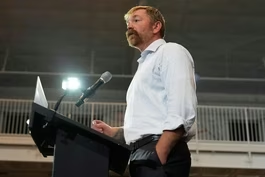 New
NewDems search for new Senate candidate after Platner drops out
Video has Closed Captions
Democrats search for Maine Senate candidate after allegations force Platner out (5m 33s)
 New
NewFamilies worry Americans imprisoned by Iran are forgotten
Video has Closed Captions
As diplomacy stalls, families worry Americans imprisoned by Iran are forgotten (6m 49s)
 New
NewHermanos Gutiérrez perform 'Los Ojos del Cóndor'
Video has Closed Captions
Hermanos Gutiérrez perform 'Los Ojos del Cóndor' and reveal inspiration for new album (7m 3s)
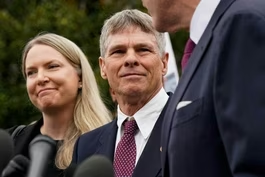 New
NewNews Wrap: Olympian pleads not guilty on pool damage charges
Video has Closed Captions
News Wrap: Olympian pleads not guilty on Reflecting Pool damage charges (6m 16s)
 New
NewRahm Emanuel on calling for new approach to U.S.-Israel ties
Video has Closed Captions
Rahm Emanuel on criticizing Netanyahu, calling for new approach to U.S.-Israel ties (9m 26s)
 New
NewRenewed U.S.-Iran fighting threatens hopes of ending war
Video has Closed Captions
Renewed U.S.-Iran fighting threatens shipping and hopes of ending war (4m 42s)
 New
NewSome Medicare beneficiaries get weight loss drug discount
Video has Closed Captions
Some Medicare beneficiaries eligible for weight loss drug discounts (7m 13s)
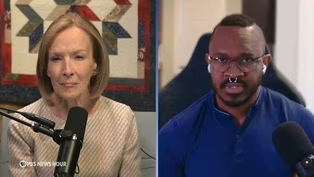 New
NewWhat political satire can reveal about the strength of a democracy
Video has Closed Captions
What political satire can reveal about the strength of a democracy (5m)
Providing Support for PBS.org
Learn Moreabout PBS online sponsorship
- News and Public Affairs

FRONTLINE is investigative journalism that questions, explains and changes our world.

- News and Public Affairs

Today's top journalists discuss Washington's current political events and public affairs.
 New Episode

 New Episode
 New Episode




 New Episode
Support for PBS provided by:
Major corporate funding for the PBS News Hour is provided by BDO, BNSF, Consumer Cellular, American Cruise Lines, and Raymond James. Funding for the PBS NewsHour Weekend is provided by...