
July 23, 2026 - PBS News Hour full episode
7/23/2026 | 57m 46sVideo has Closed Captions
July 23, 2026 - PBS News Hour full episode
July 23, 2026 - PBS News Hour full episode
Problems playing video? | Closed Captioning Feedback
Problems playing video? | Closed Captioning Feedback
Major corporate funding for the PBS News Hour is provided by BDO, BNSF, Consumer Cellular, American Cruise Lines, and Raymond James. Funding for the PBS NewsHour Weekend is provided by...
July 23, 2026 - PBS News Hour full episode
7/23/2026 | 57m 46sVideo has Closed Captions
July 23, 2026 - PBS News Hour full episode
Problems playing video? | Closed Captioning Feedback
Where to Watch PBS News Hour
PBS News Hour is available to stream on pbs.org and the PBS app.
Providing Support for PBS.org
Learn Moreabout PBS online sponsorshipAMNA NAWAZ: Good evening.
I'm Amna Nawaz.
GEOFF BENNETT: And I'm Geoff Bennett.
On the "News Hour" tonight: Iran-backed Houthi rebels fire on Saudi vessels in the Red Sea, threatening yet another crucial shipping lane and causing oil prices to spike.
AMNA NAWAZ: President Trump shies away from pressuring China over his baseless claims of election interference.
GEOFF BENNETT: And the FDA considers loosening restrictions on peptides, which have gained popularity thanks to online influencers touting their purported health benefits.
DR.
DHRUV KHULLAR, Weill Cornell Medicine: By making these things easily accessible without requiring any clinical study, it's going to make it harder still to figure out what they're actually doing inside the body.
(BREAK) GEOFF BENNETT: Welcome to the "News Hour."
International oil prices topped $100 a barrel today after Houthi rebels in Yemen claimed they attacked two oil tankers in the Red Sea, raising new fears of disruptions to global energy supplies.
AMNA NAWAZ: In response, President Trump warned, if the Houthis attack another ship, the U.S.
would inflict -- quote -- "Major military punishment.
And he also warned of escalation inside Iran.
Here's Nick Schifrin with more.
NICK SCHIFRIN: In the Red Sea overnight, a new front in the widening war with Iran, a Saudi oil tanker engulfed in flames, attacked by the Iranian-backed Houthis off the coast of Yemen.
The Houthis are threatening to shut down the Bab al-Mandab, right next to territory they control, and a vital shipping route that's a gateway to the Red Sea; 12 percent of all World Trade passes through the Bab al-Mandab, and it's especially key for oil exports from Saudi Arabia that the Houthis have been threatening to block.
The tension increased last week, when Saudi Arabia bombed a Houthi-controlled airport before an aircraft landed that the Saudis worried were carrying Iranian weapons back from the funeral of former Iranian Supreme Leader Ali Khamenei.
The Houthis then targeted a Saudi airport.
It's the most serious cross-border attack since 2022, when an unofficial truce ended nearly a decade of war that today the Houthi military spokesperson threatened to restart.
BRIG.
GEN.
YAHYA SAREE, Houthi Military Spokesman (through translator): If there is any stupidity targeting our country, it will be faced with major operations in the depths of their lands.
MARCO RUBIO, U.S.
Secretary of State: This will become a problem for the whole world.
NICK SCHIFRIN: Today, Secretary of State Marco Rubio highlighted what the U.S.
has long described as Iranian weapons and military advice sent to Houthi leadership.
MARCO RUBIO: The Houthis, frankly, got snookered into this thing by the Iranians.
And they were smart to stay out of it, and they should stay out of it, and they should stop.
NICK SCHIFRIN: A sentiment echoed by President Trump today, who warned: "Major military punishment will be inflicted upon Iran and, of course, the Houthis themselves, who I am very disappointed with, in that they have until now acted very professionally and smart."
DONALD TRUMP, President of the United States: We're doing very well against the Islamic Republic of Iran.
NICK SCHIFRIN: President Trump also today indicated he might escalate the war inside Iran after the 12th consecutive day of American strikes.
Iran said the U.S.
attacked a border crossing into Iraq, killing at least two.
The U.S.
says its strikes are further degrading Iran's control over the Strait of Hormuz.
MARCO RUBIO: The president's policy is a head for an eye.
NICK SCHIFRIN: And Rubio dismissed the chance of diplomacy.
MARCO RUBIO: The president doesn't see a lot of utility in responding to their overtures at this point, because, frankly, Iran is clearly not ready to make a deal, at least not one they're willing to live by.
NICK SCHIFRIN: But Iran shows no sign of stopping its attacks, once again launching missiles at more of the U.S.'
Arab allies, including Jordan, Kuwait, and Bahrain, while American strikes focused on Iran's west.
The drumbeat of escalation is driving up gas prices and pushed the price of oil to its highest level since May, before the U.S.
Iran cease-fire.
And, tonight, U.S.
forces sit poised, ready to escalate across the region.
For the "PBS News Hour," I'm Nick Schifrin.
AMNA NAWAZ: For a perspective on the Houthi efforts to block shipping in the Red Sea, we turn now to Timothy Lenderking.
During his decades-long career as a U.S.
diplomat, he served as special envoy to Yemen and as acting assistant secretary for Near East affairs.
He's now a principal at the law firm Squire Patton Boggs.
Welcome back.
Thanks for being here.
TIMOTHY LENDERKING, Former U.S.
Special Envoy to Yemen: Thank you.
AMNA NAWAZ: So why are the Houthis making these threats, taking these actions, and why right now?
TIMOTHY LENDERKING: I think this is something that's been in the making.
I mean, we have seen that this organization, which the Trump administration put back on the terrorism list, has been preparing for a moment like this for a long time and has a very strong and important relationship with Iran, maybe not a total complete proxy of Iran.
But it has developed these capabilities and has shown the willingness to use them, if we look back at the Gaza conflict and the regularity, and the accuracy with which the Houthis struck ships in the Red Sea, right, another essential global maritime corridor adjacent to the Straits of Hormuz, 12 percent of global energy supplies, very important artery for so many economies.
But the Houthis striking at ships of all different nationalities, killing a number of Mariners, sinking ships, this demonstrated their ability and their willingness to use these tools.
And during this interim period, I think the president's wise to say that the Houthis were behaving themselves and staying out of this conflict.
But now I think it's just too tempting for them to get involved.
AMNA NAWAZ: So you heard Secretary Rubio there say that the Houthis were snookered by the Iranians, basically saying that the Iranians seemed to pressure them into doing this.
Do you agree with that take?
TIMOTHY LENDERKING: I mean, I'm sure the Iranians have been pressuring the Houthis.
I think other parties in the region have also been pressuring the Houthis not to come to this point.
But I think, at a certain point, the Houthis are very pragmatic.
They're also very ideological, and I think they're opportunists.
If there's an opportunity to get involved in a conflict to show that they're relevant and to do a solid by their buddies the Iranians, they they're not likely to pass up such an opportunity.
AMNA NAWAZ: And the opportunity potentially cause harm to Saudi shipments, what about that?
TIMOTHY LENDERKING: Well, I mean, that's an interesting and a very unfortunate development, because I think there's been sort of a detente between Saudi Arabia and the Houthis.
Nick had mentioned the truce that we helped negotiate when I was envoy in April of 2022 has largely held and kept fighting restrained inside Yemen for all this period, despite the fact that the Houthis were firing outside of Yemen.
But the combatants inside Yemen have been mostly quiet, right?
I mean, not perfect, but certainly a truce.
And nobody wants to see that civil war reignite.
But this is the kind of incendiary, provocative behavior by the Houthis that could really muddy the waters and tilt the scales back toward war inside Yemen as well, because the Yemeni people don't want to see this.
The Yemeni people don't want a return to civil war.
But the Houthis, I think, have demonstrated disdain for the Yemeni people over a number of years.
AMNA NAWAZ: I mean, you did play a key role in brokering that 2022 peace deal.
And just to remind folks about that conflict, you're talking about the Houthis in there and the Saudi-backed government forces at war.
TIMOTHY LENDERKING: That's correct.
AMNA NAWAZ: When we talk about this widening war, how concerned are you now that you have Yemen -- and Yemen and -- rather, the Houthis and Saudi trading targets at each other directly?
How concerned are you that this is a widening war?
TIMOTHY LENDERKING: I am concerned.
And I'm sure that the Saudis, who know this country very well and have very competent people who work on this file for Saudi Arabia, and who have maintained dialogue, back channels with the Houthis and at times invited Houthis representatives to travel to Saudi Arabia, I mean, that's exactly the kind of diplomacy that needs to happen, I think, while there is a threat of credible force from the United States, from the outside to help make sure that the Houthis do the right thing.
AMNA NAWAZ: I need to ask you, while we have you, because you have also served in Saudi Arabia.
There was news this week about the U.S.
and Saudi signing this nuclear deal, gives U.S.
companies priority to supply nuclear reactors and fuel to help build a Saudi energy program.
Today, we heard President Trump introduce a new condition to that deal, essentially saying that deal won't go through unless Saudi Arabia signs the Abraham Accords, essentially normalizing relations with Israel, which is something Saudi officials have said they would not do unless there's a path to a Palestinian state.
How do you, with your experience and perspective, look at that?
TIMOTHY LENDERKING: I have been in so many meetings with the Saudis over the years.
I served there for three years, 2013 to '16, and I go back every year multiple times.
I have been in conversations with them about the 123 nuclear agreement going back to my time there.
I have been in conversations with them about normalizing with Israel.
I do believe that they could get there, but I also believe they're very firm when they say there has to be a credible pathway to a Palestinian state.
And, so far, that threshold has not been achieved to the satisfaction of the Saudis.
I expect that they will stick by that parameter.
AMNA NAWAZ: Meaning that a deal would not go through at this point if President Trump sticks to that condition?
TIMOTHY LENDERKING: No, I mean, that the Saudis -- the Saudis won't go ahead with any sort of permutation that doesn't include -- that is, normalization with Israel, that does not include a credible pathway to a Palestinian state.
AMNA NAWAZ: More questions, I think, we have for all the parties involved at this point.
Tim Lenderking, always good to see you.
Thank you for your time.
TIMOTHY LENDERKING: Thank you.
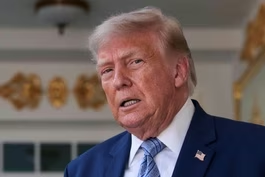
GEOFF BENNETT: In the day's other headlines: The Trump administration is imposing new tariffs on dozens of countries starting just after midnight.
That's the exact moment a prior round of tariffs is set to expire.
Officials say the new tariffs are the result of an investigation into the alleged failure of around 60 trade partners to prevent forced labor in their supply chains, to the detriment of American workers.
The U.S.
will collect duties of at least 10 percent on roughly 99 percent of all imports.
Today's action is the most significant step yet to rebuild President Trump's tariff regime after it was struck down by the U.S.
Supreme Court.
In Madison, Wisconsin, tensions are running high following the fatal police shooting of a man with a knife.
City officials identified him as Corey Ruiz, who was homeless, and say he was resisting arrest when a struggle broke out and an officer opened fire.
Video of the shooting posted on social media sparked widespread anger, with protesters marching to the state capitol to demand accountability.
At a news conference today, Madison's mayor promised a thorough investigation.
SATYA RHODES-CONWAY (D), Mayor of Madison, Wisconsin: As a city, as a community, as a society, we have to do better.
I want to be clear.
It does not matter who you are or what your past is.
You should not lose your life as a result of an encounter with law enforcement.
GEOFF BENNETT: The news conference was interrupted when a group of protesters burst in, with one taking over the podium to voice the group's anger as police and city officials looked on.
The man who killed Minnesota House Speaker Melissa Hortman was sentenced to life in prison today.
Vance Boelter pleaded guilty last month to killing the Democratic lawmaker and her husband, as well as critically wounding another state senator, John Hoffman, and his wife.
That plea allowed him to avoid the death penalty.
Instead, he was given two life terms, plus an additional 40 years, the longest sentence the judge on the case says he has ever handed down.
Boelter also faces state charges for murder and attempted murder, as well as a personal injury lawsuit.
Floodwaters are slowly receding in West Virginia after torrential rain caused flash floods that submerged entire neighborhoods.
Authorities reported dozens of water rescues.
And hundreds of National Guard troops are out in force to assist.
Governor Patrick Morrisey has said he's concerned about fatalities, as some people remain unaccounted for.
Meantime, Tropical Storm Bertha made a second landfall today, this time near the Texas-Louisiana state line, causing a storm surge and flooding in some coastal areas.
But its heaviest rains have mostly stayed offshore, and the storm is expected to weaken as it moves inland.
No deaths or major damage has been reported.
An unnamed member of Vice President J.D.
Vance's security detail is under investigation over a suspected leak to the media.
The Secret Service tells the "News Hour" that the internal review is in response to an MS NOW report last week about frustration over the vice president's last-minute travel and his use of resources for personal matters like flying his son to a golf lesson by military helicopter.
An agency spokesperson adds that disciplinary action could include a possible criminal inquiry for allegedly compromising operational and information security.
The Justice Department today withdrew subpoenas issued to New York Times reporters as part of an investigation into the sources behind reporting about security concerns involving President Trump's new Air Force One.
The Times had reported the Qatari-donated jet lacked some of the defensive systems found on the existing presidential aircraft.
The subpoenas were part of an investigation into the possible disclosure of classified information.
The move had drawn criticism from press freedom advocates, who accused the administration of trying to uncover journalists' confidential sources.
U.S.
health officials are investigating a new outbreak of cyclosporiasis that has sickened at least 72 people.
The FDA did not provide information about the source of the new outbreak or where the cases are actually located.
But it comes amid a broader outbreak of the intestinal illness, with thousands of cases reported across more than 40 states.
India's government says it's ready to speak with protesters after weeks of demonstrations, even as the protesters call for nationwide rallies tomorrow.
Young protesters defied a security crackdown today, staging a sit-in on the streets of New Delhi.
They're part of the so-called Cockroach Movement, which has fueled a wave of protests following the alleged leak of national entrance exams.
The demonstrators are demanding sweeping reforms to India's education system and the resignation of the country's education minister.
Today, the movement's leader said that failing to take such action would hurt the government of Prime Minister Narendra Modi.
ABHIJEET DIPKE, Cockroach Party Founder (through translator): Please listen to students.
An incompetent, a failed minister cannot be more important than the millions of students of this country.
And if a failed and incompetent minister is more important than millions of students, then remember that no one among them will vote for you.
GEOFF BENNETT: The protests have become one of the biggest challenges to Modi's government since he took power in 2014.
Today, he addressed the issue publicly for the first time, vowing what he called stringent punishment for anyone who may have leaked the exams.
On Wall Street today, stocks tumbled after oil prices topped $100 per barrel.
The Dow Jones industrial average lost more than 500 points.
The Nasdaq dropped more than 2 percent.
The S&P 500 also ended sharply lower.
Well, still to come on the "News Hour": we speak with the opposition leader of Belarus about how her country became isolated after supporting Russia's war against Ukraine; the end of protected status for some migrants creates staffing challenges for eldercare centers; and a new exhibit showcases an artist who until now kept her work largely hidden from public view.
In his prime-time address last week about foreign interference in U.S.
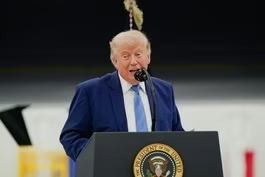
elections, President Trump made this sweeping claim about China: DONALD TRUMP, President of the United States: The People's Republic of China carried out what is believed to be the largest compromise of election data in history, resulting in China's illicit acquisition of 220 million U.S.
voter files.
GEOFF BENNETT: But when asked repeatedly this week whether he would raise the issue directly with Beijing, Mr.
Trump appeared to downplay his own warning.
DONALD TRUMP, President of the United States: Well, we're going to talk to them about it.
It took place a long time ago.
I think China is maybe a little bit different today than it was then.
But, look, they're -- they do things and we do things to them.
I'll be honest.
We do things to them too.
It's not a one-way street.
But we'll be talking to them, yes.
GEOFF BENNETT: Yesterday, Secretary of State Marco Rubio said the issue did not come up in his meeting with China's foreign minister.
QUESTION: Was there disagreement on election interference?
MARCO RUBIO, U.S.
Secretary of State: We didn't discuss that topic.
GEOFF BENNETT: That's unfolding as Democrats are raising concerns about President Trump's focus on the integrity of the nation's elections and what he and his allies might do ahead of November's midterms.
We're joined now by our White House correspondent, Liz Landers.
So, Liz, if President Trump believes China carried out what he described just last week as an extraordinary attack on a U.S.
election, why is his administration backing away from confronting Beijing over it?
LIZ LANDERS: It's unclear why the president's tone has shifted on this, but we do know that, based on the documents and the intelligence that were released last week, it doesn't really back up what the president said in that speech.
Here is what China did do, based on what was declassified.
They were involved in obtaining some of these publicly available voter data records.
The president kind of referenced that there.
But many states, most states release this kind of information publicly.
Journalists can access this.
Political parties can do it.
Sometimes, you have to pay a small fee, but it's out there publicly.
The president said also in his speech that China wanted him to lose.
There is a robust conversation that we saw in some of these declassified documents about the internal deliberations within the intelligence community talking about whether or not China wanted to interfere or influence the election.
But the report that was prepared by the then director of national intelligence, Ratcliffe, that was given to President Trump in January of 2021 after the election said that China did not deploy interference efforts and considered, but did not deploy influence efforts.
The president, as you mentioned today, said that this will not impact Xi's visit to the U.S.
in September.
GEOFF BENNETT: Meantime, the Senate Democratic leader, Chuck Schumer, he had a stark warning for Democrats this week about misinformation and what he sees as threats to the integrity of the midterms?
What's he saying?
LIZ LANDERS: Schumer is warning that Democrats need to prepare for what he says are a variety of ways that he thinks that the president and the administration will try to influence or interfere with the elections here domestically.
He talked to MS NOW about this and said that they have been doing tabletop exercises, gaming out possible scenarios.
This was a meeting that happened yesterday in the Capitol Building with Democratic senators, outside advisers and attorneys.
One of the attorneys who was there is Marc Elias.
He's represented Democrats in a lot of this election litigation in the past few years.
I spoke with him on the phone a few moments ago, and he said that Schumer and the Democrats are taking this very seriously.
He said this is the second such meeting that they have had in the last few months to talk about the upcoming midterm elections.
And he said that, in almost every scenario and exercise that he's been involved with, there's been a hypothetical brought up about ICE agents or federal agents showing up at polls and what happens in that scenario.
I have asked the president and the White House press secretary about this, and neither one of them have ruled it out.
The president told me a few months ago: "Well, I want to do whatever it takes to keep elections secure."
So Elias said that the reason that-this is important for the Democrats to be doing this right now is that the U.S.
is facing what he calls an unprecedented threat to free and fair elections.
And even in 2020, he said Trump did not take as many steps as he's taking now.
Elias said that there's a strategy that they're working on, litigation, public engagement, and combating misinformation through the press.
GEOFF BENNETT: And, at the same time, you have Republicans, certainly the Trump administration, seizing on what happened in New Jersey.
The governor there, Mikie Sherrill, said that, between 2023 and 2024, more than 6,000 noncitizens had been accidentally registered to vote.
She said more than 400 of them actually did.
What more are Republicans saying?
LIZ LANDERS: Republicans in the White House are using this as a reason to push for the SAVE America Act.
White House Press Secretary Karoline Leavitt was asked about this today and asked specifically if this New Jersey case may lead to criminal prosecutions.
KAROLINE LEAVITT, White House Press Secretary: It is completely unacceptable to have noncitizens on American voter rolls voting in U.S.
elections.
And she says it's 6,600.
We suspect it's a heck of a lot more, not just in New Jersey, but in states across the country.
LIZ LANDERS: Geoff, it's important to remind people that this number of voters, 400, that actually cast their ballots who were noncitizens, it's a very small percentage of the overall number of voters in New Jersey who cast their ballots in the last few election cycles.
This would not have changed the outcome of the election in New Jersey, the presidential election for 2024.
And I just want to note too that the president brought this up in his speech, noncitizens voting and being on voter rolls.
The Department of Homeland Security said that 250,000 noncitizens were on voter rolls in four states.
We don't know how they got that number, the administration.
And when the homeland security secretary was asked how many of those people actually have cast ballots, he could not answer that question, Geoff.
GEOFF BENNETT: All right, Liz Landers, thanks, as always.
LIZ LANDERS: Of course.
AMNA NAWAZ: An FDA advisory committee began a two-day meeting today to consider lifting a ban and widening access to seven popular peptides.
While some peptides are approved by the FDA and widely used, like insulin and GLP-1s, three years ago, the FDA blocked compounding pharmacies from producing other peptides, citing inadequate evidence of their safety and efficacy.
But they have seen a surge of support from wellness influencers and others, including Health and Human Services Secretary Robert F. Kennedy Jr., who talked about his own peptide use on Joe Rogan's podcast in February of this year.
ROBERT F. KENNEDY JR., U.S.
Health and Human Services Secretary: I'm a big fan of peptides.
I have used them myself and used them with really good effect on a couple of injuries.
My hope is that they're going to end up with -- they're still looking at the science.
My hope is that they're going to get moved to a place where people have access from ethical suppliers.
AMNA NAWAZ: Joining us now is Dr.
Dhruv Khullar.
He's a physician with Weill Cornell Medicine and author of the "New Yorker" article "Why Are People Injecting Themselves With Peptides?"
Dr.
Khullar, welcome to the "News Hour."
Thanks for joining us.
DR.
DHRUV KHULLAR, Weill Cornell Medicine: Thanks for having me.
AMNA NAWAZ: So, before we jump into the details of this meeting and what it means, just in simplest terms, can you please explain to us, what exactly is a peptide?
DR.
DHRUV KHULLAR: Sure.
So peptides are basically microproteins.
So people are probably familiar with proteins as strings of amino acids.
And if a molecule has more than 50 or so amino acids, it's called a protein.
And, generally, if it has less than 50 or so, it's called a peptide.
And our bodies make thousands and thousands of peptides.
They do all sorts of things within the body.
They regulate various systems.
They send signals to one another.
And, as you know, there are many peptides that have already been approved for use.
So, insulin is a peptide.
It moves glucose from our bloodstream into our cells.
These days, the most famous peptides are probably GLP-1s, or glucagon-like peptide-1s.
The difference here is that these are unapproved peptides and ones that haven't been rigorously studied for safety and efficacy in the way that those prior peptides have been.
AMNA NAWAZ: So we mentioned that ban that came down in the previous the Biden administration that said compounding pharmacies cannot create those peptides, the ones that are being considered today.
Secretary Kennedy says that basically created what he called gray and black markets.
What is he talking about there?
DR.
DHRUV KHULLAR: Well, it's important to note that these peptides were circulating even before that ban.
That ban would not have been necessary if no one was already compounding and using these peptides.
So the gray market use of unapproved peptides preceded what happened in 2023.
And the reason that they that ban was put into place is because we have so little clinical data on whether these molecules are safe, whether they are effective in people, and they haven't cleared any of the regulatory hurdles that we typically expect for drugs to be advertised and used in people.
And the argument about we're not going to allow things happening, and that's pushing things into a gray market, that could be used for all sorts of things that we don't otherwise allow.
I mean, you think about something like fentanyl or heroin.
No one argues that we should make those legal and accessible just because banning them somehow moves them into the gray market.
And so that argument seems to be the one that's being made here, but doesn't carry a lot of water, in my opinion.
AMNA NAWAZ: And yet we have still seen this big surge in demand and people pushing them in the wellness spaces, a lot of online influencers sharing the kinds of videos people may have seen.
Here's just a few.
WOMAN: I actually dropped almost 20 pounds in just a few weeks.
MAN: The peptide I can give you, and within a day, you will be tanner than you have ever been tanned.
WOMAN: Better skin, better elasticity and collagen production.
MAN: Peptides are going to be making us look youthful and beautiful and all of that.
AMNA NAWAZ: So, Dr.
Khullar, why are we seeing this surge of support in this online community right now?
What's driving that?
DR.
DHRUV KHULLAR: Well, there are all sorts of stories and anecdotes that are circulating on social media.
I mean, influencers have claimed that these peptides do everything from enhancing strength to improving energy and recovery and endurance, better tans, better libido.
These are all the types of claims that are being made.
Again, it's important to note that we don't have any evidence that this is actually happening.
But because influencers and others are talking about these peptides in this way, they have really caught fire.
And I think we should be open to the idea that some of these peptides could have important clinical uses in people.
But we need to do the work to figure out at what doses should they be taken, who should be taking them, do they actually produce the types of effects that people are claiming that they produce?
We don't know any of those things.
And by making these things easily accessible without requiring any clinical study, it's going to make it harder still to figure out what they're actually doing inside the body.
AMNA NAWAZ: So, as you and I speak right now, we know this panel has already voted to broaden access to at least one of the peptides they're considering.
It's BPC-157.
And it's been reported they heard testimony from a number of speakers, including some scientists who said this should not be made more accessible.
But, also, the majority of voices, it seems, were doctors, chemists, and peptide business owners who pushed for approval.
What does all of this say to you about that approval process, about how these decisions are being made?
DR.
DHRUV KHULLAR: Well, we know that some of the people who are on the committee that's making these recommendations do have conflicts of interest.
They are either people who have been involved in the compounding pharmacy industry or otherwise involved with peptides.
And so that creates serious concerns about the recommendations that are coming forward.
Just taking that one peptide, BPC-157, Body Protection Compound-157 is probably one of the most commonly used and widely recognized of these unapproved peptides.
That peptide does not have a single controlled human study to support its use.
There are interesting theoretical reasons why it might work.
There are some interesting animal studies that show that it could have some positive benefits, but there are also reasons to be really concerned about it.
So, for instance, one of the things that BPC-157 does is promote angiogenesis, and that is helpful for tissue repair and recovery.
But it also allows cancerous cells to grow.
Cancers are hungry for blood vessels, and angiogenesis is the process by which blood vessels are formed.
And so, without doing the requisite studies, we're not going to know what the potential benefits are and what the risks are of this compound.
AMNA NAWAZ: Dr.
Dhruv Khullar, we really appreciate your time.
Thank you so much for joining us tonight.
DR.
DHRUV KHULLAR: Thank you for having me.
GEOFF BENNETT: Hundreds of thousands of migrants in the U.S.
are facing uncertainty, as protections that allow them to live and work here near expiration.
That comes after the Supreme Court cleared the way last month for the Trump administration to end Temporary Protected Status, or TPS, for Syrian and Haitian nationals.
Syrians are set to lose their status tomorrow, while a federal appeals court extended the deadline for Haitians until Monday.
Now, that looming loss of those protections is raising alarm among leaders in the senior care industry, who say workers with TPS make up a major part of an already strained work force.
One of those leaders is Katie Smith Sloan, chief executive of LeadingAge, which represents more than 5,000 aging services providers.
Thank you for being with us.
KATIE SMITH SLOAN, President and CEO, LeadingAge: Thanks for having me.
GEOFF BENNETT: So let's start with the scope of this.
To what extent does the senior care industry, to include residential facilities and in-home care, rely on workers who are here under Temporary Protected Status?
KATIE SMITH SLOAN: Well, overall, 25 to 30 percent of our work force in aging services, it's far and more, people coming from other countries to care for older adults here.
And a large percentage of those are Haitians coming here to various parts of our country to provide services and supports.
So this is not insignificant to us.
GEOFF BENNETT: So, what does this mean in practical terms for an industry that is already struggling to hire and retain workers?
KATIE SMITH SLOAN: It means that, in one fell swoop, organizations will lose in some cases 40 workers, in other cases 16 workers, all at the same time.
And these are people who are providing - - they're nurses in some cases.
They're nursing assistants.
They might be housekeepers.
They might be providing culinary services.
But these are all essential services leading to the quality of life of older adults.
GEOFF BENNETT: Well, say more about that.
How does this affect the care that seniors receive, I mean, in terms of the attention that they get and the continuity of care?
KATIE SMITH SLOAN: Unlike in a hospital, where somebody maybe two or three days, when somebody moves into a nursing home, that is their home.
They're there for months, sometimes years.
When somebody needs home health services, they're receiving those services over a period of time.
So they develop deep relationships with these caregivers.
I have talked to residents who consider their caregivers part of their family.
And these caregivers understand what they like to eat.
Do they like breakfast, to have oatmeal or Wheaties for breakfast?
What do they like?
What kind of music do they like?
They have met their families.
So they develop these deep relationships over time.
And when you take that worker away, you're breaking not only a job, but you're breaking an absolutely critical relationship.
And there -- and that contributes to care continuity issues.
It breaks up the team that's providing that support.
And so it has huge implications for the residents themselves.
GEOFF BENNETT: And as these deadlines arrive tomorrow and on Monday, are workers simply expected to stop reporting to work once they lose employment authorization?
KATIE SMITH SLOAN: Yes, indeed.
Once they can't -- once they don't have a work permit, they can no longer go to work.
So, that's problematic for the providers.
They have to fill those gaps, 40 workers that they would have to fill.
So, what we're seeing is job fairs and partnerships with hospitals and community colleges and offering training and paying for training to bring in to replace those workers as best they can.
But then they have to start all over again with building those relationships.
So it's hugely disruptive.
GEOFF BENNETT: Right, because it affects the workers who are here now and the pipeline of future talent; is that right?
KATIE SMITH SLOAN: Absolutely.
And if a provider organization can't find those workers, then what we're seeing is, if they're in a nursing home, might be taking beds offline or closing a wing.
Home health agencies here and home health agencies are just simply not taking more admissions.
And so when that access to care happens, the responsibility for caring for loved falls on family members, at great emotional, practical, and financial expense to them.
I would say the other issue that we should be paying attention to from an access point of view is that, if an older adult is in a hospital and ready to be discharged, and there is no nursing bed or there is no home health nurse, they are going to stay in that hospital longer.
Nobody wants to be in a hospital any longer than they have to, but it's also at great expense to our health care system.
GEOFF BENNETT: Katie Smith Sloan, chief executive of LeadingAge, thanks again for being with us.
KATIE SMITH SLOAN: Thank you.
AMNA NAWAZ: The Eastern European nation of Belarus has been plunged into the center of Russia's conflict with Ukraine, both by its borders and by its Putin-linked President Alexander Lukashenko, who stands accused of aiding Russian attacks on Ukraine.
As the country of nine million grapples with both the fallout from the war in Ukraine and its dictatorial leader, our White House correspondent, Liz Landers, spoke to the Belarusian opposition leader, Sviatlana Tsikhanouskaya, about the state of the nation and Belarusians hope for democracy.
LIZ LANDERS: In Belarus, a Russian-linked strongman is pushing his nation to the precipice of conflict, having deployed over 1,000 soldiers, special operations forces, and border guards to the nation's southeast border with Ukraine as Ukraine's war with Russia rages on through its fifth year right next door.
At a government meeting this week, President Lukashenko pushed for more militarization.
ALEXANDER LUKASHENKO, President of Belarus (through translator): Pass on my order, everyone who does not know how to work, to join the army and to the southern border, to the forest.
This is where our guys, special operations forces, are deployed along the Ukrainian border by my order.
That's where they will go, to the army, as ordinary soldiers.
LIZ LANDERS: Just weeks after Ukrainian President Volodymyr Zelenskyy accused Belarus of waging war.
VOLODYMYR ZELENSKYY, Ukrainian President (through translator): They have been doing this since the first days of this war.
When the full-scale war started, rockets attacked us, killed children and adults.
And you know that in large numbers.
Missiles flew from Belarus on its territory along two regions bordering Ukraine.
There is equipment that directs fire on the Ukrainian population.
There are civilians there.
LIZ LANDERS: Accusations that Lukashenko denied.
ALEXANDER LUKASHENKO (through translator): We do not need to get involved in a war.
So there is no need to push us towards it.
LIZ LANDERS: But despite reassurances, the country's leading opposition figure says it's a farce.
SVIATLANA TSIKHANOUSKAYA, Belarusian Opposition Leader: The Belarusian regime is already involved in this war, but not because Belarusians chose it, but because Lukashenko chose to serve Putin.
He allowed Russian forces to invade Ukraine from Belarusian territory.
He provides military infrastructure, logistics, fuel factories, and political cover.
LIZ LANDERS: Sviatlana Tsikhanouskaya ran for president in 2020 after her husband, Sergei Tikhanovsky, was arrested on the eve of his own campaign.
She took up his fight.
Lukashenko claimed a landslide victory with over 80 percent of votes.
Tsikhanouskaya and the international community called it rigged.
SVIATLANA TSIKHANOUSKAYA: Lukashenko is not the president.
In 2020, he lost elections.
It's a person who seized his power, but he trying to serve Russia, because Russia is the source of his political survival.
LIZ LANDERS: The election sparked mass protests.
Hundreds of thousands of Belarusians took to the streets to protest his rule and were met with violence.
Security forces arrested over 37,000 protesters, crushing the demonstrations.
Tsikhanouskaya says that state brutality continues today.
SVIATLANA TSIKHANOUSKAYA: The level of repressions in Belarus for six years already reminds Stalin's time repression, because, every day, for this period of time, people are detained, like daily.
We still have at least 800 political prisoners behind bars and every day new people detained.
LIZ LANDERS: Alexander Lukashenko first rose to power this week 31 years ago, the Soviet apparatchik winning the first free election in Belarus since independence.
He has remained in power since, Europe's longest-serving leader derided as the continent's last dictator.
How dependent is Lukashenko on Putin for retaining his power in Belarus?
And, if Putin goes, does Lukashenko last?
SVIATLANA TSIKHANOUSKAYA: Lukashenko understands, if Putin is weakened, his power is -- end, because, since 2020, Lukashenko has traded Belarus sovereignty for Kremlin support, allowing Russia to invade all the spheres of Belarusian life, like media, military, economy, just to survive.
Lukashenko is a lost case.
He will serve to Russia's interest, to Putin because his own power depends on this support.
LIZ LANDERS: And since Russia's full-scale invasion of Ukraine began in 2022, that dependence has only grown.
By 2025, Belarus now relies on Russia for over half of its exports and imports, primarily Russian oil and gas at a subsidized price.
Tsikhanouskaya says that Belarus is getting dragged into the war in Ukraine because Lukashenko chose to serve Putin.
SVIATLANA TSIKHANOUSKAYA: Belarusians overwhelmingly reject direct participation in the war.
They don't see Ukrainians as enemies.
And we understand that the fates of Ukraine and fates of Belarus are interlinked.
We face the same enemy, imperialistic ambitions of Russia.
And both of our countries want to -- want freedom, independence and want European track of development.
LIZ LANDERS: And to achieve that, she says, they need help from the West.
What message do you have for President Trump about Belarus' future and goals for democracy?
SVIATLANA TSIKHANOUSKAYA: We ask America to support Ukraine, because supporting Ukraine and Belarus is not charity.
It's one of the smartest investments America can make in its own security, because, if Putin succeeds in Ukraine, he will not stop there.
But if it is stopped in Ukraine and Belarus becomes free, America will have a safer Europe and a stronger NATO and much weaker Kremlin.
I really remain optimistic.
LIZ LANDERS: Two nations tied by European dreams and Russian enstranglement, one fiercely fighting to keep its democracy, and one that dreams it will finally see it one day, despite a brutal crackdown.
For the "PBS News Hour," I'm Liz Landers.
GEOFF BENNETT: At the very tip of Cape Cod, a new exhibition is showcasing the work of an artist who spent two summers there back in the 1940s.
For much of her life, she remained largely unknown in the art world, by her own design.
But now, as her paintings receive greater public attention and remarkable stories from her life emerge, including an unlikely friendship with Pablo Picasso, that is all starting to change.
GBH Boston correspondent Jared Bowen introduces us to the work of Avital Sagalyn for our arts and culture series, Canvas.
JARED BOWEN: This is a discovery, these works painted in 1945 and 46 here in the coastal community of Provincetown, Massachusetts, with their defining lines and bold, broad splashes of color.
The artist delivers us directly into the harbor's salty air, where the dewy fog almost settles on your skin.
CHRISTINE MCCARTHY, CEO, Provincetown Art association and Museum: It was one of those truly 100 percent discovery moments where not just myself, but the members of our exhibitions committee, when we were looking through the proposal, we're like, why don't we know who this artist is?
JARED BOWEN: The artist is Avital Sagalyn, a painter for most of her 95 years before her death in 2020.
For her, painting was a private practice.
She had no interest in museums or galleries, which might tell her how to do it.
That gave her a purity, says Christine McCarthy, the longtime CEO of the Provincetown Art Association and Museum, now featuring a survey Sagalyn's Provincetown work.
CHRISTINE MCCARTHY: That's one of the most beautiful parts about being an artist who isn't interested in any of the commercial side of it, and I'm making this body of work because I want to record either something that moved me or moved me to make this.
She's an artist that should be known.
Her story is really, really good.
JARED BOWEN: That story is now being shared by Sagalyn's son, Dan, and his wife, Elaine Grossman.
DAN SAGALYN, Son of Avital Sagalyn: It wasn't until 2017 that I really got a sense of all her work.
JARED BOWEN: Although he'd always seen his mother's work throughout their family home and watched her draw and paint on family holidays, it wasn't until later in her life when Dan began to both record and fully comprehend his mother's stories.
DAN SAGALYN: Oh, look at that, the lake.
AVITAL SAGALYN, Artist: Yes, it's the lake.
JARED BOWEN: Both he and Grossman are journalists gallery.
Dan is a foreign affairs producer for the "PBS News Hour," and began teasing out the details of Sagalyn's artistic life.
ELAINE GROSSMAN, Daughter-in-Law of Avital Sagalyn: She didn't want to talk about it a lot, but she felt like she was ready to share it, and that she could share it on her own terms.
JARED BOWEN: Avital Sagalyn demonstrated an aptitude for art by age 3, but hers was a childhood marked by the savagery of World War II.
In 1940, her family fled their home in Belgium as the Germans invaded and attacked, dropping bombs on innocents.
AVITAL SAGALYN: I remember putting my arm -- my hands over my head and becoming very religious, asking God to save us.
JARED BOWEN: The family passed through Spain, where Sagalyn's mother introduced her to old masters in the Prado Museum, as she explained to her son in this 2016 conversation.
AVITAL SAGALYN: We had to see Velazquez and Goya and El Greco.
Even at a very early age, I was very interested in art.
JARED BOWEN: As a teenager, she studied art in Lisbon as the family awaited visas, enabling a move to the United States.
Arriving here, she was soon featured in a student exhibition at the Museum of Modern Art.
ELAINE GROSSMAN: Avital painted one of the works that we think is the most moving and dramatic work of her lifetime while in high school called The Horror of War, showing this black what I think is a crow flying overhead, meant to symbolize the Nazi warplanes and very graphic details of soldiers in the foreground.
JARED BOWEN: Sagalyn wouldn't show in a museum again for 70 years and never returned to the subject of war.
But she continued painting and it flourished in Provincetown.
Over two summers here, she captured daily life images, such as peers, telephone poles, and buildings, returning to paint them again and again and again.
ELAINE GROSSMAN: Avital had a practice of doing what she called variations on a theme in almost all of her artworks, and she felt compelled to explore and explore, to experiment, to experiment using different materials, different perspectives on her subject matter, until she had finally captured what it was she was trying to say.
CHRISTINE MCCARTHY: The way that she's applied the color, it's subtle.
She has really created the depth within this piece, and you feel the fog.
You feel the movement.
JARED BOWEN: McCarthy says she's especially struck by Sagalyn's use of the line, how such simplicity and spareness can say so much.
CHRISTINE MCCARTHY: I can tell you that I have umpteen boats sunsets, but when you look at these, the dunes, even that line, like, the line is so exquisite and elegant, and it's almost like she never even lifted whatever tools she was using, whether it was a pencil or a brush.
It's so lyrical.
And I think of a conductor doing this type of this with, like, a baton.
JARED BOWEN: Sagalyn was always lured by light, especially in Provincetown, where the glow from sand and sea spills into the town in ever-shifting shades.
In studying the works of Turner and Cezanne, she came to revere what she called the transformative effect of light that drew her into spaces, whether a beach or Notre Dame Cathedral, to nearly divine effect.
ELAINE GROSSMAN: She was not a very religious person, but she saw a sense of sacredness or a sense of spirit.
She used to sometimes call it the essence of what it is that she's looking at.
JARED BOWEN: For Sagalyn, Provincetown was a pilgrimage.
This is an arts colony where the greats have gathered, from Jackson Pollock to Mark Rothko to Helen Frankenthaler.
She sought out the guidance of artist and teacher Hans Hofmann, who taught numerous soon-to-be-famous painters.
DAN SAGALYN: She showed him her sketches and she showed him her drawings, and he looked at it and said, I can see you have your own style and your own technique.
You don't need to take classes.
Just keep doing what you're doing.
JARED BOWEN: And she did.
After submitting two of her Provincetown paintings, she was named a Fulbright Scholar.
The program was a pathway to Paris, where Sagalyn immersed herself in an artist's circle that led to Picasso.
DAN SAGALYN: She went to the gallery to look at his work and then out came Picasso and he said, "Avital," and he gave her a big hug, and my mother was trembling because she said, here I am with the arms of Picasso.
ELAINE GROSSMAN: They had a great many discussions back and forth and really took to each other immediately.
JARED BOWEN: Despite having Picasso as a mentor, Sagalyn continued to shun public attention, until 2019, when, at age 94, she finally consented to her first solo museum exhibition.
Now, with this second show, and as public attention expands, her legacy and work are creating a new ripple in the history of American art.
CHRISTINE MCCARTHY: Now, when I see you know a fishing boat or a pier, it's going to be a Sagalyn pier or a Sagalyn telephone pole.
Like, now in my mind, it's -- she's arrived here, and in such a big, big way.
JARED BOWEN: For the "PBS News Hour," I'm Jared Bowen in Provincetown, Massachusetts.
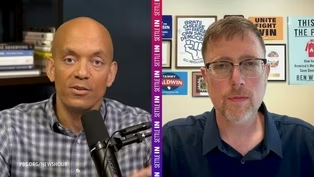
GEOFF BENNETT: While there is no shortage of analysis about what's wrong with the Democratic Party, Ben Wikler is focused on what Democrats plan to do about it.
The former Wisconsin Democratic Party chair has written a new book.
"This Is the Plan," laying out lessons from one of the most closely divided states in the country and what they could mean for Democrats nationwide.
I spoke to him for the latest episode of our PBS News podcast "Settle In."
Here's a clip of that conversation.
I want to return to what you said about the systemic reforms that you are calling for, eliminating the filibuster, reforming the Supreme Court, effectively replacing the Electoral College.
When Democrats controlled the White House and Congress during the Biden presidency, they failed, chose not to enact many of these same reforms.
So why should voters believe that Democrats would behave differently if given the option again?
BEN WIKLER, Author, "This Is the Plan: How to End America's Meltdown and Save Democracy": Well, the first thing is to choose Democrats who are ready to take action if they have the power to do so.
Now, some of these things came very close to passing during the last Democratic administration.
The national gerrymandering ban was contained in the For the People Act, and that passed the U.S.
House.
It was the first bill that the House majority passed in the U.S.
Senate.
There were almost enough senators to amend the filibuster to allow pro-democracy reforms to go through.
And Joe Biden called for that to happen, said he would sign it into law.
The two senators who stood in the way on the Democratic side are not in the Senate anymore.
That's Joe Manchin and Kyrsten Sinema.
Every major Democratic nominee for Senate that I'm tracking across the country is committed to either amending or ending the filibuster to do pro-democracy, pro-voting reforms if they get into power.
And that's a really big shift from where we have been just recently.
Down the road, we will think through who will be in the presidential primary.
And I don't know who the right person to meet the moment is going to be.
But I do think that it's on all of us to look out for people that are not going to try to restore some status quo that, frankly, was broken in and of itself, but rather want to move to a future where things actually work for everyone.
And the thing that I kept kind of bumping into as I was working on the book is that to shift the way our institutions work in order to build a better democracy is actually in line with the best and oldest traditions in our political system.
At our country's founding, there were horrific problems and crimes.
There was slavery.
There were -- only about 6 percent of people had the right to vote when the Constitution was enacted.
But there was also embed in The Federalist Papers and the Constitution, the Declaration of Independence the fundamental idea that the legitimacy of government came from support of the majority of, as James Madison wrote, the great body of the people, that that was the basic idea.
And over and over, we changed the number of Supreme Court justices, we changed the size of the House, we amended the Constitution, we added states, we changed the way people were elected.
All those changes were commonplace.
It was a matter of course that, as the country evolved, we were going to adjust how these things worked to be able to meet the moment.
And the circle of freedom kept expanding in fits and starts and contractions sometimes.
But we became a better democracy over time.
And then things got stuck.
About half-a-century ago, it's like it all got frozen in place.
The filibuster got more and more restrictive.
We stopped amending the Constitution.
The House got stuck about a century ago.
And now it's treated as though all these things were etched in stone, written from on high.
We can't change any of those things.
We have to wriggle through these tiny passageways to make any kind of change.
And right now, the way our rules are set up, it's easy to cut taxes for rich people.
It's easy to confirm Supreme Court justices who want to overturn Roe v. Wade and strip away protections for people across the country.
But it's very, very hard to do anything that helps protect the right to vote or supports people organizing a union or doing things that most people across the country across party are crying out for.
So we don't have to live like this.
We can elect people and then advocate and push those people to deliver changes to how laws are made that then allow us to make laws that serve everyone, that serve the common interest.
GEOFF BENNETT: And you can watch that full episode and more from our "Settle In" podcast on YouTube or wherever you get your podcasts.
AMNA NAWAZ: And that is the "News Hour" for tonight.
I'm Amna Nawaz.
GEOFF BENNETT: And I'm Geoff Bennett.
For all of us here at the "News Hour," thanks for spending part of your evening with us.

Belarusian opposition leader on the struggle for democracy
Video has Closed Captions
Belarusian opposition leader on fighting for democracy under Lukashenko (6m 17s)
Ben Wikler joins Geoff Bennett on 'Settle In'
Video has Closed Captions
Ben Wikler and Geoff Bennett discuss the Democrats’ plan on 'Settle In' (4m 18s)

End of migrant protections could strain elder care staffing
Video has Closed Captions
End of migrant protections creates elder care staffing challenges (4m 56s)

FDA considers widening access to popular peptides
Video has Closed Captions
FDA considers widening access to peptides promoted by wellness influencers (7m 8s)

Former U.S. diplomat breaks down Houthi attacks on shipping
Video has Closed Captions
Former U.S. diplomat breaks down Houthi attacks on Red Sea shipping (5m 58s)

New exhibit showcases long-hidden artwork of Avital Sagalyn
Video has Closed Captions
New exhibit showcases the long-hidden artwork of Avital Sagalyn (7m 24s)
News Wrap: Trump announces new tariffs on dozens of countries
Video has Closed Captions
News Wrap: Trump announces new tariffs on dozens of countries (6m 27s)
Trump reluctant to pressure China after election claim
Video has Closed Captions
Trump reluctant to pressure China after claiming election interference (6m 8s)

Trump vows major punishment after Houthi attacks in Red Sea
Video has Closed Captions
Trump threatens 'major military punishment' after Houthi attacks on tankers in Red Sea (3m 15s)
Providing Support for PBS.org
Learn Moreabout PBS online sponsorship New Episode
- News and Public Affairs

Today's top journalists discuss Washington's current political events and public affairs.

- News and Public Affairs

FRONTLINE is investigative journalism that questions, explains and changes our world.


 New Episode
 New Episode
 New Episode
 New Episode
 New Episode
 New Episode

Support for PBS provided by:
Major corporate funding for the PBS News Hour is provided by BDO, BNSF, Consumer Cellular, American Cruise Lines, and Raymond James. Funding for the PBS NewsHour Weekend is provided by...