
January 27, 2024 - PBS News Weekend full episode
1/27/2024 | 26m 44sVideo has Closed Captions
January 27, 2024 - PBS News Weekend full episode
Saturday on PBS News Weekend, how a nationwide shortage of special education teachers is affecting students with disabilities and the educators trained to work with them. Then, the changing face of motherhood and professional sports, and the push for paid maternity leave in the United States. Plus, a 14-year-old science phenom talks about his quest to develop a soap that fights skin cancer.
Problems playing video? | Closed Captioning Feedback
Problems playing video? | Closed Captioning Feedback
Major corporate funding for the PBS News Hour is provided by BDO, BNSF, Consumer Cellular, American Cruise Lines, and Raymond James. Funding for the PBS NewsHour Weekend is provided by...
Support provided by:

January 27, 2024 - PBS News Weekend full episode
1/27/2024 | 26m 44sVideo has Closed Captions
Saturday on PBS News Weekend, how a nationwide shortage of special education teachers is affecting students with disabilities and the educators trained to work with them. Then, the changing face of motherhood and professional sports, and the push for paid maternity leave in the United States. Plus, a 14-year-old science phenom talks about his quest to develop a soap that fights skin cancer.
Problems playing video? | Closed Captioning Feedback
How to Watch PBS News Hour
PBS News Hour is available to stream on pbs.org and the free PBS App, available on iPhone, Apple TV, Android TV, Android smartphones, Amazon Fire TV, Amazon Fire Tablet, Roku, Samsung Smart TV, and Vizio.
Providing Support for PBS.org
Learn Moreabout PBS online sponsorshipJOHN YANG: Tonight on PBS News Weekend, how the shortage of special education teachers across the country is affecting students with disabilities and the educators trained to work with them.
Then, the changing face of motherhood and professional sports and the push for paid maternity leave in the United States.
WOMAN: Historically, we've had a lot of men at the table who haven't seen or heard or taken issue with the issues that, you know, women face across the board.
The modern workforce includes women.
JOHN UANG: And a 14-year-old science phenomena in his quest to develop a soap that fights skin cancer.
(BREAK) JOHN YANG: Good evening.
I'm John Yang.
Today is Holocaust remembrance day, a time to commemorate the killing of 6 million Jews and many other groups by the Nazis.
In Israel this year, there is extra significance because of the trauma of the bloody October 7 Hamas attack.
In the war that attack triggered, there were more Israeli airstrikes in Gaza, less than a day after the UN's highest court ordered Israel to do all it can to prevent civilian deaths.
At least three people were killed in an airstrike that Israel said targeted a Hamas commander.
But a relative said the strike killed a mother and her children.
MIRVAT ABU HALAWAH, Sister of Victim (through translator): They were sleeping under the mercy of God.
Suddenly the rocket fell on them.
That's all I know.
It was the body of my sister and her two children.
JOHN YANG: An tentions remain high on the Red Sea.
The U.S. military said it destroyed another Houthi rebel anti-ship missile in Yemen that was ready to be launched into the Red Sea.
Just hours before that, a Houthi strike damaged a British tanker in the Gulf of Aden, setting it on fire.
The flames were finally extinguished today.
And six additional countries joined the United States, Australia, and Canada in pausing funding for UNRWA, the principal aid agency in Gaza.
UNRWA fired 12 employees Friday after Israel presented the agency officials with evidence that they took part in the October 7 attack.
National Security Advisor Jake Sullivan wrapped up two days of meetings with China's foreign minister aimed at lowering tensions.
Administration officials said Sullivan talks with Wang Yi paved the way for a call between President Biden and Chinese President Xi Jinping sometime in the spring.
Among the topics, Sullivan and Wang discussed the future of Taiwan and whether China could use its influence with Iran to ease Middle East tensions.
Boeing 737 Max 9 planes are flying again after the FAA grounded nearly 200 of them for inspections.
The only two U.S. carriers operating the plane, Alaska and United Airlines, both returned the jet to service for the first flight since three weeks ago, when a panel blew out of the side of one of Alaska's planes at 16,000 feet.
The FAA is investigating Boeing's manufacturing practices.
And the world's biggest cruise ship is set to sail tonight from the port of Miami for the Caribbean on its maiden voyage.
The Royal Caribbean vessel, the Icon of the Seas, is about as long as the Empire State building is tall, 1,200 feet from bow to stern.
It covers almost four city blocks, has 20 C decks with eight entire neighborhoods within them, and can carry up to 7,600 passengers and more than 2300 crew.
The cruise industry is still trying to recover from being shut down by the COVID-19 pandemic.
It cost them tens of thousands of jobs and billions of dollars in revenue.
Still to come on PBS News Weekend, how professional athletes are helping the push for paid maternity leave and a 14-year-old's invention that could help save our skin.
(BREAK) JOHN YANG: Seven and a half million American students, or roughly 15 percent of them, have disabilities that qualify them for special instruction, what's known as individual education plans.
But teachers trained in this critical area are in short supply.
At the beginning of the current school year, 70 percent of schools surveyed said they had openings for special education teachers.
We asked special education teachers and administrators to tell us how the shortage is affecting them.
MARYELLEN ROBINSON, Massachusetts: You're spread thin and you're working with a student on a lesson to meet their academic goals, but you're also thinking about the student behind you who's working on maybe feeding or they're getting their medications, and you're thinking, how can I support that student when I'm working with another student?
My name is Maryellen Robinson.
I am a special education teacher for students who have complex support needs in Boston, Massachusetts.
SARAH DAVIS, Minnesota: My name is Sarah Davis.
I'm a special education teacher in Minnesota, and I teach emotional and behavioral disorders.
They have gone so far as to reach out to a temp agency to bring in para educators, which it helps having bodies in the building, but it's not the same as having a teacher who know, trained, and has specialized in behaviors and mental health.
AMY QUELLETTE, Michigan: My name is Amy Oled.
I'm in Mount Pleasant, Michigan.
I'm a retired school teacher.
NADENE STEIN, Massachusetts: I'm Nadine Stein, assistant superintendent for pupil services for the Waltham Public Schools in Waltham, Massachusetts.
AMY QUELLETTE: It breaks your heart every single day as a teacher to know that you still needed more time with a student.
And not only does it break your heart, but I could cry every single day worrying about the kids and that they need more time.
NADENE STEIN: I always have big box Kleenex in my office.
That's part of my job.
But usually when someone is upset about something, we can work together and we can figure out a solution that is going to benefit people and we can move forward.
This year, I don't have a solution because I don't have people.
SARAH DAVIS: The staffing shortage really makes me question if I want to spend the rest of my career in this setting.
MARYELLEN ROBINSON: It makes me feel so sad knowing that there's such a shortage of people who want to go into this field and working with students like my own.
AMY QUELLETTE: I really loved really working with those kids who were struggling, building that relationship and helping them see that, hey, this is a positive thing and I can help you through this.
And then those successes, even though they feel very small, are huge for those students.
NADENE STEIN: We got to do a very much better job celebrating these people and thanking them and supporting them, because I don't want them to leave.
Let's get past this bump and with always the hope that it's got to get better next year.
It has to get better.
JOHN YANG: The voices of special education teachers and administrators.
Kimber Wilkerson is a professor of special education at the University of Wisconsin-Madison.
Kimber, we heard in that tape some of them talk about the burnout factor, that they are just so frazzled from all they have to do.
How big a factor is that in the shortage?
KIMBER WILKERSON, University of Wisconsin Madison: I think the job of being a special educator is a meaningful job that provides a lot of satisfaction.
But the stresses and the pressures on teachers in schools right now, they are real.
So it definitely contributes to people leaving their jobs faster than they might have in the past.
JOHN YANG: So in addition to that sort of burnout, because of all they have to do, what are the other factors that are behind this shortage?
KIMBER WILKERSON: You know, overall, in the last 10 years or so, there's been kind of an increase in this shortage of educators, and that's across the board.
But special education has always been hit sort of the hardest of all the education professions ever since it became a thing in the 70s.
And so I'd say over the last ten years or so, there's been kind of an erosion in the public's view of teaching as a desirable profession, maybe some erosion of benefits and autonomy that teachers experience.
So those things combine to create a public narrative that makes teaching and maybe special education less desirable than it was in the past.
JOHN YANG: Now, federal law guarantees students with disabilities an appropriate public education.
How is the shortage affecting that?
KIMBER WILKERSON: The shortage of special educators has an impact on the quality of services that students with disabilities receive.
Obviously, when special educators are spread more thin.
So maybe in a school where there used to be three special educators for the middle school band, and now we're down an educator, and so you have two or sometimes even one special educator who's now serving that whole population.
Of course, that person's caseload is going to be higher, and the amount of individual attention that they're going to be able to give to specific students is decreased.
JOHN YANG: What are some of the things that schools are doing to try to bridge this gap, that bridge the shortage?
KIMBER WILKERSON: Schools in states have been sort of forced to be as creative as possible.
In some cases, they're making it easier to become a special educator or a teacher.
I don't personally think those are the best solutions because what it tends to do is bring in people who are less qualified and that less quality of preparation makes them burnout even faster and provide more poor quality services to kids.
But there are some really creative solutions in terms of trying to provide supports to career changers or people who work in schools already.
Some of these are called grow your own programs, where they might take special education paraprofessionals and provide them with the education that they need to be certified.
And these are individuals who've already been working with students with disabilities and already have kind of a commitment to that school community.
JOHN YANG: What should be done or what can be done to resolve this problem?
KIMBER WILKERSON: There are some efforts in different states to increase pay for teachers to try to make the work worth the effort.
And there are also initiatives aimed at providing more professional development, more supports to be able to decrease caseloads.
And I think that the awareness of the problem and all the kind of creative solutions that universities and school districts and states are employing right now will likely and hopefully pay off in the coming years.
JOHN YANG: Now, I believe you were a special educator, and I believe your daughter is a special educator.
Talk about why this role is so important, why having special educators is so important.
KIMBER WILKERSON: I'd say from my own perspective, it was a really impactful and meaningful career choice where I could see sort of my efforts paying off right in front of my eyes and investing in students who other people have kind of written off.
My own daughter decided to go into special education.
She is actually an early career special educator.
In her fourth year, you know, she feels pressures and she feels stretched thin, and she sometimes leans on me for ideas and support and I wish that more districts could provide more support to those early educators to help prevent them from getting burnt out.
And providing more support might be opportunities for those veteran or experienced educators to have some additional sort of impacts in their own buildings as well.
JOHN YANG: I'm curious what advice you had for your daughter or what advice you would have for any young person who's thinking of getting into this.
KIMBER WILKERSON: I'd say the thing that I try to stress the most is to remember why you got into it in the first place.
Usually when people go into special education, they have, again, a desire to kind of invest in young people and try to help them achieve outcomes that other people might have decided they're not going to be able to achieve and to be an advocate for families.
JOHN YANG: Kimber Wilkerson from the University of Wisconsin-Madison, thanks very much.
KIMBER WILKERSON: Thank you.
JOHN YANG: Irina Sabalenka of Belarus won her second straight women's singles championship today at the Australian Open tennis tournament.
This first Grand Slam event of the year is an example of a growing trend in women's professional sports.
Eight players in the tournament had returned to the sport after pausing their careers to have children.
As Ali Rogin tells us, it's a scenario that's playing out on the courts, fields and tracks around the world.
ALI ROGIN: New parent and tennis star Naomi Osaka threw a spotlight on the issue of paid family and medical leave.
She launched an ad campaign with Bobbie, an organic infant formula company that advocates for a national paid parental leave policy in the US.
NAOMI OSAKA, Professional Tennis Player: With shy, I had the choice and the financial support to return to work on my own terms.
Most parents in this country do not have that choice.
The initial fear in the very beginning of pregnancy, that's something I had to push past because I was very worried that a lot of people, like sponsors, would drop me.
ALI ROGIN: The U.S. is one of only a handful of countries in the world that doesn't offer paid parental leave for new mothers.
One in four women in the U.S. return to work two weeks after giving birth.
Alysia Montano heads up and mother, a nonprofit focused on removing systemic barriers to allowing mothers to succeed in sports.
Montano is also an Olympic medalist, six time USA outdoor track champion, and a mother of three.
Alysia, thank you so much for being with us.
Is it true in your experience and your observation that the perception that motherhood is a career killer is still true?
ALYSIA MONTANO, President, &Mother: I think from the work that we've done and mother, we've helped break down these barriers of that actually being a true statement.
What makes it true is the systemic barriers that exist and continue to exist that actually ultimately end up being the career killer, not the fact that we are not able to continue our careers.
ALI ROGIN: Yeah, absolutely.
And you've said that in your experience, the companies you were working with would treat pregnancy as an injury as opposed to a natural part of somebody's life.
That seems true not just in sports, but in many other industries, too.
And I'm wondering if you can speak to how do you tackle that sort of systemic bias that still exists?
ALYSIA MONTANO: Well, I think it comes with education.
Right.
We need to understand that pregnancy is a natural part of life for many people, especially female bodied people.
And it is not an injury.
When it does become an injury is how we treat people who are pregnant and now postpartum after the fact, where we don't support them from a physical and emotional standpoint.
And ultimately they also face things within their workplace that equates to financial loss.
All of that is what ends up hurting and injuring the mother.
ALI ROGIN: And certainly those things are true not just for professional athletes, but really anybody who's getting a paycheck and is working outside the home.
Now, in the introduction, we played a clip from Naomi Osaka talking about her concerns that her sponsors might drop her following her pregnancy announcement.
And I know you went through something similar.
You had disclosed your pregnancy and Nike said, okay, well, we'll pause your contract.
And you eventually left them.
Nike subsequently ended up changing their maternity policy after you and fellow track star Allison Felix came out publicly to talk about all this.
And after all of that, you continued with your incredible career and then you founded &Mother, have things in your line of work changed since you began this journey?
And if so, how?
ALYSIA MONTANO: The changes I have seen have been great due to the work that we're doing.
You know, we've implemented the gold standard for maternal contracts within sponsorships for athletes, so they could really see what does the gold standard look, like how do we support our female athletes and not equate pregnancy to injury from a financial and emotional and just expansive sort of background.
I had my daughter Linnea and this story lid really was blown off nine years ago.
Had we not shared our stories in such a visible way, I do wonder how this could have changed Naomi's story.
Now, the big thing that I do want to raise issue to is rank.
It's really important that when we see who gets to keep their wages, that we don't just look at who is the most recognized or highest paid whoever, whether it be CEOs or our highest paid athletes.
It needs to really be something that exists within our policies that support pregnant and postpartum people.
ALI ROGIN: Speaking of policies, right now in Congress, a group of house lawmakers has come out with a proposal on some level of paid family leave.
There are also efforts in the Senate.
Why is it that you think that the United States lags behind so much of the rest of the developed world on this?
And why hasn't more attention and more focus been given to passing some sort of a paid family leave policy?
ALYSIA MONTANO: Well, I think it has to do with leadership.
Who's been at the table?
Historically, we've had a lot of men at the table who haven't seen or heard or taken issue with the issues that women face across the board.
And this is, you know, when it comes to financial inequities, when it comes to health disparities, when it comes to data and research, there's continuously been a gap on how women have been a part of the equation.
I think now we're at a very amazing turning point where we are having a huge opportunity from a media and social aspect, where we have more opportunities for our voices to be heard.
And ultimately, it can't be denied of what our needs are.
And we can really see from an economic standpoint how important it is for us to expand the modern workforce.
The modern workforce includes women, and at a vast majority of women are really taking the helm of leadership and helping make those changes.
ALI ROGIN: Absolutely.
Alysia Montano, Founder of &Mother, Olympic medalist, track champion, and mother of three, thank you so much for your time.
ALYSIA MONTANO: Thank you, Ali.
JOHN YANG: Most 14-year-old boys spend their time playing video games or skateboarding, but not Heman Bekele.
He spent the last year developing a bar of soap that could treat skin cancer.
It was the winning entry at the Annual 3M Young Scientist Challenge, considered one of the top science and engineering competitions for fifth through 8th graders.
Heman's taking a little break from his work to join us here in the studio.
Heman, tell us about this bar of soap.
How does it work?
HEMAN BEKELE: Sure.
So SCTS, which stands for Skin Cancer Treating Soap, is basically this compound based bar of soap that's charged with different cancer fighting chemicals to help treat different forms of skin cancer.
Pretty much the way that it works is it uses this drug called imidazoquinolines, and it wraps it around this lipid based nanoparticle.
And the concept here is that even though the soaps and suds will be washed away by the soap, there will still be all of the medicinal components stuck there by the lipid based nanoparticle.
And this is kind of a more new and novel approach to fighting against skin cancer.
JOHN YANG: And how did you come up with the idea of a bar of soap as the delivery product for this medicine?
HEMAN BEKELE: Yeah, I think that my main goal here was not only to fight against skin cancer, but to find a more affordable and accessible approach to it.
And so with that, you really need to find a completely different way towards the traditional form of treating skin cancer, which really is surgery or radiation therapy or something like that.
And so it led me to think of things like topical application, like a cream or a bar of soap, because those are a lot more affordable and are a lot more accessible, too.
So that's what really got me to that bar of soap as the final product.
JOHN YANG: You say you want it to be affordable and accessible, and this is not just a project.
That's one off.
You want to develop this?
HEMAN BEKELE: Exactly.
I do.
And I actually have plans that by 2028, I hope to turn this passion project into more than that.
I hope to turn it into a nonprofit organization so that I can provide equitable and accessible skin cancer treatment to truly as many people as possible.
JOHN YANG: Have you always been interested in science?
HEMAN BEKELE: I mean, since before I can remember, I've just had such a huge love for just knowing things about this world and being curious and really asking questions.
And I think that initial curiosity really did grow into my love and my passion for science and creating new things and starting to make my own experiments.
And I think that's what really started to slowly progress into this Barb soap as just a passion project.
JOHN YANG: Are there particular fields of science that are more interesting to you than others?
HEMAN BEKELE: Yeah, I love biology, and when I was younger, I really always tried to do different experiments with random household chemicals.
You would find it's crazy how far that's grown to now actually using lab validated types of chemicals.
So, yeah, just biology, chemistry, those two, just really passionate about those.
JOHN YANG: Now, in this competition, I know that three M3 paired you with a three M project engineer named Deborah Isabelle.
Was that the first time working with someone at that level?
HEMAN BEKELE: Yeah, it was my very first time actually working with someone that actually has had this much experience in something like project management and science.
And it really was great to be able to pick minds with her and be able to speak with her on so many different topics.
And she was great not only with helping me on the science point of it, but at the same time also helping me with all of her wonderful connections.
If I needed to speak with a biochemist or a biologist, I could always just ask her and she would connect me to someone like that.
And I think it's just great that not only was she super helpful in that perspective, just helping me with everything, but she also just had a wonderful connection with everyone inside of three M. JOHN YANG: What's the best thing you learned from her?
HEMAN BEKELE: I think I really was inspired by the way that she always looked at problems.
I think that she broke everything down to its really raw components.
Right.
If I asked her a question, she wouldn't just think of it as that one question, she would break it down into multiple questions.
And I think that's a great outlook at life, and it's a great outlook at how to crack things down in science, and that really did help me, even in the future.
JOHN YANG: I know there was a $25,000 award that went with this prize.
What are you going to use it for?
HEMAN BEKELE: Yeah, I think that a lot of it's going to go towards the project itself.
There's a lot of things like certifications, FDA certification, clinical trials, all of those.
And there is some expenses that come with that.
So I will invest a portion of the money for that, and then as well as that, just to help with my further education as well, whether it be college or some STEM program or something like that as well, just to further my own education as well.
JOHN YANG: Now you're in high school now?
HEMAN BEKELE: Yeah, I'm a freshman.
JOHN YANG: Do you find yourself sort of in science classes just miles ahead of your classmates?
HEMAN BEKELE: I mean, you know, it's even hard to notice when you really are passionate about what you're learning.
And I always just try to really stay invested and learn as much as I possibly can.
The possibilities with science are endless.
Right.
So whether you know a concept or you don't, it's always going to be interesting to learn as much about it as you can.
And that's what really keeps me going.
JOHN YANG: In the introduction, I was sort of joking about 14-year olds playing video games and skateboarding.
But what do you like to do for fun?
HEMAN BEKELE: Yeah, obviously, this bar of soap is definitely not all about me.
I also really love to play chess.
I run track and field for my school.
I'm a part of model UN, science Olympiad.
So there's a lot of other things I also do that I find really fun.
JOHN YANG: What's your event and track?
HEMAN BEKELE: Oh, I run really short distance, 55 meters, 100 meters, things like that.
JOHN YANG: Heman Bekele, thanks very much.
HEMAN BEKELE: Yeah.
Thank you so much for having me.
JOHN YANG: Now on the NewsHour's Instagram page, a science explainer on what happens to plastic that ends up in the ocean and how the sun plays a role in breaking it down into smaller and smaller molecules.
All that and more is on our official NewsHour account out on Instagram.
And that is PBS News Weekend for this Saturday.
On Sunday, Uganda awaits a constitutional court ruling on a law that threatens fines, life imprisonment, even death, just for being gay.
I'm John Yang.
For all of my colleagues, thanks for joining us.
See you tomorrow.

14-year-old scientist on fighting skin cancer with soap
Video has Closed Captions
14-year-old scientist Heman Bekele on his quest to fight skin cancer with soap (5m 13s)
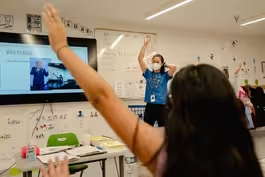
What’s driving a shortage of special education teachers
Video has Closed Captions
What’s driving a special education teacher shortage and how schools are responding (8m 2s)

Why pro athletes are pushing for paid maternity leave
Video has Closed Captions
Why professional athletes are bolstering the push for paid maternity leave (6m 7s)
Providing Support for PBS.org
Learn Moreabout PBS online sponsorship
- News and Public Affairs

FRONTLINE is investigative journalism that questions, explains and changes our world.

- News and Public Affairs

Amanpour and Company features conversations with leaders and decision makers.












Support for PBS provided by:
Major corporate funding for the PBS News Hour is provided by BDO, BNSF, Consumer Cellular, American Cruise Lines, and Raymond James. Funding for the PBS NewsHour Weekend is provided by...