
Israel strikes Lebanon without warning, more than 200 dead
Clip: 4/8/2026 | 4m 54sVideo has Closed Captions
Israel strikes Lebanon without warning, hours after Iran ceasefire announced
Confusion and tension are growing around the fragile ceasefire between the U.S. and Iran amid Israel’s ongoing strikes in Lebanon. Geoff Bennett discussed more with special correspondents Reza Sayah in Tehran and Simona Foltyn in Beirut.
Problems playing video? | Closed Captioning Feedback
Problems playing video? | Closed Captioning Feedback
Major corporate funding for the PBS News Hour is provided by BDO, BNSF, Consumer Cellular, American Cruise Lines, and Raymond James. Funding for the PBS NewsHour Weekend is provided by...
Israel strikes Lebanon without warning, more than 200 dead
Clip: 4/8/2026 | 4m 54sVideo has Closed Captions
Confusion and tension are growing around the fragile ceasefire between the U.S. and Iran amid Israel’s ongoing strikes in Lebanon. Geoff Bennett discussed more with special correspondents Reza Sayah in Tehran and Simona Foltyn in Beirut.
Problems playing video? | Closed Captioning Feedback
How to Watch PBS News Hour
PBS News Hour is available to stream on pbs.org and the free PBS App, available on iPhone, Apple TV, Android TV, Android smartphones, Amazon Fire TV, Amazon Fire Tablet, Roku, Samsung Smart TV, and Vizio.
Providing Support for PBS.org
Learn Moreabout PBS online sponsorshipGEOFF BENNETT: And we're joined now by "News Hour" special correspondents Reza Sayah in Tehran and Simona Foltyn in Beirut.
Reza, we will start with you.
We're seeing reports of air defense systems going off in Tehran tonight.
And Iran says it may reenter the conflict following Israeli strikes in Lebanon.
What are you hearing on the ground right now?
REZA SAYAH: Yes, this cease-fire agreement is not even 24 hours old and there's signs that it's falling apart.
Iranian state media reporting that Tehran is prepared to exit the cease-fire agreement if Israel continues its bombing, its airstrikes targeting locations in Lebanon.
And, seemingly, Tehran has taken a couple of steps in doing that.
They're once again shutting down the Strait of Hormuz and, according to state media, the Revolutionary Guard launching a number of missiles targeting locations in the Gulf.
Mohammad Bagher Ghalibaf, he's the speaker of Iran's Parliament.
He accused Washington's partner Israel of violating the cease-fire agreement by attacking locations in Israel and launching drones into Iranian airspace.
Around 8:00 p.m.
local time here in Tehran, once again, Tehran's air defense system activated.
We heard that familiar volley of anti-aircraft fire in the skies, usually an indication that the drone is up above.
Abbas Araghchi, the foreign minister here in Iran, with a message to Washington, saying the United States is a choice, to either abide by the agreement or choose to continue this war through Israel.
GEOFF BENNETT: And, Reza, there also appears to be a major gap on the nuclear issue.
President Trump says there will be no uranium enrichment.
Iran, Iranian officials insist they have that right.
How wide is the divide between the two sides at this point in this fragile cease-fire?
REZA SAYAH: Yes, many gaps.
These two sides haven't even sat down to begin negotiations, and there's indications that there's lots of confusion.
You look at the idea of uranium enrichment, the White House explicitly saying that Iran cannot enrich uranium.
That's one of Tehran's conditions.
They believe that a peaceful nuclear program is their right.
And you look at the Strait of Hormuz, Iran is demanding a new protocol to ensure safe passage, saying they want to charge fees for ships and tankers.
No indication that Washington is going to accept that.
And you look at Washington's other demands for Iran to cut ties with proxies, to curtail its ballistic missile program, Tehran's demands for the U.S.
to get rid of its troops from the region, end sanctions, lots of demands, no indication of any compromise.
GEOFF BENNETT: And, Simona, based on your reporting, what more do we know about the Israeli strikes in Lebanon today and their impact?
SIMONA FOLTYN: Well, this was a massive attack by Israel on Lebanon, unlike anything we have really seen over the past month or during the previous war back in 2024.
There was no prior warning given by the IDF, which means that civilians didn't have the chance to get to safety, which is why we are seeing this high and still rising in death toll with more than 200 people killed, hundreds injured, and this sweeping bombardment of densely populated urban areas, not just here in the capital, Beirut, but also in the south and east of the country.
The IDF says it was targeting Hezbollah infrastructure and fighters, which it said had moved outside of Hezbollah's typical areas of control.
But what we have really seen are horrific scenes of people, including children, being pulled from the rubble of a residential building, grocery stores, shops, pharmacies and bakeries.
So what this escalation has really done is inflict a very heavy civilian toll and sow panic and chaos among a traumatized population on a day when many had hoped that a cease-fire was on the horizon.
GEOFF BENNETT: And, Simona, the president told our Liz Landers on the phone this morning that Lebanon is not part of the cease-fire agreement.
What does that mean for the situation there?
SIMONA FOLTYN: Well, Israel has said that it will continue to strike Lebanon as long as Hezbollah remains a threat in what increasingly sounds like an open-ended war.
Let's remember that the IDF has never been able to defeat Hezbollah militarily in the previous wars and occupations.
Now, on top of that, the IDF appears to have broadened its targets to include Hezbollah's political, financial, as well as media institutions, institutions that are considered legal here in Lebanon and the attacks on which international rights groups have called war crimes.
The IDF also said that it wants to clear Southern Lebanon of all Hezbollah supporters, who still constitute a significant share of Shia Muslims here in Lebanon.
So, all of this really raises the question, at which point would the IDF consider Hezbollah defeated?
Because, clearly, it's no longer just about the weapons, but also about the organization and its constituents and the ideology.
GEOFF BENNETT: Simona Foltyn in Beirut and Reza Sayah in Tehran for us tonight, our thanks to you both.
 New
NewA Brief But Spectacular take on how life is a play
Video has Closed Captions
A Brief But Spectacular take on how life is a play (3m 14s)
 New
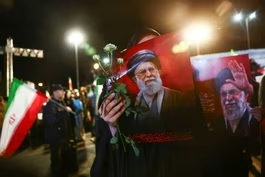
NewFormer U.S. officials on chances Iran ceasefire can hold
Video has Closed Captions
Former U.S. officials analyze chances fragile Iran ceasefire can hold (7m 29s)
 New
NewICE detains DACA recipient delivering milk to premature baby
Video has Closed Captions
DACA recipient detained by ICE while delivering milk to premature daughter in NICU (7m 10s)
 New
NewNews Wrap: NATO chief meets with Trump amid tensions
Video has Closed Captions
News Wrap: NATO chief meets with Trump in bid to ease tensions (5m 26s)
 New
NewOil infrastructure recovery will take months, expert warns
Video has Closed Captions
Expert warns Middle East energy infrastructure will take months to recover (6m 41s)
 New
NewPortland's $1.6B climate fund sparks spending debate
Video has Closed Captions
America’s first billion-dollar climate fund sparks spending debate in Portland (8m)
 New
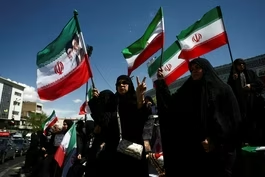
NewTrump says Israeli strikes on Lebanon a 'separate skirmish'
Video has Closed Captions
Trump says Israeli strikes on Lebanon a 'separate skirmish' not part of Iran ceasefire (2m 58s)
 New
NewU.S.-Iran ceasefire tested by Strait of Hormuz chokehold
Video has Closed Captions
U.S.-Iran ceasefire tested by Strait of Hormuz tension and Israel’s war in Lebanon (6m 23s)
Providing Support for PBS.org
Learn Moreabout PBS online sponsorship
- News and Public Affairs

FRONTLINE is investigative journalism that questions, explains and changes our world.

- News and Public Affairs

Amanpour and Company features conversations with leaders and decision makers.












Support for PBS provided by:
Major corporate funding for the PBS News Hour is provided by BDO, BNSF, Consumer Cellular, American Cruise Lines, and Raymond James. Funding for the PBS NewsHour Weekend is provided by...