
'One Day in September' traces baseball's first All-Star Game
Clip: 7/13/2026 | 7m 2sVideo has Closed Captions
'One Day in September' chronicles how baseball's All-Star Game was born
Baseball’s best will showcase their talents on the field in Philadelphia during MLB's All-Star Game. What fans might not know is that the game traces its origins back to an event in Boston more than a century ago. The little-known chapter in baseball history is the subject of a new book, “One Day in September.” Jeffrey Brown sat down with author Scott Reich for our arts and culture series, CANVAS.
Problems playing video? | Closed Captioning Feedback
Problems playing video? | Closed Captioning Feedback
Major corporate funding for the PBS News Hour is provided by BDO, BNSF, Consumer Cellular, American Cruise Lines, and Raymond James. Funding for the PBS NewsHour Weekend is provided by...
'One Day in September' traces baseball's first All-Star Game
Clip: 7/13/2026 | 7m 2sVideo has Closed Captions
Baseball’s best will showcase their talents on the field in Philadelphia during MLB's All-Star Game. What fans might not know is that the game traces its origins back to an event in Boston more than a century ago. The little-known chapter in baseball history is the subject of a new book, “One Day in September.” Jeffrey Brown sat down with author Scott Reich for our arts and culture series, CANVAS.
Problems playing video? | Closed Captioning Feedback
Where to Watch PBS News Hour
PBS News Hour is available to stream on pbs.org and the PBS app.
Providing Support for PBS.org
Learn Moreabout PBS online sponsorshipGEOFF BENNETT: Tomorrow, baseball's best will showcase their talents on the field in Philadelphia during Major League Baseball's All-Star Game.
What fans might not know is that the midsummer classic traces its origins back to an event in Boston more than a century ago.
It's a little known chapter in baseball history that's the subject of a new book.
Senior arts correspondent Jeffrey Brown has that conversation.
JEFFREY BROWN: In September 1917, a star-studied cast of players, including Babe Ruth, Ty Cobb, and Shoeless Joe Jackson, came together to play a ball game with an unusual purpose, to raise money for a late player and sports writer named Tim Murnane.
A new book makes the case that game would lay the foundation for the modern All-Star Game.
It's titled "One Day in September: Baseball, Brotherhood, and the Birth of the All-Star Game."
Author Scott Reich joins me now.
Welcome to you.
So maybe perhaps to understand what this game is all about, tell us a little bit about Tim Murnane.
He was a player first, but then he was quite a renowned sportswriter in his time, right?
SCOTT REICH, Author: All-Star Game": He certainly was.
He became essentially the Godfather of the early baseball era, the conscience of the game, arguing for rule changes and strong character development, somebody who felt that baseball was much more than a sport; it was a place where we could develop a nation and the civic infrastructure needed to support a pastime.
JEFFREY BROWN: And he did this as a sports writer for The Boston Globe?
SCOTT REICH: Yes, he wrote as a sportswriter for 30 years at The Boston Globe.
He also wrote several books, including a book that he wrote, released several editions of called "How to Play Baseball," in which he would teach people not only the mechanics of the game and strategy, but also lessons on life.
And so he became this beloved figure, not only in the greater Boston area, but around the country, because his column would often be syndicated.
And he was a respected voice who had been connected to the game from its very birth all the way until his death in 1917.
JEFFREY BROWN: So he passes away from a heart attack, I understand.
And the idea was to honor him and also, importantly, raise money for his family.
The stars came out for this game, but it sounds a very unusual way.
They came on their own time and on their own dime.
SCOTT REICH: They did.
Murnane died of a heart attack at 65.
He had gotten married a second time and had young kids later in life, and he had very little money when he died.
And baseball felt that, given all he had done for the game, that it would be an opportunity to pay it forward and back to him by creating a memorial fund.
So they scheduled this game at Fenway Park.
And what's truly magical about it is that the rest of the league, both American and National Leagues, played on that day, but their best players left the teams, missed their games, and on their own dime took overnight trains to be in Boston so they could pay homage to this godfather and create a situation where they could raise money for his family.
JEFFREY BROWN: So set the scene a little.
It's 1917.
World War I has begun?
What is the place of baseball in the culture at this moment?
SCOTT REICH: In 1917, in April of that year, Woodrow Wilson asks Congress to declare war, and there's a very serious question about whether baseball should go on at all, because, given the importance of what was happening overseas and young men being shipped to fight, but they ultimately kept playing.
And so baseball became not only a reminder of what the country had been before the war, but a sense -- a place of continuity, a place where people could still feel that life was somewhat normal, and that's what people celebrated on Murnane Day.
Despite the war that was going on, there was a chance for people to come together, to gather in public and combine spectacle and civic obligation in a fresh way that synthesized earlier benefit games and created a truly special skills competition that preceded a game, in which the Boston Red Sox, who were the defending champions with Babe Ruth on the mound playing against this galaxy of all stars.
JEFFREY BROWN: So, you mentioned the skills competition.
So this event had some things around it that feel very familiar even today, like a hitting competition and a race around the bases, I gather.
Other celebrities attended?
SCOTT REICH: Certainly.
So, Babe Ruth, surprise, won the home run derby.
It was a fungo hitting contest.
They had most accurate throw, race around the bases, longest throw, as you described, incredible entertainment before the game.
Huge celebrities of the day came, including the great Will Rogers, who, if you can believe it, rode a horse literally on the field at Fenway Park with a big rope in his arms, literally lassoing the players, and to great comic relief.
Fanny Brice of the Ziegfeld Follies was selling programs, conveniently forgetting to give change to customers so she could swell the coffers of the memorial fund.
John L. Sullivan, the great heavyweight boxing champ, was coaching first base in his pugilistic pose, pretending to fight every runner that got on base.
So it was really a who's who of that era with all members of Congress and mayors and business leaders.
It was just a tremendous tribute not only to what Murnane had done in terms of his contributions to the game, but the values that he imparted in the community broader than baseball.
JEFFREY BROWN: So the official All-Star Game, as we have come to know it, didn't start until much later.
In what ways do you say that this game sort of laid a foundation for what that became?
SCOTT REICH: No question it laid a foundation.
The first game, as you said, was years later.
It was in 1933 in Chicago.
The only reason that it came about was because The Chicago Tribune, in connection with the city hosting the World Fair, wanted to do something to liven people's lives up a little bit, given that the Depression was everywhere.
And so they said, let's bring the best and the brightest baseball players that we can find.
And a lot of those players had been certainly alive, and many of them had participated even in the first game, including Babe Ruth.
And Ruth hit a home run-in the first official All-Star Game.
So you can draw a direct line between those two.
And, of course, when we think about the modern skills contest with the home run derby the night before the All-Star Game, that traces its origin to a day like this that popularized it.
JEFFREY BROWN: Clearly, the game has changed.
The culture has changed.
What lessons do you think there might be for us today from what happened in 1917?
Why did you want to write a book that we could learn about it?
SCOTT REICH: I wrote this book because I think it's important to remember times where we really come together as a community.
We live in a very divided nation.
And the opportunity to recognize our common humanity and to pay tribute to somebody who had done something for everybody else, I think, really resonates in any time and place.
And, for me, what especially inspired me was this idea that, for a few hours, people could put aside whatever was going on in their lives and agree that, for a little while, they were going to care about the same thing in the same place.
And, of course, we still go to games, and there are people who are incredibly generous and philanthropic and compassionate.
But there is something special about doing so in that era without all the technological disruptions and the chance for people to pay it forward, fathers and mothers bringing children, watching them buy programs for a good cause.
This was a time when people gathered and revealed something not only about our pastime, but about who we are as Americans.
And it's always worthwhile to remember that.
JEFFREY BROWN: All right, the book is "One Day in September: Baseball, Brotherhood, and the Birth of the All-Star Game."
Scott Reich, thank you very much.
SCOTT REICH: Thank you.
 New
NewLindsey Graham's career and influence on American politics
Video has Closed Captions
Lindsey Graham's career and influence on American politics (10m 47s)
 New
NewNews Wrap: Judge says IRS lawsuit filed for improper purpose
Video has Closed Captions
News Wrap: Judge says Trump's lawsuit against IRS filed for 'improper purpose' (6m 21s)
 New
NewNolan Wells' family presses for transparent investigation
Video has Closed Captions
Nolan Wells' family presses for transparent investigation into his death (7m 32s)
 New
NewTamara Keith and Amy Walter on Lindsey Graham's passing
Video has Closed Captions
Tamara Keith and Amy Walter on Lindsey Graham's passing (7m 34s)
 New
NewTrump says U.S. 'taking over' strait as Iran war reignites
Video has Closed Captions
Trump says U.S. 'taking over the strait' as conflict with Iran reignites (7m 37s)
 New
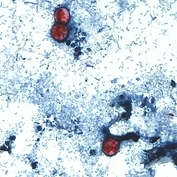
NewWhat we know about cyclosporiasis outbreak's link to produce outbreak
Video has Closed Captions
What we know about the cyclosporiasis outbreak linked to produce (6m 16s)
Providing Support for PBS.org
Learn Moreabout PBS online sponsorship
- News and Public Affairs

FRONTLINE is investigative journalism that questions, explains and changes our world.
 New Episode
- News and Public Affairs

Today's top journalists discuss Washington's current political events and public affairs.
 New Episode
 New Episode
 New Episode
 New Episode
 New Episode
 New Episode
 New Episode
Support for PBS provided by:
Major corporate funding for the PBS News Hour is provided by BDO, BNSF, Consumer Cellular, American Cruise Lines, and Raymond James. Funding for the PBS NewsHour Weekend is provided by...