Virginia Home Grown
Virginia Apples
Clip: Season 26 Episode 6 | 5m 4sVideo has Closed Captions
Discover Virginia’s role in shaping popular apple varieties
Peggy Singlemann shares an overview of the history of apples in Virginia from cider apples to the commonwealth's role in shaping the Fuji apple. Featured on VHG episode 2606, August 2026.
Problems playing video? | Closed Captioning Feedback
Problems playing video? | Closed Captioning Feedback
Virginia Home Grown is a local public television program presented by VPM
Virginia Home Grown
Virginia Apples
Clip: Season 26 Episode 6 | 5m 4sVideo has Closed Captions
Peggy Singlemann shares an overview of the history of apples in Virginia from cider apples to the commonwealth's role in shaping the Fuji apple. Featured on VHG episode 2606, August 2026.
Problems playing video? | Closed Captioning Feedback
Where to Watch Virginia Home Grown
Virginia Home Grown is available to stream on pbs.org and the PBS app.
Providing Support for PBS.org
Learn Moreabout PBS online sponsorshipAnd Randy, talking about culture, apples are also part of our culture, and I dove into the apples of Virginia and was fascinated to learn that we had two native crab apples here in Virginia.
>>Oh, wow.
>>Yeah, our sweet crab apple, which looks a lot like this one.
Okay?
>>Okay.
>>But also our southern crabapple.
And also to learn that colonists brought over plants by seed the apple plant.
And again, anything made from seed, as we know, that's open pollinated.
It's random as to what you're going to get.
And these apples here are kind of representative of the crazy apples that came from that seed from the colonists.
>>Okay.
>>All righty?
But then here in Virginia, back on the crab apple front, this Hewe's Crab apple came about through genetic, you know, variation with the seed.
And this one here actually was an excellent cider apple, to the point that Thomas Jefferson said that when this was crushed, he could almost see the liquid gold going out of it to make wonderful cider.
>>Wow.
>>Isn't that kinda cool?
>>Yeah.
>>'Cause we have to understand that back in the 1600s and 1700s, cider was the primary drink.
It wasn't about the alcohol.
It was about the nutritious value of cider, because who knew what was in that water?
But the cider was definitely pure and safe to drink.
Plus, it had lots of vitamins, had antioxidants, as well as other wonderful benefits of health, okay?
>>Right.
>>So, while we were busy here in the colonies, messing with apples from the seed, over in France in the 1500s, they developed this Southern Rambo apple, and it's one of the few apples of the time that people could eat, called a table apple or dessert apple.
>>And you said the 1500s?
>>1500s.
>>Wow.
>>Yeah, but it didn't get to the colonies until the mid-1700s.
>>Okay.
>>Took some time to get here.
But here in the United States, or I should say in the colonies, they were still busy with apple production here in Virginia.
And in came the very famous Pippin apple, but it first started on Long Island, and then it came here, and it grew so well in the Blue Ridge 'cause of the terraforma, 'cause of gorgeous soil, gorgeous weather, like everything else.
It thrived and it became a cider apple, very well known and connected with Virginia, along with our Winesap.
Now, the Pippin got renamed to the Albemarle Pippin, but the Virginia Winesap, which heralded from New Jersey, was also renamed because it did so well here and became connected.
Isn't that kind of fun?
We stole two- >>Yeah.
>>And took 'em as our own.
(Peggy laughs) >>Yeah.
>>But they also made wonderful ciders.
>>That's awesome.
>>But again, back over on the other side of the pond, we have some more table apples being developed.
And this one here, Pitmaston Pine Apple, because it really tastes like a pineapple.
It has a pineapple flavor to it.
>>Oh, wow.
>>And this is in the 1800s that these apples are starting to really be developed, and it's through the 1800s that we shift from cider and baking and drying and cooking with apples to also eating them as dessert and as a table and to pick up and munch on like you and I do.
>>Right.
>>But also, the advent of refrigeration helped that come along.
So, what we don't know, or what people don't know, is that the Red Delicious, okay, in the late 1800s was developed in Ohio.
And it became a smash because it has a thick, leathery skin so we could keep long, and they could hold it in storage and refrigeration.
And it became America's number one apple in the early 1900s.
>>Wow.
>>But to circle this back to Virginia, there's another fun apple story that we connect to, okay?
In 1790, we're back into Thomas Jefferson era, there was an apple introduced called Ralls' Genet from France.
It was a phenomenal apple with wonderful flavor, really good crispy tartness, but it didn't keep long.
And so, actually, a pomologist in Japan in the 1930s took the attributes of the Red Delicious with the thick skin and the fact that it could keep long and crossed it with the Ralls' Genet from 1790.
>>Oh, wow.
- And brought in an apple we enjoy today, and drum roll, it is the Fuji apple.
And the Fuji apple was introduced in the 1930s.
>>Beautiful.
>>And to think that the genetics of the Fuji apple goes back to a Virginia apple, that Ralls' Genet.
Isn't that kind of fun?
>>It is amazing.
>>So, whenever you pick up a Fuji apple, think about what you're eating, and that you're eating an apple that was developed here in Virginia, as well as one crossed in Ohio overseas in Japan for us to enjoy.
When you get into the stories of apples, it's just fascinating.
I had so much fun researching all of this.
>>It is so awesome.
>>Yes, it is.
It's a fun story, anyway.
>>It is.
Video has Closed Captions
Clip: S26 Ep6 | 3m 12s | Increase your blackberry harvest with proper pruning techniques (3m 12s)
Video has Closed Captions
Clip: S26 Ep6 | 8m 14s | Learn about tobacco cultivated by indigenous peoples to use for ceremonial purposes (8m 14s)
Video has Closed Captions
Clip: S26 Ep6 | 3m 16s | Brighten up your garden with sunflowers (3m 16s)
Video has Closed Captions
Clip: S26 Ep6 | 8m 18s | Meet a fourth-generation farmer that practices a traditional sun drying process to cure peanuts (8m 18s)
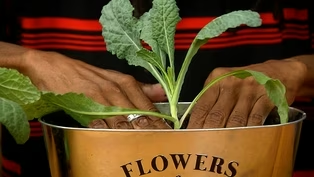
Video has Closed Captions
Clip: S26 Ep6 | 4m 31s | Learn how transplant lettuce and kale into your garden (4m 31s)
Providing Support for PBS.org
Learn Moreabout PBS online sponsorship

- Home and How To

Hit the road in a classic car for a tour through Great Britain with two antiques experts.
 New Season





 New Episode
 New Episode


Support for PBS provided by:
Virginia Home Grown is a local public television program presented by VPM