Virginia Home Grown
Ceremonial Tobacco
Clip: Season 26 Episode 6 | 8m 14sVideo has Closed Captions
Learn about tobacco cultivated by indigenous peoples to use for ceremonial purposes
Peggy Singlemann visits the cultural garden at Upper Mattaponi Tribal Headquarters in King William to talk with Chief Frank Adams and Nokomis Custalow about nicotiana rustica, the variety of tobacco cultivated in pre-colonial Virginia for ceremonial use. Featured on VHG episode 2606, August 2026.
Problems playing video? | Closed Captioning Feedback
Problems playing video? | Closed Captioning Feedback
Virginia Home Grown is a local public television program presented by VPM
Virginia Home Grown
Ceremonial Tobacco
Clip: Season 26 Episode 6 | 8m 14sVideo has Closed Captions
Peggy Singlemann visits the cultural garden at Upper Mattaponi Tribal Headquarters in King William to talk with Chief Frank Adams and Nokomis Custalow about nicotiana rustica, the variety of tobacco cultivated in pre-colonial Virginia for ceremonial use. Featured on VHG episode 2606, August 2026.
Problems playing video? | Closed Captioning Feedback
Where to Watch Virginia Home Grown
Virginia Home Grown is available to stream on pbs.org and the PBS app.
Providing Support for PBS.org
Learn Moreabout PBS online sponsorship>>When someone built a canoe, they would bless the canoe with tobacco.
When they put their drum together, they would always bless the drum by sprinkling tobacco on the surface of the drum.
When we have powwows or dances or visitation from other tribes, first thing you do is, is everybody's got tobacco in their hand, or in their pocket or in the pouch.
Everyone sprinkles a little bit of tobacco on the ground to just cleanse the area as we dance to celebrate everything.
Culture, celebrate harvest, celebrate the coming of fall, celebrate the coming of spring.
And when we put tobacco down, we don't make a big showing of it.
It's kind of a one-on-one thing with yourself and the great spirit, the creator of all, yes.
So it's a spiritual thing just to get yourself in the right place before you dance, you speak, you make decisions.
And we depend on the tobacco just for peace of mind.
But we know, and it's passed down from ancestor to ancestors, generation to generation, that this is a central part of any village is to have some spiritual tobacco.
>>Nokomis, what's the theme of this garden?
What's its purpose?
>>The purpose is understanding our foodways as well as medicinal plants.
This is actually the three sisters that we're growing.
The corn, bean, and squash.
Gives us an understanding how they all three grow together, and why they work together so well.
>>Right.
>>Right in front of us, we have another food way, the blackberries.
You can eat this in many different ways or puck them off or a snack.
>>Yeah.
>>Right over here to your right, we have milkweed.
>>Milkweed.
>>Absolutely, not only does it attract our monarchs to have that pollination to grow more, but it's a fiber.
Not only the milkweed is considered a fiber, around the corner, you also have Dogbane.
>>Yes.
>>Both of these plants create cordage for our community to either make fishnets or baskets to put our corn in.
>>Yeah.
>>And then right here we have the star of the show, the ceremonial tobacco.
>>Yes.
>>Absolutely.
So this is a Nicotiana Rustica.
This was more commonly used by the indigenous people of Virginia.
So as you notice, it's starting to get brown here that it's going to be the seed.
So we start plucking those off when it's ready to grow more each year.
It's also meant for ceremonial compared to the tabacum that Europeans are bringing over to the Americas.
>>Absolutely, you know, it's a fascinating plant.
Because people just don't understand there's such a difference between the ceremonial versus the commercial plant.
>>Correct.
>>You know, it's nigh and day almost.
>>Absolutely, so when it comes to ceremonial, the examples of that for indigenous people would be more for communicating and sending message to our deities.
We would call our deities creator or God, Ahone, which is one of many words in our Virginia Algonquian languages we're learning here.
For the tabacum that English is bringing over, they're more for industrial reasonings.
I'm here for the money, right?
>>Yep, exactly.
>>So they're just trying to figure out how they can work with the indigenous people to make a little bit more money in their pocket.
>>Right, so they actually grew a different tobacco too.
The leaves are larger.
Actually, it's more subtropical too, because it grows from zone seven down to zone 11.
>>Absolutely.
>>Which is Virginia, of course, down to Florida.
While this tobacco, the ceremonial tobacco, they can actually grow in zone three up in Canada.
>>All the way down.
>>All the way down.
Yeah, it's a shorter growing season.
>>A little bit.
It can also kind of tolerate a little bit of frost, but for the most part, both definitely needs warm, humid air.
>>The optimum place is in Virginia, right here.
This is where it grew the best.
Back in the day we traded tobacco for other things that we didn't have available here.
We walked to the mountains to get flint to make arrow tips and tools, but we had to trade for that.
They didn't just give it.
We didn't have money to buy it, so we took tobacco with us, and we traded tobacco as well as beaver pelts and hides just so we could haul the stones home to make our tools.
The Europeans came in and they commercialized the peace pipe and things like that.
But for us we didn't use tobacco, smoke tobacco on a daily basis.
It was only in ceremonial things that we even would dare even partake of tobacco.
And the tobacco we grew was extremely potent.
Even when we used that tobacco, we would cut it with other things, such as cedar bark or pine needles or whatnot, just to take the harshness and the hallucination effects of the tobacco.
>>Nicotiana rustica is a little bit of a biting taste according to the English.
A little bit stronger, higher in nicotine.
>>Much higher, actually.
>>And then for the tobacco, it's more milder, more sweeter.
That's what they would have preferred to have in that economy for our landscape.
>>I understand the nicotine content of this plant is close to 9%.
Very, very high.
>>Very high, which is why the English chose theirs specifically.
>>Yeah, that nicotine content was actually down to 3%.
But I think too, as a plant, we get confused with it, and we try to take the commercial tobacco, and sort of in our mind put it in place of the ceremonial tobacco.
And the use, the culture, everything beyond is completely different.
>>Yeah, we don't use it as a greed.
It's more for communicating and sharing with one another, sharing space.
When it comes to modern ceremonies or powwows, for example, we will pray over that circle.
It's just a way to kind of get that bad energy out of the area before we enter and show all of that positivity to show and educate to our community.
>>So if I wanted to plant this at home, what would it require?
>>Yeah, so after the last frost, you will plant it in well-drained loamy soil.
There's some indications when it's time to get a harvest throughout the leaves, whether it's from bottom into the top, you'll see some yellow on it.
That's the time you can start plucking the leaves.
Or another indication is the brown buds.
Those are the seeds.
So throughout the season, you can start picking them slowly but surely in order to plant those for next year.
>>Fantastic, I'm hoping people have now learned, particularly that this tobacco here is nothing like our commercial tobacco.
And the symbolism and the I'll say the sacredness of this plant to the indigenous people is not one to belittle.
It's basically almost a circle.
>>Right.
>>The center of that circle.
>>Absolutely, we want to try to hold on tight to what we have.
This is one of many ways that we're trying to bring back to our territory, our environment, and our communities.
You know, trade happens a lot.
So the tabacum has a pink flower, much broader, much larger.
It's not bad that we grow that, but when it comes to kind of showcasing culture and what that means to us, we want to kind of stick to who we are, and what it makes more sense to us.
>>Yes, and I'm sure you have children working in this garden.
>>Absolutely, just recently, back in April, they do it every year.
We have what is called Family Planting Day.
We start off with seedlings that our coworkers start off here first, and then we bring the families in of the tribal communities.
We kind of tell a story about it, talk about it, and the purpose, and then we have them get their hands dirty in the soil, and just have a good time with family, and a good space for each of one of us.
>>I can't think of a better place to be with my hands in the soil.
>>Absolutely.
>>And cultivating something such as important as this.
Thank you so much for sharing.
And thank you for just even enlightening me about the differences.
I had no idea, and I've learned so much through you.
>>Absolutely, I want to say KeNah, thank you in our language, as a way of having this opportunity to be able to showcase what we're doing here.
>>This is what we are, this is who we are.
This is why we're here.
Tobacco is a huge connection that we don't want our youth to lose the idea, or the knowledge of how to grow and nurture, and the value of being able to put your hands on some native tobacco that just can't buy in a store.
And it's a connection with the land, mother earth.
If you can grow tobacco, the tribe will always prosper and be alive.
Video has Closed Captions
Clip: S26 Ep6 | 3m 12s | Increase your blackberry harvest with proper pruning techniques (3m 12s)
Video has Closed Captions
Clip: S26 Ep6 | 3m 16s | Brighten up your garden with sunflowers (3m 16s)
Video has Closed Captions
Clip: S26 Ep6 | 8m 18s | Meet a fourth-generation farmer that practices a traditional sun drying process to cure peanuts (8m 18s)
Video has Closed Captions
Clip: S26 Ep6 | 4m 31s | Learn how transplant lettuce and kale into your garden (4m 31s)
Video has Closed Captions
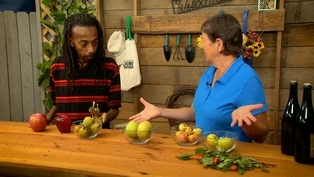
Clip: S26 Ep6 | 5m 4s | Discover Virginia’s role in shaping popular apple varieties (5m 4s)
Providing Support for PBS.org
Learn Moreabout PBS online sponsorship

- Home and How To

Hit the road in a classic car for a tour through Great Britain with two antiques experts.
 New Season





 New Episode
 New Episode


Support for PBS provided by:
Virginia Home Grown is a local public television program presented by VPM