
December 18, 2025 - PBS News Hour full episode
12/18/2025 | 57m 46sVideo has Closed Captions
December 18, 2025 - PBS News Hour full episode
December 18, 2025 - PBS News Hour full episode
Problems playing video? | Closed Captioning Feedback
Problems playing video? | Closed Captioning Feedback
Major corporate funding for the PBS News Hour is provided by BDO, BNSF, Consumer Cellular, American Cruise Lines, and Raymond James. Funding for the PBS NewsHour Weekend is provided by...
December 18, 2025 - PBS News Hour full episode
12/18/2025 | 57m 46sVideo has Closed Captions
December 18, 2025 - PBS News Hour full episode
Problems playing video? | Closed Captioning Feedback
How to Watch PBS News Hour
PBS News Hour is available to stream on pbs.org and the free PBS App, available on iPhone, Apple TV, Android TV, Android smartphones, Amazon Fire TV, Amazon Fire Tablet, Roku, Samsung Smart TV, and Vizio.
Providing Support for PBS.org
Learn Moreabout PBS online sponsorshipGEOFF BENNETT: Good evening.
I'm Geoff Bennett.
AMNA NAWAZ: And I'm Amna Nawaz.
On the "News Hour" tonight: New economic data# show a slo.. but Americans remain concerned# about the cost of living.
GEOFF BENNETT: We fact-check the claims President# Trump made in his year-end White House address.
AMNA NAWAZ: And the United States announces# a multibillion-dollar weapons sale to Taiwan,## prompting condemnation from China.
BAO WEIZHONG, 99th Marine Brigade (through# translator): I think the Russia-Ukraine war is## a wake-up call for Taiwan.
Like Ukraine,# we have a powerful adversary nearby.
(BREAK) AMNA NAWAZ: Welcome to the "News Hour."
Inflation is showing fresh signs of cooling,# ticking up 2.7 percent year over year,## nearly half-a-point lower than many# economists had expected.
The new data## follows the release this week of# a long-delayed jobs report that## showed weak growth and the highest# unemployment rate in four years.
GEOFF BENNETT: Taken together, the numbers could# bolster the case for more rate cuts in 2026,## though, economists caution data# collection for both reports was## significantly affected by the government shutdown.
Last week, the Federal Reserve cut# interest rates for the third time in## four months, citing downside risks in the# employment market as its major concern.
For a perspective on the economy,# we're joined now by Austan Goolsbee,## president and CEO of the# Federal Reserve Bank of Chicago.
Welcome back to the program.
AUSTAN GOOLSBEE, Former Chairman, Council of# Economic Advisers: Thank you for having me.
GEOFF BENNETT: So let's start with today's## inflation report.
What stands# out to you in these numbers?
AUSTAN GOOLSBEE: Well, there's a lot to# like in the report that we saw today.
If you remember, because of the government# shutdown, we just literally went dark on## inflation data.
And what we saw right before# it went dark was a little bit disturbing.
There## were some categories of inflation that looked# like they were going up or not coming down.
This report today, what struck me overall is that# the headline numbers were much below where they## were expected, and that was pretty broad-based,# and it wasn't just concentrated in one freak## thing.
Now, one-month data is no months, as I# like to say, because there's a lot of variability,## and that's especially true when you're kind# of reaching down and pulling the bottle out.
We got to brush the dust off of it.
There are# imputations and things.
We would want to see## this sustained, but there was encouraging news,# the improvements that we saw in inflation today.
GEOFF BENNETT: Encouraging news.
For months now, the economy has# been sending.. inflation easing, but the labor market# showing real signs of weakness.
When## you step back and look big picture,# what concerns you the most right now?
AUSTAN GOOLSBEE: Well, what concerns# me the most is if we were to get## more readings like the ones we were# getting before the data turned off,## where both sides of the so-called dual# mandate for the Fed, which the law says,## when we set monetary policy, we're trying to# maximize employment and stabilize the prices.
If both sides are getting worse at the same# time, that's a very uncomfortable position for## the Central Bank to be in.
And that's where# we were, progress on inflation stalled out,## but the job market weakening slowly, showing# some stability, but weakening pretty steadily.## If we return to a circumstance like# that, that'd be the biggest concern.
The more we get readings like the price# readings that we got today on inflation,## the more confidence we would have.
Now,# look, we're on -- we could be on path## back to 2 percent.
And then, in my view,# rates could start going back down again## to some settling point that's below# where we are today by a fair amount.
GEOFF BENNETT: Yes.
So is there enough information# that would support cuts?
AUSTAN GOOLSBEE: I don't -- for me, one# month is not enough information, certainly.
But the more information you get, you# just want to have some assuredness that## we are on path back to 2 percent.
If we make# progress like this multiple months in a row,## that gives you that kind of confidence.
You# just want to be a little careful one month.
There were -- as I say, if you get down# into the weeds of these inflation readings,## there are a lot of imputations where they said,# well, we didn't have any information in October,## so let's assume it was zero kind# of thing.
You wouldn't want to rely## just on one month's number when# the number is noisy like that.
But as I describe it, there's a lot to# like in this inflation report.
Let's## get some more reports like that, and# then we will be feeling much better.
GEOFF BENNETT: Got it.
Bottom line, affordability remains Americans'.. prices are the single biggest issue for voters# across the political spectrum; 70 percent of## those people who were polled said that the# cost of living in their area is not affordable.
What realistically can the# Fed do to ease that burden?
AUSTAN GOOLSBEE: Seventy percent is a big number.# That matches out here in the heart of the Midwest,## the Seventh District of the Fed.
All# the businesspeople I'm talking to,## all the consumers that I'm talking to, they're# mentioning prices as a major component.
The nature of what does affordability# mean, there's some aspect of that that## has to do with incomes too, not just what# the price level is.
And all of those things## in the economy are mostly not under the# Fed's direct control or intervention.
You got to remember, the Fed is taking# the lead on economic stabilization.## We're trying to figure out, where are we in the# business cycle?
If there's danger of recession,## then we want to consider loosening to try to# ease those dangers.
If the economy looks like## it's overheating and inflation is getting# up too high, we're going to work on that.
But what we do is not directly# about long-run economic growth,## long-run incomes.
We're just trying to stabilize# inflation and get it back to 2 percent.
That's## what we have stated as our goal.
And we're# going to do that.
It's just been -- we have## been elevated for a long time now, and it's# not as easy as you would hope it would be.
GEOFF BENNETT: Austan Goolsbee, president and## CEO of the Federal Reserve Bank of# Chicago, thanks again for your time.
AUSTAN GOOLSBEE: Yes, wonderful to see you again.
AMNA NAWAZ:## In the day's other headlines: Police# in North Carolina say retired NASCAR## driver Greg Biffle and his family# were among seven people killed when## their private jet crashed this# morning outside of Charlotte.
Officials say the Cessna C550 had tried# to land shortly after taking off from a## regional airport used by several NASCAR teams# and Fortune 500 companies.
Eyewitness video## captured the fiery crash and a large plume# of smoke.
The NTSB and FAA are investigating.
The "News Hour" spoke to Biffle# last year, when he used his own## flying experience to deliver supplies# to communities hit by Hurricane Helene.
GREG BIFFLE, Former NASCAR Driver: For me,## it's people helping people.
Our motto in this# country is, we.. And I had the opportunity in front of me to# help more people and bring awareness.
I would## expect someone to do that for me.
That's# why I want to do that for these folks.
AMNA NAWAZ: Biffle won more than 50# races across NASCAR's three circuits,## including 19 at the Cup Series# level.
He was 55 years old.
The U.S.
government has admitted to liability# in January's deadly air collision in Washington,## D.C.
In its official response to a lawsuit# from one of the victims' families, the Justice## Department said -- quote -- "The accident# could have been avoided" if the helicopter## pilot -- quote -- "had maintained visual# separation by seeing and avoiding the airliner."
Sixty-seven people were killed when an# Army Black Hawk helicopter crashed into## an American Airlines plane as# it was coming in for a landing.## Today's filing opens the door for families to# seek damages in the deaths of their loved ones.
The White House announced today that# Washington, D.C.
's leading performing## arts center will bear the president's name# and be known as the Trump-Kennedy Center.
DONALD TRUMP, President of the United States:# I was surprised by it.
I was honored by it.
AMNA NAWAZ: This afternoon, Mr.
Trump spoke# about his reaction to the renaming.
He## handpicked the board and is himself chairman.# Members of the Kennedy family fired back.
Maria Shriver, who's the niece of John F. Kennedy,# wrote -- quote -- "It's beyond wild that he would## think adding his name in front of President# Kennedy's name is acceptable.
It is not."
And House Democratic Leader Hakeem Jeffries said## the board has no authority to rename# the center without legislative action.
The Democratic National Committee says it# won't issue its report on the party's poor## showing in last year's elections.
DNC Chair Ken# Martin says that dwelling on the past would be## a -- quote -- "distraction," adding that# Democrats are -- quote -- "already putting## our learnings into motion.
We're winning again,# even in places that haven't gone blue in decades."
The decision comes after Democrats# have enjoyed a string of recent wins## in special elections and off-year statewide# votes.
It also spares top figures like Joe## Biden and Kamala Harris from further# scrutiny of their failed campaigns.
New York has a new archbishop after# Pope Leo tapped 58-year-old Bishop## Ronald Hicks to serve the areas more# than two million Catholics.
Like Leo,## Hicks is from the Chicago area.
He will# replace the retiring Cardinal Timothy Dolan,## who recently confirmed a $300 million plan# to compensate victims of sexual abuse.
Today, the outgoing Dolan introduced# Hicks at a press conference,## where he pledged continued -- quote --# "accountability, transparency and healing."
BISHOP RONALD HICKS, Archbishop-Designate# of New York: As a church, we can never## rest in our efforts to prevent abuse, to# protect children and to care for survivors.
AMNA NAWAZ: Hicks is widely seen as a# moderate whose style is similar to that## of the pope's.
He largely avoids political# matters, though last month he endorsed a## condemnation from his fellow bishops of the# Trump administration's immigration raids.
The Islamic State group today praised last# weekend's attack on a Hanukkah celebration## at Australia's Bondi Beach in which 15# people were killed.
The group called## the killings a -- quote -- "source of# pride," but did not claim responsibility.
This comes as the youngest victim, a 10-year-old# girl named Matilda, was laid to rest.
At a vigil## today, mourners sang the Australian folk tune# that shares her name in tribute to her and all## the victims of Sunday shooting.
Elsewhere,# a funeral was held for the oldest victim,## 87-year-old Alex Kleytman, a Holocaust survivor# who died shielding his wife from gunfire.
In corporate news, TikTok has# signed a deal to sell its U.S.
unit,## meaning it can continue operating in this country.## That's according to a memo seen by the AP# and others.
It says that Oracle, Silver Lake,## and Abu Dhabi-based MGX would together# control about 45 percent of the new entity.
The sale would end years of efforts to force the# company's Chinese parent, ByteDance, to divest its## U.S.
business over national security concerns.# The deal is expected to close in January.
Meanwhile, the parent company of President Trump's# TRUTH Social platform says it's merging with a## privately held fusion power company.
They say the# combined company will be valued at more than $6## billion and will aim to provide the electricity# needed to power artificial intelligence.
Trump Media shares jumped more# than 40 percent on the news,## but they're still down sharply on the year.
Elsewhere on Wall Street, stocks ended# higher after that encouraging inflation## data.
The Dow Jones industrial leverage# posted a modest gain of about 65 points.## The Nasdaq jumped more than 300 points.# The S&P 500 also ended higher on the day.
And journalist Peter Arnett has died.# A high school dropout from New Zealand,## Arnett covered more than a dozen wars# over a four-decade career.
In 1966,## he won the Pulitzer Prize for his# reporting on the Vietnam War.
Later,## he was one of the few Western journalists to# stay behind after the fall of Saigon in 1975.
Arnett spoke to the "News Hour" about his decision# to stay while revisiting the country in 2015.
PETER ARNETT, Journalist: The reason I stayed# behind is that I'd been there at the beginning,## say, 1962, and I'd covered it throughout# those intervening years.
So I felt that## I just had to stay behind to see what would# happen to Saigon when the communists arrived.
AMNA NAWAZ: Arnett went on to join CNN,## where he won acclaim for his live updates# from Baghdad during the 1991 Gulf War.
But his career was not without controversy.# He left CNN in 1999 after a flawed report## on a Vietnam War atrocity that# apparently never happened.
And## NBC later fired him after he said on# Iraqi state TV that the U.S.-led war## plan was failing.
He eventually# retired from reporting in 2014.
Arnett's family says he'd been suffering from# prostate cancer.
Peter Arnett was 91 years old.
Still to come on the "News Hour": President# Trump eases federal restrictions on marijuana;## the Trump administration's plans to cut funding## for hospitals that provide# transgender care for minors;## and the former ambassador to Venezuela weighs in# on the U.S.
blockade on sanctioned oil tankers.
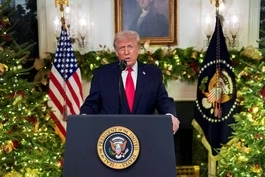
GEOFF BENNETT: President Trump# addressed the nation last night## in a politically charged prime-time speech.
AMNA NAWAZ: In front of Christmas trees at# the White House, he blamed his predecessor,## Joe Biden, and the Democrats in general# for economic challenges and inflation.
Our White House correspondent,# Liz Landers, has this fact-check.
DONALD TRUMP, President of the# United States: Good evening, America.
LIZ LANDERS: As the first year of# his second term comes to a clos.. President Trump projected positivity.
DONALD TRUMP, President of the United# States: Over the past 11 months,## we have brought more positive change# to Washington than any administration## in American history.
There has never been# anything like it.
And I think most would agree.
LIZ LANDERS: The roughly 20-minute speech mostly# focused on the state of the economy, as new## polling shows Americans concerned about the price# of goods and souring on his handling of the issue.
In the latest PBS News/NPR/Marist poll, 57# percent disapprove of the job he's doing on## the economy.
Just 36 percent of poll respondents# approve, a record low across both his terms.
Throughout the address, the president falsely# referred to inflation as a solved problem.
DONALD TRUMP: When I took office,# inflation was the worst in 48 years,## and some would say in the history of# our country.
Inflation has stopped,## wages are up, prices are# down, our nation is strong.
LIZ LANDERS: As we reported earlier# in the program, inflation has slowed,## but year-over-year inflation remains higher# than the Federal Reserve's 2 percent target.## Inflation was at a four-decade# high in 2022 under President Biden,## but had been higher at multiple points in the# 20th century, most recently around 1980 at## nearly 14 percent.
It had fallen to 3 percent# by the time Trump took office in January.
DONALD TRUMP: The last administration and their## allies in Congress brought in millions# and millions of migrants and gave them## taxpayer-funded housing while your# rent and housing costs skyrocketed.
LIZ LANDERS: The president repeatedly pointed# his finger at both the Biden administration## and immigrants for rising costs.
Deportations# have been a major piece of the second Trump## administration's agenda, at times receiving# criticism for using potentially illegal tactics.
There is no clear evidence# that immigration substantially## contributed to rising housing costs for citizens.
DONALD TRUMP: Democrat politicians also# sent the cost of groceries soaring,## but we are solving that too.
LIZ LANDERS: Consumer Price Index data# actually shows that more grocery items## have increased in price this year than decreased.
DONALD TRUMP: The price of eggs# is down 82 percent since March## and everything else is falling# rapidly, and it's not done yet,## but, boy, are we making progress.# Nobody can believe what's going on.
LIZ LANDERS: The wholesale price# of eggs has fallen more than## 82 percent, but retail prices have# fallen just 44 percent from March## to September.
And the Consumer Price# Index rose by 3 percent in September.
DONALD TRUMP: Gasoline is now under# $2.50 a gallon in much of the country.## In some states, it, by the# way, just hit $1.99 a gallon.
LIZ LANDERS: This is an exaggeration.# Estimates show that national gas prices## averaged closer to $2.90 per gallon,# and while some stations in certain## states have prices below $2, that's# including membership promotions.
DONALD TRUMP: I negotiated directly with# the drug companies and foreign nations,## which we're taking advantage of# our country for many decades,## to slash prices on drugs and# pharmaceuticals by as much as 400,## 500, and even 600 percent.
In other words,# your drug costs will be plummeting downward.
LIZ LANDERS: While costs for# some drugs may drop next year,## the price cuts the president talked# about are not mathematically possible.## A 100 percent cut would mean# prescription drugs would be free.
DONALD TRUMP: I have secured a record-breaking# $18 trillion of investment into the United States,## which means jobs, wage increases,# growth, factory openings and far## greater national security.
Much of this# success has been accomplished by tariffs.
LIZ LANDERS: President Trump's own# White House Press Office has tallied## half of that number in investments, $9.6# trillion.
But that includes many informal## pledges from foreign countries# and already announced projects.
Qatar and the United Arab Emirates have# each pledged more than $1 trillion, but## that's more than their gross domestic products.# The president's speech included falsehoods and## hyperbole.
One of the only new initiatives he# announced was what he called a warrior dividend## for military service members.
But the money# comes from previously approved funds by Congress.
DONALD TRUMP: In honor of our# nation's founding in 1776,## we are sending every soldier $1,776.
Think of# that.
And the checks are already on the way.
LIZ LANDERS: He claimed that# tariffs and the Big Beautiful## Bill tax package will help pay for the dividends.
Senator Roger Wicker praised the move,# noting in a statement the $2.9 billion in## funding comes from the bill passed over# the summer.
It was allocated to offset## housing costs and cost of living increases# and meant to be doled out over two years,## instead of a lump payment.
But the funds# do not come directly from tariff revenue.
DONALD TRUMP: We're poised for an economic boom,# the likes of which the world has never seen.
LIZ LANDERS: The president ended his message# with defiance as he looked ahead to next year.
DONALD TRUMP: We are respected again# like we have never been respected before.
LIZ LANDERS: For the "PBS# News Hour," I'm Liz Landers.
AMNA NAWAZ: Well, President Trump signed# an executive order today reclassifying the## federal status of marijuana, categorizing it as a# drug with less potential for harm and dependence.
GEOFF BENNETT: It's a major shift in policy that## could have wide-ranging effects# on cannabis use and research.
William Brangham joins us now with more.
WILLIAM BRANGHAM: That's right.
For many years, .. meaning the government considered it dangerous# to use with no medical benefits.
Today's move## will slide marijuana down into Schedule III with# drugs like Tylenol with codeine and testosterone.
While this doesn't legalize marijuana, this shift# would allow for greater research about the drug,## which is something President Trump# touted during his announcement today.
DONALD TRUMP, President of the United States: This# reclassification order will make it far easier## to conduct marijuana-related medical research,# allowing us to study benefits, potential dangers## and future treatments.
It's going to have# a tremendously positive impact, I believe.
WILLIAM BRANGHAM: So for# more on this policy shift,## we are joined again by Beau Kilmer.
He's# with the RAND Drug Policy Research Center.
Beau, thank you so much for being here again.
Let's walk through some of the impacts of this# shift, the first one being research.
We just heard## the president say this is going to open up the# floodgates for new scientific research.
Is that## true?
What kind of research will they be doing?# What kind of questions might scientists be asking?
BEAU KILMER, RAND Drug Policy Research Center:# Yes, well, so you can do research on Schedule I## drugs, but there's a lot of paperwork and# a lot of hoops you need to jump through.
So, traditionally, when you would move# from a Schedule I to a Schedule III drug,## it would mean less bureaucracy to deal with, and# it should increase access to research.
However,## the Congressional Research Service put out a# report last year saying that, because of a law,## that they didn't think that rescheduling# cannabis was actually going to have that## much of an effect on research because of this# bill that had already been signed into law.
Now, look, on the margins, this could increase# access for research and maybe it will reduce## the stigma for some researchers.# But the bigger question I have is,## who's going to pay for the research?
Typically,# the National Institutes of Health would support## a lot of this research as trying to figure out the# benefits and the risks associated with cannabis.
And so the question is, will there --# will NIH continue to fund this research?## Will they prioritize it?
Will they put more# money into it?
That to me is the bigger question.
WILLIAM BRANGHAM: And what do you# think, any other major shifts this## categorization change might trigger?
BEAU KILMER: Oh, it's going to make## some cannabis companies a lot richer.
As part of the federal tax code,# there's a section called 280(e).
And## essentially what this -- which this part of the# code requires is that, if you are trafficking## in a Schedule I or a Schedule II drug, you# can't claim normal business exemptions on## your federal taxes.
And so that means there's# quite a burden for these cannabis companies.
But by moving cannabis from Schedule I to# Schedule III, that 280(e) part of the tax code## no longer applies.
So the cannabis companies# are going to be very happy with this shift.
WILLIAM BRANGHAM: President Trump today said he# didn't want this to be seen as condoning the use## of marijuana, which he kept saying is bad, kids,# don't do it.
Do we know if that is true?
I mean,## we have had all these states legalizing# recreational marijuana.
Do we know,## is it a net benefit to society?
Are there# are there downstream health impacts?
BEAU KILMER: Yes.
I mean, we're still learning a lot about the# produc.. most of the health research that# goes on with respect to cannabis## isn't necessarily focused on the products# that you would get in the dispensaries.
So there are -- there's a lot of# research that still needs to be## done in terms of the potential# benefits, as well as the risks.
WILLIAM BRANGHAM: Do you have a sense as# to why this has taken so long?
I mean, drug## policy advocates have also argued for this for a# long time.
Many other administrations said they## would get to this, never did.
Are you surprised# it happened during the Trump administration?
BEAU KILMER: Well, look, I mean,## people have been debating reschedu.. But it was actually during the Biden# administration that they began to## make this move toward rescheduling.
And# there are two ways to reschedule drugs.## You can either pass legislation or you# could go through the executive agencies,## and it requires input from the Department of# Health and Human Services, as well as the DEA.
And so this process was started# during the Biden administration.## Health and Human Services put out this report.# And then the DEA put into the Federal Register## that they were going to be considering# this.
And then, based on that, there was,## I think, over 40,000 public comments, and# then there were supposed to be some hearings.
And then, in theory, after those hearings,# then the DEA would make a decision and then## put that into the Federal Register.
Well,# over the past couple of years, things got## really hung up with those hearings.
So it's not# entirely clear to me what's going to happen.
Are we going to skip those and just go# right to the DEA putting something into the## Federal Register about it being reclassified to# Schedule III, or will there be hearings, where## policymakers, as well as the public, will hear# more about the health implications of cannabis?
WILLIAM BRANGHAM: Is it your sense# that this change might prompt more## states to legalize recreational or medicinal use?
BEAU KILMER: I don't know.
I mean, we already# have about 40 states that allow cannabis to be## used for certain medical purposes.
And about half# the states have passed legalization for adult use.
Moving from Schedule I to Schedule III, the big# change there is, it -- to be a Schedule III drug,## it means that the federal government actually# recognizes that there's medical value.
Now,## whether or not that shift from I to# III is enough to kind of move public## sentiment enough to where you're going# to get more of these bills passed or## initiatives passed in different# states, I'm not entirely sure.
But this -- I mean, the thing to keep in mind# is that this isn't going to legalize what's## happening at the state level.
I mean, everything# you see with respect to medical legalization,## as well as adult use legalization, this# is still all illegal under federal law.
And just moving from Schedule I to Schedule# III doesn't necessarily make these things and## make any of this activity legal in# the eyes of the federal government.
WILLIAM BRANGHAM: All right, that is Beau# Kilmer at the RAND Drug Policy Research Center.
Beau, thank you so much for being here.
BEAU KILMER: Thanks for having me, William.
GEOFF BENNETT:## The Trump administration has approved the# largest single package of weapons sales## to Taiwan in U.S.
history.
Many of the systems# mirror those the U.S.
has supplied to Ukraine.
The move is part of a broader U.S.
effort# to help Taiwan, like Ukraine, deter and,## if necessary, defend itself against a far# larger neighbor.
Beijing has responded angrily.
Nick Schifrin reports.
NICK SCHIFRIN: In Taiwan, the military# prepares for war with American artillery## designed to sink Chinese invaders.
It's the very# same weapon the U.S.
provided Ukraine to target## Russian invaders.
Taiwan is ordering $4 billion# worth of this mobile artillery system, HIMARS,## and $4 billion worth of self-propelled# artillery also widespread in Ukraine.
Today's package also includes a billion# dollars worth of autonomous drones made## by U.S.
manufacturer Anduril.
For years, the# U.S.
has urged Taiwan to focus less on big,## expensive weapons systems that are# unlikely to survive a Chinese invasion,## and instead to fight like Ukraine.
Ukrainian soldiers used less expensive# mobile weapons like the Javelin to disable## Russian tanks.
After years of debate, Taiwan has# embraced the same weapons and idea of fighting## like a porcupine, making itself impossible or# fatal to swallow, including with the Javelin,## $375 million worth including in today's package.
BAO WEIZHONG, 99th Marine Brigade# (through translator): I think the## Russia-Ukraine war is a wake-up# call for Taiwan.
Like Ukraine,## we have a powerful adversary nearby.
That's# why we need more asymmetric weapons to## strengthen both our defense and ground forces# and counter a powerful air force such as China.
NICK SCHIFRIN: China's People's Liberation Army,# or PLA, has launched one of the fastest military## modernizations in world history.
The U.S.
says the# buildup is custom-designed to prevent U.S.
forces## to come to Taiwan's rescue, as demonstrated# in these propaganda videos, and to be able## to invade Taiwan by 2027, today's package of# weapons designed to stop this from happening.
BONNIE GLASER, German Marshall Fund: These# are weapons that will really prevent the PLA## or maybe even prevent Xi Jinping from making# a decision to send the PLA across the strait,## because they will impose very# high cost on an invading PLA.
NICK SCHIFRIN: Bonnie Glaser# is the Indo-Pacific program## managing director of the German Marshall Fund.
DONALD TRUMP, President of the United States:# It's a great honor to be with a friend of mine.
NICK SCHIFRIN: Glaser says there was no guarantee# President Trump would send Taiwan weapons,## when he's made clear he wants a deal with# Chinese leader Xi Jinping.
But the new## National Security Strategy declares# deterring a conflict over Taiwan,## ideally by preserving military# overmatch, is a priority.
BONNIE GLASER: Many people have suggested that# President Trump is softening his language toward## China, that he may be willing to use Taiwan as# a bargaining chip, and that he doesn't really## care very much about Taiwan's security.
But I# think that this language tells us otherwise.## He is not pursuing a more isolationist strategy# or pulling back from our commitment to Taiwan.
NICK SCHIFRIN: Which is exactly what angered# Beijing today, calling the weapons announcement## a violation of diplomatic agreements and an# attack on Chinese sovereignty and security.
GUO JIAKUN, Chinese Foreign Ministry# Spokesperson (through translator): The U.S.## side is already covering.. is China's core interest and the first# impassable red line in Sino-U.S.
relations.## No one should underestimate the firm will and# strong capability of the Chinese government## and people to defend its national# sovereignty and territorial integrity.
BONNIE GLASER: This is a bit# of a warning message.
However,## it is only rhetoric.
And this is the third# arms sale that has taken place since the## two leaders met.
And China's reaction# has been limited to tough rhetoric.
NICK SCHIFRIN: But the new head of# Taiwan's opposition party, Cheng Li-wun,## is worried about Chinese rhetoric, and# argues Taiwan should limit its defense## spending and says more weapons could provoke# the very war they're designed to avoid.
She## also recently told Deutsche Welle NATO# was to blame for the war in Ukraine.
CHENG LI-WUN, Chair, KMT (through translator):# Putin is a president-elected through democratic## votes.
You can't label him a dictator.
Pinning# that label on him is unreasonable and unfair.
NICK SCHIFRIN: But the Taiwanese government,# with the help of the Trump administration,## is trying to arm itself to avoid the# war that Ukraine has had to fight.
For the "PBS News Hour," I'm Nick Schifrin.
AMNA NAWAZ: The Trump administration# today took its most significant moves## yet in a wide-ranging effort to restrict# gender-affirming medical care for minors.
GEOFF BENNETT: The Department of Health and Human## Services unveiled a series of# actions meant to effectively## ban transition-related medical treatments# nationwide for those under the age of 18.
Stephanie Sy has more.
STEPHANIE SY: Geoff and Amna,# the moves announced today include## cutting off federal Medicare and Medicaid# funding from hospitals that provide those## treatments and prohibiting Medicaid# funding from paying for such care.
Here's what Secretary Kennedy had to say.
ROBERT F. KENNEDY JR., U.S.
Health and# Human Services Secretary: This morning,## I signed a declaration.
.. treatment for children with gender# dysphoria.
These procedures fail to me## professionally recognize standards of care.# Medical professionals or entities providing## sex-rejecting procedures to children are out of# compliance with these standards of health care.
STEPHANIE SY: We will delve into those# controversial assertions in a moment,## but we should say that, before these policies# are enacted, there's a lengthy rulemaking## process that has to take place and groups such# as the ACLU are already threatening lawsuits.
To break some of this down, I'm# joined now by Selena Simmons-Duffin,## who covers health policy for NPR# and was at today's announcement.
Selena, thank you so much for joining us.
We know that about 45 percent of hospital# spending comes from Medicare and Medicaid,## so threatening to cut that off# would be existential, I imagine,## for most hospitals.
Even though these# are only proposed rule changes now,## are we going to see widespread stoppage# in this care?
What might the impact be?
SELENA SIMMONS-DUFFIN, NPR: Yes, I mean,# children's hospitals have been pioneers in## this treatment for transgender young people,## which can include puberty blockers, hormone# therapy.
Very rarely, it can include surgery.
But part of the reason why children's# hospitals are attractive to parents,## children who are considering this treatment,# is because they're interdisciplinary and they## have really high-quality teams,# that you can talk to therapists,## you can talk to psychiatrists, you can# really get that full spectrum of care.
And I think that if these rules are# enacted, this care will no longer## happen at hospitals across the country.
And# that includes in places where it is legal,## even though there are 25-plus states that# have banned the care at the state level.
STEPHANIE SY: Help us understand how unprecedented# it is to have the government tell hospitals## they won't have access to federal funding if# they provide a certain kind of medical care.
SELENA SIMMONS-DUFFIN: It# is extremely unprecedented.
This type of rule is called the condition# of participation.
And it's used to create## kind of a bare minimum of standards for# health and safety in hospitals normally,## so rules such as you must have a crash# cart available if you're providing care## for people in emergencies, you must have a# certain number of staff-to-patient ratio,## those kinds of things, very, very, very# basic, kind of the floor of health and safety.
And you could imagine that the same approach,# using conditions of participation, as you say,## this kind of existential tool# to -- over hospital budgets,## you could use it for any variety of care that any# health secretary now or in the future disfavors.
And we're talking about Robert F. Kennedy# Jr., the current health secretary,## who has talked skeptically about a host# of medical care that is regarded as the## standard of care and regarded as safe and# effective, from antidepressants to vaccines.## So it really opens up an enormous can of# worms if this -- these rules take effect## and are allowed to stand through the legal# challenges that will for sure be coming.
STEPHANIE SY: For all the talk of gold standard# science at the announcement today, there were a## few nonscientists who made declarative statements# dismissing gender dysphoria altogether.
I want to play what Jim O'Neill, deputy secretary# at HHS, who has no medical degree, had to say.
JIM O'NEILL, U.S.
Health and Human# Services Deputy Secretary: Men are men.## Men can never become women.
Women are# women.
Women can never become men.
(APPLAUSE) JIM O'NEILL: At the root of the evils we# face, such as the blurring of the lines## between sexes and radical social agendas,# is a hatred for nature as God designed it.
STEPHANIE SY: Both sides, Selena, of# the treatment debate claim to have## science on their side and accuse the# other side of acting ideologically,## in a way that harms children.
How# are we to separate the science## from ideology?
Is anything definitively# known about safe and effective treatment?
SELENA SIMMONS-DUFFIN: Well, I think you## can really hear ideology at play in# those stat.. I mean, he did not say that evidence doesn't# support the use of threat treatments among the## pediatric patients because they have these# side effects, et cetera, et cetera.
No,## he was saying men cannot become women, women# cannot become men.
He's speaking about adults.
And that is kind of the foundation of# understanding what it means to be transgender.## So there was that thread throughout the whole# event today that transgender people don't exist## in the world view that you were hearing from the# health officials in this Trump administration.
What you see in the materials from this HHS is# kind of a rejection of the premise that there## are people for whom there might be benefit# from this care.
And so I don't think that## there -- this is really a good-faith debate about# whether the care works or not or what the protocol## should be.
It's really kind of more of a bigger# picture conversation, like Jim O'Neill said,## about God and about gender and about sex# and what's changeable and what's not.
And so I do think that it is striking# that, even under immense pressure,## the American Academy of Pediatrics, the American# Medical Association, the Endocrine Society,## all of these organizations that are composed# of doctors that actually see these patients and## engage with this care don't agree and really# roundly reject this characterization and the## way that this administration and this health# department have been presenting the evidence.
STEPHANIE SY: That is Selena# Simmons-Duffin with NPR joining us.
Thank you.
SELENA SIMMONS-DUFFIN: You're welcome.
GEOFF BENNETT: Brazil's president said# today that his country is willing to help## prevent an armed confrontation# between the U.S.
and Venezuela.
The remarks come one day after the# Trump administration announced it## would block sanctioned oil tankers# traveling to and from Venezuela and## after weeks of escalating pressure# on the government of Nicolas Maduro.
Last night, we heard from a critic of# the Trump administration's approach,## tonight, a different perspective.
Jimmy Story spent 25 years in# the U.S.
State Department and## most recently served as ambassador to the# Venezuela Affairs Unit based in neighboring## Colombia.
He now works as a partner# at an international consulting firm.
Thanks for being with us.
JAMES STORY, Former U.S.
Ambassador for the# Venezuela Affairs Unit: It.. be here, Geoff.
Thanks for ha.. GEOFF BENNETT: You spent years on the ground# dealing with Venezuela.
From your vantage point,## how significant a turning point is this# moment in U.S.
policy toward Maduro?
JAMES STORY: Well, this is a significant moment.
And, particularly, the interdiction# of the ship, The Skipper,## who was falsely flying the flag of Guyana, is# a big move, because the Maduro dictatorship,## Maduro regime lives off of exporting oil# on the black market to certain markets## internationally.
So this is going to have# a chilling effect on both legitimate and## illegitimate traffic, something I advocated# for, frankly, for quite a number of years.
I think this is within international legal norms,## and certainly it was something that will# have a big impact on the Maduro regime.
GEOFF BENNETT: So walk us through# precisely why you think stopping## the sale of Venezuelan oil will lead# ultimately to the downfall of the regime.
JAMES STORY: Well, part of this is, we got to go# back to July of last year, when Nicolas Maduro## lost an election that was neither free nor fair,# but an election that he allowed to go forward,## not with a candidate that won the primary# of the opposition, Maria Corina Machado,## nor with her selected replacement, but with# her second choice, who was Edmundo Gonzalez.
They weren't anticipating that the Venezuelan# people would come out in droves and overwhelmingly## vote him out of office.
And he's just# refused to leave office.
So he remains## in office because he's supported by people who# are making money through various methodologies.## Narcotics trafficking is one of them.
Of# course, gold smuggling would be another.
And, finally, it's the export of oil, particularly# in the black market to certain markets in Asia,## that gives him the money that he needs to# pay off certain generals in his employ.
So## this will have a big impact on his# ability to pay to stay in power.
GEOFF BENNETT: What about the president's talk# of taking back Venezuelan oil?
Doesn't that hand## Maduro a ready-made narrative that the U.S.# is motivated by resources, not by democracy?
JAMES STORY: When I think about the issue# of Venezuela, the resource issue is like## number five or six on the list of reasons.# They are a failed state that provides safe## haven for foreign terrorist organizations such# as the FARC-D, the ELN, Hezbollah and others.
They allow the Russians to undermine# democracies across the region by## using Venezuela as a launching pad for# their online platforms.
They forced out## 25 percent of the population of Venezuela.
Some# nine million Venezuelans have left that country.
They're under indictment for narcotics# trafficking.
They're under indictment in the## International Criminal Court for crimes# against humanity.
So I was surprised that## the president focused on this piece of it,# when there's so many other issues to focus on.
GEOFF BENNETT: How should the administration# strike the right balance between pressuring## the regime without worsening conditions# on the ground for ordinary Venezuelans?
JAMES STORY: As a former diplomat, as a# retired ambassador, I fully believe in## the art of diplomacy and the art of the# possible when it comes to negotiations.
I think that framing needs to start with# Maduro's departure and then frame out,## well, how do you build a robust democracy# in a country where the institutions of state## have been undermined for so long?
But I# think our focus really needs to be on,## let's support what the Venezuelan people# have requested, getting an election.
Let's work on transitional government# and transitional justice.
And then how## can the international community come together to## make certain that democracy takes place# and stays in power there in Venezuela?
GEOFF BENNETT: So, with this Trump pressure# campaign, what does success actually look## like?
And how will we know that we haven't# traded one form of instability for another?
JAMES STORY: Well, one of the key indicators, are# people -- will people still be leaving Venezuela## or will they start to return?
Are people having# access to food and medicine, the things that## they were denied under a very corrupt, very# cruel criminal enterprise there in Caracas?
And, also, to what extent is Venezuela# presenting itself as a threat to its## neighbors, neighbors such as Trinidad# and Tobago, neighbors such as Guyana,## and even with Colombia, where they# share a very long, very unstable border,## where criminal organizations regularly# cross back and forth between the two?
So I think those are the kinds of things I'd# be looking at up front.
And then, finally,## I'd say what the role of the military is.# I think we learned a lesson in Iraq with## de-Baathification .
There are some bad actors# in the military, the Cartel of the Suns.
Some## of them are involved in that.
Others have# been involved with crimes against humanity.
To what extent, though, can the military be# brought in to this experiment or this process## of reinstitutionalizing the country?# I think that's going to be very key.
GEOFF BENNETT: Jimmy Story, thanks so# much for your insights.
We appreciate it.
JAMES STORY: Geoff, it's a pleasure# to be with you all.
Thank you.
AMNA## NAWAZ: It's been said that# nobody can fully.. the meaning of love unless they have had a dog.
Billy Collins agrees.
The former# U.S.
poet laureate is a literary## lion of the New York Public Library# and member of the American Academy of## Arts and Letters.
He recently released his# 12th volume of poetry called "Dog Show."
Senior arts correspondent Jeffrey Brown# spent time in New York City with Collins## and with dogs to explore this enduring# relationship and how Collins translates## it to the page.
It's part of our# arts and culture series, Canvas.
BILLY COLLINS, Poet, "Dog Show" There's one.
Hey, buddy.
Hey, what's goin.. JEFFREY BROWN: Billy Collins, a dog lover and# owner who's been writing about them for decades,## he's now pulled together a selection of those# poems in a volume he's dedicated to 85 dogs,## those of friends as well as his own.
Watercolor illustrations by Pamela Sztybel help## show what's beguiled Collins ever since# he got his first dog as an only child.
All right, so you like this dog's life?
(LAUGHTER) BILLY COLLINS: I do, yes, yes.
JEFFREY BROWN: Yes?
BILLY COLLINS: Dogs like to be out.# .. JEFFREY BROWN: When you're# writing, you are part dog?
We talked recently in New York at# the American Kennel Club Museum of## the Dog about why dogs have been# such a compelling topic for him.
BILLY COLLINS: If you write long enough,## you discover these obsessions that# you might not have been aware of.
JEFFREY BROWN: Did it look like an obsession?
BILLY COLLINS: Well, it didn't until I raked# them together, until I went through all my## poems and picked out the dog poems.
Then it seemed# like, wow, that's a lot of dogs for one person.
JEFFREY BROWN: The young Collins only got a dog# of his own after much cajoling of his parents,## and his father's reaction has stuck with him.
BILLY COLLINS: When we got a dog# from the pound, my father said:## "We're going to get a dog, but, remember,# we're buying a heartache," which was,## the dog's going to die before we will,# which is a fact of dog and human life.
Somebody said, the only -- dogs are# flawless, except they die too soon.
JEFFREY BROWN: And this became a kind# of theme in some of the poems, right?
BILLY COLLINS: Absolutely.
One of the things about a dog poem or .. could be a goldfish, is, you really# have to avoid sentimentality.
So... JEFFREY BROWN: Which you want to avoid.
BILLY COLLINS: That's what we're trying# to avo.. and -- but I do have that poem of -- you# know, I think, "A Dog on His Master."
JEFFREY BROWN: Yes.
BILLY COLLINS: And so here the dog is quite# aware of his own mortality and .. if the owner see -- it reverses --# if the owner shares that awareness.
"A Dog on His Master."
"As young as I look, I'm growing older# faster than he.
Seven to one is the ratio## they tend to say.
Whatever the number, I# will pass them one day and take the lead,## the way I do on our walks in the woods.# And if this ever manages to cross his mind,## it would be the sweetest shadow I# have ever cast on snow or grass."
JEFFREY BROWN: It also goes# to the relationship of,## how much does the dog understand us or lead us?
BILLY COLLINS: Right.
And if we think of friends.. you don't want anything from me, I don't# want anything from you, we're just friends,## and the only thing we really want is to spend some# time together.
That's it in a pure friendship.
So many, many of the poems are just about# odd features of dog life.
One is about## when people dress up dogs in a soldier's coat# or a lab coat or something.
Another one is## trying to talk to a dog in Paris and explain# English idioms to the dog quite late at night.
And there's a poem where I wonder# why the dog gets up every once in## a while and moves from this room to the next room.
JEFFREY BROWN: I know you're asked all# the time, like, what starts a poem?
Now,## do you start thinking I'm going# to write a poem about a dog?
BILLY COLLINS: Yes, something about# a dog that I want to write about,## and I will have that much going into it.
There's a there's a poem called "Dharma" where# I am investigating the dogs.
I'm impressed by## the dog's lack of possessions, the fact# that the dog doesn't have any money or## clothing or they seem -- and that leads to# thinking that they are kind of Buddhists.## They're free of these encumberments of# money and jobs and all that the way.
"The dog trots out the front door every# morning without a hat or an umbrella,## without any money or the keys to her doghouse# never fails to fill the saucer of my heart with## milky admiration.
Who provides a finer example# of a life without encumbrance?
Thoreau in his## curtainless hut, with a single plate, a single# spoon?
Gandhi, with his staff and spectacles?
"Off she goes into the material world with nothing# but her brown coat and her modest blue collar."
JEFFREY BROWN: While endlessly intrigued by# what dogs can tell us about the human condition,## Collins has written on subjects of all# kinds, including, when he was poet laureate,## his poem for the nation entitled# "The Names" honoring victims of 9/11.
BILLY COLLINS: "Yesterday, I lay awake in# the palm of the night.
A soft rain stole in,## unhelped by any breeze, and when I# saw the silver glaze on the windows,## I started with A, with Ackerman, as# it happened, then Baxter and Calabro,## Davis and Eberling, names falling into# place as droplets fell through the dark."
JEFFREY BROWN: Your poetry in general# has a kind of simplicity to it,## a clarity to it, but a lot of craft goes into it.
BILLY COLLINS: I think the craft part comes# from having taught English literature for many,## many decades and having this# kind of Rolodex of poetic## stuff revolving and teaching semester after# semester, Wordsworth, Emily Dickinson, Hardy.
So the voice in my poems is very straightforward.# It's without guile and even kind of chummy with## the reader.
Someone said no line must# sleep.
Every line needs to be aware## of the lines around it, as opposed to prose,# where the sentences just drive forward.
Poetry is## a language that means more and sounds# better than other written expressions.
JEFFREY BROWN: And there's still# a place for it, even in this... BILLY COLLINS: Oh, absolutely.
JEFFREY BROWN: Yes?
BILLY COLLINS: There will always be a place# for it, yes.
It .. exercises of the imagination and gives us a new# sense of how to look at the world and intensifies,## I think, our sense of being in the world.# It makes us take ourselves more seriously.
JEFFREY BROWN: Meanwhile, back in# the dog park, the party went on.
BILLY COLLINS: It's like# a cocktail party.
You will## see people or dogs getting into different groups.
JEFFREY BROWN: Yes.
BILLY COLLINS: There's some loudmouth# barking bull.. barking.
I don't know.
It's just -- they're# socializing.
They're a social group, yes.
JEFFREY BROWN: So, you feel at home at the party?
BILLY COLLINS: Very much so.# I'm not sure what my role is,## except observer.
I feel at home,# yes.
I'm glad to be invited.
JEFFREY BROWN: For the "PBS News# Hour," I'm Jeffrey Brown in New York.
GEOFF BENNETT: Well, that's the "News# Hour" for tonight.
I'm Geoff Bennett.
AMNA NAWAZ: And I'm Amna Nawaz.
On behalf of the entire "News Hour"# team, than..
Chicago Fed president on the economy's mixed signals
Video has Closed Captions
Clip: 12/18/2025 | 6m 11s | Chicago Fed president on the economy's mixed signals (6m 11s)

Ex-ambassador: Blockade could have chilling effect on Maduro
Video has Closed Captions
Clip: 12/18/2025 | 6m 6s | Venezuela oil blockade could have 'chilling effect' on Maduro, ex-ambassador says (6m 6s)
Fact-checking Trump's politically charged prime-time speech
Video has Closed Captions
Clip: 12/18/2025 | 5m 55s | Fact-checking Trump's claims in his politically charged prime-time speech (5m 55s)

News Wrap: Greg Biffle and family killed in plane crash
Video has Closed Captions
Clip: 12/18/2025 | 7m 33s | News Wrap: NASCAR's Greg Biffle and family among 7 killed in North Carolina plane crash (7m 33s)

Poet Billy Collins explores love, loss, life in 'Dog Show'
Video has Closed Captions
Clip: 12/18/2025 | 8m | Poet Billy Collins explores love, loss and life in 'Dog Show' (8m)
Trump administration moves to restrict gender-affirming care
Video has Closed Captions
Clip: 12/18/2025 | 7m 5s | Trump administration moves to restrict gender-affirming care for minors nationwide (7m 5s)

U.S. weapons package for Taiwan angers China
Video has Closed Captions
Clip: 12/18/2025 | 5m 8s | What’s in the U.S. weapons package for Taiwan and why China is angry (5m 8s)

What the marijuana policy shift means for cannabis research
Video has Closed Captions
Clip: 12/18/2025 | 7m 4s | What the federal marijuana policy shift means for cannabis use and research (7m 4s)
Providing Support for PBS.org
Learn Moreabout PBS online sponsorship
- News and Public Affairs

FRONTLINE is investigative journalism that questions, explains and changes our world.

- News and Public Affairs

Amanpour and Company features conversations with leaders and decision makers.












Support for PBS provided by:
Major corporate funding for the PBS News Hour is provided by BDO, BNSF, Consumer Cellular, American Cruise Lines, and Raymond James. Funding for the PBS NewsHour Weekend is provided by...