
DO YOU HEAR THE “ONG” IN SONG?
7/11/2024 | 55m 33sVideo has Audio Description
LET’S LEARN about babies! Read THE NAMING CEREMONY. Meet a baby monkey.
LET’S LEARN about babies! Read THE NAMING CEREMONY. Count babies in cribs. Meet a baby monkey and a doctor. Solve “The Case of the Uncompromising Community.” Learn how mammals and reptiles are different. Dance your feelings. One-hour programs help children ages 4-7 learn while having fun. Content provided by Brooklyn Preschool of Science, Houston Zoo, Meet the Helpers, New Victory.
See all videos with Audio DescriptionADProblems playing video? | Closed Captioning Feedback
Problems playing video? | Closed Captioning Feedback
Let's Learn is a local public television program presented by THIRTEEN PBS
DO YOU HEAR THE “ONG” IN SONG?
7/11/2024 | 55m 33sVideo has Audio Description
LET’S LEARN about babies! Read THE NAMING CEREMONY. Count babies in cribs. Meet a baby monkey and a doctor. Solve “The Case of the Uncompromising Community.” Learn how mammals and reptiles are different. Dance your feelings. One-hour programs help children ages 4-7 learn while having fun. Content provided by Brooklyn Preschool of Science, Houston Zoo, Meet the Helpers, New Victory.
See all videos with Audio DescriptionADProblems playing video? | Closed Captioning Feedback
How to Watch Let's Learn
Let's Learn is available to stream on pbs.org and the free PBS App, available on iPhone, Apple TV, Android TV, Android smartphones, Amazon Fire TV, Amazon Fire Tablet, Roku, Samsung Smart TV, and Vizio.
Providing Support for PBS.org
Learn Moreabout PBS online sponsorship- [Presenter] Ready to learn?
- I have with me here my friend, - Malena!
- [Presenter] It's time to share a story, read and write.
- What's this word going to be?
- [Presenter] Discover science.
- Whoa!
[child laughs] - [Presenter] Sing.
♪ How you goin' clean up the Earth ♪ ♪ If you don't clean your room - [Presenter] Play, and so much more.
- We solve - [Both] Word mysteries!
- [Presenter] Stay tuned for lessons and activities.
[children giggling] [bright music] Funding for this program was provided by the JPB Foundation.
[bright music continues] - Did a word that's important to you go missing?
- And now all you can feel, do, or think is the opposite of that word?
- Then call us!
I'm Sly.
- And I'm Gabby.
We're word detectives and we solve- - [Both] Word mysteries!
- Together, we run the Wordsville Online Detective Agency.
- We'll find your missing word fast.
- Not to mention briskly.
- And swiftly!
- Yeah, we're really good with words.
- [Children] Wordsville!
- Happy friendiversary, Gabby.
- Happy friendiversary to you, Sly.
I can't wait to celebrate being best friends together at the park!
- The park?
I wanna celebrate with cupcakes and comics.
- Wait, why are we disagreeing on the one day a year we celebrate our friendship?
- Look, Firefighter Ember's calling.
Maybe this is connected to a word mystery.
- Word Detectives, help!
Someone took my compromise mug.
This is it.
- It says compromise, but that looks more like a bowl to me.
- No way.
The handle makes it a mug.
- Actually, it's both.
I call it a mug, but I can use it as a bowl too.
It was given to me for being good at helping friends with different ideas come to an agreement.
- That's the definition of the word compromise.
Compromise means an agreement made between people with different ideas.
- Sly, if the word compromise is missing, that's why we quarreled.
- We didn't quarrel, we disagreed.
- Those words mean the same thing.
They're the opposite of compromise.
- So now we're being uncompromising by not changing our minds.
- But the biggest problem by far is that without my mug, I have nothing for drinking hot chocolate!
- We need to get you a cup asap.
- No, we need to solve this case asap!
Firefighter Ember, tell us what happened so Sly can animate it.
- [Sly] Let's recap!
- [Firefighter Ember] I had a very busy day planned.
I promised to bake cookies with Baker Graham at two and do a fire safety demonstration for Reporter Read's news report also at two.
Neither of them was happy that I made plans with both of them at the same time.
I suggested we think up a compromise on how we could help them both, over a nice mug of hot chocolate.
But when I finished making it, both of them and my mug were gone!
And in its place I found this.
- I'll save the scene of the mystery screenshot for our case notes.
- Don't worry Firefighter Ember, we'll solve this case.
Let's get through our case notes without disagreeing.
- [Sly] So far we know what happened.
Someone took Firefighter Ember's compromise mug and now everyone is uncompromising and stubborn.
- [Gabby] We know where it happened.
The fire station when Firefighter Ember was busy making hot chocolate.
- [Sly] The scene of the mystery clues are a cookie cutter and a microphone.
- [Gabby] And the suspects are Baker Graham and Reporter Read.
- I'm sure Baker Graham did it.
- I think it was Reporter Read.
- We have to interview them both to figure out who did it, how, and why.
- Which suspect should we call first?
- Baker Graham!
- Reporter Read!
- Let's decide by playing rock, paper, scissors.
- [Both] Rock, paper, scissors.
- Scissors!
Rock beats scissors.
So I guess we'll start by interviewing Baker Graham.
- Word Detectives, sorry, can't talk right now.
My customers all want cookies and my cookie cutter is missing.
They won't take no for an answer.
- Hmm.
Sounds like they're being uncompromising.
- I think his customers just know what they like.
- [sighs] I wish we weren't arguing on our friendiversary.
- Baker Graham, can you tell us why you were at the fire station?
- Firefighter Ember promised me we'd made cookies together, but Reporter Read showed up saying she had plans with Firefighter Ember at the exact same time!
- You sound frustrated by that.
- I am!
Firefighter Ember said we should come up with a compromise to fit in both activities but I was not interested in changing my plans.
So when she went to make hot chocolate, I left, just like I need to do now.
- Baker Graham definitely did it.
He wasn't interested in compromising.
- I still think it was Reporter Read.
It's time we interviewed her.
- You okay, Reporter Read?
- Firefighter Ember was supposed to do a fire safety demonstration for my news report, but apparently she'd rather bake so I have to do it myself!
But I've misplaced my microphone and- - Your fire helmet is on backwards.
- [groans] Do you need something?
- To know what happened at the fire station today.
- Like I said, I needed Firefighter Ember to help me with my news report.
But when I got there, Baker Graham was already there!
- Did that bother you?
- Of course it did!
I made plans with my friend and she made plans with someone else.
She wanted us to compromise on what to do next, but she wasn't willing to give me her full focus.
So I decided to go, which is what I'm going to do now.
- Reporter Read definitely did it.
- I still think Baker Graham did it.
- Well, if we can't agree or compromise, maybe reviewing the case notes will help.
- [Sly] Both suspects left clues behind.
That must be Baker Graham's cookie cutter.
- [Gabby] And that's Reporter Read's microphone.
- They were both upset Firefighter Ember made plans with them at the same time.
- [Gabby] And they were both unwilling to compromise with Firefighter Ember.
[both gasp] - [Both] But did they compromise with each other?
- Great minds think alike.
Let's reenact it.
- Now presenting the word mystery animated reenactment of The Case of the Uncompromising Community.
- Baker Graham, you're here.
And Reporter Read, you're here too.
- I am!
It's two and fire safety demonstrations wait for no one.
- Of course!
I was just- - About to bake cookies with me.
- But she made plans to do a demonstration for me!
- I may have accidentally made plans with both of you, but I'm sure we can find a compromise over some delicious hot chocolate.
- I don't wanna compromise!
- I don't wanna compromise either.
My plans with my friends are important to me.
- Mine too!
- Let's steal her mug so we don't need to compromise just because Firefighter Ember made plans with both of us.
- Even though Sly and I didn't agree on who we thought did it- - We were both right.
It was Baker Grant and Reporter Read.
- Both of you?
- They took the compromise mug together when Firefighter Ember was making hot chocolate.
- That's how!
- They were upset Firefighter Ember made plans with both of them.
- And they didn't wanna find a compromise on what to do next.
- That's why they did it.
- It's true.
We did it.
I'm sorry.
- I'm sorrier!
- I'm sorriest!
- Can you stop disagreeing so I can get my mug back?
Finally, we can sit down with some hot chocolate and find compromises for everyone.
- Well, a kitchen is a good place to do a fire safety demonstration.
- And the more cooks, the more cookies!
- Are you suggesting we compromise and do both activities together?
- We are!
- We are!
- [All] Thanks Word Detectives!
- Another word mystery solved even without us agreeing along the way.
- Now that's friendship.
You ready to start celebrating our friendiversary?
- Only if we celebrate with scrumptious cupcakes and comics!
- Which we can read and eat in the park picnic style.
- [Both] A perfect compromise.
[bright music] - Hi friends!
It's Isabel and welcome to my reading nook.
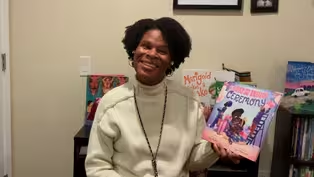
Today we're going to be reading the story, "The Naming Ceremony," written by Seina Wedlick and illustrated, that's the person who drew the pictures, by Jenin Mohammed.
Every good story has a problem and a solution.
A problem is something that goes wrong in the story and the solution is how it gets fixed.
Today as we read this story, I'd like you to think about what could possibly go wrong in a story about a sister who helps choose a name for her baby sister.
Let's get started.
[uplifting music] "Naming Ceremony," written by Seina Wedlick, illustrated by Jenin Mohammed.
Amira is excited.
Today is her baby sister's naming ceremony.
Mama puts a coral bracelet on baby sister's wrists.
"How do I pick a name for baby sister?"
Amira asks.
"Think of something meaningful that you would want her to have.
A blessing, a wish, a story.
Each of your names were carefully picked just for you," says Mama.
"Now, baby sister will also get her own special names," says Amira.
"Yes, just as special as that little dimple in your cheek."
Amira sits quietly for a minute.
"What name do you have for baby sister?"
she asks.
"You'll have to wait and see," says Mama.
"We will start as soon as the baby wakes up."
"When you wake up little one, I will have the perfect gift for you," Amira whispers.
Amira strokes the red coral beads on baby's sister's wrist and looks at her own coral beads.
Mama also received one when she was a baby.
Grandma Nana too.
Amira loves all her family's traditions.
Ding-dong!
Guests!
It is Grandma Nana with the cousins.
The little twins, Onize and or Oricha run past Amira, laughing and giggling.
Mm-hmm.
Amira takes a whiff of the tray of akara.
"What gift do you have for baby sister?"
says Amira with a mouthful of fried beancake.
"Shakira," says Grandma Nana.
Shakira!
Surely baby sister has a lot to be thankful for.
But what if baby sister doesn't like the name she picks?
[gasps] Did you hear the problem in the story?
Me too.
Ding dong!
Amira jumps up and rushes to the front door.
It is Miki.
"Hi Amira!"
"What gift do you have for baby sister?"
asks Amira.
"Akahana.
This means bright red flower.
I picked this for your baby sister from our garden."
Red flower?
What a beautiful name!
Surely baby sister will be just as lovely.
Ding-dong, ding-dong!
It is Uncle Ali, the storyteller.
Boom, boom, boom!
He plays Amira's favorite tune.
She starts to dance and asks, "Uncle Ali, what gift do you have for baby sister?"
"Uhwe," he says with a wink.
Uhwe.
Moonlight.
Everyone knows stories are best told at night.
Surely baby sister will be a wonderful storyteller like Uncle.
Rat-tat-tat.
Uncle Ali plays another tune on his drum.
Soon Onize and Oricha are dancing along to his stories.
Ding dong!
It is her best friend.
"Hi Amira!"
says Tamas.
"What gift do you have for baby sister?"
asks Amira.
"Rubik.
I will teach her how to solve it."
Rubik!
Surely baby sister will be very brilliant.
Shakira, Akahana, Uhwe, Rubik.
Such interesting names.
Amira wonders if she should change her gift.
Will baby sister like the name she picks?
But it is too late to change her gift now because baby sister is awake!
"Baby sister, I have a present for you.
I'll be right back."
Amira hurries to the garden and announces loudly, "Baby sister is awake!
It is time to start!"
She runs to the kitchen.
"Baby sister is awake!
It is time to give her gifts!"
She stops by the playroom.
"Baby sister is awake!"
Amira hurries back.
She does not wanna be late for baby sister's naming ceremony.
The kitchen is empty, the garden is empty.
There is no one at the front door.
Everyone is squashed in the living room.
It is tight and cozy.
"Thank you all for gathering with us today.
We are honored that you have chosen to come and celebrate with us," says Papa.
"The name we have chosen is..." The room is silent.
"Habiba," says Mama.
"Habiba means beloved.
And today, we give Habiba the gift of names."
Amira looks at the room filled with family and friends from all over the world.
Beloved, it is perfect for baby sister.
And so it begins.
Everyone names Habiba until it is Amira's turn.
Baby sister stares at Amira expectantly.
Amira twiddles her fingers together.
Hers is the last gift.
She takes a deep breath.
"I name her Otta.
This means friend.
You will always have me as your friend," Amira whispers to Habiba.
Baby sister smiles her special smile with a little dimple in her cheek.
I love you Otta.
Wasn't that a great story?
Names are so very important and it looks like Amira was worried all along that her name just wouldn't be good enough.
Did you catch that that was the problem in the story?
And in the end, what did she realize?
That names are special and her name was perfect for her baby sister as well.
Today I'd like you to think about your name.
Our names are special too.
My name Isabel means beautiful.
What does your name mean?
Can you ask a friend or a trusted family member what your name means?
Why were you named your name?
[bright music] Hmm.
Hi friends!
It's Isabel and welcome to my learning corner!
Today I'm looking for shortcuts, ways that I can read something faster.
I thought of it!
Today, let's explore the shortcuts of glued sounds.
The glued sounds that I think that I wanna focus on are: ang, ing, ong, and ung.
Are you ready to explore some glued sounds with me?
Great!
Let's get started!
Before we get ready to build some words together, I'd like to get our ears ready to hear the glued sounds in words.
Today we're going to blend the first sound we hear, the onset, with the glued sound we hear or the rhyme, like this.
H-ang.
Hang!
Or s-ing.
Sing!
You got it!
Let's do a few more together.
R-ing.
Ring.
S-ong.
Song.
L-ung.
Lung!
Great job!
We're ready to do some reading.
Let's build some words!
Hi friends.
Before we start reading today, I wanted to talk to you about the shortcut I was looking for.
The shortcut are glued sounds.
Each of these letters will still make their sound, but because the vowel is followed by the N and the G, ng, it's kind of hard to hear all the sounds.
So the shortcut is just to remember that these three letters, when you see them in that combination, are going to say ang, like in fang.
These three letters are going to say... That's right, ing!
These three letters are going to say ong, and these three letters are going to say ung.
If we keep that in our mind, right, ang, ing, ong, ung, when we see words that have those glued sounds in them, then we can read them faster.
So let's try it with ang.
B-ang.
Bang.
[object thudding] Where did that come from?
The power of words.
R-ang.
What's the word?
Rang!
[bell ringing] Did you hear that?
How about if I took this and I made this word?
R-ing.
Ring.
Oh!
S-ing.
Sing!
[ethereal music] S-ong.
Aw.
H-ung.
Hung.
Like I hung those pictures a while ago.
Hung.
Are you ready to read some more words?
Let's go.
Let's read!
Think of our glued sounds for today.
Let's answer a question before we read.
What sounds do these letters make when you see them together?
Ang.
Ing.
Ong.
Ung.
Great job!
Now we're ready to read.
When the word appears on the screen, read it as fast as you can.
If you need to sound out the words as you read, that's fine.
Let's go!
[no audio] [no audio] Did you read all of the words correctly?
Song, fang, wing, sang, lung, king.
You're an awesome reader!
Now it's time to write.
Our last activity of the day is a dictation activity.
So before we get started, go ahead and grab a piece of paper or something to write on and a pencil or something to write with and come right back.
[bright music] Are you ready?
[children cheering] Great!
Today when we write, we're focusing on our glued sounds.
I want you to think about the first sound you hear and our glued sound that will follow it.
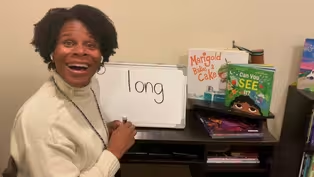
So the word we're gonna be writing today is long.
L-ong.
Let's think.
What are the letters that are going to spell that word?
L. Go ahead and write it.
Ong.
That's right.
Like in song.
Okay, is this what you wrote?
L-ong.
Long.
Great job!
Friends, you have been marvelous today.
And today and every day, I want you to be listening for glued sounds.
They're everywhere and they're a great shortcut to reading!
Until next time, see you later friends!
[bright music] - [Narrator] When babies are raised by both their mom and dad, it's sometimes called co-parenting.
Although this type of family structure is found in several different animal species, it is common in many bird groups.
This type of family structure has its benefits and downsides.
One benefit is that the parents can share the job of finding food and protection.
Taking turns allows the parents to take care of themselves too.
In general, Schmidt's red-tailed monkeys are known for their distinctive heart shaped markings on their nose and are native to Central Africa.
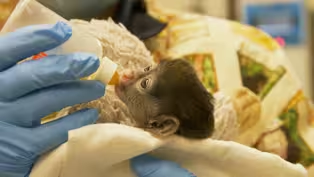
The Houston Zoo is home to six red-tailed monkeys, including the new baby.
[bright music] - Hi everyone!
My name is Sun Kim.
I'm a teaching artist with the New Victory Theater.
I'm also a choreographer and dancer who specializes in popping, one of the many styles of street dance.
Have you seen popping before?
Let me show you.
[panels thudding] [gyrating music] [gyrating music continues] Ooh!
Thank you, thank you.
Wasn't that a cool performance?
I bet we can all dance like that if we try.
Who wants to go first?
Me, you?
Me, me, me, me!
Wait, wasn't that one of the movements that I did in the video?
Can we replay the video?
[gyrating music] That was the movement!
Let's do it together.
Bring your arm all the way out and then you're gonna stop three times as you circle your wrist.
Oh, look at this!
We're so popping!
Wait, I think before I added words.
Can we rewind again?
Me, me, me, me!
Oh right, I was raising my hand and saying, "Me, me, me, me!"
Because I was excited.
But my movement was also showing that I was excited.
That's what I love about dance.
It's its own language.
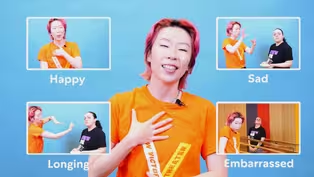
As dancers, we don't need words, we move to express our emotions.
Let's see, how else am I feeling right now?
Aw, how did you know that I was craving a donut?
Mm!
I feel so happy!
I think that's my happy donut dance!
Oh hey, Siobhan!
- Hi Sun!
- Did you see my donut dance?
- I did, and I could really see happiness coming from it.
- Thank you!
If you don't mind, I would love to see your happy dance.
- Okay.
- When do you feel happy?
- Hmm.
- Is it donut for you too?
- Actually, when I take a drink of water 'cause I'm really, really thirsty, that makes me really happy.
- I'm sure it does.
[joyful music] Oh, happy water dance!
Wow, that's fantastic, Siobhan!
I love the shoulder popping!
It reminds me of, wait, where did my donut go?
- Oh wow.
I thought you were done with it so I threw it away.
- Threw it away, you mean it's gone?
I'll never see it again?
- How are you feeling?
- Sad.
I feel sad.
Angry, but mostly sad.
- A sad dance.
- The donut and I had amazing relationship.
It was the best relationship that I ever had.
I miss it so much.
I think my sadness is becoming more longing.
- A longing dance.
All those dances were so beautiful, Sun.
I could really feel what you were feeling.
- Ooh!
Siobhan, I see a game here.
Why don't we add more emotions and see how we can express them through dance?
- Okay, sure!
Like how?
How do we pick them?
- Where do you keep all of your emotions?
A box!
Just like in my performance video.
Ooh, this is perfect.
Can I get a drum roll please?
You draw one at random.
Embarrassments.
Have you ever felt embarrassed, Siobhan?
- Uh-huh.
- Show us!
Express it through dance.
- Oh wow.
That felt great.
What about you, Sun?
- Me, embarrassed?
I don't know.
- Embarrassment dance.
- Expressing your feelings truthfully through words can be challenging.
Sometimes the words don't come out the way you want them to, but through a dance, you can express your emotions however you want, release them, and feel a lot better about them.
Like all of my feelings with the donut.
Sure I was happy than sad, than longing, then embarrassed.
But now that I've gone through all that, my body remembers it so the next time I meet with happiness or sadness or longing or embarrassment, donut or not, I have a safe and fun way to express myself.
Remember, all our emotions are valid and there for a reason.
Jealousy!
So instead of putting them in a box to ignore, love!
Express them through dance and set them free.
Guilt!
However you are feeling, pride!
You are the choreographer of your emotions.
[cheerful music] Have fun and we'll see you next time!
[bright music] - My name is Ashton.
I'm seven years old.
I love to play baseball because it keeps me healthy and strong.
Come check out the ways I like to practice.
First I like to catch.
Then I like to practice my swing but don't forget your helmet!
I'd love for you to come practice with me one day.
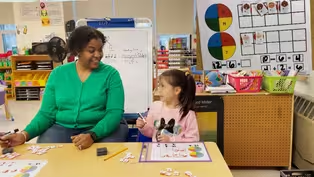
[bright music] - Hello, my name is Ms. Tahese.
I'm a first grade teacher and today I'm going to show you two strategies that we can use when we're adding numbers or subtracting numbers within the number 20.
The first strategy is called make a 10.
And that is what we're going to use when we're adding numbers.
The second strategy is called take from 10 and that's a strategy that we'll use when we're subtracting numbers within 20.
Now in my classroom, my students really enjoy playing with baby dolls and learning about baby animals and it's just babies everywhere.
So what I wanted to do is because they have such an interest in babies, I wanted to extend that interest to math.
And so what I did is I took some counters, the red and yellow counters that we have in our classroom, and I just added little images of babies to it.
Then I made these two mats.
Well, they're double-sided and I'll show you each side.
So this side is gonna be the side that we use for our make a 10.
And as you can see, there are two 10 frames.
There are two places for spinning, that's gonna give us the number we need, and a place to write our number sentence.
Now today when we play our game or do the activity, we are gonna pretend that the 10 frames are cribs since we're working with babies and we wanna put the babies in the cribs to go to sleep.
So that's what we're gonna do when we do our make a 10 game.
When we do our take from 10 game, again, now if you see I have again another two 10 frames, two more spinners with numbers that go up to 14, and then a place to write our number sentences.
In this game, we're gonna pretend that the babies are in the crib sleeping but some of them get up and are hungry and are taken out of the crib to have a snack and we're gonna find out how many babies are left napping.
In order to play both games, whether it's the make a 10 or take from 10, we are gonna need some other items besides our counters.
We are going to need a paper clip and a pencil.
This is gonna serve as our spinner.
So simply we would just put our paperclip here where the black dot is, use our pencil to hold it in place and spin to get our numbers for our number sentence.
Today I'm here with... - Lily!
- Thanks Lily for joining me.
So we are going to start our first activity.
Like I said in the beginning, we are going to do an activity where we're going to make a 10 using the numbers within 20.
So Lily's gonna go ahead and start by spinning on her wheel for her first number.
- Seven.
- Seven.
So we're gonna go ahead and write seven into our number sentence so that we don't forget.
And then Lily's gonna go ahead and add those babies to the crib.
Go ahead, Lily.
- I'm gonna put five in the top.
'Cause I know that five is half of 10, so it probably would be five in the top.
And I count on.
Six, seven.
- Awesome.
Now Lily's gonna spin to see how many babies need to go into our second crib.
- Four.
- Four, awesome.
Let's add some babies to that second crib.
- And I'll just put one less from the top, from the full one because I know that it's five.
- Some of us already know what seven plus four is, but instead of just knowing it, right, we can come up with a strategy.
And like we said, our strategy today is make a 10.
So Lily is gonna show us now how we would make a 10.
So Lily, if we wanna make a 10, how many babies are we gonna take from our second crib and put 'em into the top crib?
- Three.
- Three.
Okay.
And so now Lily, what would be our new number sentence starting with our top crib?
- It would be 10 plus one.
- Great.
And what does 10 plus one give us?
- 11.
- 11.
So that means if 10 plus one is 11, then seven plus four must be... - 11.
- Right, because we didn't get rid of any babies, right?
And we didn't add any more.
We're still the same amount.
We just moved the way that they are in the crib.
So now that we've done our make a 10, we're going to do another strategy, our take from 10.
And this again, like I said in the beginning, is what we use when we're subtracting numbers within 20.
So we are going to flip our boards over because as I told you, we have it on both sides.
Okay.
And we are going to get started.
So Lily's gonna spin.
- 12.
- 12.
- Fill up one of a 10 frame because it's a 10 frame, you know that there's going to be 10 in there if you fill up the 10 frame.
- [Ms. Tahese] I agree with you Lily, thank you so much.
- [Lily] And then we know how many two is so we can just put in two.
- Yeah.
So in this story, Lily, in our first story we had babies in two cribs sleeping.
With this story, we had babies also in the crib, two cribs.
But now they wanna get up 'cause they're hungry.
So we're gonna figure out how many babies are gonna end up leaving this crib.
So Lily's going to spin to find out, oh, let's write that down, first you write it, Lily.
So let's write 12.
'Cause that's how many babies we have sleeping right now.
Now we're gonna spin and find out how many babies are gonna be waking up and leaving the crib.
- Six.
- Six, okay.
Now when we are doing a take from 10, we wanna look at which crib already has 10 babies in it, right Lily?
So which crib are we gonna take the babies from?
Which crib already has 10 babies in it?
- This one.
- Alright, how many are we gonna take from there?
- Six.
- So let's do that.
- Take away the first five.
Take away one more.
- Great.
So now that we've done that, let's write what we just did in our number sentence over here just to be sure that we don't forget.
So what did we just do?
- 10 minus six.
- 10 minus six.
Which gives us how many, so how many babies are left in our top crib?
- Four.
- Great.
But now we still have some babies in that second crib, they're still sleeping.
So we're gonna figure out how many babies we have in all that are still sleeping.
So we're going to add our top crib to our bottom crib.
All right, so what's our number sentence, Lily?
- Four plus two.
- [Ms. Tahese] Okay.
- [Lily] Equals six.
- So if four plus two equals six, that means 12 minus six must equal... - Six.
- Six.
Great.
Alright, I really like this game, Lily.
Thanks for joining us today.
Bye!
- Bye!
[bright music] - Hi, my name is Dr. Carr and I'm a helper.
I am very proud of my job because I get to help you feel better.
I'm a doctor.
My job is to help you feel better when you are sick or if you get injured.
I'm going to tell you a little more about how doctors like me help.
When I go to work, I wear scrubs or a lab coat.
They have these great pockets to hold all of my tools.
You may also see me wearing gloves.
Don't worry, gloves are just to make sure we don't spread any germs.
I have a lot of other tools to help you during a doctor's visit or a medical emergency.
Let's check 'em out.
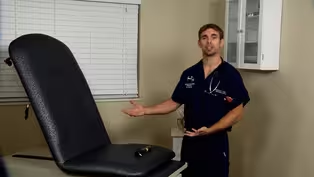
When you visit me, you may be in a room like this.
A few tools that help me with my job are: an examination table or bed.
This is a little different than the beds or tables you have at your home.
This allows you to sit up high so I can examine you.
My stethoscope.
This lets me listen to sounds in your body like your heartbeat or your breathing.
My otoscope.
This helps me check your ears and your nose.
Doctors also use many different kinds of medicine to help you feel better.
In an emergency, we might not be able to talk right away, but I want you to know that I will make time to talk with you and your parents to explain everything.
When we talk, I may need to ask you some questions like, how are you feeling?
Or where are you hurt?
I might also ask you to explain something that happened so I know how to help you.
It's okay to tell me that you feel upset, hurt, scared, or angry.
I like to listen to you and you can tell me the truth.
You can help me by listening to instructions and by answering my questions.
The hospital may seem scary at first, but everything we do here is to help you.
If you have any questions about my tools or a plan to make you feel better, you can always ask.
So what's my job?
To keep you healthy.
What's your job?
To be healthy.
- Hi, my name is Ceucynth, my husband Roberto and I have three kids, Ian, Zoe and Lucas.
My kids and I love to read together.
The kids are in different reading levels, but we make it fun for all of us.
We put the phones away, we each choose a book, and read for 20 minutes and then we talk about it.
- A paper of himself?
- Yeah, like a paper of himself.
- [Ceucynth] Another activity we love is having one of the kids reading for all of us.
- The falls are beautiful.
- [Ceucynth] We act out characters to make it fun.
- There can be no spring.
- It's great when the kids can help each other.
- Ian, do you know what council means?
- Council?
- [Ceucynth] I love to encourage them to discuss the story.
What do you think is happening?
- Lakes will never melt.
- Okay.
- And neither will the ice.
- [Ceucynth] Reading is so wonderful because it's a way that we can be together and make a connection, have a fun time, and we learn from each other.
[bright music] - Hello.
- How you doing today?
- Great!
- Awesome.
Good.
I'm happy to hear that.
So one thing that I love most about the Brooklyn Preschool of Science is the animals.
There are different lizards, there are geckos, bearded dragons.
What else?
- Crab and a hamster.
- Hamsters, hermit crabs.
There are Madagascar hissing cockroaches, Guinea pigs.
Even a giant bunny.
Yeah!
- Yeah and there's a gecko.
- Yes, that's right.
So today I am going to take out some of these awesome animals.
Sahil, if you want to, you can pet them, you can hold 'em, maybe even put them on your head.
- What?
I don't like to.
- You don't have to.
I was just being silly.
Are you ready?
- Yeah.
- I'm gonna take out my first animal.
- What is it?
- Let's see.
My first animal, her name- - A skink!
- Is Einstein.
- And it's a skink.
- That's right.
Einstein is a blue-tongued skink.
Comes from Australia.
- I'm petting her.
- Good job.
How does she feel?
- Good.
- She feels good?
Here look.
Go right down the body.
Oh, you're being so gentle.
Thank you.
She is covered in scales.
- Scales.
- Yeah, she's covered in scales.
And she is coldblooded.
- Coldblooded.
- Yes.
And you know what?
Like most reptiles, she hatched from an egg.
- [Sahil] I just saw her tongue out.
- [Krystal] Yeah, she's sticking out her tongue.
What color is her tongue?
- Blue.
- That's right.
Do you know that in the animal kingdom, do you know what she does?
- [Sahil] Yeah.
- Colors can signify poison.
So if she's out somewhere walking around and there's a predator close by, do you know what she'll do?
- Yeah.
- She will stick out her blue tongue.
She'll go, "Na-na-na-na-na-na-na!"
And the predator says [gasps] "That animal has a blue tongue!"
- Na-na-na-na-na-na-na!
- Yeah, just like that.
And the predator says, "You know what?
That animal might be poisonous so I'm not going to eat her."
- No.
- Yeah.
And the skink gets to live another day.
- Yeah.
- Can you say hooray for the skink?
- Hooray!
- That's right.
So we have this awesome, awesome animal here.
And now I'm gonna show you another animal.
Are you ready?
- Yeah!
- And... - The turtle.
- Yeah, we have our box turtle.
Can you say hello box turtle?
- Hello box turtle.
- Yes, that's right.
Look, he has his house.
His whole house is right here.
- The shell?
- Yes.
And look, just like the blue-tongued skink, he has scales.
- Scales.
- He's coldblooded.
- Coldblooded.
- Yes.
And like most reptiles, hatched from an egg.
I'm gonna take out another animal.
Are you ready?
- Yeah.
- For the next animal?
- Yeah!
- Okay.
- Right there.
- Put this tank on the table like this.
One, two, oh!
One, two, three.
Got him this time.
Yes, this is my gerbil.
Can you say hello gerbil?
- Hello gerbil.
- Yes.
Now can you please take one finger?
Can you pet the gerbil for me?
How did she feel?
- Soft.
- She felt soft.
I have a question.
The gerbil, does the gerbil feel like the other animals?
No.
- No?
No.
This gerbil, is it covered in scales?
- No!
- That's right!
Look at this.
She's so hairy.
- Yeah.
- She's covered in fur and she's nice and warm.
- Yeah.
- She's warm blooded.
- Yeah.
- Yes.
Warm blooded.
Hey, this animal here, this gerbil, it's a mammal.
Can you say that?
Can you say mammal?
- Mammal.
- Yeah.
Mammals, they're warm blooded and they're covered in fur.
Do you want to pet her?
Would you like to hold her?
- No.
- No?
Okay.
Do you wanna say see you later to the gerbil?
- See you later.
- Alright, good job.
So the gerbil is a mammal, yes.
Are the other animals, the skink and the box turtle, are they mammals?
- No.
- No?
- No.
The skink and the turtle are not.
- Do you know what they are?
- Yeah.
- What are they?
- The turtle's walking!
- Yes.
Can you say reptiles?
- Reptiles.
- Yes.
Reptiles.
Unlike the gerbil, you see they don't have any hair.
- Nah.
- No.
They have scales.
- Scales.
- And they're cold blooded.
- Cold blooded.
- Yes.
Good job.
Look at the chart paper behind me.
On one side, look at the top.
It says reptiles.
- Reptiles.
- On the other side, mammals.
- Mammals.
- I have some pictures here.
Sahil.
- Yeah?
- I'm going to show you these pictures, okay?
And you tell me where I should place the picture.
Should I place it under a reptile or mammals.
Are you ready?
Well, not just yet.
I'm gonna tell you when.
I'll show you the picture first and then you tell me where it belongs, okay?
So remember, reptiles, covered in scales, hatch from eggs, and they're cold blooded.
Mammals, covered in fur.
Right?
They're warm.
- Warm.
- That's right.
And they did not hatch from an egg.
- They don't.
- No.
Are you ready?
I'm gonna show you your first picture.
Are you ready?
- Yeah.
- Friends at home, are you guys ready?
- Yeah.
- You think they're ready?
Okay.
First picture.
What is this guy?
A bunny rabbit.
- Bunny rabbit.
- Yes, bunny rabbit.
Hmm.
Where should I put the bunny rabbit?
Should I put it- - On this side.
- Way to go!
Gimme five.
You're awesome.
Because that's a mammal.
Okay, you ready?
What's next?
- Yeah.
- And whoa.
Bearded dragon!
- What is it?
- It's a bearded dragon.
- Yeah.
- Yes, covered in scales, cold-blooded, hatched from an egg.
Where should I put this guy?
- Good job, buddy.
He is a reptile.
Awesome.
Are you ready for the next?
Leopard gecko.
- Leopard gecko.
- Yeah, leopard gecko.
Where should I put the leopard gecko, do you think?
Gimme five.
You're so awesome.
Can you say reptile?
- Reptile.
- Good job.
All right, let's see what's next, okay?
- Yeah.
- Look at this cute little guy.
Where does this hamster go?
- Here.
- Good job.
Can you say mammal?
- Mammal.
- There you go.
You're doing such a great job, buddy.
Let's see what's next.
- A turtle.
- Yes.
Where should I put the turtle?
Good job.
Can you say reptile?
- Reptile.
- You're amazing.
Aw, cute little kitten!
- The kitten!
- Aw.
Where should I put it?
Oh, let's look at it again.
There are no scales.
- No scales?
- Yeah, no.
It's covered in fur.
So where should I put this guy?
He's not a reptile.
He's a mammal.
- A mammal.
- Yeah, that's right.
This little hairy guy is a mammal.
This one might be a little tricky.
Are you ready?
But we're gonna think about it, okay?
- Yeah.
- Who's this?
- Me!
- Sahil!
Wait a minute, are you a reptile or a mammal?
Think about it.
What do you have on the top of your head?
- Hair.
- Yes, that's right.
No scales.
- No scales.
- Where should I put this guy?
No, these guys are all covered in scales.
- Yeah.
- You're a mammal, bud.
- Yeah.
- Okay.
- I'm a mammal.
- That's right.
And there's one more to go.
You ready?
- Yeah!
- Let's see who is, it's Miss Krystal!
- Yeah!
- Where should I go?
Where do I belong?
Where do you think?
- Here.
- What?!
I go right here with you, buddy.
Remember, we are warm-blooded, right?
- Warm blooded.
- That's right.
Covered in hair.
Can we say to our friends at home, see you later mammals?
- See you later mammals.
- Bye-bye now.
- Bye-bye now.
- See you next time.
- See you next time.
[Ceucynth speaking in Spanish] [Ceucynth speaking in Spanish] [Ceucynth speaking in Spanish] - Like a paper of himself?
- Yeah, like a paper of himself.
[Ceucynth speaking in Spanish] - The falls are beautiful.
[Ceucynth speaking in Spanish] - There can be no spring.
[Ceucynth speaking in Spanish] - Ian, do you know what council means?
- Council?
[Ceucynth speaking in Spanish] - What do you think is happening?
- Lakes will never melt.
- Okay.
- And neither will the ice.
[Ceucynth speaking in Spanish] - [Presenter] Funding for this program was provided by the JPB Foundation.
[bright music] [bright music continues] [bright music continues] [bright music continues] [bright music continues] [upbeat chime]
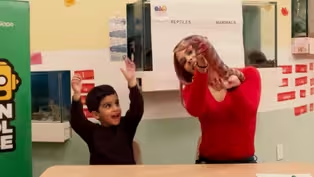
ARE YOU A REPTILE OR A MAMMAL?
Video has Audio Description
Explore the differences between mammals and reptiles. (8m 58s)
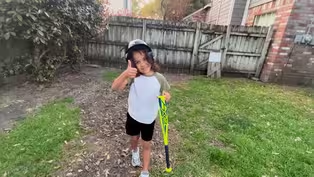
ASHTYN PLAYS BASEBALL TO STAY HEALTHY AND STRONG!
Video has Audio Description
Ashtyn plays baseball to stay healthy and strong! (41s)
Video has Audio Description
Meet a baby monkey who lives at the Houston Zoo. (47s)
Video has Audio Description
Tahese Warley teaches strategies for adding and subtracting numbers 1-20. (7m 39s)
Video has Audio Description
Sun Kim from New Victory shows how to express your feelings through dance. (6m 37s)
GLUED/WELDED SOUNDS: ANG, ING, ONG, UNG
Video has Audio Description
Explore glued and welded sounds "ang", "ing", "ong" and "ung" with Isabel Simmons. (8m 55s)
Video has Audio Description
Meet a doctor! His job is to help people feel better when they are sick or injured. (1m 55s)
Video has Audio Description
Isabel Simmons reads THE NAMING CEREMONY, by Seina Wedlick and pictures by Jenin Mohammed. (8m 25s)
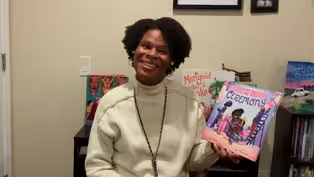
Video has Audio Description
Isabel Simmons reads THE NAMING CEREMONY, by Seina Wedlick and pictures by Jenin Mohammed. (8m 25s)
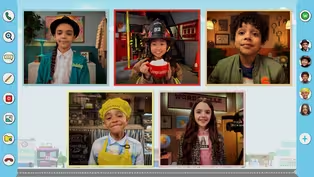
WORDSVILLE: THE CASE OF THE UNCOMPROMISING COMMUNITY
Video has Audio Description
No one in Wordsville can agree after Firefighter Ember's "compromise" mug goes missing. (7m 24s)
Providing Support for PBS.org
Learn Moreabout PBS online sponsorship















Support for PBS provided by:
Let's Learn is a local public television program presented by THIRTEEN PBS