
December 8, 2025 - PBS News Hour full episode
12/8/2025 | 56m 45sVideo has Closed Captions
December 8, 2025 - PBS News Hour full episode
December 8, 2025 - PBS News Hour full episode
Problems playing video? | Closed Captioning Feedback
Problems playing video? | Closed Captioning Feedback
Major corporate funding for the PBS News Hour is provided by BDO, BNSF, Consumer Cellular, American Cruise Lines, and Raymond James. Funding for the PBS NewsHour Weekend is provided by...
December 8, 2025 - PBS News Hour full episode
12/8/2025 | 56m 45sVideo has Closed Captions
December 8, 2025 - PBS News Hour full episode
Problems playing video? | Closed Captioning Feedback
How to Watch PBS News Hour
PBS News Hour is available to stream on pbs.org and the free PBS App, available on iPhone, Apple TV, Android TV, Android smartphones, Amazon Fire TV, Amazon Fire Tablet, Roku, Samsung Smart TV, and Vizio.
Providing Support for PBS.org
Learn Moreabout PBS online sponsorshipMe.
Good evening.
I'm on the Nevadas.
Geoff Bennett is on assignment on the NewsHour tonight, the Supreme Court hears arguments on a major test of the president's power over independent agencies.
European leaders rally around Ukraine after the United States appears to shift its national security strategy to favor Russia, and researchers find some of the highest rates of mental decline in a population that's long been one of the most difficult to study Native Americans.
Native Americans are very hesitant about volunteering for these types of things, and that comes historically from studies that were involuntary and done on Native American people.
Major funding for the PBS NewsHour has been provided by the ongoing support of these individuals and institutions, and friends of the NewsHour, including Leonard and Norma glorified, and the Judy and Peter Bloom Koffler Foundation.
In 1995, two friends set out to make wireless coverage accessible to all, with no long term contracts, nationwide coverage, and 100% US based customer support.
Consumer Cellular Freedom calls.
And with the ongoing support of these individuals and institutions.
This program was made possible by the contributions to your PBS station from viewers like you.
Thank you.
Welcome to the NewsHour.
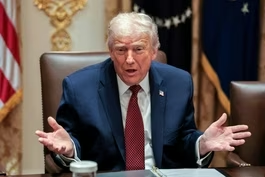
The Supreme Court heard arguments today and a legal case that could vastly expand presidential powers.
At stake are 90 years of precedent that have kept presidents from being able to remove members of independent government agencies.
The case looks at whether President Trump acted legally in firing Rebecca Slaughter, a Democratic member of the bipartisan Federal Trade Commission, saying her service was inconsistent with Trump administration priorities.
Slaughter sued, arguing the commissioners can only be fired for inefficiency, neglect of duty or malfeasance.
Today, Trump administration lawyers argued that gives agencies too much power and continues to tempt Congress to erect.
At the heart of our government, a headless fourth branch insulated from political accountability and democratic control.
But liberal justices warned about the impact this could have on the balance of power.
You're asking us to destroy the structure of government and to take away from Congress its ability to protect its idea that a the government is better structured with some agencies that are independent.
Joining me now to discuss today's arguments is the NewsHour Supreme Court analyst, Amy, how?
She's co-founder of SCOTUSblog.
Good to see you, Amy.
Good to see you, too.
So let's set the table here.
Rebecca Slaughter was actually first appointed by President Trump in 2018, reappointed by President Biden, fired by Trump in March.
The Trump administration called the legal precedent that usually protects people like her from being removed.
A decaying husk.
What's behind that legal precedent that's protected people like slaughter?
So this is a decision that dates back to 1935 and in fact, involves very similar facts.
FDR SR wanted to fire a commissioner of the Federal Trade Commission, in no small part to put his own people in the job.
The commissioner resisted.
He eventually was fired, went to court, and the Supreme Court in that case upheld the same removal statute that is at the center of this case.
It said Congress enacted these removal statutes precisely because it wants agencies like the FTC to be independent, and it isn't infringing on FDR executive power because the agency doesn't exercise substantial executive power.
And so the Trump administration here is arguing that the president should be able to fire whomever he wants.
Exactly.
It rests on something that's sometimes known as the unitary executive theory, which is the idea that the president is in charge of the executive branch and has complete control over that.
And that as part of that exercise of power, he needs to be able to remove anyone in the executive branch without being subject to these restrictions to carry out his duties.
So we heard from Justice Sotomayor there saying that this is about the rebalancing of power.
It takes Congress's power away and gives it more to the president, reshapes the government.
What about the conservative majority on the court?
How did they look at this issue?
When are they likely to rule in Trump administration's favor?
So they had a different set of concerns.
They were concerned that under Rebecca Slaughter's theory, Congress could, in essence, take executive departments like the Department of the interior, the Department of Agriculture out of the executive branch and make them independent multi-member agencies like the FTC, over which the president would then have limited control.
Because of these removal restrictions, Justice Brett Kavanaugh suggested that this would be sort of an end run that could thwart presidents ability to carry out their policies, because Congress could, for example, have a removal statute like this and enact long terms for the members of these agencies so that they no one president could have all of the appointees on the commission at once.
And the president wouldn't be able to fire them, and they could resist carrying out the president's policy initiatives.
As we pointed out, as you've noted, the FTC is a bipartisan five member independent agency.
If the court rules in the Trump administration's favor, is the impact just going to be felt by the FTC here?
Well, that was part of the debate today.
There are roughly two dozen other independent agencies that have similar removal statutes.
And the liberal justices in particular pressed John Sauer, the solicitor General.
You know, where would your logic go?
How far would it extend?
And it seems likely that it would apply to a lot of these independent agencies, like the consumer safety, Protection Commission and the National Labor Relations Board, the Merit Systems Protection Board.
And the question is really, how far will it go?
There are also a courts in which the judges don't have life tenure and have similar removal provisions, as well as the Federal Reserve Bank, as you mentioned, they're not unrelated here.
Next month, the justices are going to hear arguments in President Trump's decision to fire Federal Reserve Governor Lisa Cook.
Did you hear anything today that leads you to believe that they could rule one way or the other when it comes to that case?
Not a whole lot that the Solicitor General, John Sauer, said, well, of course, the fed is different when it comes to the Federal Reserve Board's for cause removal provision that the president is seeking to fire Lisa Cook, one of the Fed's board of governors.
Essentially for cause he has made allegations of mortgage fraud and said that she should be removed from the fed for that reason.
Cook has, of course, hotly disputed those allegations.
Another big day at the Supreme Court.
Amy Howe, co-founder of SCOTUSblog.
Always great to have you here.
Thank you.
Thank you.
We start the day's other headlines with a brewing bidding war for Warner Bros.
Discovery.
Paramount.
Skydance launched a hostile all cash offer directly to the company's shareholders, valued at some $108 billion.
It comes just days after Netflix agreed to a $72 billion deal to buy the company's TV, movie studio and streaming assets.
Paramount's counteroffer would buy those businesses, plus CNN, among others.
Paramount is run by the Ellison family, which has close ties to President Trump, and its offer includes financing from Affinity Partners, the investment firm run by Trump's son in law, Jared Kushner.
President Trump's former personal lawyer, Elena Harbor, resigned today as acting U.S.
Attorney in New Jersey.
Her announcement comes a week after an appeals court found she'd been serving in the role unlawfully.
In a social media post.
Job said she's stepping down, quote, to protect the stability and integrity of the office, which I love adding quote but do not mistake complies for surrender.
Harbor says she'll remain with the Justice Department as a senior advisor to Attorney General Pam Bondi.
Late night host Jimmy Kimmel has signed a one year contract extension with ABC.
The comedian was briefly suspended in September amid backlash over comments he made about the assassination of conservative activist Charlie Kirk.
Kimmel's current contract was due to expire next May, meaning he's now due to stay on the air through May of 2027.
Turning overseas now, Syria has been marking one year since a swift rebel uprising toppled dictator Bashar al-Assad, ending decades of his family's iron fisted rule.
Of the thousands of jubilant Syrians gathered in the capital city of Damascus, where officials put on a parade of tanks, helicopters and other military hardware.
But behind the ceremonial show of force, many Syrians remained guarded about the future, especially when it comes to their basic needs.
Considering me and Eman, the situation is 50% better.
There's security and we can go anywhere comfortably.
But some things are still lacking.
Like financially, for example, there's no supply and things have become more expensive and people are raising the prices and remarks.
Today, Syrian President Middle Middlesborough announced that, quote, victory is only the start.
The former al-Qaida commander pledged a new chapter for the nation, saying his government would help to rebuild the country.
The Christian Association of Nigeria says that 100 students who were abducted last month have been freed, though more than 100 others remain in captivity.
Gunmen attacked the Catholic school in Niger State on November 21st, seizing more than 300 schoolchildren and a dozen of their teachers.
50 escaped shortly afterward.
Video from today shows the newly released children arriving at the state Government House, where they were expected to be reunited with their families.
It's not clear how they were freed or if any arrests were made, and no group has claimed responsibility.
In Japan, at least 23 people were injured after a powerful 7.5 magnitude earthquake struck off the country's northern coast.
Alarm sounded as the quake hit around 11 p.m.
local time.
Officials reported one tsunami of up to 28in and ordered evacuations for 90,000 people amid wider tsunami warnings, which were later lifted.
Japanese officials say there could still be aftershocks in the coming days.
Thailand and Cambodia are accusing each other of breaking their cease fire as new clashes reignited the country's long standing border dispute.
Thailand says it bombed Cambodian targets after a Thai soldier was killed in cross-border fire.
Cambodian officials say at least four civilians have been killed in the latest violence.
Tens of thousands, meanwhile, have fled their homes in both nations seeking shelter in bunkers or sprawling evacuation sites.
The Thai prime minister vowed to proceed with what he called appropriate measures for the Thai maker.
Thailand never wants to see violence.
We insist that Thailand has never initiated the clashes or encroached into their land whatsoever.
But Thailand will not stand for its sovereignty being violated.
Cambodia's prime minister called for his country to, quote, unite for the cause of the nation during this difficult period.
President Trump says he'll allow Nvidia to sell its H 200 chips to what he called approved customers in China and other countries.
In a social media post.
Trump also said the US government would get a 25% cut of future sales of the chip.
The announcement is a win for Nvidia CEO Jensen Huang, who has been pressing the white House for such access to China's market.
But critics worry the chip would help China to compete with the US in artificial intelligence.
This comes as China's trade surplus has surged past the $1 trillion mark for the first time ever.
That's according to new data out today.
And it comes despite a continued drop in shipments to the U.S.
amid ongoing trade tensions between the two countries.
Instead, China is selling more goods to places like Southeast Asia, Europe and Africa.
The meantime, on Wall Street, stocks pulled back from recent highs.
The Dow Jones Industrial Average slipped more than 200 points.
The Nasdaq gave back about 30 points.
The S&P 500 also ended in negative territory, and a three year old Indian boy has become the youngest player in chess history to earn an official rating.
Saroja Singh Kushwaha surpassed the minimum requirement at the age of just three years, seven months and 20 days.
He broke the previous record by about a month by winning five of his eight rated matches, according to local media.
The toddler, who's still in nursery school, enjoys playing chess up to five hours a day.
Still to come on the NewsHour, some Indiana Republicans resist white House calls to redraw their congressional maps.
President Trump proposes $12 billion in aid to farmers hurt by the tariffs.
And Tamara Keith and Amy Walter break down the latest political headlines.
This is the PBS NewsHour from the David M Rubenstein Studio at Weta in Washington and in the West, from the Walter Cronkite School of Journalism at Arizona State University.
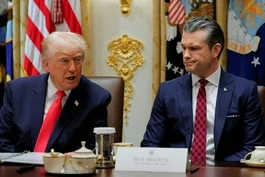
A European official tells PBS NewsHour that Ukraine and its European allies will present new edits to an American peace proposal by tomorrow.
The U.S.
has been pursuing a solution to the war in Ukraine, and recently highlighted those efforts as part of its new national security strategy.
That shifts historic U.S.
language on Europe.
Nick Schifrin examines that document, but begins his report in eastern Ukraine, where Kiev is struggling to hold the line.
In eastern Ukraine, it's a fight against time.
Soldiers patrol the city of Konstantinov, under siege and under nets designed to protect from Russian drones.
The battle is now street to street.
Nearby Russian soldiers post their own drone videos, hunting Ukrainian positions.
32 year old Demetrios, like every soldier here, exhausted but determined to resist military and diplomatic pressure.
Not a course is.
I count every centimeter of the motherland as important, and we don't plan to give it up just like that.
Faster than 2000 1300 miles away.
Today, Western European leaders who share that determination rallied around Ukrainian President Volodymyr Zelensky last week.
These leaders allegedly said in private the U.S.
might betray Ukraine.
Today, they tied their own security to Ukraine's.
We are still and remain strongly behind the crisis and giving support to your country, because we all know that this is the destiny of this country for destiny here.
I'm skeptical about some of the details which we are seeing in the documents coming from the US side.
That skepticism over a U.S.
peace proposal and security guarantees negotiated with Ukraine.
A European official tells PBS NewsHour.
The US is still pushing Ukraine to give up the portion of the Donbas region that it controls, and that Russia has failed to capture through 11 years of war.
That territory would be internationally recognized as Russian, but demilitarized.
On that, Zelenskyy said there was no agreement telling Bloomberg today, quote, there are visions of the U.S., Russia and Ukraine and we don't have a unified view on Donbass.
Zelenskyy says he needs the U.S.
and Europe to work together between Europe and the United States.
The Russians they choose, we can't manage without Americans, things which we can't manage without Europe.
But the White House's new national security strategy flips the traditional script on Europe.
It reads it is a core interest of the United States to negotiate an expeditious cessation of hostilities in Ukraine in order to stabilize European economies, prevent unintended escalation or expansion of the war, and reestablish strategic stability with Russia.
And it warns of European civilizational erasure.
The larger issues facing Europe include activities of the European Union and other transnational bodies that undermine political liberty and sovereignty.
It is far from obvious whether certain European countries will have economies and militaries strong enough to remain reliable allies.
This weekend, Moscow agreed to correct the corrections that we see correspond in many ways to our vision.
So there is reason to hope this could be a modest guarantee that constructive joint work on finding a peaceful settlement for Ukraine, at a minimum, can continue.
Producers for perspective on the White House's national security strategy, we get two views.
Heather Conley was deputy assistant secretary of state for European affairs during the George W Bush administration, and is a nonresident fellow at the American Enterprise Institute, a Washington think tank.
And Dan Caldwell was an adviser to Defense Secretary Pete Hegseth.
He was in the Marine Corps and has worked for a member of Congress and think tanks that focused on veteran and defense issues.
Thanks very much to both of you.
Welcome to the NewsHour.
I just read you in that story, the Language on Europe calling for strategic stability, with Russia accusing the EU of undermining, political liberty and warning of European civilizational erasure, and that Europeans might not be strong enough to remain reliable allies.
Dan Caldwell, is that the right language?
Well, I just want to point out the document says something else that says that Europe is strategically vital to the United States.
Document makes clear that we want to be partners with Europe.
However, Europe can't be effective partners to us if they continue their economic, military and cultural decline.
If they keep going down the path that they are.
They will not be partners.
They'll be dependents and free riders, and that's in no one's interest.
On the question of Russia and pursuing strategic stability.
I think that's in the interest of the United States in Europe, because instability leads to a risk of a war, and a war as a nuclear power like Russia is, again, in no one's interest.
So either can we take that, taking that thought on European decline, but also strategic stability is in US interests with Russia.
I mean, I agree with Dan.
The document is clear.
We are concerned about Europe's economic competitiveness.
Certainly many American presidents have been concerned about low European defense spending.
But President Trump in the letter before the security strategy, says, hey, look, they've agreed to do 5%.
It is exactly though the message about the cultural erasure, that Europe's democracies, they have political parties, and we're putting our thumb on particular parties that the current administration agrees with on strategic stability.
It is Russia that over the past 15 years has violated basically every international arms control agreement that we have had.
And even the Trump administration has acknowledged those violations.
To achieve strategic stability is to do that with our allies, to present again peace through strength, the strength of a strong nuclear deterrence, a strong military defense.
And then we can come to the table.
But Russia has to be transparent, and they have been anything but transparent.
Daron Caldwell, strategic stability with Russia, with Europe rather than despite Europe respond to that.
Well, again, in the document, it actually gets in this as well too is the way to achieve that is first and foremost got it.
And the Ukraine war.
And it's going to be a messy process.
And it's not going to be a peace that ultimately gives Ukraine everything it wants.
But it's going to be a decent peace and give a peace that hopefully allows Ukraine to exist as a sovereign country with a path to prosperity.
So I think that's important.
But also to, again, as the document points out, is that Europe has tremendous power and that they can do a lot more themselves to ultimately deter and contain Russia.
And so that's an important part of this too, is that they need to take up more of the burden in dealing with the security challenges in their own backyard, primarily those dealing with Russia and the economy.
This is a fundamental difference between the United States government that now sees the future with Russia as strategically stable, and a Europe that generally sees Russia as the adversary beyond the war in Ukraine.
Right.
Exactly.
And this is how this war ends, or how it temporarily is paused.
That is what's going to create the strategic stability.
And if the United States, rather than being, again, on the side of our European allies, pressing for sovereignty and territorial integrity, something that the national security strategy continues to emphasize.
Well, Russia has violated that for the last 11 years, creating the instability in Europe.
Europe is stepping forward.
They're doing more.
But if we're if we if we're the bridge, if we're moderating between these two, that means we are not firmly on the side of sovereignty, territorial integrity and standing with our allies.
Let me, switch to Latin America here, because a significant portion of the document is dedicated to Latin America, and the United States is southern border.
And it includes this language, a reference to a 19th century opposition to European colonialism in Latin America.
Quote, the United States will reassert and enforce the Monroe Doctrine to restore American preeminence in the Western Hemisphere.
And this now is a reference to China and Russia.
We will deny non hemispheric competitors the ability to position forces or other threatening capabilities or to own or control strategically vital assets in our hemisphere.
This Trump corollary to the Monroe Doctrine is a common sense and potent restoration of American power and priorities.
Dan Caldwell, what's your response to that language?
Ultimately, at the end of the day, there are more vital national interests in the Western Hemisphere than there are anywhere else in the world.
What happens in our own hemisphere is, frankly, more important than who controls the Donbas, or who controls eastern Ukraine?
Yes.
And who controls the Anbar desert in western Iraq?
Yes.
So I think that it is it is a great thing that this administration is making clear that the Western Hemisphere is our top priority now.
Again, I want to also point something out, that does not mean that every single national security resource, whether it's our diplomatic efforts, whether it's a military effort to other parts of soft power, is going to be solely focused on the Western Hemisphere.
And again, I think the document makes that clear.
I mean, disappointed to see is that that's been kind of the framing that you've seen leading up into the release of this document and the coming release of National Defense Strategy.
And so, again, I for most of our history, the Western Hemisphere was where we were mostly focused, and the Monroe Doctrine was our most important foreign policy doctrine.
And over time, as the world has changed, the United States has had to do different things.
But because of of where we focused and because we've been distracted by things overseas that aren't necessarily core to our safety and prosperity, I do think that we have neglected the Western Hemisphere, too much.
And I'm glad to see the president change that.
Heather Connolly, we've been distracted as well, just said, is that right?
Well, I think for the last 20 years, yes, we have been overly concentrating on the Middle East.
And that in some ways, the first Trump administration's 2017 national security strategy reset that balance and said, we have great power competition.
Our adversaries are Russia and China.
This strategy takes us in a very different direction.
It returns us back to the 19th century to spheres of influence.
But I think what it doesn't tell us is what those modern national security threats are.
The document is silent on North Korea's construction of intercontinental ballistic missiles that can reach the United States or Russia, Russian hypersonic cruise missiles.
That's why we're building Golden Dome, which is prominent in the doctrine.
So when we have this sphere of influence, that's exactly why the Kremlin just said, this is wonderful because they want to create a sphere of influence.
So does China.
Heather Conley, Dan Caldwell We'll have to leave it there.
Thanks very much to you both.
Thank you.
Thank you.
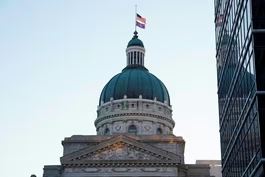
The Indiana Senate today convened to debate the possibility of redrawing state congressional maps ahead of the 2026 election.
The new proposed map would likely give Republicans two additional seats.
And President Trump is highly invested in the outcome.
Our white House correspondent, Liz Landers, has been watching all of this and joins me now.
Good to see you, Liz.
Thanks for having me.
It's a little unusual here, right, because the Indiana Senate leaders first said they would not consider redistricting, that they didn't have support.
They then reversed course.
So what happened?
Well, this mid-cycle redistricting has now been moving through the Indiana State House for about the last week or so today.
It hit the Senate Election Committee, where they were debating this for several hours.
We heard from the public people speaking in opposition to this.
Also people speaking in in support of redistricting in Indiana last week.
This passed out of the Indiana House and it passed with an overwhelming majority.
And this new congressional map would redraw the current Indiana map.
Right now, the Indiana state delegation is made up of seven Republicans, two Democrats who represent them in Congress.
This redrawing of the map would redraw it so that it would be nine likely Republican districts, and no Democratic districts.
And the way that this would happen is dividing Indianapolis, the capital city, into four of these different districts, so diluting some of their, voting power there.
I spoke with the former Republican mayor of Indianapolis, Greg Ballard, on the phone last week.
He said to me he's opposed to this.
He also thinks it's a bad idea because it will, fray the community there and dilute the voting power of the folks in Indianapolis.
So this week, all eyes are now on the Senate.
The Senate president pro tem, Roger Bray, he is opposed to this redistricting effort in Indiana.
And he says that he thinks that there could be unintended consequences down the line.
For Republicans trying to consolidate power there and even other Republicans who do support this.
Senator Ron also saying he backs this, he also doesn't think that this is going to pass out of the Senate this week.
The votes are there.
There's you know, everyone's been talking about transparency in this and that.
Nothing has changed.
It's the same.
It's the same as it was when we came in a couple of months ago to start discussing the votes of last week's Hoosiers.
Hoosiers got great values and the threats and all of that to my colleagues on the other side has been nothing but make them dig in even stronger.
It's it's had a reverse effect on it.
We're expecting the Indiana State Senate to continue to debate this for the next few days, and then they will have a final vote, probably on Thursday.
We know President Trump really wants to see this happen, and he's been very vocal about it on social media as well.
Posted on Truth Social at least a half a dozen times about this in the last three weeks, including on Friday when he posted this quote.
If they stupidly say no, vote them out of office.
They are not worthy and I will be there to help.
Thank you Indiana.
Why is the president so interested in Indiana?
Well, one person that I spoke to who's close to the white House says that the president is highly interested and invested in this.
Another person said that he is obsessed with this.
He's been making calls around the clock to allies across the country about this.
And part of this comes down to the concerns both at the white House and within the larger Republican Party in Washington, that the Republicans could lose the House next year in the 2026 midterms, and how that could impact the president's agenda.
It's also why you've seen Vice President JD Vance flying to Indiana during the summer to talk about this.
We understand from reporting that House speaker Mike Johnson has been talking with lawmakers on the phone in Indiana about this as well.
So sort of this all hands on deck effort from Republicans here in DC.
All the attention is also raised, the political temperature.
It seems to go beyond politics now.
Right.
There have been some reports of death threats against some of the Indiana senators.
Tell us more.
We've counted more than ten Republicans in the Indiana State House who've publicly posted or talked to local press about some of these death threats that they're getting.
Also, the governor there, Mike Braun, has been receiving some of these threats as well.
Some of these include swatting incidents to people's homes, also their businesses.
Some of these are also bomb threats, but not in particular.
One of the people who got one of these death threats, Senator Mike Haziq, he's also a Republican.
He is opposing this redistricting effort, and he says that it is in direct response to President Trump's own language.
He has a daughter who has down syndrome.
He says he has been offended by the president's use of derogatory terms against other politicians.
And he wrote on social media, quote, this is not the first time our president has used these insulting a derogatory references, and his choice of words will have consequences.
Our white House correspondent Liz Landers reporting tonight.
Liz.
Thank you.
Thanks for having me.
President Trump announced a $12 billion relief plan for American farmers today.
It's aimed at supporting an industry hit by lower sales, higher expenses and the president's tariff policy this past year in retaliation for U.S.
tariffs, China initially dialed back its purchase of American soybeans.
That, coupled with persistently low crop prices, have taken a serious toll on farmers bottom lines.
William Brangham has more on the president's plan and how it might play out.
That's right.
I'm not.
This aid package includes $11 billion in direct, one time payments to crop farmers through the U.S.
Department of Agriculture.
The remaining billion could be used by farmers whose crops fall outside that USDA program.
The aid comes at a difficult time for smaller family farms.
Bankruptcies are rising and have been for the last three years.
Today, USDA Secretary Brooke Rollins assured farmers that relief is on the way.
The money will move by February 28th of 2026, but by the end of this month.
So just in the next couple of weeks, every farmer, that is able to apply for it will know exactly what that number looks like.
So as you are going to your lender, as you are working to ensure and understanding what you can plant for next year, you will have that number in hand to help us understand what this means for farmers.
We are joined by Patrick Thomas of the Wall Street Journal.
Patrick, thank you so much for being here.
Before we get to the aid package, I mentioned some of the stresses on farmers, but can you tell us a little bit more about the pressures that they are under right now?
Yeah, and thanks so much for having me on, I appreciate it.
So farmers have had an exceptionally difficult year.
And really, it's been a difficult last couple of years.
So there's a number of different factors.
Number one is just costs.
I mean, when we think of inflation that have hurt the American consumer.
Farmers have also dealt with just normal uptick in costs.
You're talking about utilities.
You're talking about their general living expenses.
But on the farm fertilizer has gone up, an exponential amount, not just because of tariffs.
It's been on the rise for some time.
Seed costs.
So the crop seeds for the corn, soybeans and other things that they plant on their farm seed costs have gone up as well.
You talk about equipment repairs, just general machinery.
A lot of the costs have just been rising.
And then you think about that, coupled with the fact that their revenue is either flat or declining, crop prices for corn and soybean and and other crops even, too, like wheat and, have been down or have been flat while their costs have been going up.
And that's for a number of reasons.
I mean, we've had a glut of corn and soybeans in this country for, over a year, and that's due to a couple of years of bumper crops.
And farmers are very good at what they do.
So they've they've done a good job of producing a lot of corn, a lot of soybeans.
We had the biggest corn crop on record, as estimated by the USDA.
This year.
So that's, in kind of a weird twist of fate that doesn't help the farmer when they have too much corn.
And then you have on top of everything that I've just outlined, you have the tariffs that have come into play.
And earlier this year, you saw China stopped buying us soybeans.
China is by far and away the biggest buyer of U.S.
beans.
So if you're a farmer selling your soybeans at 8 or $9 a bushel, you definitely lost a lot of money.
You did not break even.
So that is just some of the challenges that farmers have dealt with.
So, so there's this $12 billion in aid.
How is that going to roll out?
Will this be direct cash going to the farmers.
What's the timing on this?
Yeah, that is that is the plan is indicated by, Trump administration officials today, saying that they will allow farmers to begin applying over the next couple of weeks.
So that they will be eligible.
And then by February, the USDA secretary said that they will they'll start sending one time cash payments to farmers, as kind of a, band aid fix, if you will, for over this, over this last year of of troubles and and again, it's been a challenging year.
So band aid implying that this may not be this may be enough to get them through the short term, but long term some of these challenges may still remain.
Yeah.
That's correct.
And you'll hear the administration use a term calling it a bridge quite often.
What they're alluding to is trying to get the farmer from this year to next year, because farmers have to pay, down their debts, they have to take out loans and finance for next year's crop.
So they, after they have to take out some debt is they're didn't make any money.
They're going to take out debt and buy the fertilizer and the crop seeds and start planning for how they're going to do next, how they're going to plan next year.
So they need financing for that and have to show the bank that they will have money coming in.
And so what this does is it allows a farmer to go to their bank and say, I'm going to get this aid from the government.
I need to operate for another year and be able to get that loan if they can.
So it doesn't long term fix some of the market issues.
You have this deal with China that is, has some farmers are still skeptical about China holding up its end of the bargain.
If we're going to have long term problems that their buying, there's just a lot of uncertainty about what the market is for trade and demand long term for the amount of crops that we produce in this country.
The deal you're mentioning here, this is the deal that Trump and President XI of China struck last fall about China saying, well, we will now start to buy soybeans again from the U.S.
there is some skepticism whether that's going to really pan out.
Yeah, that's correct.
Just among farmers in general, you know, farmers are always a bit of a skeptical bunch.
But that said, and they would agree with that.
But the, the skepticism I hear from various farmers is really about will China actually buy all that they promised, Trump and, Scott Bezzant that they've said they would.
So if you recall, there was an agreement between Trump and XI for 12 billion metric tons of soybeans this year.
Originally, the white House said that would be in 20 2025.
They're now saying it will be this harvest season.
So there's some uncertainty from farmers about if China will follow through with this.
China's only purchased about 20% of of that 12,000,000,000 million metric tons.
So that that has caused some consternation among farmers.
Will China follow through with this?
It's only been 20% this calendar year so far.
So that's where some of the hesitation is.
All right.
That is Patrick Thomas of the Wall Street Journal.
Thank you so much for sharing your reporting with us.
Absolutely.
Thank you.
President Trump is starting to face some pushback on several fronts, including from within his own party, to discuss that and more.
We turn now to the analysis of our Politics Monday duo that is Amy Walter of The Cook Political Report with Amy Walter and Tamara Keith of NPR.
Great to see you both here.
So let's talk about Liz Landers reporting earlier on that push Republicans are making in Indiana for redistricting.
Tim, as you well know, the president has been very vocal about it.
He's basically strongarm this effort, threatened political retribution.
But as Liz reported, Republicans, they're not even sure that they have the votes.
So what's at stake for the president and Republicans there?
Well, there's a lot at stake for the president.
He does not want to lose the House next year.
And as we saw in a series of off year and special elections that we've seen this year, Democrats have outperformed by about 13 points.
If you take all of the Republicans that won by less than 13 points, that's a lot of Republicans in the House.
So there's a very real problem.
This is part of why President Trump is trying to change the change the rules of the game.
But it also creates challenges.
When you change the lines in the middle of the decade, you're you're messing up districts for incumbents.
And some people don't want that to happen.
You're also taking really safe seats and making them somewhat less safe so that you can, in theory, get more seats.
And it also then set off what we've seen in California.
There's now talk in Virginia about redrawing the lines there once.
Abigail Spanberger.
Goes and gets into office in January.
So there is essentially by opening this Pandora's box now, it's not clear that the president actually comes out that far ahead.
Yeah, I think that's exactly what happens is in our calculations of the Cook Political Report, even if the Indiana map passed after all of this and all of the push by Republicans and the president to draw more seats, Republicans are likely to net no more than two seats.
If Indiana doesn't pass, then it's it's even it's basically a wash.
So to me, the issue isn't so much of how desperate he is to get two more seats.
It was much more about to show that he still is in charge, that this idea that people are going to push back on him.
If they do, there will be consequences.
Hence the true social post, the the, the threats to be primaried.
All the heavy pressure is really, I think, much more about the president, one needing a win psychologically, much more than what he needs to keep control of the House and to to send a signal to other Republicans that if they stray from the president's wishes, there will be consequences for that.
Speaking of, Republicans have strayed from the Republican from the president's wishes.
Rather, we saw Congresswoman Marjorie Taylor Greene speak out for the first time since saying she will step down from office.
In a 60 minutes interview at the time, as you know, she's gone from a Maga loyalist, you know, publicly breaking with the president.
She spoke in that interview about the difference between how some of her Republican colleagues speak about the president behind closed doors versus in public.
Take a listen behind the scenes.
Do they talk differently?
Yes.
How?
Oh, and it's it would shock people.
Well, let's shock people.
Okay.
I watched many of my colleagues go from making fun of him, making fun of how he talks, making fun of me constantly for supporting him to when he won the primary in 2024.
They all started.
Excuse my language.
Leslie kissing his and decided to put on a Maga hat for the first time.
Tam, as you know, hours after that aired, President Trump railed against going on Truth social truth social, rather calling her a rotten apple and a dumb person.
How are you looking at all this?
And traitor Green?
So this is a story as old as time, or as long as Trump has been on the political stage.
You've heard Republicans talk about how privately it's different than what people say publicly.
And she has she's taken it out into the open.
She is openly expressing frustration with him.
And that is leading to him lashing out.
She says that she's gotten threats and all of these other things that many people have experienced it, you know, doxing and and swatting and all of these things that many people involved in politics have gotten on the wrong side of Donald Trump have experienced.
She decided just to sort of like pull the pull the parachute and quit Congress early, which actually creates far more problems for the president and his party in the House than if she stuck around and took the beating and and had a primary and won or lost or whatever.
So in a way, she's actually hurting him more by leaving Congress than by staying there.
How do you see this playing?
I thought also, it was interesting in this interview when Lesley Stahl pushed her on.
Do you consider yourself a Maga Republicans?
She said, I consider myself an America First candidate.
And what's going to be fascinating, especially as we start to get post midterms and we start talking about the presidential race and who is going to run for president in 2028.
You can see this possibility of there being two lanes.
Who's the MAGA president presidential candidate, i.e.
the person who maybe has Trump's blessing and who's going to try to run in a different lane, perhaps one that they call America First or something.
So it's not going to be an anti-Trump lane as much as it's going to be something that looks not as aligned with Donald Trump himself or some of his policies in terms of what we've seen from the president when it comes to messaging.
And one of the biggest issues for voters, that is affordability.
You now have him going to Pennsylvania tomorrow to speak about this.
The whole affordability concerns is something President Trump has called a fake narrative created by Democrats.
There was a recent poll from Fox News I should point to that says 46% of voters say the president's economic policies have hurt them.
15% say they have helped him, help them, rather, how do you look at the president's decision to speak on this now?
This is long overdue.
In fact, President Trump has held a lot of events at the white House for he's held court in the cabinet Room or the Oval Office and taking questions on a wide range of things.
But he and his administration, well, administration officials have gone out on the road, but nobody notices because President Trump takes all the attention and all the oxygen.
But President Trump himself, I went back through his travel throughout this year as president.
He has done less than half a dozen messaging related events.
Only a couple of those have been about the economy in terms of going out on the road, selling his policies to the American people, going into a swing state in a swing district, which is what he's doing tomorrow.
He's done so little of that.
He's been to more sporting events than he's held, events to sell his policies on the economy and or sell the one big, beautiful bill out in the country.
And so, this is a shift a senior white House official tells me there will be much more of this, but they've been telling me that for a month.
So, we will see what gets added.
And where President Trump is.
Welcome.
Because with his his approval rating is underwater as it is, there will likely come a time when there are Republicans who are in difficult seats who say, thank you so much.
I would love to not have you be here, Amy.
Well, and underlying all of it is this challenge that just as we saw with this piece on soybeans that his policies themselves, voters believe are causing a rise in prices.
So it's not just that they believe that he has president has been doing certain things, are not doing certain things.
It's not the one thing that is so important to the president.
This issue of tariffs is a big weight.
And without that weight or unless that weight is lessened, it's going to be very hard to sell.
Affordability.
Amy Walter Tamara Keith, rather always great to see you both.
Thank you so much.
You're welcome.
It's estimated that around 7 million Americans have Alzheimer's disease, a number that's expected to double by 2060.
But researchers have found that some of the highest rates of cognitive impairment and dementia exist in a population that's long been one of the most difficult to study Native Americans.
Stephanie Sy recently traveled to Seattle to understand why.
And so this is this is a full sized brain inside this laboratory at UW Medicine in Seattle.
Scientists study brains hands on, both healthy and deceased.
And so in Alzheimer's disease, the brain atrophies.
It starts to shrink.
Doctor Durkin leads the lab where more than 4000 human brains are preserved for science.
So this person, may have Alzheimer's disease.
They may have Lewy body disease.
They may have some some tiny little strokes that we call micro infarction, all contributing to their dementia.
Alzheimer's disease is marked by abnormal protein deposits in the brain.
This lab houses one of the nation's leading Alzheimer's projects.
And you look at in the microscope, it's so cool, right?
The goal to analyze brain tissue in hopes of unlocking new treatments and cures for the disease that is the leading cause of dementia among older adults.
The greatest gift you can give to science, I think, is your brain.
It's really the gift that keeps on giving.
The brain bank depends on brain donations, some of which have been stored and studied for more than 40 years.
But there is a key gap among the thousands of brains in the repository.
Less than five have been donated from Native Americans, so the fact that we don't have very many Native American donor brains makes it a lot more difficult for us to understand what's happening before they die.
Native Americans have some of the highest risk factors for developing Alzheimer's.
A 2024 new study found that 54% of older American Indians now have some degree of cognitive impairment, a significantly higher rate compared to the general population.
Cognitive impairment can be a precursor to dementia, including Alzheimer's disease.
There are a number of things that can lead to memory impairment besides Alzheimer's disease that are also prevalent in in those communities.
Doctor Thomas Grabowski directs the University of Washington's Alzheimer's Disease Research Center.
There's a high rate of cerebrovascular disease and diabetes.
There's higher rates of post-traumatic stress disorder.
There's higher rates of alcoholism.
There's high it's surprisingly high rates of, traumatic brain injury and all these factor in why hasn't there been more research around this particular community, which has comorbidities for cognitive decline and Alzheimer's as well?
It's a community.
It's a collection of communities which are particularly wary, I would say, of, some of the, institutionalized scientific process in the United States.
And so building trust with the communities is harder and slower.
It's a long process.
That process began nearly three years ago for 76 year old Linda Holt, a Native American and former health director of the Squamish tribe.
Once a year, she makes a nearly two hour trip that includes an early morning ferry ride from her home in Bremerton, Washington, to a UW hospital in downtown Seattle.
All right, so the next test is going to be a memory test.
There, Holt is given a series of cognitive tests.
And earlier I had read you a list of words.
You could tell me all of the words you remember from that list.
Face.
Velvet.
Church.
Daisy.
Red.
Parachute.
She's enrolled in ongoing research, now being conducted as part of a decades long study into Alzheimer's by teams from the University of Washington and Washington State University.
Now, can you please tell me the name of this animal?
Lion?
This one rhinoceros.
Campbell.
She signed up for the study.
Despite her own reservations.
Native Americans are very hesitant about volunteering for these types of things, and that's comes historically from studies that were involuntarily done on Native American people across the country.
32,000 Americans participate in Alzheimer's research, but less than 250 participants identify as either American Indian or Alaskan Native.
The Seattle program is actively trying to recruit Native Americans, and already has nearly 40 participants, with the goal of enrolling 100 in the next few years.
So by 2050, we're going to have eight times the number of 85 year olds in tribal communities.
And Cole Alec is an assistant professor at Washington State University who grew up in North Dakota as part of the Turtle Mountain Chippewa Tribe.
How are you?
You look great.
That's miles worth it.
He says the program uses fellow Native Americans to not only help recruit participants like Holt to the study, but to guide them throughout the research process.
I would never do this by myself, my mom or my siblings or my grandparents, wherever to go to an appointment.
Growing up, there was always someone with them.
It's kind of, I think a bonding, that is done between natives that it's like, oh, where are you from?
You know.
What's it like on the reservation where you grow up and sharing that kind of of information and getting to know that person has a big impact.
It seems like your memory is doing pretty well.
While Holt isn't showing any signs of dementia or cognitive impairment, she says she's become an advocate for this research within her community.
How this disease impacts families just really interested me as far as coming up with ways to prevent it, ways to help stop it once it develops, ways to cure it.
Face velvet church Daisy Red 67 year old Eric Perreault also signed up for the study.
His Native American heritage can be traced back to his mom, who he says began showing signs of cognitive decline near the end of her life.
I saw my mom decline and that was very difficult.
A grant from the NIH funds this research.
But earlier this year, as part of a larger effort by the Trump administration to slash federal spending, the programs funding was delayed.
A few months later, their grant was renewed.
Well, I'm glad that, the research is managing to continue despite all of the anti-science sentiment that is in this country.
You might be asked at some point whether you are interested in, you know, ultimately letting us look at the brain.
While steady progress is being made.
Several hurdles still remain, especially when it comes to brain donation.
I have, cultural issues with that.
When you leave this world, you have to have your whole body.
Yes.
To go?
Yes.
So we devoted a lot of the last five years to just understanding how to transact a research relationship with participants, like the ones that we interviewed today.
What sorts of things are culturally acceptable to them?
What sorts of ways can we reconcile how we do scientifically integral work with their their norms?
This person has lost a huge amount of their brain mass because of Alzheimer's disease.
Back at the brain bank, Doctor Keane says only actual brains can reveal the kind of ground truth needed to develop targeted treatments and preventions.
Native Americans will have specific differences in what causes dementia, how susceptible they are to certain things, what drugs might work better or worse.
We can only really know that once we've been able to study the brain tissue from those folks.
And that's true for any community.
But researchers say the contributions Linda Holt has already made may be crucial for healing the next generation.
For the PBS NewsHour, I'm Stephanie Sy in Seattle.
And that is the NewsHour for tonight.
I'm Amna Nawaz.
On behalf of the entire NewsHour team thank you for joining us.
Major funding for the PBS NewsHour has been provided by friends of the NewsHour, including Robert Kaplan and Wendy J. Selden through the Raymond James Charitable Endowment Fund.
I absolutely love my job because I love the people I work with.
Everyone is trying to connect on a personal level.
We look out for one another.
We love to see our teammates thrive.
You don't have to change how you walk.
You don't have to change how you talk.
We can bring our authentic selves to work and do our best stuff.
That's joy.
The Ford Foundation, working with visionaries on the frontlines of social change worldwide.
The John D and Catherine T MacArthur Foundation committed to building a more just, verdant and peaceful world.
More information at MCH found.org.
And with the ongoing support of these institutions.
This program was made possible by the contributions to your PBS station from viewers like you.
Thank you.
You're watching PBS.
Europe rallies around Ukraine after U.S. shifts strategy
Video has Closed Captions
Clip: 12/8/2025 | 11m 3s | European leaders rally around Ukraine after U.S. shifts strategy to the Western Hemisphere (11m 3s)
Indiana Republicans repel calls to redraw congressional maps
Video has Closed Captions
Clip: 12/8/2025 | 5m 9s | Some Indiana Republicans resist White House calls to redraw their congressional maps (5m 9s)
News Wrap: Bidding war brews for Warner Bros. Discovery
Video has Closed Captions
Clip: 12/8/2025 | 6m 40s | News Wrap: Paramount Skydance starts bidding war for Warner Bros. Discovery (6m 40s)
Supreme Court considers Trump's power over federal agencies
Video has Closed Captions
Clip: 12/8/2025 | 5m 52s | Supreme Court hears arguments on Trump's power over independent agencies (5m 52s)
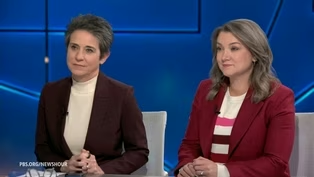
Tamara Keith and Amy Walter on resistance to Trump policies
Video has Closed Captions
Clip: 12/8/2025 | 8m 8s | Tamara Keith and Amy Walter on the pushback against Trump policies (8m 8s)

Trump proposes $12 billion in aid to farmers hurt by tariffs
Video has Closed Captions
Clip: 12/8/2025 | 6m 45s | Trump proposes $12 billion in aid to farmers after 'exceptionally difficult year' (6m 45s)

Why Native Americans are facing high rates of mental decline
Video has Closed Captions
Clip: 12/8/2025 | 8m 56s | Why Native Americans are facing high rates of mental decline (8m 56s)
Providing Support for PBS.org
Learn Moreabout PBS online sponsorship
- News and Public Affairs

FRONTLINE is investigative journalism that questions, explains and changes our world.
- News and Public Affairs

Amanpour and Company features conversations with leaders and decision makers.








Support for PBS provided by:
Major corporate funding for the PBS News Hour is provided by BDO, BNSF, Consumer Cellular, American Cruise Lines, and Raymond James. Funding for the PBS NewsHour Weekend is provided by...